Metamorphosis and the Trial
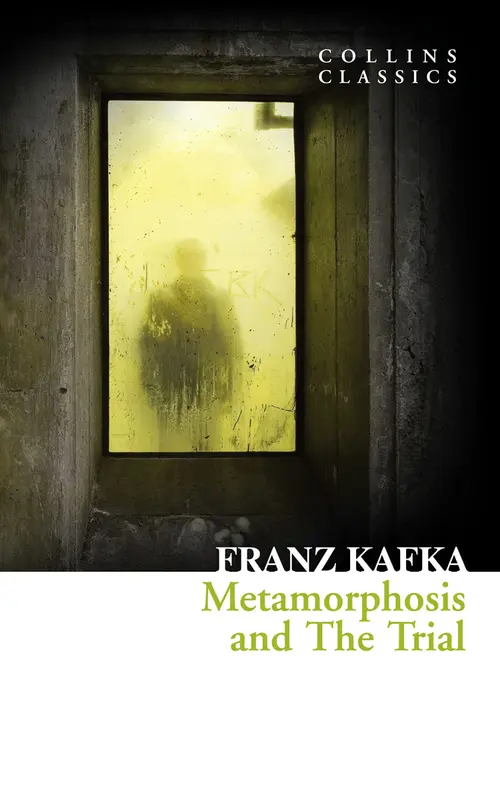
METAMORPHOSIS AND THE TRIAL
Franz Kafka
Translated by David Wyllie

History of Collins
In 1819, millworker William Collins from Glasgow, Scotland, set up a company for printing and publishing pamphlets, sermons, hymn books, and prayer books. That company was Collins and was to mark the birth of HarperCollins Publishers as we know it today. The long tradition of Collins dictionary publishing can be traced back to the first dictionary William published in 1824, Greek and English Lexicon. Indeed, from 1840 onwards, he began to produce illustrated dictionaries and even obtained a licence to print and publish the Bible.
Soon after, William published the first Collins novel, Ready Reckoner; however, it was the time of the Long Depression, where harvests were poor, prices were high, potato crops had failed, and violence was erupting in Europe. As a result, many factories across the country were forced to close down and William chose to retire in 1846, partly due to the hardships he was facing.
Aged 30, William’s son, William II, took over the business. A keen humanitarian with a warm heart and a generous spirit, William II was truly “Victorian” in his outlook. He introduced new, up-to-date steam presses and published affordable editions of Shakespeare’s works and The Pilgrim’s Progress, making them available to the masses for the first time. A new demand for educational books meant that success came with the publication of travel books, scientific books, encyclopedias, and dictionaries. This demand to be educated led to the later publication of atlases, and Collins also held the monopoly on scripture writing at the time.
In the 1860s Collins began to expand and diversify and the idea of “books for the millions” was developed. Affordable editions of classical literature were published, and in 1903 Collins introduced 10 titles in their Collins Handy Illustrated Pocket Novels. These proved so popular that a few years later this had increased to an output of 50 volumes, selling nearly half a million in their year of publication. In the same year, The Everyman’s Library was also instituted, with the idea of publishing an affordable library of the most important classical works, biographies, religious and philosophical treatments, plays, poems, travel, and adventure. This series eclipsed all competition at the time, and the introduction of paperback books in the 1950s helped to open that market and marked a high point in the industry.
HarperCollins is and has always been a champion of the classics, and the current Collins Classics series follows in this tradition – publishing classical literature that is affordable and available to all. Beautifully packaged, highly collectible, and intended to be reread and enjoyed at every opportunity.
Life & Times
Metamorphosis and The Trial
Kafka’s fiction is synonymous in our times with tales that are as bleak and unsettling as they are entertaining. His literary world is populated by despotic figures and powerless antiheroes. His work has inspired some of the greatest modern writers; he is often imitated and rarely matched. But if Kafka had had his own way at the end of his short life, he would have gone out in even greater obscurity than he came in: unknown, unpublished, unremembered.
Family Life
Franz Kafka was born in Prague, to Jewish parents, at a time of great flux in Europe. Borders were shifting, empires were crumbling, and the alliances and rivalries that would ultimately lead to World War I were growing stronger by the year. Kafka was to die without witnessing the worst horrors of European anti-Semitism, including the deaths of his three sisters during the Holocaust, and he was always at best a token attendee at synagogue, but he nevertheless grew up fundamentally aware of the ‘different’ status of Czechoslovakia’s Jews.
The Kafkas were relatively wealthy, however – the father, Hermann, was a successful retailer – and they could afford to give young Franz a first-rate education. He attended, and excelled at, a prestigious school in the centre of Prague, and then studied law at university. He was, on paper at least, a credit to his family – but his was a difficult family, and one whose influence would shape the fiction he went on to write.
Franz was the eldest child of six, but his two younger brothers both died in infancy. Hermann Kafka was an overbearing father, a man of ‘strength … loudness of voice … self-satisfaction’ and ‘worldly dominance’ of whom Franz had a lifelong fear; the weight of expectation on young Kafka, now the only son in a family of daughters, was considerable. He lived up to it for a while, earning a doctorate in law and a respectable wage, but this profession was never more than a day job for Kafka. His real passion was for writing, and he devoted his free moments to composing short stories. Before long he was choosing jobs based on the amount of writing time they afforded him – to the great disdain of his father.
Two Muses
Kafka’s fiction is notable for its repeated themes of isolation, disorientation, and helplessness at the hands of an authoritarian power. There is no doubt that he wrote his father, or the sense of menace represented by his father, into most, if not all, of his work, and it is little wonder that the protagonists of both Metamorphosis and The Trial (composed in 1914 – 15) are loners to whom frightening things just happen. They are essentially bystanders to their own inevitable downfall.
But Kafka did not simply write about fathers and sons: he turned the unhealthy relationship of his own experience into something altogether more surreal and dystopian. It is as if he had come to see the whole world through the prism of his own sense of existential chaos. In The Trial, Josef K is arrested, accused and hauled before the courts for an unknown crime, becoming a defenceless plaything for a cruel and faceless authority. In Metamorphosis, Gregor Samsa awakes to find he has turned into a grotesque oversized vermin, a transformation that not only disgusts but also inconveniences his father in particular. Both men are consumed with a nebulous, uneasy guilt – the knowledge that they are inexplicably wrong, and out of place in normal society.
Kafka’s second great muse was his on-again-off-again fiancée, Felice Bauer, with whom he had a difficult and no less dysfunctional relationship. Having met her in 1912 via his great university friend Max Brod, Kafka found her at once remarkably unattractive and yet strangely alluring. This woman, described in his diary as having an ‘empty face that wore its emptiness openly … almost broken nose … unattractive hair, strong chin’, seemed to have an incredible creative effect on him, and he fell into a period of intense and feverish writing. (‘How the story developed before me,’ he wrote of 1912’s The Judgement, a father-son story written in one night and dedicated to Felice, ‘how everything can be said.’)
Kafka and Felice became engaged in 1914, and almost immediately Kafka felt suffocated by her and especially by her family. ‘Had they sat me down in a corner bound in real chains,’ he wrote after their engagement party, ‘placed policemen in front of me, and let me look on simply like that, it could not have been worse.’ When Felice and other friends of Kafka’s learned of his apathy they staged a dramatic intervention – a trial of sorts – in which he was sat down and categorically informed that the engagement was off. It was shortly after this embarrassing incident that Kafka wrote The Trial, with its final judgement by an indistinct figure whom Josef K cannot make out: ‘Was it one person? Was it everybody?’
Downfall
Two years later Kafka and Felice were back on, and enjoying a romantic holiday; they became engaged again, and separated again. The relationship ended once and for all when Kafka became gravely ill with tuberculosis in 1917. It was a condition that would ultimately kill him, and from his forced pension in 1918 until his death aged just 40 in 1924 he spent most of his time being looked after by his sister Ottla or by sanatorium doctors.
He continued to write during his illness – indeed, he had more time than ever to do so, his output including numerous stories and a series of letters to lovers and family members. One missive, later published as Letter to His Father, was a 103-page denouncement of Hermann Kafka’s terrible parenting.
Little of Kafka’s work was published in his lifetime and many of his novels – among them The Trial – were never fully completed. When he knew he was dying he made Max Brod his literary executor and instructed him to burn everything. But Brod had always seen the true value of Kafka’s writing, and instead of burning anything he published it all. ‘Franz should have appointed another executor,’ he said by way of justification.
Franz Kafka died in Austria in 1924, preceding both of his parents and his three doomed sisters. Unbeknownst to him, he left a literary legacy that influenced and arguably defined the creative output of the twentieth century: his perceptive insights into mental and emotional oppression – whether by a strict father or a totalitarian regime – are echoed in the works of authors from Orwell and Camus to Nabokov and Coetzee. The boldest novels of the twentieth century were not just dystopian, absurdist and surreal – they were positively Kafkaesque.
METAMORPHOSIS
CHAPTER 1
One morning, when Gregor Samsa woke from troubled dreams, he found himself transformed in his bed into a horrible vermin. He lay on his armour-like back, and if he lifted his head a little he could see his brown belly, slightly domed and divided by arches into stiff sections. The bedding was hardly able to cover it and seemed ready to slide off any moment. His many legs, pitifully thin compared with the size of the rest of him, waved about helplessly as he looked.
“What’s happened to me?” he thought. It wasn’t a dream. His room, a proper human room although a little too small, lay peacefully between its four familiar walls. A collection of textile samples lay spread out on the table—Samsa was a travelling salesman—and above it there hung a picture that he had recently cut out of an illustrated magazine and housed in a nice, gilded frame. It showed a lady fitted out with a fur hat and fur boa who sat upright, raising a heavy fur muff that covered the whole of her lower arm towards the viewer.
Gregor then turned to look out the window at the dull weather. Drops of rain could be heard hitting the pane, which made him feel quite sad. “How about if I sleep a little bit longer and forget all this nonsense”, he thought, but that was something he was unable to do because he was used to sleeping on his right, and in his present state couldn’t get into that position. However hard he threw himself onto his right, he always rolled back to where he was. He must have tried it a hundred times, shut his eyes so that he wouldn’t have to look at the floundering legs, and only stopped when he began to feel a mild, dull pain there that he had never felt before.
“Oh, God”, he thought, “what a strenuous career it is that I’ve chosen! Travelling day in and day out. Doing business like this takes much more effort than doing your own business at home, and on top of that there’s the curse of travelling, worries about making train connections, bad and irregular food, contact with different people all the time so that you can never get to know anyone or become friendly with them. It can all go to Hell!” He felt a slight itch up on his belly; pushed himself slowly up on his back towards the headboard so that he could lift his head better; found where the itch was, and saw that it was covered with lots of little white spots which he didn’t know what to make of; and when he tried to feel the place with one of his legs he drew it quickly back because as soon as he touched it he was overcome by a cold shudder.
He slid back into his former position. “Getting up early all the time”, he thought, “it makes you stupid. You’ve got to get enough sleep. Other travelling salesmen live a life of luxury. For instance, whenever I go back to the guest house during the morning to copy out the contract, these gentlemen are always still sitting there eating their breakfasts. I ought to just try that with my boss; I’d get kicked out on the spot. But who knows, maybe that would be the best thing for me. If I didn’t have my parents to think about I’d have given in my notice a long time ago, I’d have gone up to the boss and told him just what I think, tell him everything I would, let him know just what I feel. He’d fall right off his desk! And it’s a funny sort of business to be sitting up there at your desk, talking down at your subordinates from up there, especially when you have to go right up close because the boss is hard of hearing. Well, there’s still some hope; once I’ve got the money together to pay off my parents’ debt to him—another five or six years I suppose—that’s definitely what I’ll do. That’s when I’ll make the big change. First of all though, I’ve got to get up, my train leaves at five.”
And he looked over at the alarm clock, ticking on the chest of drawers. “God in Heaven!” he thought. It was half past six and the hands were quietly moving forwards, it was even later than half past, more like quarter to seven. Had the alarm clock not rung? He could see from the bed that it had been set for four o’clock as it should have been; it certainly must have rung. Yes, but was it possible to quietly sleep through that furniture-rattling noise? True, he had not slept peacefully, but probably all the more deeply because of that. What should he do now? The next train went at seven; if he were to catch that he would have to rush like mad and the collection of samples was still not packed, and he did not at all feel particularly fresh and lively. And even if he did catch the train he would not avoid his boss’s anger as the office assistant would have been there to see the five o’clock train go, he would have put in his report about Gregor’s not being there a long time ago. The office assistant was the boss’s man, spineless, and with no understanding. What about if he reported sick? But that would be extremely strained and suspicious as in fifteen years of service Gregor had never once yet been ill. His boss would certainly come round with the doctor from the medical insurance company, accuse his parents of having a lazy son, and accept the doctor’s recommendation not to make any claim as the doctor believed that no-one was ever ill but that many were workshy. And what’s more, would he have been entirely wrong in this case? Gregor did in fact, apart from excessive sleepiness after sleeping for so long, feel completely well and even felt much hungrier than usual.
He was still hurriedly thinking all this through, unable to decide to get out of the bed, when the clock struck quarter to seven. There was a cautious knock at the door near his head. “Gregor”, somebody called—it was his mother—“it’s quarter to seven. Didn’t you want to go somewhere?” That gentle voice! Gregor was shocked when he heard his own voice answering, it could hardly be recognised as the voice he had had before. As if from deep inside him, there was a painful and uncontrollable squeaking mixed in with it, the words could be made out at first but then there was a sort of echo which made them unclear, leaving the hearer unsure whether he had heard properly or not. Gregor had wanted to give a full answer and explain everything, but in the circumstances contented himself with saying: “Yes, mother, yes, thank-you, I’m getting up now.” The change in Gregor’s voice probably could not be noticed outside through the wooden door, as his mother was satisfied with this explanation and shuffled away. But this short conversation made the other members of the family aware that Gregor, against their expectations was still at home, and soon his father came knocking at one of the side doors, gently, but with his fist. “Gregor, Gregor”, he called, “what’s wrong?” And after a short while he called again with a warning deepness in his voice: “Gregor! Gregor!” At the other side door his sister came plaintively: “Gregor? Aren’t you well? Do you need anything?” Gregor answered to both sides: “I’m ready, now”, making an effort to remove all the strangeness from his voice by enunciating very carefully and putting long pauses between each, individual word. His father went back to his breakfast, but his sister whispered: “Gregor, open the door, I beg of you.” Gregor, however, had no thought of opening the door, and instead congratulated himself for his cautious habit, acquired from his travelling, of locking all doors at night even when he was at home.
The first thing he wanted to do was to get up in peace without being disturbed, to get dressed, and most of all to have his breakfast. Only then would he consider what to do next, as he was well aware that he would not bring his thoughts to any sensible conclusions by lying in bed. He remembered that he had often felt a slight pain in bed, perhaps caused by lying awkwardly, but that had always turned out to be pure imagination and he wondered how his imaginings would slowly resolve themselves today. He did not have the slightest doubt that the change in his voice was nothing more than the first sign of a serious cold, which was an occupational hazard for travelling salesmen.
It was a simple matter to throw off the covers; he only had to blow himself up a little and they fell off by themselves. But it became difficult after that, especially as he was so exceptionally broad. He would have used his arms and his hands to push himself up; but instead of them he only had all those little legs continuously moving in different directions, and which he was moreover unable to control. If he wanted to bend one of them, then that was the first one that would stretch itself out; and if he finally managed to do what he wanted with that leg, all the others seemed to be set free and would move about painfully. “This is something that can’t be done in bed”, Gregor said to himself, “so don’t keep trying to do it”.
The first thing he wanted to do was get the lower part of his body out of the bed, but he had never seen this lower part, and could not imagine what it looked like; it turned out to be too hard to move; it went so slowly; and finally, almost in a frenzy, when he carelessly shoved himself forwards with all the force he could gather, he chose the wrong direction, hit hard against the lower bedpost, and learned from the burning pain he felt that the lower part of his body might well, at present, be the most sensitive.
So then he tried to get the top part of his body out of the bed first, carefully turning his head to the side. This he managed quite easily, and despite its breadth and its weight, the bulk of his body eventually followed slowly in the direction of the head. But when he had at last got his head out of the bed and into the fresh air it occurred to him that if he let himself fall it would be a miracle if his head were not injured, so he became afraid to carry on pushing himself forward the same way. And he could not knock himself out now at any price; better to stay in bed than lose consciousness.
The Story Continues on BooksBarbecue!
Enjoyed this preview? ❤️ Do not stop here!
Read the complete book free online → 🔗
Continue reading now on BooksBarbecue and discover every page!
Love reading? Bookmark BooksBarbecue.com for more amazing books!
Happy Reading!