Meet Me Halfway
Cover
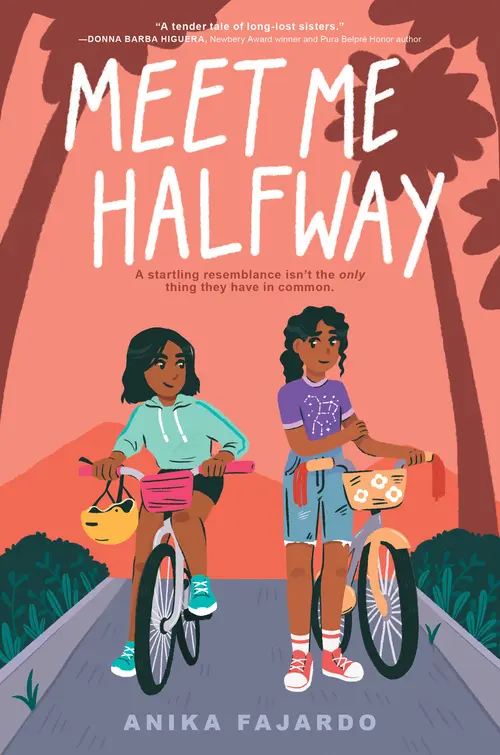
“A tender tale of long-lost sisters.”
—Donna Barba Higuera, Newbery Award winner and Pura Belpré Honor author
Meet Me Halfway
A startling resemblance isn’t the only thing they have in common.
Anika Fajardo
Title Page
Dedication
To my mom
CHAPTER 1 Mattie 
Brown eyes flecked with amber peer back at me. Above them are my eyebrows, a little bushier than usual. There’s my smallish nose, the one my mom says I inherited from my father. I turn my head, tilt my chin. But the face I’m studying doesn’t move.
“What are you looking at?” the girl demands.
“Nothing,” I mumble, embarrassed for getting caught staring at her. But I can’t stop. Back home, at the Minnesota State Fair, there’s a funhouse with a hall of mirrors, each one distorted to make you taller or fatter, shorter or skinnier. In those mirrors, you can see yourself, only different. Looking at the face across from me, I feel like I’m in that funhouse instead of a seventh-grade classroom.
The girl is wearing jean shorts and a T-shirt that says Throw like a girl. Her hair is the same brown as mine, although hers is smooth and loose around her shoulders, while I always wear my curls in a tight ponytail. She’s looking everywhere but at me.
“Boys and girls,” announces the social studies teacher. The chaos of the first-period classroom quiets. “We have a new student today.”
It’s not the first day of school for Poppy View Middle School, but it’s my first day. I slouch in my seat, wishing I could disappear.
“Would you please introduce yourself,” the teacher says, gesturing for me to join her at the front of the room.
My stomach tightens. I slink out of my chair and avoid making eye contact. I hate being in the spotlight, so I’m relieved that only a few students seem to care who I am. Most are doodling in their notebooks or checking their phones in their laps.
“Um, hi.” I shift from one foot to the other.
And that’s when, one by one, all the kids in my new class—except the girl in the seat across from mine—turn to stare. They switch off their phones. They put down their pencils. They lean toward each other, whispering. They nod and point. At me. My palms get sweaty. My toes curl in embarrassment.
“I’m Mattie,” I croak. What did I do wrong? Did they want my whole story? Was I supposed to give my full name? “Gómez,” I add a little uncertainly. I’m the only Gómez in my family now. When my mom got remarried over Labor Day weekend, she took Bob’s last name—Jasper—dropping Gómez like it didn’t mean anything, like there wasn’t a whole story behind it.
“Welcome, Mattie. Now, I want everyone to—”
The teacher is interrupted by a boy whose hair sticks up in a spike at the back of his head. “Mrs. Ellingham,” he calls out, “why does the new girl look just like Mercedes Miller?”
There are more murmurs. Mrs. Ellingham looks at me. She looks at the girl seated across from my desk. “Mercedes and Mattie do look very similar,” she agrees.
The girl who must be Mercedes Miller is studying her mint-green fingernails like they’re the most interesting thing in the world.
Mrs. Ellingham looks at us like we’re a puzzle. She nods her head of gray hair. She’s tall and looks even taller in the long, billowy dress she’s wearing. “Maybe they’re related,” she suggests.
Related? I’ve never seen this girl before in my life. But there’s a strange twitch in the back of my brain, even as I think this. And, although warm California sun is streaming through the classroom windows, a shiver thrums from my toes to my fingertips. I can’t tell if it’s one of my panic attacks or something else.
Mrs. Ellingham’s bright-pink lipstick creases as she smiles. “Are you two related?”
“No,” we say. Even though we speak in unison, our voices are different. Mine is small and just a little squeaky. Hers is bold, forceful, as if the idea of being related to me is the worst thing in the world.
“Well,” says Mrs. Ellingham, looking from me to Mercedes. “I’m sure you two will end up being great friends.” She smiles again.
She’s the only one smiling.
“In the meantime, let’s get to today’s lesson.”
I scurry back to my seat and resume my spot across from Mercedes. She seems to be pretending that I don’t exist, which is a lot like what everyone has been doing around me lately. My new stepbrothers act like I’m a piece of the furniture, Bob follows my mom around like a lovesick puppy, and my mom juggles the three of them while unpacking and reorganizing our stuff at the new house.
“We’re starting our mythology project today,” Mrs. Ellingham says. She writes the word “mythology” on the whiteboard in swirling letters. “The mythology of a culture reveals that culture’s history and beliefs.” She underlines “mythology” with a flourish. Below it, she writes: “Greek,” “Roman,” “Maya,” “Inca,” “Egyptian.” “Studying the stories of ancient civilizations helps us understand our own lives.”
I think about my new life here in California. I’m pretty sure ancient civilizations aren’t going to help me understand any of this.
“Hey!” I hear a hoarse whisper behind me as Mrs. Ellingham continues to talk about myths. “Hey, Mercedes and new girl.”
I turn around to see the boy with the spiky hair leaning back in his chair. He whispers, “You guys are probably doppelgängers.”
“Doppel-what?” I whisper back.
Mercedes glares at me and the boy.
“A doppelgänger. You know, someone who looks just like you. Like twins only not.”
Twins? I examine Mercedes. She has a small brown freckle on her chin, and mine is freckle free. My teeth gap in the front; hers hug each other close. Her skin is a shade darker than mine. My forehead is a little wider. Even so, there’s something eerily familiar about this girl. Despite the fact she’s carefully avoiding eye contact, it feels like an invisible wire connects us.
“Hey,” the boy hisses again, “did you know it’s bad luck to see your doppelgänger?”
My stomach drops like I just ate rocks. I’m not usually superstitious, but I ask, “What kind of bad luck?” I’ve already had enough bad luck.
The boy checks to see if Mrs. Ellingham is watching and then scoots his chair closer to me and Mercedes. “Some people die after seeing their doppelgänger.”
My hands feel tingly and my heart thumps.
“Do you feel okay?” he asks me. “What did it feel like when you first saw Mercedes? Your doppelgänger?”
“Um,” I say. “Weird, I guess.” I don’t say that it doesn’t really feel like a bad-weird. Just weird.
Mercedes leans forward and hisses, “Shut up.”
I’m not sure if she’s talking to him or me.
“It’s only a coincidence,” she adds. I can tell by the squint in her brown eyes that she has decided it’s bad-weird. “It didn’t mean anything.”
“Boys and girls!” Mrs. Ellingham claps her hands. The three of us jump. The boy scurries to his own place as the teacher says, “Look at the person sitting across from you.”
We all look. Except Mercedes. Her eyes avoid mine.
“Say hello to your project partner!” Mrs. Ellingham says cheerfully.
Now Mercedes looks up. And she glares at me. Her cheeks turn bright pink. I feel my own burn. How have I managed to make enemies with a girl I’ve only just met and then end up partnered with her on our first big project? All on my first day in a new school? It must be my doppelgänger bad luck.
“Write both your names on the assignment and exchange phone numbers. You’ll need to do some of this project outside of class. My room will always be open after school, too.”
A few voices cheer, a few groan. Mercedes is one of the people groaning. Then she sighs a loud sigh that says how much she doesn’t want to be my partner.
“What was your name again?” she asks, pencil poised above her paper.
“Mattie.” Does she feel it? Does she feel the bad luck? “Mattie Gómez,” I tell her. For one millisecond after I say my last name for the second time that day, her eyes flick to me and then back to the paper.
“How do you spell Mattie?” She emphasizes the T’s, sharp and jagged. Her eyes bore into me, as if I came to Poppy View Middle School just to make her life miserable. I never asked to be here. If I were still at my old school, I could be doing group projects with people who actually like me. Maybe even with my best friend, Mai. I try to picture life back home in Saint Paul, Minnesota. Soon the leaves will turn red, lopsided pumpkins drawn by first graders will be taped to the school windows, and the air will smell like the first frost.
Mercedes taps her pencil on the paper, waiting.
“Two T ’s,” I tell her. “M-A-T-T-I-E.”
“It’s a…,” she begins. She pauses as if searching for the right word. “It’s a cute name.”
“Thank—”
“My friend had a dog named Mattie,” she adds.
A dog?
I smile the way I do when my mom tells me to clean my room, but I know I probably won’t. “Well, it’s short for Matilde.” And then I spell very, very slowly, “M-A-T-I-L-D-E.”
Mercedes shoots me a look that could freeze a lake in Minnesota. I shrug.
“I’m named after the wife of this famous dead poet Pablo Neruda,” I inform her. “You’ve probably never heard of him. It was my father’s idea.” I’m not sure why I say that. I never talk about my father to anyone.
Mercedes traces the M in her own name over and over until it’s dark and black. “I’m named after a wife, too. The wife of a famous writer.”
We don’t make eye contact, but the wire between us seems to buzz.
CHAPTER 2 Mercedes
The moment she walks into Mrs. Ellingham’s room, I get a sinking feeling deep in my bones.
“Whoa,” Gaby whispers, her breath hot in my ear. “That new girl looks just like you.”
My chest burns. Gaby and I watch Mrs. Ellingham hand the girl a textbook and point her toward the only empty seat in our classroom. Across from me.
“Not really,” I say, even though anyone can see that the girl and I have hair the same brown color that looks black in some light and reddish in others. We also happen to have it cut in the same style just past our shoulders. Hers is in a ponytail but I can tell it’s the same curly frizz as mine. “I mean, obviously, she’s never heard of a flat iron. Or been to a mall.”
“Other than the hair and the, uh, weird clothes.” The girl is wearing crisp, dark jeans—totally out of style—and a T-shirt that says Lake Superior. “There’s something,” Gaby insists. “I don’t know—something familiar that makes her look just like you.”
I shake my head, but it’s obvious. There’s the slight upward curve of our eyes. There’s her chin—a little pointy like mine. We both have button noses, although mine is definitely cuter.
“Ha,” I say with a short laugh. “I don’t think so.” I try my best to sound offended, like I don’t know what she means. I don’t want her to guess my secret.
Just then the bell rings and she returns to her spot. Gaby is my best friend, but I’m glad she’s at the front of the room and I’m in the back. Mrs. Ellingham shoos people into their seats. Then she makes the new girl introduce herself. Mattie.
She’s got to be who I think she is. Although I usually love being right, this time I wouldn’t mind being wrong. What is she doing here? At Poppy View Middle School? In seventh grade? With me?
All around the classroom, kids whisper and stare at me and the girl, pointing out the obvious: that we look alike. As the girl speaks, her face turns as red as the notebook on her desk. I almost feel sorry for her. There’s a sad quiver in her voice as she tells the class her name.
“Gómez,” the girl says.
Gómez. I’m certain now. Just my luck.
And my luck gets worse when Mrs. Ellingham assigns partners for our next project. Me and the new girl. As I write Mattie’s name on my worksheet, she tells me her father named her after some poet’s wife. A zing goes through me when she says the word “father.”
I know I should keep my mouth shut, but I can’t help blurting out, “I’m named after a wife, too.” I don’t recite my whole story about not knowing my dad. Instead, I repeat, “The wife of a famous writer.” I don’t mention that the writer is this Colombian dude, Gabriel García Márquez, or that his wife’s name was Mercedes Barcha. “I’m not named after a car,” I add, even though she didn’t ask if I was.
“Mercedes is a cool name,” Mattie says.
A cool name. I almost smile. But then I look at her sloppy shirt and frizzy ponytail and think about her saying the word “father.” How uncomfortable it made me feel. I don’t need this girl being friendly or telling me what’s cool.
She rips a piece of paper out of her notebook. “I guess we need to exchange numbers,” she says, writing her name and phone number on the top half. She tears off the bottom and hands me the scrap of paper. “So we can work on our project.” Her voice is low. It sounds like mine when I’m tired or trying to get Mom to buy me something expensive. In other words, it’s annoying.
“Fine.” I write my number on the ripped paper and hand it to her.
At lunch, Gaby and Rebecca won’t leave me alone.
“I still can’t believe that new girl,” Gaby says. The three of us look over at Mattie, who is sitting at the lunch table with the dorkiest kids in seventh grade. I never thought I would meet her, but if I did, I always thought she would probably be a lot like me—you know, pretty cool. I never would’ve guessed she’d actually look like me… but be nothing like me.
Gaby explains to Rebecca, “She’s this un-cool version of our girl. Like, if Mercedes didn’t dress like Mercedes.” Gaby is obsessed with clothes. She used to always ask to borrow mine, but over the summer her chest grew and my clothes don’t fit her anymore. Gaby has always been the flaky one, Rebecca is the serious one, and I’m the perfect one—the one with the wealthy mom, cool shoes, cute little brother, and fun ideas.
“That’s so weird! How is it even possible?” asks Rebecca, staring at Mattie Gómez from across the lunchroom. “For someone to look just like you?”
“It’s called a doppelgänger.” After social studies, I looked up the word on my phone. A ghostly and often negative double of a living person. Standing at my locker, getting jostled by the sixth graders heading to phys ed, I read the definition over and over. Negative? The zing I felt earlier zinged again, right into my stomach.
“A what?”
“A doppelgänger,” I repeat. They both give me a funny look. Weird as it sounds, saying I have a doppelgänger seems like a better alternative than telling them the whole story.
“Doppel-what?” Rebecca says.
“She’s in a gang?” asks Gaby.
Ugh. The three of us have been friends since first grade, but sometimes they can be so annoying. I explain, “A doppelgänger is someone who looks like your twin but isn’t.” I don’t mention the bad luck part. “Like, you know how Cristina looks like Gal Gadot?”
They giggle. Ever since Mom hired a nanny to take care of my little brother, we’ve been arguing with her about this. Cristina insists she doesn’t look anything like the movie star, but we keep telling her she does.
“Gaby, your doppelgänger is that girl in that one show,” Rebecca says.
Gaby laughs harder. “You never know the names of any celebrities, do you, Becca?”
“Your doppelgänger is Zendaya!”
Phew. I’m glad they’ve stopped asking questions about me. About Mattie.
Gaby and Rebecca collapse in giggles. A juice box gets tipped over and we shriek as we escape the sticky mess. All the seventh graders turn and stare at us, which means it’s time to put on a show, remind everyone how popular we are. I start humming our favorite song, and right away Gaby and Rebecca join in. We’ve been rehearsing a bunch of choreography during sleepovers this summer and we’re ready. We stand up and use our bags of chips as microphones. We know all the lyrics and sing in unison. Gaby and Rebecca swing their hips to the right, to the left. I’m in the middle so I do the foot moves, in and out. “Na-na-na-na-na!” we sing. Kids around us look up from their sandwiches and laugh. The three of us coordinate our disco moves and the lunchroom audience stomps the beat. “I’m in the stars tonight!” I wail into my Doritos microphone. I love the feeling of being in the spotlight.
I’m about to take a big, exaggerated bow when Mrs. Leeds comes marching toward us. Uh-oh. Our principal does not like it when we’re loud at lunch.
“Ladies,” Mrs. Leeds says in a warning voice.
“Sorry,” we say. I like being the center of attention, but I also like being a good student.
As I’m sitting down again, I spot Mattie Gómez at the dork table and our eyes catch for a split second. Something seems to connect us, like an invisible spiderweb.
CHAPTER 3 Mattie
Mattie!” I hear someone shout as I follow the other seventh graders to lunch. It’s the boy with the spiky hair. The one who said it’s bad luck to see your doppelgänger.
“I’m in your social studies class. I’m November.”
“That’s your name? November?”
“Exactly. Like the month.” He doesn’t seem embarrassed about his name at all. “You can sit with us if you want,” he continues as we enter the lunchroom. He points at a table near the back where two kids are unpacking their lunch bags. A boy with black hair that hangs over one eye and a tiny girl in pigtails. “That’s Ted. That’s Sunny.”
I survey the landscape, looking for the place where a new kid would fit. At one end of the room, four tables are crowded with boys who pop up and down like prairie dogs. At the other end are a couple tables filled with girls—one of which includes my doppelgänger. Near November’s friends are several more tables half-filled with kids. I feel an ache in my chest as I picture Mai eating lunch with our other friend Sonja instead of me. A wave of homesickness washes over me. I plop my lunch bag next to November and his two companions. Better than sitting alone.
“Has anyone told you that you look just like Mercedes Miller?” the boy with black hair says.
“I know, right, Ted?” November says. “They’re both in my social studies class—you can hardly tell them apart.”
The girl in pigtails named Sunny says something I can’t understand. “What?”
“You look like twins,” she says. Her voice is squeaky like she doesn’t use it much. “Are you related?”
Sunny is just one more kid who has asked if I’m related to Mercedes Miller today. Social studies, then English, then science. Ms. Garcia, the science teacher, kept calling me, “Mer—Mattie,” as if that was my new name. Mer-Mattie. Like I’m some kind of sea creature.
“Never seen her before in my life,” I tell my lunchmates, returning to my sandwich. Just as I take a bite, November asks, “Where are you from, Mattie?”
People are always asking me where I’m from, especially when they see me with my mom. She has light-brown hair and blue eyes; I have dark hair and brown eyes. She’s tall and angular; I’m still growing and have a bit of what Mai’s grandma calls “baby fat.” My mom—and her family for five generations—is from Minnesota. My father is from Colombia. The one in South America. I’ve never been there. Or met him.
“I was born in Santa Cruz,” November volunteers while I chew, “and Ted is from Los Angeles. Sunny is from Oklahoma. How about you?”
Oh. “Minnesota.”
Sunny mumbles something.
“What?” I ask.
Sunny squeaks, “I was new last year.”
“And I was new in fifth grade,” Ted tells me.
“I’m the welcoming committee,” November says. “We take in new kids.” He looks from Ted to Sunny. “If you want.”
Do I want a welcoming committee? Do I need one? I think about the two weeks with my new stepfamily before my mom and Bob’s wedding. That was supposed to be our welcoming vacation. The five of us stayed in a rented cabin in the woods in northern Minnesota. There was a lake and a boat with a motor that spat black smoke, and there were loons calling in the evenings. Five-year-old Lucas kept asking if we were in Canada. Even though it was a nice place with a good view and a firepit for s’mores, the vacation didn’t feel very welcoming. My two soon-to-be stepbrothers didn’t have much to say to me. Lucas discovered dock fishing and smelled like dead fish most of the time. And it wasn’t until my mom found an old chess set in a cupboard that Kenny acknowledged my existence. That’s when I found out he belongs to a chess club, just like Mai and I did in fifth grade. He still wasn’t exactly welcoming, but at least he couldn’t completely ignore me while we were playing chess—especially when I checkmated him.
The Story Continues on BooksBarbecue!
Enjoyed this preview? ❤️ Do not stop here!
Read the complete book free online → 🔗
Continue reading now on BooksBarbecue and discover every page!
Love reading? Bookmark BooksBarbecue.com for more amazing books!
Happy Reading!