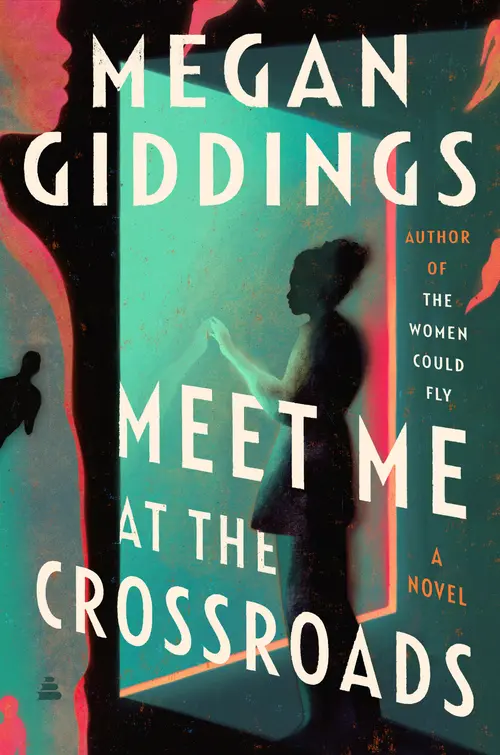
Meet Me at the Crossroads
Cover
Part One
1
No person saw the doors appear; that honor was reserved for a polar bear crunching a seal bloody, a murmuration making its clouds in the sky above the earth, a pair of black kites searching out grasshoppers in the soon-to-be kindling grass, a coati who had been asleep in the midday’s heat with its paws on its black snout, and a dog preoccupied with finding the rotting carcass it couldn’t stop smelling. The animals, not understanding these things were doors, yet understanding they were not of this world, quickly left the area. Later, different people would go on television so intoxicated by the attention they were receiving that they were able to smile wide as they exaggerated and spewed out conflicting details. Some claimed to have heard a great voice coming from the air, encouraging them to announce the arrival. Others saw burning bushes singing loud the end of days. And one man, a farmer from mid-Michigan, was blunt and matter-of-fact in his perfidy. He was fertilizing soybeans, and then there was a door. It would not open. It would not burn. The door itself was a rich blue some days, one time silver, although no one else ever saw it that way, and sometimes, it wasn’t even there at all.
In the days that followed the appearance, each country handled things differently. Four of the doors, because they were in not densely populated places, were unknown for years to people outside those countries. When they were found later, it was to some people’s great annoyance. Because three had originally been sighted and collectively acknowledged—one in Michigan, one in Australia, one in Germany—they had given the sense that, finally, here it was, the end of days. Things in threes were always a warning. Despite arrests, despite violence, despite calls for common sense and patience, people surged around the doors. Ad hoc towns grew around them, sermons and prayers were held regularly, the surrounding grass and crops were destroyed by the pressure of thousands kneeling and waiting to see what all of this meant.
And for those who did not have faith, there was a swirling of opinions. Aliens! They were always pulling stunts on people, and here was another one, a step further from the flashing lights in the sky and sucking people up in tractor beams. Or maybe, finally, here was proof that we were all living in a vast, sick game of The Sims: See, the user had put the wrong thing in the wrong place, and here was proof that nothing mattered. Life did not make sense because we were pixels and blobs meant to be observed and tormented. Articles and theories and think pieces abounded. Maybe the doors were a trendy artist’s conceptual piece. We would find out that each one of these stupid, overdiscussed portals was valued at a million dollars.
Then people learned they could not burn, that bullets bounced off them. They could never get soaked with kerosene or blasted with water, and when knocked on, they sounded like any other door. They did not open for any presidents or prime ministers or kings or queens. They did not open for scientists, not even the ones who spoke gently and dreamed about them. They did not open for the pope or the Dalai Lama or the popular televangelist from Southern California who wrote very dull books that could be summed up as, The only way not to be a sinner was to give him and his church a lot of cash.
One day, a man filled with grief and longing traveled to Australia. His wife had died abruptly (many people were tubing, the inner tubes flipped, some people were lost, it was another horrifying thing buried in the news’ miasma). Every day when he was in grief’s clasped hands, she, the only she in the entire world for him, was always in the periphery. Church didn’t matter any longer. Friends didn’t know what to do with the intangibility of no funeral, only a potential memorial service. His father told him the only answer in times like those was to live. The man’s wife had always wanted to see the Flinders Ranges (her laugh when she saw birds, her sigh when she saw beauty), so he flew to Australia. At the base of a mountain, he found a blue door and prayed. And after the fourth hour of prayers, the door swung open.
He walked and walked through an orange desert until he heard someone singing. He turned and there she was. The man walked her across the desert. Her hand was cold. I will stay with you forever, he said. This is the space where later, at their church, they invited people to testify. To listen to what God had given us: a chance to resurrect our dead. Yes, there were dangers to going through the doors, but this was all meant to be a test of his love.
And some people said his wife had never been truly missing. She had taken advantage of the chaos to run off with her lover but then things with the lover had been boring. The wife refused to talk about the other side. She would not answer questions about what it had been like to drown. She could not talk about what her body was. A blasphemy, some churches said. So, soon, most people ignored them. This is one of the things about living now, if a thing only stays mysterious, doesn’t give a person money or acclaim, only seems to exist as a reminder of the universe’s vast inscrutability, it is often deemed as being worthless or a grift. A minor tragedy of modern times might be how much comfort has become valued over knowledge or kindness or understanding.
But some families remained to worship. New people, who longed for their beloveds, trickled into these different churches. In Michigan, a new religion formed: the Church of Fortitude and Blessings was one of its many names. Ayanna’s father was one of the first children raised in it. His parents, because they were more lenient than others and because theirs was a spirited kid who was good at math, still let him go to public school. He learned quickly not to tell other people about his faith. Services were on Tuesday nights and Sunday mornings. When he went and prayed before the door, he started wearing hats and hoods, hoping not to be easily recognized from a distance. Enough Black families had moved into the area that it was possible. And besides, Antony was pretty popular at school.
Don’t worry, this is a story about Ayanna. Be patient. Soon, she’ll be born.
Antony was popular at church too, because his mother was considered a seer. In those beginning days, it was more of a catchall term than just about prophecy. Think of it as akin to nun. She prayed, she kept everyone fed, and she knit sweaters and blankets while watching television and made them available to others in a small basket at every service. She encouraged a community to blossom. For a week before it actually happened, she had a recurring dream in which the door in Michigan finally swung open.
Each dream was the same: Walking in their old shopping market, picking up the Cheerios Antony loved, then heading to the milk aisle. There, next to a display for eggnog and eggnog-flavored nondairy creamer, was the blue door. A sound like a car crash from a distance where people ask what was that and then speculate about what it was. Peeking out behind floral curtains, they saw the people arguing in the street, the smashed glass, the red and blue lights approaching. The door swung open, and her own voice said, Don’t let Antony come in here. Sometimes, it said, Don’t let your kin walk these paths.
She didn’t tell people that the door spoke to her in these dreams.
On the Saturday morning when it happened, she grabbed Antony by the hood of his sweatshirt and kept a firm grip on the black fabric. There was what looked like a path made of gold in the doorway, a boulder covered in rich green moss, in normal-looking grass. Another child, desperate to be the first person in the world to pass through the door, sprinted toward it and then was pushed out of the way by an adult man. A few people gasped. The child’s mother yelled “asshole” at the man, and someone else turned and started scolding her for using that language in front of the children. A teenage boy chased the man—no one could tell if he was racing him to the entrance or teaching him a lesson for pushing a child. Antony longed to be a member of the scene, rather than an observer. He could sense all the gossip and bragging rights and attention to be harvested from doing something wild in this moment but would never squirm or push away from his mother. That was a story he did not want to have told about him.
The two squeezed through the door at the same time. One stopped immediately. The other went farther in, where he could not be seen.
“This is,” he began, and then the only word that could be used to describe what happened is he popped. Turned into a splash of red and peach with fully intact pink fingernails. Outside, people sprinted away. Still, Antony and his mother did not move.
“You will never go through that door,” she whispered.
He nodded. They were close enough that she understood he would never do that, but she was asking him, quietly, for reassurance and control. Telling him what to do gave his mother what she needed.
Then, the teenager walked out. A streak of red on his face, golden leaves stuck in the top of his thick, curly hair. In his hands, some golden rocks and three of the fingernails. Antony recognized him from school, not from church. He was older and ran track. Jumped hurdles in a way that made him look like a beautiful horse.
“Mateo,” Antony called. “Mateo, you’re fine.”
It was the only thing he could think of saying. The boy was disoriented. He looked around and was weeping, not bothering to wipe at the flow of tears or the blood on his forehead.
“Mom.”
Finally, she let Antony go. He ran to Mateo. The boy handed him the fingernails, the gold rocks. He was shaking and Antony kept patting him on the shoulders and saying “You’re fine.” It was a little awkward to comfort a boy older than him, but he knew it was the right thing to do in that moment. Antony’s mother walked past him. She went all the way to the doorway and gazed in. A few people followed, and they stood in a concerned cluster. There was no sound coming from whatever world lay in front of them. A brief breeze that carried what smelled like a mix of lilac and rot and salt.
“Do you hear her?” a little white girl said. Antony couldn’t remember if her name was Maddy or Addy.
No one knew what she was talking about.
The girl said she heard her mother’s voice. “It’s proof,” she said, “that this is heaven. I thought I had forgotten her voice,” the girl said multiple times, “but finally, I heard her again.” She smiled. The girl said her mother was saying “Your hair is so long now.” Her eyes were blue with flecks of brown, cheeks flushed as if she had braised herself in a too-warm bath. Antony’s mother stooped down and asked, “How long has your mama been gone?”
“Three years.”
Antony was listening to Mateo, who said he had seen pink figures walking the path. He was mad that none of the adults were taking care of him. Being kind and patient was hard. Some of the figures were people but very small, Mateo said. Some were stretched too tall, and a few were fluctuating between shapes. They were so pink they hurt his eyes. While Mateo kept talking and talking as if he had been there years rather than a few dramatic minutes, Antony slipped one of the stones into his pocket. He kept pretending the fingernails were also stones, because every time his brain remembered the pop, it took all his willpower not to succumb to nausea. There was hair stuck in the blood on Mateo’s cheek. It felt disrespectful to drop the fingernails on the ground.
“I have to go to my mother,” the girl said.
“Did you see what happened to that man?”
“But he was fine.” She pointed to Mateo.
“We don’t know why he’s okay, baby.”
Antony realized it was raining in little spits and mists. He turned, and almost everyone who had been at the service was in the barn that now functioned as the prayer center. They were smart enough to be afraid.
The girl squirmed, but everyone held on to her.
She lashed out and bit and scratched, but still everyone held. They let her hurt them. My mother, my mother, she sobbed. The girl bit Antony’s mother’s hand, and for the rest of her life, there was a scar on the soft part between thumb and pointer. Four teeth marks. The girl kicked everyone with her pink-and-white light-up tennis shoes. They flashed as she lashed out.
Mateo said he had heard his grandfather’s laugh.
Antony took a step farther away from the door, pulled Mateo with him. He did not want to hear his grandfather or his father. Their soft, slow speech, the way they both coughed a little after eating in the exact same way, their cadence that he now carried in his voice. His mom winced sometimes when she heard him laugh now. There were already moments when late at night, awake at the time when all the world felt still, he felt sure he had heard someone saying his name. Antony would always tell himself it was a dream, but the way his body reacted made him feel certain that no, the voice had been real, had been his father’s voice.
He would not tell Ayanna’s mother any of this when they met at college. Not even one night when she would sit him down, tell him the worst thing that had ever happened to her because she loved him and wanted him to understand everything about her. He would not take her invitation to share. She had been raised normally. God did not lure people into traps in her religion. Her god was distant and judgmental, and all his sicko behavior was from thousands of years ago. Her god did miracles like putting a beautiful lady’s face on a shirt, sending white ladies on daytime television angels, and promising eternity.
The door closed with a small thud.
The girl screamed at all the adults that had held her back, “I hate you. I hate you.” Her voice shrill and young. It could’ve just been an I-want-that-toy meltdown at Target.
Later, when Ayanna’s mother told Antony she was pregnant, he gave her the gold stone as a gift. He told her a friend had given it to him when he was a teenager and every time he kept it in his pocket, something wonderful happened. Meeting her at a party. Getting a full ride to the university. Good grades. This.
Opal took the stone gladly. It was not the response she had expected, but one of the reasons why she liked Antony was because she could never anticipate what he was going to say. She had seen it in his desk, in a small bag with what looked like, maybe, fingernails, dirt with flecks of gold, and another gold rock. What had she been looking for? An answer for why he seemed so much older than her or a reason for why he was so different from everyone else she had ever met, or to know him without all the effort.
“Where did he find it?”
Antony shrugged. “On vacation somewhere weird.”
It was a tone he used only when he was lying, but Opal didn’t know him well enough to know that yet. His eyes were soft, and she thought he might be thinking of their life together. They would be the ones filling drawers with rocks and knickknacks. A house filled with proof that they had traveled and loved. A year after Mateo had gone through the door, he had tried again. One of the fingernails in the sack was his.
2
When you meet at twenty in a crowded living room lit only with Christmas lights, twinkling purple-yellow-blue-white in a pulsating rhythm, when the music is so loud you have to lean in so that your lips are almost always brushing an ear to be heard, when you walk home together, and because you’ve had an unquantifiable amount of alcohol between the jungle juice and the shots and beers, and still you’re talking and talking, and even though you haven’t really, truly, purposefully touched yet, most of your brain power is spent on the heat of the other person walking home next to you on the sidewalk, how close your fingers are coming to brushing their hands or their thighs, and have you ever wanted anyone, truly, before in your entire life, and of course, when you kiss—finally—there is no room in either of your brains to think of consequences. And that’s why, slightly before the time you’re twenty-one, one of you is pregnant and both of you are casually saying things like maybe you were just not cut out for four-year college—you can make good money in HVAC—to prepare everyone for what’s to come.
And when you get married at twenty-one and two weeks and at twenty-one and three-quarters, well, of course you haven’t had the important conversations. You’ve been so busy listening to people talk at you about how long life is, how there are things you don’t have to do right now, and what about adoption, what about you-know-the-medical-procedure-that-we-dare-not-speak-its-name because Opal is already the kind of nice lady who loses her mind every time the word is uttered, what about your degree, what about money, so the two of you make home a quiet place. The babies don’t need stress.
By twenty-six, because you have not talked religion beyond basic platitudes about heaven and love, you have not talked rules and priorities for raising children, you have just been trying to keep your heads above water, and everything is trouble. It’s the ordinary trouble that most people would say happens. And in fact, it isn’t that unusual. For most people, faith is embarrassing to put into words. It’s harder to explain exactly the way faith has added streetlamps and thruways into your life, your beliefs, especially if you’re someone who doesn’t regularly go to church or pray.
It’s harder still if you’re someone who grew up in a faith that was featured multiple times in Dateline episodes and later in annoying podcasts and who was regularly monitored by the US government to articulate why, suddenly, when you hear the flutter, your potential child’s potential heartbeat, your brain leaps back to that red barn, to the blue door, to your grandmother leading a prayer among the surviving soybeans, and to when the smell of soil in early summer heat was its own promise from the god you knew. How could you have ever fought your girlfriend about what she wants to do, when your god didn’t care about those things?
There’s a place you hope your child is never called to, but every time you’ve glimpsed it, it has been more impossibly beautiful than the last time you saw it. Sometimes, the sky is cotton candy pink, sometimes pool-at-night blue. Where the paths are golden, where people bring back full silver and gold flowers and palms and pothos and quietly sell them to collectors for vast sums of money, even though the plants often die quickly when they’re out in our sun, our cold. Where the voices of the dead can be heard, sometimes singing and calling everyone’s names, where once, alone on a winter morning, you swore you heard the loudest voice of your life saying “Antony, Antony, it’s okay to leave here,” and you knew that was the voice of God, and your mouth crumpled into a gorgeous pink quiver, your eyes the warmest thing against all that January cold, and you were torn between wondering if you were delusional and narcissistic enough to have to tell yourself that God said it was okay for you to go away to college or if it was the truth, he loved you enough to tell you to go. That day, the air leaking from the open doorway smelled like bonfire and apple cider, and that, too, felt like a sign. The doctor said, Oh, it’s twins, and Opal cried harder.
The Story Continues on BooksBarbecue!
Enjoyed this preview? ❤️ Do not stop here!
Read the complete book free online → 🔗
Continue reading now on BooksBarbecue and discover every page!
Love reading? Bookmark BooksBarbecue.com for more amazing books!
Happy Reading!