Marked In Flesh
Books by Anne Bishop
BOOKS BY ANNE BISHOP
THE OTHERS SERIES
Written in Red
Murder of Crows
Vision in Silver
Marked in Flesh
THE BLACK JEWELS SERIES
Daughter of the Blood
Heir to the Shadows
Queen of the Darkness
The Invisible Ring
Dreams Made Flesh
Tangled Webs
The Shadow Queen
Shalador’s Lady
Twilight’s Dawn
THE EPHEMERA SERIES
Sebastian
Belladonna
Bridge of Dreams
THE TIR ALAINN TRILOGY
The Pillars of the World
Shadows and Light
The House of Gaian
Title Page
Copyright

ROC
Published by New American Library,
an imprint of Penguin Random House LLC
375 Hudson Street, New York, New York 10014
This book is an original publication of New American Library.
Copyright © Anne Bishop, 2016
Penguin Random House supports copyright. Copyright fuels creativity, encourages diverse voices, promotes free speech, and creates a vibrant culture. Thank you for buying an authorized edition of this book and for complying with copyright laws by not reproducing, scanning, or distributing any part of it in any form without permission. You are supporting writers and allowing Penguin Random House to continue to publish books for every reader.
Roc and the Roc colophon are registered trademarks of Penguin Random House LLC.
For more information about Penguin Random House, visit penguin.com.
eBook ISBN: 978-0-698-19042-9
LIBRARY OF CONGRESS CATALOGING-IN-PUBLICATION DATA:
Names: Bishop, Anne, author.
Title: Marked in flesh/Anne Bishop.
Description: New York City: ROC, [2016] | Series: A novel of the Others; 4
Identifiers: LCCN 2015041574 (print) | LCCN 2015044812 (ebook) | ISBN 9780451474476 (hardcover) | ISBN 9780698190429 (ebook)
Subjects: LCSH: Women prophets—Fiction. | Shape-shifting—Fiction. |
Werewolves—Fiction. | Vampires—Fiction. | BISAC: FICTION / Fantasy/
Urban Life. | FICTION/Alternative History. | GSAFD: Fantasy fiction. | Occult fiction.
Classification: LCC PS3552.I7594 M37 2016 (print) | LCC PS3552.I7594 (ebook) | DDC 813/.54—dc23
PUBLISHER’S NOTE
This is a work of fiction. Names, characters, places, and incidents either are the product of the author’s imagination or are used fictitiously, and any resemblance to actual persons, living or dead, business establishments, events, or locales is entirely coincidental.

Version_1
Contents
Books by Anne Bishop
Title Page
Copyright
Dedication
Acknowledgments
Geography
Maps
A Brief History of the World
CHAPTER 1
CHAPTER 2
CHAPTER 3
CHAPTER 4
CHAPTER 5
CHAPTER 6
CHAPTER 7
CHAPTER 8
CHAPTER 9
CHAPTER 10
CHAPTER 11
CHAPTER 12
CHAPTER 13
CHAPTER 14
CHAPTER 15
CHAPTER 16
CHAPTER 17
CHAPTER 18
CHAPTER 19
CHAPTER 20
CHAPTER 21
CHAPTER 22
CHAPTER 23
CHAPTER 24
CHAPTER 25
CHAPTER 26
CHAPTER 27
CHAPTER 28
CHAPTER 29
CHAPTER 30
CHAPTER 31
CHAPTER 32
CHAPTER 33
CHAPTER 34
CHAPTER 35
CHAPTER 36
CHAPTER 37
CHAPTER 38
CHAPTER 39
CHAPTER 40
CHAPTER 41
CHAPTER 42
CHAPTER 43
CHAPTER 44
CHAPTER 45
CHAPTER 46
CHAPTER 47
CHAPTER 48
CHAPTER 49
CHAPTER 50
CHAPTER 51
CHAPTER 52
CHAPTER 53
CHAPTER 54
CHAPTER 55
CHAPTER 56
CHAPTER 57
Dedication
For
Julie and Roger
and for
Nadine and Michael
Acknowledgments
ACKNOWLEDGMENTS
My thanks to Blair Boone for continuing to be my first reader and for all the information about animals, weapons, and many other things that I absorbed and transformed to suit the Others’ world; to Debra Dixon for being second reader; to Doranna Durgin for maintaining the Web site and for information about housing for horses; to Adrienne Roehrich for running the official fan page on Facebook; to Nadine Fallacaro for information about things medical; to Jennifer Crow for insights about mom stuff; to Anne Sowards and Jennifer Jackson for the feedback that helps me write a better story; and to Pat Feidner for always being supportive and encouraging.
A special thanks to the following people who loaned their names to characters, knowing that the name would be the only connection between reality and fiction: Bobbie Barber, Elizabeth Bennefeld, Blair Boone, Kelley Burch, Douglas Burke, Starr Corcoran, Jennifer Crow, Lorna MacDonald Czarnota, Julie Czerneda, Roger Czerneda, Merri Lee Debany, Michael Debany, Mary Claire Eamer, Sarah Jane Elliott, Chris Fallacaro, Dan Fallacaro, Mike Fallacaro, Nadine Fallacaro, James Alan Gardner, Mantovani “Monty” Gay, Julie Green, Lois Gresh, Ann Hergott, Lara Herrera, Robert Herrera, Danielle Hilborn, Heather Houghton, Pamela Ireland, Lorne Kates, Allison King, Jana Paniccia, Jennifer Margaret Seely, Denby “Skip” Stowe, Ruth Stuart, and John Wulf.
Geography
GEOGRAPHY
NAMID—THE WORLD
CONTINENTS/LANDMASSES
Afrikah
Australis
Brittania/Wild Brittania
Cel-Romano/Cel-Romano Alliance of Nations
Felidae
Fingerbone Islands
Storm Islands
Thaisia
Tokhar-Chin
Zelande
Great Lakes—Superior, Tala, Honon, Etu, and Tahki
Other lakes—Feather Lakes/Finger Lakes
River—Talulah/Talulah Falls
Mountains—Addirondak, Rocky
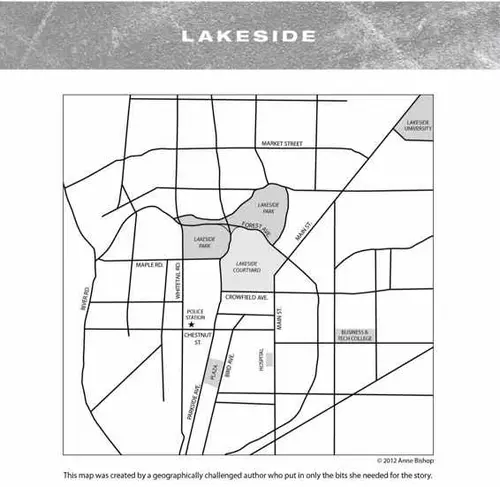
Cities and villages—Bennett, Endurance, Ferryman’s Landing, Hubb NE (aka Hubbney), Jerzy, Lakeside, Podunk, Prairie Gold, Shikago, Sparkletown, Sweetwater, Talulah Falls, Toland, Walnut Grove, Wheatfield
DAYS OF THE WEEK
Earthday
Moonsday
Sunsday
Windsday
Thaisday
Firesday
Watersday
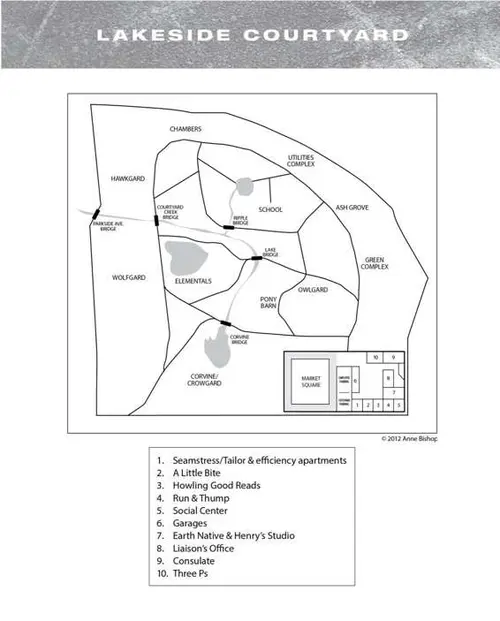
Maps
A Brief History of the World
A Brief History of the World
Long ago, Namid gave birth to all kinds of life, including the beings known as humans. She gave the humans fertile pieces of herself, and she gave them good water. Understanding their nature and the nature of her other offspring, she also gave them enough isolation that they would have a chance to survive and grow. And they did.
They learned to build fires and shelters. They learned to farm and build cities. They built boats and fished in the Mediterran and Black seas. They bred and spread throughout their pieces of the world until they pushed into the wild places. That’s when they discovered that Namid’s other offspring already claimed the rest of the world.
The Others looked at humans and did not see conquerors. They saw a new kind of meat.
Wars were fought to possess the wild places. Sometimes the humans won and spread their seed a little farther. More often, pieces of civilization disappeared, and fearful survivors tried not to shiver when a howl went up in the night or a man, wandering too far from the safety of stout doors and light, was found the next morning drained of blood.
Centuries passed, and the humans built larger ships and sailed across the Atlantik Ocean. When they found virgin land, they built a settlement near the shore. Then they discovered that this land was also claimed by the terra indigene¸ the earth natives. The Others.
The terra indigene who ruled the continent called Thaisia became angry when the humans cut down trees and put a plow to land that was not theirs. So the Others ate the settlers and learned the shape of this particular meat, just as they had done many times in the past.
The second wave of explorers and settlers found the abandoned settlement and, once more, tried to claim the land as their own.
The Others ate them too.
The third wave of settlers had a leader who was smarter than his predecessors. He offered the Others warm blankets and lengths of cloth for clothes and interesting bits of shiny in exchange for being allowed to live in the settlement and have enough land to grow crops. The Others thought this was a fair exchange and walked off the boundaries of the land that the humans could use. More gifts were exchanged for hunting and fishing privileges. This arrangement satisfied both sides, even if one side regarded its new neighbors with snarling tolerance and the other side swallowed fear and made sure its people were safely inside the settlement’s walls before nightfall.
Years passed and more settlers arrived. Many died, but enough humans prospered. Settlements grew into villages, which grew into towns, which grew into cities. Little by little, humans moved across Thaisia, spreading out as much as they could on the land they were allowed to use.
Centuries passed. Humans were smart. So were the Others. Humans invented electricity and plumbing. The Others controlled all the rivers that could power the generators and all the lakes that supplied fresh drinking water. Humans invented steam engines and central heating. The Others controlled all the fuel needed to run the engines and heat the buildings. Humans invented and manufactured products. The Others controlled all the natural resources, thereby deciding what would and wouldn’t be made in their part of the world.
There were collisions, of course, and some places became dark memorials for the dead. Those memorials finally made it clear to human government that the terra indigene ruled Thaisia, and nothing short of the end of the world would change that.
So it comes to this current age. Small human villages exist within vast tracts of land that belong to the Others. And in larger human cities, there are fenced parks called Courtyards that are inhabited by the Others who have the task of keeping watch over the city’s residents and enforcing the agreements the humans made with the terra indigene.
There is still sharp-toothed tolerance on one side and fear of what walks in the dark on the other. But if they are careful, the humans survive.
Sometimes, they survive.
Epigraph
As humans it is our right, our destiny, to claim the world for ourselves. We must display the fortitude needed to wrest the land away from animals who hoard water and land, who have no use for resources such as timber and oil, who make no contributions to art or science or better living conditions for anyone. We cannot become the supreme beings we were meant to be as long as we allow animals to frighten us into believing we have to submit to the boundaries they set. The human race has no boundaries. If we stand together, we will be invincible. We will be the masters, and the world will belong to us first, last, and forever.
—Nicholas Scratch, speaker for the Humans First and Last movement
It’s always about territory. It’s about taking care of your pack, about having food and good water. It’s about having enough of those things so your pack can survive and your pups can grow up. Other or human, it’s what we all want. And when one kind of animal overruns an area to the point where many kinds of animal begin to starve, it’s up to the predators to thin out the herds before there’s nothing left for anyone. That’s a simple truth whether you’re talking about deer or humans.
—Simon Wolfgard, leader of the Lakeside Courtyard
Prologue
N,
We must strike soon to achieve a swift and victorious result. Rally our allies and begin the diversions that will keep eyes focused away from Thaisia’s ports. Ship whatever you can, however you can. A hungry army cannot fight the enemy we face. As soon as those last ships are secured in our ports, we will claim what rightfully belongs to the Cel-Romano people and wipe out the vermin currently overrunning the virgin farmland.
—Pater
To: All HFL Plains Chapters, Thaisia
Proceed with stage one of the land reclamation project.
—NS
CHAPTER 1
CHAPTER 1
Sunsday, Juin 5
The sweet blood has changed things. You have changed because of her. We are intrigued by the humans who have gathered around your Courtyard, so we will give you some time to decide how much human the terra indigene will keep.
•••
Simon Wolfgard, leader of the Lakeside Courtyard, stared at his bedroom ceiling, the words of warning, of threat, chasing away sleep, as they had for the past few nights.
The words weren’t the only thing chasing away sleep. Procrastination was a human trait, and in this past week, he’d discovered that it had its own kind of bite. Wolves didn’t procrastinate. When the pack needed food, they went hunting. They didn’t make excuses or find some unimportant thing that didn’t need doing at that very minute. They got on with the business of taking care of the things that in turn took care of them.
I wanted Meg to heal from the cut she made last week. I wanted to give her time before asking her to carry some of the weight of these decisions. She’s the Trailblazer who is finding ways for other cassandra sangue to survive. She didn’t make decisions for herself or anyone else for twenty-four years, and now she’s supposed to make all these important decisions that could mean life or death for... who? The other blood prophets? All the humans living in Thaisia?
Growling, as if that would scare his thoughts into hiding, Simon rolled over, closed his eyes, and pushed his face into his pillow, determined to get a little more sleep. But the thoughts were excellent hunters and devoured sleep.
We will give you some time to decide how much human the terra indigene will keep.
For the past week, he’d made excuses to himself and the rest of the Courtyard’s Business Association, and they had let him make those excuses because none of them—not Vlad or Henry or Tess—wanted to tell Meg what was truly at stake now. But time, like Meg’s strange, fragile skin, was not something he could afford to waste.
Rolling the other way, Simon stared at the window. As he raised his head, his ears shifted to Wolf shape, pricking to better catch the sounds outside.
Sparrows. Those first sleepy chirps that announced the dawn when the sky began its change from black to gray.
Morning.
Pushing aside the tangled sheet, Simon hustled into the bathroom to pee. As he washed his hands, he glanced over his shoulder. Did he need to shower? He bent his head and gave himself a sniff. He smelled like a healthy Wolf. So he would shower later when he’d have to deal with more than the one human who was his special friend. Besides, she wouldn’t be taking a shower either.
He took a step away from the sink, then stopped. Skipping a shower was one thing, but the human mouth in the morning produced scents strong enough to discourage close contact.
Loading toothpaste onto his toothbrush, Simon studied his reflection while he cleaned his teeth. Dark hair that was getting shaggy—he’d need to do something about that before the Courtyard’s guests arrived. Skin that had browned a bit from working outside without a shirt on. And the amber eyes of a Wolf. Human skin or Wolf form, the eyes didn’t change.
He rinsed out his mouth and started to put the toothbrush back in the medicine chest above the sink. Then he looked at his reflection and lifted his lips to reveal his teeth.
No, the eyes didn’t change when he shifted to Wolf, but...
Shifting his head to Wolf form, he loaded the toothbrush with toothpaste a second time and brushed the other, better, set of teeth. Then he growled because a Wolf’s mouth wasn’t designed to rinse and spit. He ended up leaning over the sink and pouring cups of water over his teeth and tongue so no one would think he was foaming at the mouth.
“Next time I’m just chewing a twig as usual,” he grumbled when he shifted back to fully human.
Returning to the bedroom, he pulled on jeans and a T-shirt. Then he stepped to the window and put his face close to the screen. Cool enough outside for socks and sneakers—and a sweatshirt since they would be walking at Meg’s speed, not his.
He finished dressing, then grabbed his keys out of the dish on his dresser and went out the door in his apartment that opened onto the back hallway he shared with Meg. He unlocked her kitchen door and opened it carefully. Sometimes she used the slide lock as extra security, and breaking her door by accident would just cause trouble.
He’d caused enough trouble the time he’d broken the door on purpose.
No slide lock. Good.
Simon slipped into Meg’s kitchen and quietly closed the door. Then he headed for her bedroom.
A light breeze coming through the partially opened window played with the summer curtains the female pack—Meg’s human friends—had helped her purchase and hang. The morning light also came through the window, giving him a clear look at the woman curled up under the covers.
Was she cold? If he’d stayed with her last night, she wouldn’t be cold.
“Meg?” Cautious, because she could kick like a moose when she was scared, he gave her shoulder a little push. “Time to wake up, Meg.”
She grunted and burrowed under the covers until only the top of her head showed.
Wrong response.
Holding out one hand to block a potential kick, Simon laid the other hand on her hip and bounced her against the mattress a couple of times.
“What? What?” Meg struggled to sit up, so he obligingly grabbed her arm and pulled.
“Time to wake up.”
“Simon?” She turned her head and blinked at the window. “It’s still dark.” She flopped down on the bed and tried to pull up the covers.
He grabbed the covers, and the brief game of tug had her sitting upright again.
“It’s not dark; it’s just early,” he said. “Come on, Meg. We’ll take a walk.”
“It’s not morning. The alarm clock didn’t go off.”
“You don’t need an alarm clock. You’ve got sparrows, and they say it’s morning.”
When she didn’t respond, Simon hauled her to her feet and steered her out the bedroom door and down the hallway to the bathroom.
“Are you awake enough to pee and brush your teeth?”
She closed the door in his face.
Taking that as a yes, Simon returned to Meg’s bedroom and pulled out the clothes she would need. Most of the clothes. Apparently a male wasn’t supposed to take a female’s underclothes out of a drawer unless he was mated to that female. And males weren’t supposed to see the underclothes unless females wanted the underclothes to be seen.
He didn’t understand why everyone fussed about taking clean clothes out of a drawer. Underclothes smelled a lot more interesting after the female wore them.
Probably not something human females wanted to know.
While he waited, he made up the bed, more to discourage Meg from falling back into it than because he wanted to tidy the room. Besides, running his hands over the sheets and breathing in her scent made him happy.
Why had he thought sleeping in his human form last night was a good idea, especially when it meant sleeping alone? If he had shifted to his Wolf form as he usually did, he could have stayed with Meg, could have curled up next to her in her bed.
All right, he hadn’t thought staying in human form overnight was a good idea, just a necessary exercise. Six Wolves from the Addirondak packs were coming to the Lakeside Courtyard next week to experience interacting with humans in ways they couldn’t in their own territory. Three were adults who were already dealing with the humans who lived in towns located in and around the Addirondak Mountains. The other three were juveniles who had completed their first year of the human-centric education that would train them to keep watch over the humans living in Thaisia.
Keeping watch to make sure humans kept to the agreements their ancestors had made with the terra indigene was dangerous work. The Others might refer to humans as clever meat—and they were—but they were also invading predators who grabbed territory whenever they could. And despite what their government officials said, humans weren’t really concerned with the overall well-being of their kind. Humans belonging to the Humans First and Last movement had howled about a food shortage in Thaisia and said the terra indigene had caused it. But it was the HFL humans who had sold the surplus stores of food to the Cel-Romano Alliance of Nations for profit and then lied about it. Those lies had spurred a fight in Lakeside that resulted in the deaths of police officer Lawrence MacDonald and Crystal Crowgard. By doing those things, humans had drawn the attention of terra indigene who usually stayed away from human-controlled places while their intentions were benevolent.
Those earth natives, who lived deep in the wild country, had decided that the humans living in Thaisia had committed a breach of trust, and all agreements between humans and the Others might be rescinded. Probably would be rescinded. Already there were restrictions on what kind of cargo could be carried by ships traveling on the Great Lakes. There were restrictions on what kind of human could travel from one human city to another. The human governments that oversaw human concerns on a regional level were reeling from the sanctions. If ships couldn’t carry food and merchandise from one region to another, if trains couldn’t carry food and fuel to cities that needed both, what would happen to all the humans living on the continent?
If the humans who were supposed to be in charge had paid any attention to Thaisia’s history, they would know what would happen to the humans. The invasive, two-legged predators would be eliminated, and the land would be reclaimed by the earth natives, the terra indigene, the Others.
But that wouldn’t be as easy to do as it had been a few centuries ago. Then, there was little that the humans built or used that would harm the land if left to decay on its own. Now there were refineries that processed the crude oil being drawn out of the earth. Now there were places that stored fuel. Now there were industries that might damage the land if left untended. How much would be harmed if those things were destroyed or abandoned?
Simon had no answers, and the terra indigene who watched over the wild country—the dangerous, primal beings who cloaked their true terra indigene nature in forms so old those shapes had no names—would not be concerned with answers. Even if everything else disappeared from the world to make room for the new that would be born from destruction and change, they would still exist.
The Story Continues on BooksBarbecue!
Enjoyed this preview? ❤️ Do not stop here!
Read the complete book free online → 🔗
Continue reading now on BooksBarbecue and discover every page!
Love reading? Bookmark BooksBarbecue.com for more amazing books!
Happy Reading!