Margery Kempe
Chapters (69)
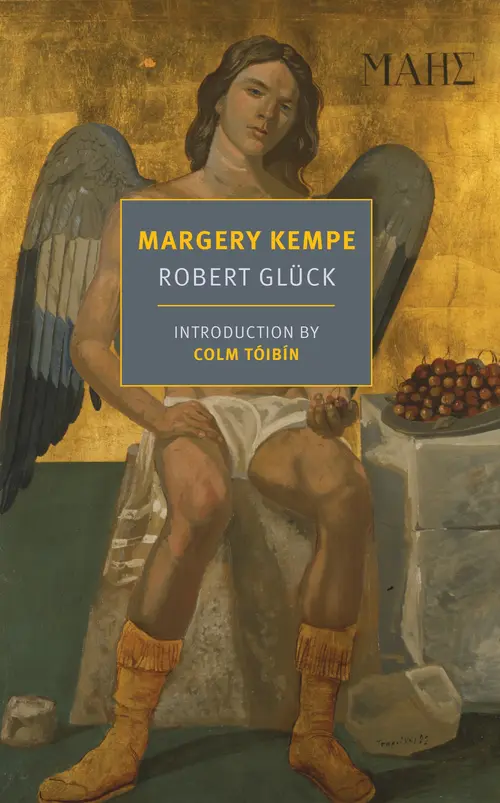
Cover
Biographical Notes
ROBERT GLÜCK (b. 1947) is the author of two novels, Margery Kempe and Jack the Modernist; two short-story collections, Elements and Denny Smith; and Communal Nude: Collected Essays. His books of poetry include Reader, La Fontaine with Bruce Boone, and In Commemoration of the Visit with Kathleen Fraser. He made an artist book, Parables, with Jose Angel Toirac and Meira Marrero Díaz, and he wrote the preface to Between Life and Death, a book of paintings by Frank Moore. With Camille Roy, Mary Burger, and Gail Scott, he edited the anthology Biting the Error: Writers Explore Narrative. In the late 1970s, Glück and Bruce Boone founded New Narrative, a literary movement that makes use of self-reflexive storytelling and essay, lyric, and autobiography in one work. Glück served as the director of the Poetry Center at San Francisco State University, where he is an emeritus professor. He was the co-director of Small Press Traffic Literary Center and an associate editor at Lapis Press. He lives “high on a hill” in San Francisco.
COLM TÓIBÍN is the author of nine novels, including The Master and Brooklyn, and two collections of stories. His play The Testament of Mary was nominated for a Tony Award for Best Play in 2013. He is the Mellon Professor of the Humanities at Columbia University.
Title Page
MARGERY KEMPE
ROBERT GLÜCK
Introduction by
COLM TÓIBÍN
NEW YORK REVIEW BOOKS

New York
INTRODUCTION
Some way into Margery Kempe, Robert Glück ends a chapter with a question: “How can the two halves of this novel ever be closed or complete? Or the book is a triptych: I follow L. on the left, Margery follows Jesus on the right, and in the center my fear hollows out ‘an empty space that I can’t fill.’” It is characteristic of this free-wheeling, intriguing, and self-aware novel to shift tone and change direction so abruptly. The two halves of the novel referred to are, on the one hand, the story of the narrator’s love affair with a handsome, evasive, and elusive American aristocrat, the so-called L., and, on the other hand, the story of Margery Kempe, an English Christian mystic, born around 1473, who wrote what is often called the first autobiography in English.