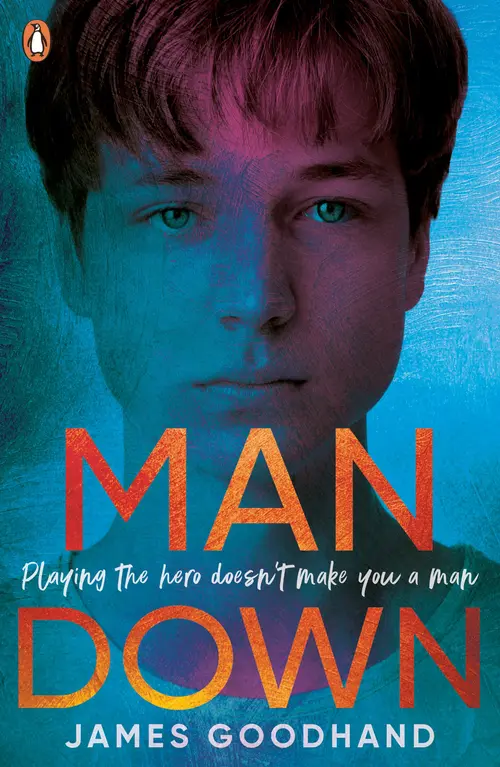
Man Down
Cover

Content note: this book contains the depiction of suicidal thoughts, coercive and manipulative relationships, and drug use.
About the Author
James Goodhand lives in Surrey with his wife and young son. A mechanic by day, much of his work has been written at an oil-stained workbench whilst ignoring a queue of broken cars in need of his attention. James’s debut novel, Last Lesson, was nominated for the Branford Boase Award.
Other books by James Goodhand
Last Lesson
Dedication
For Felix

Four’s a Crowd
Will Parks is no longer alone.
This is the precise instant it begins. He is being watched. Followed. Everywhere.
And he won’t be alone again until The End.
Will himself has not noticed anything change in these last few seconds. Why would he when there are so many more pressing matters to worry about? Not least that he’s stuck in a confined space with a girl he doesn’t even know.
He’s wedged in the back seat of his brother’s blue Fiat, the second car in the queue at the level crossing. The stereo plays way too loud, bassline pummelling Will’s back from the enormous speaker behind his seat. Frowning eyes stare from the rear-view mirror of the car ahead. His older brother, Danny, plumes vape smoke through his open window into the September evening. In the front passenger seat, a girl. She’s dressed up for a Friday night with Danny. Her name is April, although Will doesn’t know this yet. He’d only dared to look at her for the briefest of moments when they picked her up. She’s beautiful, though; that he knows. Of course she is. And she’ll be gone in a fortnight.
‘He loves them and leaves them’ – that’s what people say about Danny.
The train comes into view at last: an express scything across the marshes. It crosses in front of them in a blur, fast and close enough to make the little car rock on its springs. The flashing red lights switch to amber and Danny pulls away in his usual manner. Mr Unimpressed-Glare in front adds a small hand gesture to his expression of disapproval.
They rumble over the tracks into the part of town known as Patten’s Island to drop Will off, his plans somewhat less stimulating than what Danny no doubt has in mind. But they make it barely a hundred metres beyond the crossing before Will feels several thunks from somewhere beneath his feet. The car begins to slow. The smell inside, candy-flossy vape smoke and April’s perfume, is overpowered by the acrid whiff of mechanical failure. The stereo is suddenly silent as they come to rest, revealing a gathering chorus of horns from behind them.
Three times Danny twists the key. Four. Five. The engine cranks a little slower each time, the sound of his cool dying. He’s furious, although you’d need to be someone as close to him as his own younger brother to recognize the signs: the reddening at the earlobes, the tremor in his right arm as he waves the traffic past, the sweat beading in the stubble of his skin-fade haircut.
In one movement, Danny is outside with the bonnet open. His muscle-fit jumper is rolled to the elbows, creating the illusion that he might have the foggiest idea what’s gone wrong. That he might even fix it.
Unable to get out of the back seat without causing a fuss, Will instead stares out of his side window at the derelict shop they are stopped outside, with its peeling paint and cracked pebbledash. It was once a dry-cleaners, though the only evidence of that now are the rusted scars left by the signage. The sea is visible in the gap between this building and its neighbour. The light is fading fast, the setting sun like raging fire and smoke over the marshes. Will concentrates on the view, his head locked round at ninety degrees to his body.
I should have walked, he thinks. I really, really should’ve fucking walked.
‘You see your nan every Friday night?’ April asks.
Will’s heels dig into the car floor. She’s less than a metre away from him. Way too close for a conversation. At least she hasn’t turned right round, instead just inclining her head to the side. Limited risk of eye contact.
‘Sweet of you,’ she adds, even though Will hasn’t replied.
‘Sometimes,’ Will eventually says. A lie. He does see her every Friday night; spends most evenings round there if he isn’t working, and he’d wish it no other way. He’s only too well aware there will come a time, soon, when he won’t be able to do so any more.
‘What you reckon to sixth form?’ she asks.
‘S’OK.’
Will stares at his iPhone in his lap, smearing a wet thumb round in circles on the lock screen.
‘Hear about the dartboards?’
He gives a snort of laughter. He has heard about them – how they didn’t survive a week in the common room before being removed after Saul Caan had to be taken to A and E with a dart buried barrel-deep in the back of his neck.
‘You’re at ECS?’ he asks. Three days into lower sixth at Ebbswick Community Secondary, he’s sure he hasn’t seen her around. Though the fact that he hasn’t yet set foot inside the common room has, of course, limited his opportunities for meeting his fellow students.
‘I’m the new girl,’ she says bouncily, turning right round to face Will and giving it some jazz hands. ‘Got a kindly upper-sixther to show me the bright lights of the town, though.’
Will focuses on his brother, perched on the wing of the car, unsure whether April’s sarcastic tone is in reference to the suggestion of Ebbswick-on-Sea containing even a single bright light, or that Danny’s invitation could be in any way interpreted as an act of kindness.
‘Where should we go?’ she muses out loud.
Will smiles back at her for a moment. ‘It’s …’
April stares at him, waiting. But Will has merely succumbed to the pressure to begin a sentence, trusting that the rest of the words will follow. They haven’t. This is always happening. When will he learn?
‘It’s …’ he says once again.
At some quiet moment in the near future, he’ll reflect on this exchange and carry out a post-mortem, running over every word and gesture in forensic detail, as he often does in the aftermath of a social encounter. At the heart of these investigations lies the big question he can never answer with any certainty: What is it that I’m so afraid of?
Saying something really fucking stupid, that’s part of it for sure. But there’s something deeper. It’s a fear of being seen. Of being outed as weird – the hardest reputation to shift once gained. That’s the furthest conclusion Will is able to reach. If he could only believe he might interact with another human being without the certainty they’ll leave disappointed, amused – repulsed, even – by the encounter, if he could know that’s not how it would end, maybe he’d be OK.
It’s far from just conversations with girls at which Will falls short, although those are perhaps where the struggle is at its most acute. And it’s not because Will fancies those girls, even if his maroon-faced appearance makes it look like he does. In truth, Will doesn’t so much fancy girls as exist in awe of them, considering himself thoroughly unworthy of their attention. He’s two weeks off seventeen, but he long ago accepted that it’s exceptionally unlikely he’ll ever have sex. Sometimes he wonders if he might, in the long-distant future, when he’s thirty or forty perhaps, pay for it – just to find out what it’s all about.
‘What subjects you doing?’ April asks.
‘English, history, physics, photography,’ Will reels off.
‘Snap,’ she says, grinning. ‘Be seeing you in photography. One of my five.’ She does a disgusted face.
‘Five?’
‘Beasting myself, aren’t I? Figure if I keep myself busy, no one’ll notice I’ve got no mates.’
You’ll have friends soon enough, Will thinks. You must be seriously clever, he also thinks. But he doesn’t voice either of these thoughts, for fear they’ll sound like an attempt at a compliment.
‘Sorry, kids, but this old bus ain’t going nowhere fast,’ Danny announces, kneeling on the edge of the driver’s seat. His hands are remarkably spotless for someone who’s been supposedly nursing a broken engine for the past six minutes.
‘What’s up with it?’ April asks.
‘Radiator, looks like.’
‘Shit. Sounds expensive.’
‘I’ll slip a new one in tomorrow,’ he says.
Will is always impressed by Danny’s ability to speak with utter confidence on matters of which he knows little or nothing.
‘You all right walking to Nain’s from here, little bro?’ he asks with a warmth he doesn’t usually use to address Will.
‘How come you call her nine?’ April says.
‘Nain,’ Danny corrects, although it sounds indistinguishable from the number. ‘Welsh for “Gran”. It’s where she grew up.’
Will is only too relieved to be squeezing past the front seat, unfolding his six-five frame into the salty air. He gives his brother a thumbs up, towering awkwardly over him.
‘Don’t forget to walk Beppo,’ Danny adds with a smirk.
This is a running joke, entirely at Will’s expense, but he laughs all the same because it’s easier than getting annoyed.
‘Got the lead?’ Danny winks.
Will opens his rucksack and shows it to him.
‘Woof woof,’ Danny says, playfully jabbing his arm.
‘Catch you in photography,’ April calls after him, just as another train howls past the level crossing.
Will pretends he doesn’t hear her.
She must think I’m so fucking rude, he thinks.
Shoulders rigid and hands jammed in pockets, Will walks away.
And he is followed.
That Friday Feeling
Will rounds the corner into his nain’s road. The single working street light glows in the darkness, wobbling like a flower on a stalk as an onshore breeze kicks up over the beach in the distance. He passes an old caravan, slumped at the kerb on flat tyres that haven’t turned in years. The bungalow over the road has its glass front door held together with parcel tape.
This part of town is known as Patten’s Island, although it isn’t an island, and Mr Patten – the businessman who built it – had the good sense to bugger off a long time ago. An area of reclaimed marshland, surrounded by sea on two sides, hundreds of chalets line its grid of roads. Once a half-fashionable holiday destination, in recent decades the buildings fell first into disrepair, and then into the hands of private landlords, who do as little for their tenants as they can get away with. Fifty years ago, you might have seen the neighbourhood depicted on postcards, but these days you’re more likely to find it in one of those ‘crap towns’ sort of books, which a particular type of person is entertained by.
Will stops for a moment outside Nain’s front door and takes a deep breath, as he always does. He knows that once he’s pressed the doorbell or stuck his key in the lock, he’s at the mercy of whatever might be waiting for him inside. There have been times when that fact has come close to making him walk away. He turns for a moment and looks at the few multicoloured flowers and stone squirrels that decorate her front garden. This small plot used to burst with blooms in every colour imaginable, a proper neighbourhood landmark. These days she keeps it simple.
‘Let yourself in, Wilbo,’ a voice shouts from inside.
Nain is in the kitchen, where she’s half sitting on, half leaning against a wheeled stool at the worktop. In front of her is a mound of roughly chipped potatoes and a gin and bitter lemon in a half-pint beer jug.
‘Look at the bloody state of them,’ she says, pointing a shaking finger at the chips. ‘Silly old fart.’
Will crouches to give her a hug and kisses her hot forehead. Beneath her silver woolly jumper she feels like a baby bird.
‘I said I’d cook my tea,’ he says, spotting the gammon and pineapple laid on foil and the beans on the stove. ‘You’ve eaten?’
‘Portuguese Louisa left ten minutes ago.’ Nain has a protocol when referring to her carers, prefacing their first names with their country of origin. ‘Cumberland pie. That makes it Friday?’
‘Yup.’
‘Don’t get old, Wilbo. Working out the day of the week from what’s on the menu! Bloody hell.’
She digs around in the fridge and Will helps her extract the chip pan from right at the back.
‘I’ll do my tea, Nain,’ he says quietly but firmly.
‘What use am I when I can’t even feed you?’
‘How are you?’ he asks. ‘Sorry, got called into work the last couple of nights.’
‘You work too hard.’ She rubs his arm.
‘We kinda need the money. Been OK, though?’
‘Fine, dear. Fine. Not buying green bananas, you know.’
Will tries to laugh, gripping his hand round Nain’s as she attempts to light the gas rings.
‘Go sit down,’ he says. ‘I’ll join you in a minute.’
He guides her to her chair, arm linked with hers, lowers her by the shoulders into her threadbare mustard-coloured armchair and waits while she packs cushions round herself. As he steadies her, he looks at the wall over the fireplace. His grandad stares back at him, or at least so it seems from the sparkling life in his eyes. The framed portrait rests above a highly polished cherry-wood box on the mantelpiece.
‘April 2018,’ Nain says, wedged in position now. ‘I was thinking about it the other night. He had no idea I was taking it. Last time we ever went out to a party. Worked out it was precisely a hundred days before, well, you know …’
Will nods. Like so many of Nain’s photos dotted about the house, it’s so beautiful that it’s impossible to walk past. It’s the sort of picture you can only take using an old camera with no electronics deciding you’re wrong, because it breaks all the rules. Ninety per cent of the image is jet black, with slivers of white where his hair and the deep wrinkles in his Middle Eastern skin catch the low light. There is the quick-witted grin, the Sinatra cut of his suit: an entire person in a thirty-centimetre square.
‘How you getting on with the camera?’ Nain asks. She gifted her 1970s Olympus to Will a year ago. ‘Shooting lots? Film’s expensive, I know.’
‘A bit. Here and there.’
He rarely leaves home without it. His wages allow him a thirty-six exposure roll every two weeks, together with the school darkroom fees so he can process it.
‘I live in hope that you’ll have something to show me one of these days. I know you have the eye.’
Will can’t bring himself to show his work to anyone, especially not Nain, who he’s certain he couldn’t compare to if he practised for a lifetime. This is something Nain can’t begin to understand, because while they may well share an eye for a good picture, above all they share a lack of belief in their own abilities. Someone need only glance around the walls of her small chalet, not just at the photographs but also at the watercolours of beaches and landscapes, the Indian-ink line drawings of animals, the scenes of fairies and picnicking teddies burned into slabs of timber, to realize that all those years spent working the delicatessen counter in an out-of-town supermarket were a waste of her skills. But Nain would never think such a thing. She can name scores of gifted people in this very neighbourhood; people who possess all the skill and flair to be master cake bakers, model makers, writers, who instead give themselves to jobs where someone makes you put your phone in a locker and tells you what time you can eat your lunch. There are professions that aren’t open to people from places like Patten’s Island; she’s long known that.
‘It’s chilly in here,’ Will says, flinching at the clank each time he prods the ignition button on the gas fire.
‘Don’t you bloody dare!’ Nain laughs. ‘It’s September, for crying out loud.’
Will doesn’t argue, instead unfolding a blanket and laying it over her knees.
‘Least I can do is keep the gas bill under control,’ she says. Her expression shifts suddenly, lips tightening against teeth. ‘He was out there again this afternoon.’ She points to the closed curtains, beyond which is her small back yard. ‘Brazen, he is.’
Will’s fairly sure he knows where this is going, but plays along regardless. Out of what – politeness? Duty? He’s never sure.
‘Who was out there?’
‘What’s-his-name. You know. Arbuckle! That Jonny Arbuckle next door.’
‘Does he still live there?’
Will knows that the De Souza family live there, that Mr Arbuckle moved away five years ago.
‘Stealing my electricity again. Making a racket all afternoon.’
‘Maybe he was using his own electricity, Nain.’
‘Drills, saws, sanders – all sorts. He thinks I’m such a mug.’
‘I don’t think anyone’s stealing from you.’
‘I can’t afford it, Wilbo. As if things aren’t bad enough.’
‘Try not to worry. I’m sure –’
‘It makes me so bloody cross.’ There are tears in her eyes now as she slams a fist against the arm of her chair.
Will hugs her and kisses her head. Her soft white hair smells of the perfume she’s always worn and, as Will closes his eyes, he realizes that it’s him who feels safe now, even though he’s the one doing the comforting. He thinks how bizarre it is that minutes ago she was remembering the exact day she took a particular photograph, and in another moment she’s recounting something that never happened, or relying on a foil dish of Cumberland pie to tell what day it is.
As the moments pass, he feels the tension in her ease, and knows that she’s either talked herself round or forgotten entirely what had wound her up in the first place.
‘Gonna sort my tea,’ he whispers, creeping back to the kitchen.
The chips are almost golden and bubbles rise slowly through the gloopy baked-bean sauce, popping and splattering the hob. Noise spills from the old medium-wave radio on top of the fridge. Through the whistling interference and the crackle of static, Will can detect two separate stations fighting each other to be heard. There’s some sort of country and western song with swooping steel guitar, and then there’s a radio play with cut-glass accents talking about a pheasant shoot.
Who are these people who listen to dramas on the radio, Will briefly wonders, and why don’t they watch telly instead? He notices that if he concentrates on the music, the conversation fades into the background; if he focuses on the posh farmers, the song recedes till it’s like the music in a lift. There’s a great crack of interference as he sweeps the aerial to one side, finding a sweet spot where just the music remains.
He lifts the basket of chips to drain and switches the gas taps off. Before joining Nain, he stands for a moment and looks about the kitchen – at the irrelevant stuff that’s been part of the scenery for every memory he’s made here: the bar of hand soap no one uses, marbled green and white and split end to end; the London Olympics commemorative plate above the door, veined with superglue; the fridge magnets from places no one in the family has been.
He thinks about his first A-level physics lesson this morning. The law of entropy was the topic: how all things in the universe move over time from order to chaos. And he thinks how there was a time when his life existed in perfect order: when everybody who mattered was still alive, when no one had illnesses that would take them away, when both parents still lived under the same roof and divorce was just a word used in gossip about other families. His life once had order, and he was happy. As order moves towards chaos, Will thinks, so happiness falls to bits and becomes misery.
He takes a seat next to Nain, knowing that what little order that still remains will soon be chaos too.
But he’s wrong. Unlike most of nature’s known laws, there’s room for a little negotiation where entropy is concerned. Things are about to get better for Will.
Although they might get worse first.
Work
Will stares at the folded trousers and the green and red striped waistcoat as his manager slides them over the bar to him. He feels nauseous. For a change, it’s not because of the stench of stale beer and festering mops that always fills the pub until it gets aired out at opening time.
‘Front of house?’ Will asks. ‘I’d maybe rather stay on pot wash.’
‘Kitchen’ll manage without you,’ his manager tells him.
‘I’m just not sure I’m –’
‘High time we got you customer-facing – nice strapping lad like you. It’s a cracking day. Be some tarts down looking for a bit of fun, mark my words. You’ll be thanking me later.’ He winks at Will. His name is Mick Touch, and there have been whispers from the younger girls on the staff that suggest his surname is not inaccurate.
Will keeps his hands clear of the uniform, as if picking up the pile of well-worn clothes will commit him to the gig. It’s barely past ten on Sunday morning, but beyond the pub’s glazed frontage the beach is already sprouting blankets and windbreaks, and the sea is fizzing with autumn sun.
The Story Continues on BooksBarbecue!
Enjoyed this preview? ❤️ Do not stop here!
Read the complete book free online → 🔗
Continue reading now on BooksBarbecue and discover every page!
Love reading? Bookmark BooksBarbecue.com for more amazing books!
Happy Reading!