Machado de Assis
Cover
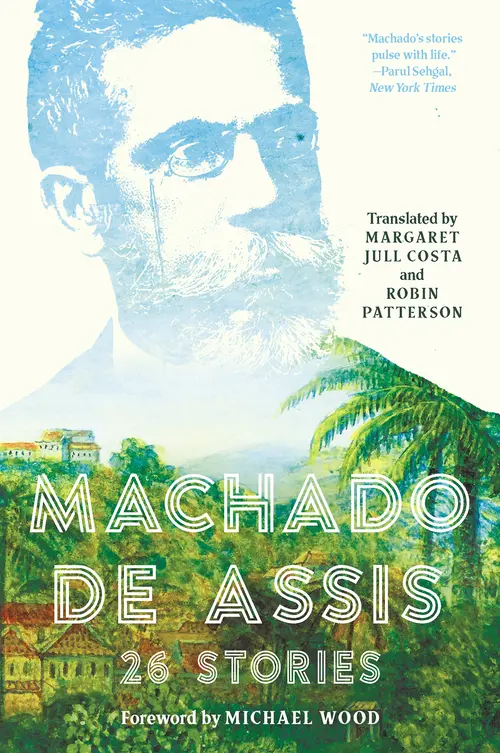
Title
MACHADO DE ASSIS
26 STORIES

Joaquim Maria Machado de Assis
Translated by
MARGARET JULL COSTA
AND
ROBIN PATTERSON

LIVERIGHT PUBLISHING CORPORATION
A division of W. W. Norton & Company
Independent Publishers Since 1923
NEW YORK | LONDON
Foreword by Michael Wood
FOREWORD
JOAQUIM MARIA MACHADO DE ASSIS wrote short stories throughout his career, publishing seven collections between 1870 and 1906, interspersed with his nine novels. Critics like to divide the novels into two sets, seeing the first four as slender and “romantic” (the author’s own term) and the last five as complex, ironic masterpieces. We can’t do anything like this with these stories, although we may say that with the years the continuing lightness of touch is applied to darker subjects. We move from young love and shallow social ambition to suicide and slavery, from portraits of manners to deep philosophical questions. But even this impression calls out for some correction. There are dark early stories too, and light late ones. So perhaps the firmer truth is that if we read the stories in sequence we get better at registering the darkness, at seeing through the light, so to speak.
Machado’s short stories resemble those of Chekhov in their talent for saying too little (that is, just enough), but his closest literary companion, if we are looking for comparisons, is his almost exact contemporary Henry James, and especially in his longer pieces, where he appears as a great master of the form that James called “our ideal, the beautiful and blest nouvelle.”
But more than either of these writers, Machado constantly engages in an open playfulness with the reader. In the stories as in the novels, his style of wit belongs with that of Henry Fielding or Laurence Sterne, whose work he knew well. We could also cite the excellent company he could not know he would come to keep, that of Vladimir Nabokov and Italo Calvino.
Machado has generally been well served by translators, although many of his stories have not until now appeared in English versions. But no one has caught the ease and grace of his prose as Margaret Jull Costa and Robin Patterson have. This achievement is important not only because it allows us actually to see a style traveling from one language to another but because the apparently casual movement of Machado’s writing, so well rendered here, allows all kinds of implications to arise as if of their own accord.
In one story, a single narrator tells us both that “there are no mysteries for an author who can scrutinize every nook and cranny of the human heart” and that one of his characters “had a series of thoughts that remained hidden from the author of this story.” In others we meet imagined readers who are “less canny,” “less demanding,” or “more experienced.”
Machado teases his readers, but he also relies on them to be his accomplices; and sometimes he makes our complicity distinctly uncomfortable. In the last story in this volume, “The Tale of the Cabriolet” (1906), a slave arrives at the church of São José in Rio de Janeiro and asks the priest to perform the last rites at a nearby house. The man seems “quite distraught” about the news he is carrying, and the narrator comments:
Anyone reading this with a darkly skeptical soul will inevitably ask if the slave was genuinely upset, or if he simply wanted to pique the curiosity of the priest and the sacristan. I’m of the view that anything is possible in this world and the next. I believe he was genuinely upset, but then again I don’t not believe that he was also eager to tell some terrible tale.
The sacristan in fact spends the rest of the story sniffing out the tale for himself, not because he is a gossip or a meddler but because he loves tales. “With him it was a case of art for art’s sake.” And with us? With Machado himself? Aren’t we looking for tales, terrible or not? How far are we from being upset?
The wit and grace of Machado’s writing never diminish in these stories, and the scene is almost always the same. We are watching the bourgeoisie of Rio Janeiro at play, and occasionally trying to be serious. They misunderstand each other, they get married, they worry about dying, there is the occasional violent murder. Money and the business of keeping up appearances are large questions. The characters read Hugo and Feydeau, Dumas père and Dumas fils, and indeed the general tone is that of nineteenth-century Paris as reconstructed in so many Latin American locations of that time. Machado is gently mocking this class that believes only in borrowed culture, or in what the Brazilian critic Roberto Schwarz calls “misplaced ideas,” but he is not advocating any kind of nativism.
When the chief character of “The Alienist,” refusing distinguished positions offered to him by the king of Portugal, refers to the Brazilian city of Itaguaí as “my universe,” we laugh because he seems to have made his world so small. But then we may also feel that his grandiose claim for his hometown and the exclusive fascination of others with the culture of Europe are simply rival forms of provincialism. There is a third way. We can take all culture, local and international, as our own, and this is the practice suggested by Machado’s own allusions, as it is by those of Jorge Luis Borges, writing a little later in a neighboring Latin American country. “We cannot confine ourselves to what is Argentine in order to be Argentine,” Borges says, and Machado might add that we don’t have to believe that Paris is the capital of the world in order to read French literature.
In “Father Against Mother,” first published in 1905, near the end of Machado’s life, the stage belongs not to the bourgeoisie but to a lower social sector, that of a man who has been a clerk in a store, a bookkeeper to a notary, an office boy, and a postman, and is now a slave catcher. This was “one of the trades of the time,” the narrator says, and of course “not . . . a very noble profession.” This understatement has considerable force because the story has already informed us in some detail about “certain . . . implements” of slavery:
There was the neck iron, the leg iron, and the iron muzzle. The muzzle covered the mouth as a way of putting a stop to the vice of drunkenness among slaves. It had only three holes, two to see through and one to breathe through, and was fastened at the back of the head with a padlock.
Nothing very noble here, just ingenious mechanical cruelty. The idea of putting a stop to vice must be rank hypocrisy, but Machado continues to imitate the voice of moral piety:
[T]he muzzle also did away with the temptation to steal, because slaves tended to steal their master’s money in order to slake their thirst, and thus two grave sins were abolished, and sobriety and honesty saved. The muzzle was a grotesque thing, but then human and social order cannot always be achieved without the grotesque, or, indeed, without occasional acts of cruelty.
The same tone is present when the narrator remarks that slave catchers are “helping the forces who defend the law and private property,” and that their trade therefore may be said to have “a different sort of nobility, the kind implicit in retrieving what is lost.”
Slavery was finally abolished in Brazil in 1888, by which time Machado had published four of his seven volumes of stories. The slave trade itself had ended in 1850. Slaves are everywhere in these works, a fact of life, and not often commented on. We can be sure Machado has little sympathy for the woman who complains of her “feckless slaves,” or the man who alternately smashes plates over his slaves’ heads and calls them by “the sweetest, most endearing names.” There is a slave who is “more brother than slave as regards devotion and affection.” But generally the slaves are just slaves, part of a subjugated work force taken for granted. Is Machado endorsing the institution of slavery? No, he is evoking a world and leaving the judgment of that world to the reader’s conscience. And in “Father Against Mother” he is slyly hoping we will not share the opinions offered.
But then after evoking the horrible instruments and the fragile justifications for their use, he invites us to think of both the slave catcher and a caught slave as human beings capable of love and distress. The slave catcher and his wife are very much in love and desperately want to have a child. At last they have a son, but then they have no money—the trade is not going well. They are evicted from their house, and the man is about to leave his son at the foundling hospital, when he sees and arrests a runaway female slave. He is the father named in the title, and she is the mother. I won’t reveal the plot further, since the point is to signal the incredible poise and moral reach of Machado’s narrator. We don’t exactly feel sympathy for the man, but we are tempted to something like it, even if our minds are still full of the thought of those horrible implements described at the story’s start. Of course the system doesn’t excuse him, but he didn’t invent the self-serving regime of “human and social order” that everyone is so happy to take as a norm.
Roberto Schwarz calls the story “How to Be a Bigwig,” first published in 1881, “the key to [Machado’s] mature satirical style.” This story has no apparent darkness, and the reader’s role is essential. The work is pure dialogue, so we don’t even have Machado’s narrator as an unreliable playmate or misinformant. A father decides to have a chat with his son, who has just turned twenty-one. The boy has “a private income and a college degree,” he could do almost anything. “[P]olitics, the law, journalism, farming, industry, commerce, literature, or the arts” all await him if he wants them. Whichever he chooses, the father says, he will need a very particular second career, “just in case the others fail entirely, or do not quite meet [your] ambitions.” This career is that of a bigwig. The boy doesn’t understand, and the father explains. The bigwig is a man of “measure and reason,” who fits the role so perfectly because he has nothing in his mind that might compete with the steady, empty gravity of his comportment. There are people who have ideas and conceal them, but it is far better, the father says, to have no ideas at all, and he finds in his son “the perfect degree of mental vacuity required by such a noble profession.” It is important to waste a lot of time in the company of others, because “solitude is the workshop of ideas.” A good habit is to go into bookstores to chat, rather than to read or buy anything, and a proper mastery of clichés is invaluable. “Publicity” is to be wooed, the young man’s future speeches are to be packed with ready-made phrases, and above all, the father says, “whatever you do, never go beyond the boundaries of enviable triteness.” He adds, “I forbid you to arrive at any conclusions that have not already been reached by others.” The son thinks this is all going to be quite difficult, and the father agrees. The father, very pleased with himself, compares the advice he has just given to his son with Machiavelli’s instructions in The Prince.
Clearly Machado’s mature style involves a mockery of this complacent, cynical advisor and his passive, all too obedient client. But then we think perhaps the father is a satirist himself, mocking the world he lives in, and trying to provoke his son into the very thinking he says he should avoid. Does he really need to compliment him on his mental vacuity? And what about the son? Could he be playing a waiting game, aghast at his father’s nonsense but not sure what to do? What if all three of these interpretative possibilities are in play? I doubt whether many of us can juggle them all at once, but there is nothing in the story that will allow us finally to choose among them. And the readings I have just suggested do not even include the one that is hiding in plain sight: the father may be sincere and also quite right. His views and the world he evokes are regrettable affairs, but since when did regret do away with the truth?
Machado’s stories—delicate, funny, elusive, never bitter, often near to unacknowledged horrors—teach us how to read: how to read the stories themselves and how to read their often too complacent world, perhaps even more subtly than his novels teach their related lessons. We might think, in conclusion, of the masterpiece called “Midnight Mass” (1894), which begins with the voice of a man saying, “I’ve never quite understood a conversation I had with a lady many years ago, when I was seventeen and she was thirty.” We think we already know this story, simply by learning the sexes and ages in question. In one sense we do. It is all about mutual desire and embarrassment and missed implications. But then we remember that the narrator is saying he doesn’t understand it even now, and we wonder if we really are wiser than he is. What does it mean when nothing happens, and that same nothing lingers unforgettably in your life?
Michael Wood
Introduction
INTRODUCTION
MUCH HAS BEEN MADE OF Joaquim Maria Machado de Assis’s humble beginnings, and yet he, apparently, thought his own life to be of little interest and insisted that what counted was his work. Of course, in general terms, he’s right, but, given his evolution from a poorly educated child of impoverished parents to Brazil’s greatest writer and pillar of the establishment, a brief biographical note would not seem out of place. His paternal grandparents were mulattos and freed slaves. His father, also a mulatto, was a painter and decorator, his mother a washerwoman, a white Portuguese immigrant from the Azores. Both parents, however, could read and write, which was not common among working-class people at the time.
Machado was born in 1839 and brought up for the first ten years of his life on a country estate on the outskirts of Rio owned by the widow of a senator, Maria José de Mendonça Barroso Pereira, who became his godmother. Machado also had a sister, but she died when only four years old. Although he did go to school, he was far from being a star pupil. It seems, however, that Machado helped during mass at the estate’s chapel, and was befriended by the priest, Father Silveira Sarmento, who may also have taught him Latin. Machado’s mother died of tuberculosis when Machado was only ten. He then moved with his father to another part of Rio, and his father remarried. Some biographers say that his stepmother, Maria Inês da Silva, looked after him, and that Machado attended classes in the girls’ school where she worked as a cook. Some say that he learned French in the evenings from a French immigrant baker. Others describe Machado as showing a precocious interest in books and languages. What is certain is that he published his first sonnet in 1854, when he was fifteen, in the Periódico dos Pobres (the Newspaper of the Poor). A year later, he became a regular visitor to a rather eccentric bookshop in central Rio owned by journalist and typographer Francisco de Paula Brito, which was a meeting place for all kinds of people, including artists and writers.
At seventeen, Machado was taken on as an apprentice typographer and proofreader at the Imprensa Nacional, where the writer Manuel Antônio de Almeida encouraged him to pursue a career in literature. Only two years later, the poet Francisco Otaviano invited him to work as writer and editor on the Correio Mercantil, an important newspaper of its day and one that is often mentioned in these stories. He wrote two operas and several plays, none of which met with great success, but he loved the theater and became involved in Rio’s theater world from a very young age. Indeed, by the time he was twenty-one, he was already a well-known figure in intellectual circles. He worked as a journalist on other newspapers and founded a literary circle called Arcádia Fluminense. During all this time he read voraciously in numerous languages—it is said that, as well as modern literature, he set himself the lifetime goal of reading all of the universal classics in their original language, including ancient Greek. He built up an extensive library, bequeathed to the Brazilian Academy of Letters (of which he was cofounder and first president). Between the ages of fifteen and thirty, he wrote prolifically: poetry, plays, librettos, short stories, and newspaper columns, as well as translations from French and Spanish and all or most of Dickens’s Oliver Twist. It would appear that his reported ill health, notably the epilepsy described by several of his biographers, did not in any way hold him back.
In 1867 he was decorated by the emperor with the Order of the Rose, and subsequently appointed to a position in the Ministry of Agriculture, Commerce, and Public Works. He went on to become head of a department, serving in that same ministry for over thirty years, until just three months before his death. The job, although demanding, left him ample time to write, and write he did: nine novels, nine plays, more than two hundred stories, five collections of poems, and more than six hundred crônicas, or newspaper columns. He also found time to marry, his wife proving crucial both to his happiness and to the expansion of his literary knowledge. Carolina Augusta Xavier de Novais, the sister of a close friend, was five years older than Machado; they fell in love almost instantly and were soon married, despite her family disapproving of her marrying a mulatto. Carolina was extremely well educated and introduced him to the work of many English-language writers. They remained happily married for thirty-five years, and when she died in 1904, at the age of seventy, Machado fell into a deep depression. He wrote only one novel after her death, Memorial de Aires (1908), and his last collection of stories, Relíquias de Casa Velha (Relics from an Old House), published in 1906, is prefaced by a very tender sonnet dedicated to her. On his death in 1908, he was given a state funeral. And yet his occupation on his death certificate was given as “Civil servant,” and when his final work, Memorial de Aires, was published later that year, it went almost unnoticed.
The Story Continues on BooksBarbecue!
Enjoyed this preview? ❤️ Do not stop here!
Read the complete book free online → 🔗
Continue reading now on BooksBarbecue and discover every page!
Love reading? Bookmark BooksBarbecue.com for more amazing books!
Happy Reading!