Lute

Copyright Notice
The author and publisher have provided this e-book to you without Digital Rights Management software (DRM) applied so that you can enjoy reading it on your personal devices. This e-book is for your personal use only. You may not print or post this e-book, or make this e-book publicly available in any way. You may not copy, reproduce, or upload this e-book, other than to read it on one of your personal devices.
Copyright infringement is against the law. If you believe the copy of this e-book you are reading infringes on the author’s copyright, please notify the publisher at: us.macmillanusa.com/piracy.
Dedication
For my George, the bravest of all of us
Map
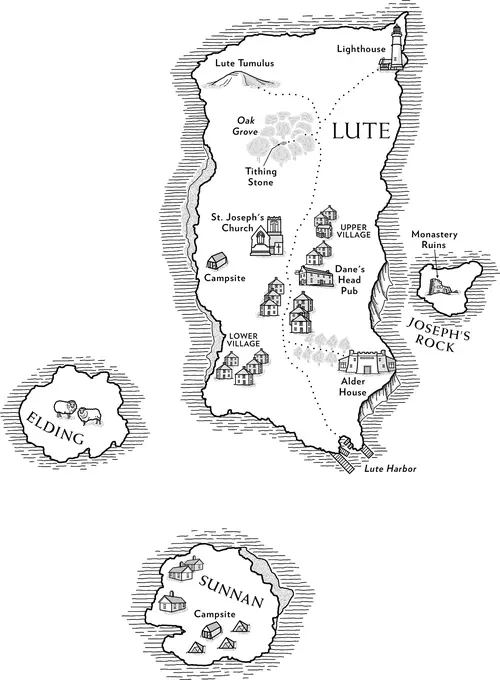
The endlessly charming Isles of Lute rank high among Britain’s best-kept secrets, and once you’ve arrived, it’s hard to understand the reason for all that secrecy. Despite Lute’s murky reputation on the mainland, so far as this writer could tell, the greatest risk these isles pose to visitors is the temptation to chuck it all in and become a local yourself.
From the picture-perfect central village to the low-key, cheery welcome offered by the islanders, Lute appeals to bird-watchers, neo-pagans, and amateur historians alike—along with anyone wishing to escape the relentless dread of the news cycle. Come for ancient superstitions, stay for a well-poured pint at Dane’s Head pub and a peek at one of the last puffin nesting sites in southern England.
(Top tip: whatever rumors you may have heard about Lute, don’t bring them up to the locals. Any mention of “the Day” will result in a frosty reception and a
THREE DAYS BEFORE
The glare from the sea is pure white, too blinding to see any distance from the back door, even with my hand stretched above my eyes. All I can do is scream loudly enough to reach across the lawn.
“Charlie?!”
Everybody on the island can probably hear me. How undignified. How American.
Emma starts hollering in imitation. “Chaaaaarlieeee!”
Oh, that voice of hers—lovely, adorable, way too much for me right now. The pitch is so high, my brain feels like it’ll burst.
I crouch, squinting, and idly tickle her to get her to stop, but she keeps trying to screech again between fits of giggles. I draw her in, kiss one sticky cheek, and glance up past her tangled curls, worry needling me.
A drifting cloud lessens the glare, but I still don’t see Charlie. He’d have come at the sound of his name if he were safe and within earshot. He does like to wander but never far, and he always comes back. He stays in orbit.
Sally is already pulling the enormous, brocaded living room drapes shut when I come through, as if we were heading out for six months instead of a few days’ break. Emma runs into the living room, and Sally startles, hands in the air, bracing for the three-foot-tall tackle.
I picture our housekeeper as a linebacker and stifle a smirk. She’d probably be good at it.
“John Ashford’s around the side, milady,” Sally says, ignoring Emma’s attempts to scale her leg. “He thought you might like the use of his pickup truck to get down to the harbor.”
She always says pickup truck like it’s a foreign delicacy.
I smile. “Awesome, that’ll be helpful.”
I didn’t flinch when I heard milady this time. Sally hardly says it anymore. It slips out when she’s busy. It has the ring of a joke, like calling Charlie “Esquire” or Emma “Dr. Treadway” when she’s playing checkup with her dolls.
How am I a milady? How is anyone in this day and age?
“Have you seen Charlie?” I ask.
Sally frowns, thinking. “Isn’t he at the landing with Lord Treadway?”
“You think so?”
“I’m sure I saw them go off together.” She wipes her hands on her trousers. “Do you want me to have a look around?”
“No, no. It’s fine, you’re busy enough as it is.” I smile another goodbye, but my heart’s still pounding like there’s something wrong.
It’s fine, he’s fine, he’s with his dad, calm the hell down, Nina.
Outside, John Ashford’s green pickup is idling on the drive, the driver himself nowhere to be seen.
“John Ashford,” not just “John.” Sally uses his full name because on an island with a population of less than two hundred, there are somehow seven Johns to differentiate between. Five of them have been off fighting for the past four years, but John Ashford remains John Ashford, and ancient John Jones is still John Jones. You’d think new parents would get it together among themselves to vary the names they give their babies, but that’s not the way of things here, and if I’ve learned anything in the past seven years on Lute, it’s that “the way of things” likes to stay put. Even in wartime. Everywhere around us, life’s been upended, but here, it’s only seemed to shift.
I wonder if things are still the same in Florida. Strip malls extending their reach like concrete kudzu, theme parks whirling, playgrounds flash-drying in the summer sun. I feel a little pain behind one eye at the thought of my childhood home, flat and glaring, and then blink it away as I reach for my daughter.
I hold Emma back from the growl of the running engine, and then John Ashford’s head pops up past the hood.
“Seen this one before?” He’s got his hand out low, careful. He turns to wink at Emma. “This is a proper mini-beast. Fancy saying hello?”
She’s flying past me before I can think to grab her. At the sight of whatever John’s holding, she goes very still, a near-silent oh falling from her mouth. My placid sorry, I’ll handle her smile becomes a real one when I lean over John’s hand too and see a glossy green beetle with a red face.
“Not invasive?” I ask quietly.
“Nah, I should think not. Looks like a bloody-nosed beetle to me, as Lute as they come.” He grins, and his face explodes with creases. “I’m not using profanity in front of your daughter, Lady Treadway, that’s honestly what they’re called. I’ll snap a picture and find out for sure. That’s what they’re paying me for, after all.”
“Is that what they’re paying you for?” I grin back. “Not the paperwork and repairs and cataloging and protecting endangered birds and—?”
“Oh, you stop. There are far worse jobs.” The light in his eyes dims a little.
This is the way we reference the war, in asides, quiet gratitude, and humility, sharing postcards and emails we’ve gotten from those off fighting, well-tended vegetable gardens, and meticulous ration books. Never directly. But maybe that’s just how people behave around me because of my American accent, the voice of the enemy. Don’t mention the war.
Or maybe it’s more that we can’t face the full reality of it, the images we get in the news—all those occupied countries, cities gone dark in military curfew or reduced to rubble, bloated bodies washing up on the shores of practically every continent, refugee camps growing and burning down and growing again, rows upon rows of draped soldiers ready for sorting and sending home.
While here on Lute, everything is perfectly fine.
Partly to reassure myself, I pat John Ashford on one broad shoulder on my way to scoop Emma up. Her eye has turned to track some seabird or other down the drive—John’d know the taxonomy—and if I don’t grab her now, she’ll be chasing it, and I’ll be chasing her the whole way to the docks.
“I’ve got your bags loaded if you ladies care to ride along.” John motions to the back of the truck. I hadn’t even noticed our luggage lined up inside.
“Oh, gosh.” My stomach drops the way it always does when someone goes out of their way to be nice. “Thank you. You really didn’t need to—”
“It is my pleasure. What else is she good for?” He slaps the roof of his pickup with obvious affection. There’s a grand total of two motorized vehicles on our easily walkable Lute Island, and given that the other is a motorbike, this is the only one with a usable flatbed. He takes pride in showing it off, even if the name emblazoned on the side is NATIONAL TRUST, not JOHN ASHFORD, WARDEN AT LARGE.
A muffled huh-woof resounds from the house a second before our half-feral Labrador comes barreling outside, and I curse myself for forgetting to shut the door. Usually Max would be off at a wild tear, halfway across the island by the time I can so much as shout his name—not that he listens to it—but today, the truck has his attention. When he tries to jump in with the luggage, frothing happily, I seize the opportunity, pulling him gently by the collar back inside where Sally waits with a headshake.
“Daft creature,” she says. “Come on, Max. You’re stuck with me this week, but I’ll give you some treats.”
By the time I’ve got the door shut, Emma has decided to emulate the dog, trying to clamber inside the truck, pulling and falling, shouting, “Up! Up!”
Oh, my sweet fully feral thing. I round the truck and kiss her on the head, smelling strawberry shampoo, and pull her with me as I climb into the passenger seat.
“Milady. M’junior lady.” John Ashford’s Scottish accent always pops out more when he’s speaking in grandiose terms. Which is often.
He shuts the door for us, ever gallant. Everybody does everything for us on Lute. It’ll never not be disconcerting. We Treadways are like permanent resort guests, and most of the people who help us aren’t even on the Alder House payroll. After nearly seven years, I still struggle to see how we’ve earned all this goodwill.
John Ashford’s truck bumps us out of the tidy lines of wych elms penning in the drive, and I wince again from the afternoon light off the sea. Emma’s hanging too far out the open window, arms outstretched like she’s trying to catch a drift and fly away.
“I hear the pony!” she shouts.
I tug her carefully back into my lap and answer John’s questioning smile with a shrug. “She really wants a horse.”
He chuckles. There aren’t any horses on Lute. Never have been. It’s not the way of things—they get skittish here, apparently—and I’m not going to be the first Lady Treadway to upend tradition just because my preschooler begs me to. She can go out riding with her aunt and cousins when we get to Surrey tomorrow.
We rumble past the school and down to the island’s landing bay. I scan every inch of horizon along the way but can’t spot Charlie or anyone else of his size, probably because all the other children are already on their way off the island.
The coast looks calm today, thank God, so at least our boat won’t be battered by waves all the way across the Bristol Channel like the last time we traveled to the mainland, almost a year ago. They say these waters are safer than ever now, patrolled and well out of the action, which does make sense. It’s not just for our little archipelago’s sake that the warships are placed where they are. An undefended Bristol Channel would allow the enemy deep into the belly of Britain.
I hold Emma tighter. We’ve made it through four years of war without incident. Last week’s cease-fire seems to be holding. We’ll be fine today.
I can’t yet see the dock where our boat is waiting, but I do see the much larger Pride of Lute cutting smoothly through the water, every inch of its deck packed with passengers. It reminds me of photos I’ve seen of trains packed with children evacuating London during the Blitz.
God. No. Stop. If anything, it looks like a spring break party yacht.
They’ve got to be uncomfortable packed in like sardines, but then, they’re in for a quicker ride than we are, twenty minutes tops to get over to Sunnan Island versus hours to the mainland. It’ll be a rustic weekend for everybody, even the ones who’ve snagged the moldering holiday cottages. Tents and bonfires for the rest, but a little discomfort is a small price to pay to indulge Lute Island’s favorite superstition one more time.
I wilt a little watching them go, like a child who hasn’t been invited to the party, but that’s not strictly fair. Just the other day, two of “the mums,” Wendy and Jenny, asked if I was coming with the kids to Sunnan now that the decision had been made to send them away. When I said we were leaving too, for our anniversary, they looked more disappointed than I’d expected.
“If you’re still here, you can wave us off, then,” Wendy said, which only made me feel awkwarder, not knowing that that was a thing.
I wasn’t there this morning as they boarded, after all, but I doubt anybody really noticed. I did debate going, standing on the dock and watching—Sally asked me, carefully, lightly, whether I planned to—but nobody explicitly said it was one of my responsibilities, least of all Hugh, who was completely preoccupied with getting us ready to go. We still weren’t packed until an hour ago, and Charlie was restless and Emma was whiny and then hyper, and in the end, I couldn’t get my head around the why of it. Why should any of them care that Nina Treadway turned up to wave from the shore as they set off on a boat?
It’s not like I’m close with any of the island parents. All our children are slightly different ages, so we never had that playgroup-bonding experience, and most of the mums have known each other since they were all kids themselves. Their families are dug deep in the community. It’s hard to break into their local shorthand, to keep up with their social rites. Even so, “You can see us off, then.”
At least I know that seeing the children off to Sunnan isn’t a Lute tradition, since this is the first time they’ve done it. The custom as it stood for millennia was for every single islander to remain on Lute for the Day, irrespective of age or condition. Not this year. There was an official island-wide vote, and this was the decision. Given the war, our diminished numbers, etcetera, etcetera, the children would be excused from taking part, along with a few adult caretakers, including Rev. Warren. He usually stays on island, apparently, which surprised me, given how pagan it all feels.
It’s kind of amazing that they’re keeping this tradition going, even in wartime. In other places, they call it Midsummer or Alban Hefin. Here, we usually just call it “the solstice,” and have cream teas out in neighbors’ gardens, but not this year. This is the seventh solstice, which makes it “the Day.”
It’s all so sincere in its fraught-ness, but who can fault them for their flights of imagination? It’ll probably be a helpful distraction, frankly, with so many loved ones still off fighting. I just hope the weather stays nice for everybody here while we’re away.
As we continue bumping along the dirt track, John Ashford whistling with gusto from the driver’s seat, I spot Matthew Clare, the lighthouse keeper, walking north along the cliffside, scruffy black hair blowing wild, shoulders held high against the wind, like it’s ten degrees colder for him than for anybody else but he still refuses to wear a jacket or even roll down his sleeves. Like he’s punishing himself.
No motorbike today. He must have been at the docks, helping get the kids off the island. I guess he’s staying, then.
As we pass, Matthew gives a rote wave to the truck, thinking it’s just John. I would wave back if I didn’t suspect he’d find a way to twist the gesture into an insult.
I’d like to say I’ve given up trying to figure out why Matthew Clare has despised me from the day Hugh first brought me to this island, but the annoying, sticking-point thing of it is: Matthew may not be a ball of sunshine, but he is nice and good and helpful and completely beloved here. He’s the one who fixes people’s bird feeders if they fall down in a storm, delivers grocery orders to elderly neighbors, stops to pet cats, and checks on the goats. He’s, by all measures, lovely. And he hates me.
I try not to think about him. It should be easy enough when he’s not around, but every so often, I remember it so vividly, as if I were right back there in that church—the glare he’d fixed me with when Hugh introduced us and I tried to offer condolences, as if I’d spat at him. That glare has evolved as the years have worn on, but it’s never lessened in intensity.
It shouldn’t bother me as much as it does. It’s not like this is a first. I’ve never been like Becca, my neon-shiny sister, a magnet for friends. Mom told me often enough how unlikable I am—a taker, a killer—and I learned to shrink, to be uncontroversial, to go unnoticed. Even here, tucked away, that’s how I operate. And still, I’ve offended him somehow, the man everybody sees as the best of us.
God, it gnaws at me.
The road sinks lower, curving back around toward the shore. I lean past Emma, searching for Hugh and Charlie, but I only see my husband with his back turned, his elegant hands tangled in his gray-flecked hair, then gesticulating, then back in his hair. He’s got his sleeves rolled up, holiday ready. Maybe Charlie’s already on board, flipping switches he’s not supposed to touch.
“Suh-moke,” Emma says.
“Sure enough.” John chuckles, amused by her growing vocabulary, but his eyes aren’t laughing.
I turn to see what they’ve seen, an inauspicious gray cloud issuing from the stern of our cruiser. Now I can see that Hugh’s sleeves are rolled up practically, not jauntily. He’s got oil stains on his linen shirt, which is not like him. He’s been trying to fix something. This has never once gone well in the entire seven years I’ve known him. He begins to pace the dock, pointing wildly at a burly, bearded man who seems to do nothing but shrug. It’s not until John pulls up and cuts the engine that I recognize the guy. He’s a mechanic who’s come out a few times all the way from Devon to see to the island’s small power station.
“I’m not the expert here,” he’s saying, and something in his tone tells me this isn’t the first or even fifth time he’s had to recite that over Hugh’s shouting.
“But see, you are the expert here, because all other experts are gone. You know engines. You know your own boat. Can’t you just take another look at this one?”
Hugh can’t stop moving his hands, into his thick hair, his pockets, picking at each other, balling, releasing. It’s no wonder the mechanic perches there unmoving, like a rabbit in a field deciding which way to run.
“Out. Want get out.” Emma starts crawling through the open window too quickly for me to grab her.
Just in time, two hands appear as if from nowhere and snatch her into the parking lot while she wiggles wildly. “You can’t fly, fairy princess. You haven’t got your wings yet!”
“Oh my God.” I practically keel over with relief as Joanna opens the door for me. “This child is going to kill me.”
Jo grins, adjusting Emma onto her hip. “I have her. You go talk to Hugh.”
I hesitate. “Do you know what’s going on?”
“Engine trouble.”
Worry sinks into my stomach, but it’s tempered with excitement of a different sort. The truth is, I was disappointed when Hugh suggested we get away this week. I’ve been so curious about the local traditions, so damn patient—waited nearly seven years for the mythical Day to come around—but Hugh seemed desperate to go.
It didn’t take me long to realize why. His father passed away seven years ago, on the Day, by some sick coincidence, and Hugh wasn’t there to say goodbye. He was in the middle of the Atlantic, on the deck of an ocean liner, meeting me for the first time. Falling in love while his father died.
The Story Continues on BooksBarbecue!
Enjoyed this preview? ❤️ Do not stop here!
Read the complete book free online → 🔗
Continue reading now on BooksBarbecue and discover every page!
Love reading? Bookmark BooksBarbecue.com for more amazing books!
Happy Reading!