Luck of the Titanic
Also by Stacey Lee
The Downstairs Girl
Outrun the Moon
Under a Painted Sky
Dedication
To my number one son, Bennett.
There are no cowboys in this one, but there are a few sailors.
Epigraph
Of the eight Chinese passengers aboard the Titanic, six survived.
List of Characters Aboard the Titanic
Third-Class Passengers
- Valora Luck
- James Luck
- Chow “Bo” Wah
- Wink
- Olly
- Drummer
- Ming Lai
- Fong
- Tao
- Heath Bledig
- Dina Domenic & Mr. and Mrs. Domenic
First-Class Passengers
- Amberly Sloane
- April Hart & Mrs. Hart
- Charlotte Fine & Mrs. Fine
- Albert Ankeny Stewart & valet “Croggy” Crawford
- J. Bruce Ismay, chairman of White Star Line
- Lady Lucy Duff-Gordon & Sir Cosmo Duff-Gordon
- Bertha Chambers
Crew
- Captain Edward Smith
- Andy Latimer, first-class steward
- “Skeleton,” third-class steward
- Officer Merry
- “QM,” quartermaster
- “Master-of-Big-Arms,” master-at-arms
- Brandish, lead fireman
- Baxter, first-class porter

INSIDE THE RMS TITANIC
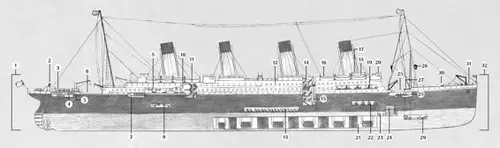
- Stern
- Docking Bridge
- Poop Deck
- Aft Third-Class General Room
- Third-Class Smoking Room
- Aft Well Deck
- Second-Class Library
- À la Carte Restaurant
- Second-Class Barbershop
- Café Parisien
- First-Class (“Tidal Wave”) Aft Staircase
- First-Class Promenade
- Third-Class Dining Saloon
- First-Class (“Tidal Wave”) Forward Staircase
- Elevators
- Officers’ Quarters
- Collapsibles
- Lifeboats
- First-Class Special Staterooms (“Cabbage Patch”)
- Bridge
- Boiler Room 6
- Third-Class Cabins
- Storage Closet
- Squash Courts
- Forward Well Deck
- Foremast & Crow’s Nest
- Cargo Shaft
- Forward Third-Class General Room
- Cargo Hold
- Forecastle Deck
- Anchor
- Bow
MIDSHIP CROSS SECTION
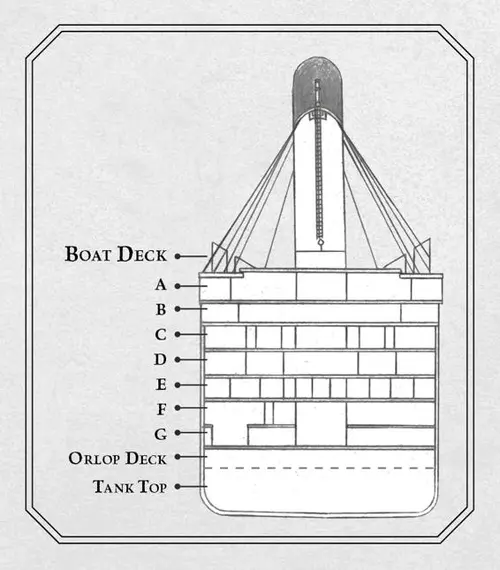
E-DECK
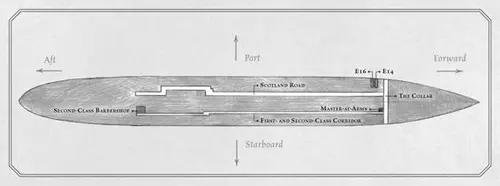
Illustrations copyright © 2021 by Wenhan Shao
Valor and Virtue
Valor and Virtue
The captain paced his weathered deck,
A-talkin’ to his boots.
They were his pride and joy, you see,
Anchored him like roots.
The right one he named Valor;
It always steered his course.
The left one he called Virtue;
’Twas steady as a horse.
Together, they had saved him from
Many a tottery fall.
Gripped the wood like tentacles,
In tempest, twirl, or squall.
He never took them off, did he,
Not even when he bathed.
Which wasn’t very oft, ’tis true,
The same as when he shaved.
But even boots outwear their seams;
Their leather cracks and splits.
And one day Valor sprang a leak,
And Virtue’s heel went quits.
When the captain surveyed, at the end of his legs,
The boots, like ragged jerky,
He cried, “Woe is me,” threw them to sea,
Then pitched himself into the murky.
1
April 10, 1912
When my twin, Jamie, left, he vowed it wouldn’t be forever. Only a week before Halley’s Comet brushed the London skies, he kissed my cheek and set off. One comet in, one comet out. But two years away is more than enough time to clear his head, even in the coal-thickened air at the bottom of a steamship. Since he hasn’t come home, it is time to chase down the comet’s tail.
I try not to fidget while I wait my turn on the first-class gangway of White Star Line’s newest ocean liner. A roofed corridor—to spare the nobs the inconvenience of sunshine—leads directly from the “boat train” depot to this highest crossing. At least we are far from the rats on Southampton dock below, which is crawling with them.
Of course, some up here might consider me a rat.
The couple ahead of me eyes me warily, even though I am dressed in one of Mrs. Sloane’s smartest traveling suits—shark grey to match her usual temper, with a swath of black bee-swarm lace pinned from shoulder to shoulder. A lifetime of those dodgy looks teaches you to ignore them. Haven’t I already survived the journey from London? A half a day’s travel, packed into a smoky railcar, next to a man who stank of sardines. And here I am, so close to the finish line, I can nearly smell Jamie—like trampled ryegrass and the milk biscuits he is so fond of eating.
An ocean breeze cools my cheeks. Several stories below in either direction, onlookers crowd the dock, staring up at the ship rising six stories before them. Its hull gleams, a wall of liquid black with a quartet of smokestacks so wide you could drive a train through them. Stately letters march across its side: “TITANIC.” On the third-class gangway a hundred feet to my left, passengers sport a variety of costume: headscarves, patterned kaftans, fringed shawls of botany wool, tasseled caps, and plain dungarees and straw hats. I don’t see a single Chinese face among them. Has Jamie boarded already? With this crowd, I may have missed him.
Then again, he isn’t traveling alone, but with seven other Chinese men from his company. All are being transported to Cuba for a new route after coal strikes here berthed their steamship.
Something cold unspools in my belly. I received his last letter a month ago. Time enough for things to change. What if Jamie’s company decided to send them somewhere other than Cuba, maybe a new route in Asia or Africa?
The line shifts. Only a few more passengers ahead of me.
Jamie! I call in my mind, a game I often played growing up. He doesn’t always hear, but I like to think he does when it matters.
In China, a dragon-phoenix pair of boy-and-girl twins is considered auspicious, and so Ba bought two suckling pigs to celebrate our birth, roasted side by side to show their common lot. Some may think that macabre, but to the Chinese, death is just a continuation of life on a higher plane with our ancestors.
Jamie, your sister is here. Look for me.
Won’t he be surprised to see me? Shocked may be more accurate—Jamie has never handled surprise well—but I will get him to see that it is time for him, for us, to move on to bigger and better things, just as our father hoped.
I think back to the telegram I sent him when Ba passed five months ago.
Ba hit his head on post and died. Please come home. Ever your Val.
Jamie wrote back:
Rec’d news and hope you are bearing up okay. Very sorry, but I have eight months left on my contract and cannot get away. Write me details. Your Jamie.
Jamie would have known that Ba had been drunk when he hit his head, and I knew he wouldn’t mourn like I had. When you live with someone whose mistress is the bottle, you say your goodbyes long before they depart.
Someone behind me clears her throat. A woman in a pinstriped “menswear” suit that fits her slender figure like stripes on a zebra watches me, an ironic smile wrapped around her cigarette. I put her in her early twenties. Somehow dressing in men’s clothing seems to heighten her femininity, with her creamy skin and dark hair that swings to her delicate chin. She lifts that chin toward the entrance, where a severe-looking officer stands like a box nail, a puzzled look on his face.
I bound forward on the balls of my feet, muscled from years of tightrope practice. Ba started training Jamie and me in the acrobatic arts as soon as we could walk. Sometimes, our acts were the only thing putting food on the table.
The severe officer watches me pull my ticket from my velvet handbag.
Mrs. Sloane, my employer, secretly purchased tickets for the two of us with her dragon’s hoard of money. She didn’t tell her son or his wife about the trip, or that she might stay in America indefinitely to get away from their money-grubbing fists and greedy stares. After her unexpected demise, I couldn’t just let the tickets go to waste.
“Afternoon, sir. I am Valora Luck.”
The officer glances at the name written on my ticket, then back at me, his steep cheekbones sharp enough for a bird to land on. His navy visor with its distinctive company logo—a gold wreath circling a red flag with a white star—levers as he inspects me. “Destination?”
“New York, same as the rest.” Is that a trick question?
“New York, huh. Documentation?”
“You’re holding it right there, sir,” I say brightly, feeling the gangway shift uncomfortably.
He exchanges a guarded look with the crewman holding the passenger log. “Luck?”
“Yes.” In Cantonese, our surname sounds more like “Luke,” but the British like to pronounce it “luck.” Ba had decided to embrace good fortune and spell it that way, too. He’d intended the lofty-sounding name “Valor” for Jamie, and “Virtue” for me—after a sea shanty about a pair of boots—but my British mum put the brakes on that. Instead, she named my brother James, and I got Valora. It’s a toss-up as to which of us is more relieved.
“You’re Chinese, right?”
“Half of me.” Mum married Ba against the wishes of her father, a vicar in the local parish.
“Then at least half of you needs documentation. Ain’t you heard of the Chinese Exclusion Act? You can’t go to America without papers. That’s just how it is.”
“Wh-what?” A pang of fear slices through me. The Chinese Exclusion Act. What madness is this? They don’t like us here in England, but clearly, they really don’t like us in America. “But my brother’s on this ship, too, with the members of the Atlantic Steam Company. They’re all Chinese. Did they get on?”
“I don’t keep the third-class register. You’ll need to get off my gangway.”
“B-but my lady will be expecting me.”
“Where is she?”
I was prepared for this question. “Mrs. Sloane wanted me to board first to make sure her room was ready.” Of course, she had already pushed off on a different ship, one that wouldn’t be making a return journey, causing me great inconvenience. “We had her trunk forwarded here a week ago. I must lay out her things.” Mum’s Bible is in that trunk, within its pages my only picture of her and Ba. At last, my family will be reunited, even if it is just with a photo of our parents.
“Well, you’re not getting on this ship without the proper documentation.” He waves the ticket. “I’ll keep this for her for when she boards. Next!”
Waiting passengers begin to grumble behind me, but I ignore them. “No, please! I must board! I must—”
“Robert, escort this girl off.”
The crewman beside the severe officer grabs my arm.
I shake him off, trying to muster a bit of respect. “I will see myself off.”
The woman in the menswear suit behind me steps aside to allow others to go before her, her amber eyes curiously assessing me. “I saw a group of Chinese men enter the ship early this morning,” she says in the no-nonsense tone Americans use. “Perhaps you can check if your brother was one of them.”
“Thank you,” I say, grateful for the unexpected charity.
A family pushes past me, and I lose the woman in a flurry of people, parcels, and hats. I find myself being squeezed back into the train depot, like a piece of indigestible meat. Mrs. Sloane would’ve never stood for this outrage. Probably a rich lady like her would have persuaded them to let me on. But there is no one to speak for me now. I descend the staircase, then exit the depot onto the quay. The glare from the overcast sky cuts my eyes.
I figured the hardest part of this endeavor would be getting on without Mrs. Sloane. Never could I have foreseen this complication. What now? I need to be on that ship, or it could be months, maybe years, before I see Jamie again.
Something skirts over my boot and I recoil. A rat. They are certainly bold here, called by the peanut peddlers and meat pie hawkers. I shrink away from a pile of crates, where the rodents are making short work of a melon rind. The river slaps a rhythm against the Titanic’s hull, and my heart beats double time with the slosh.
Taking the American’s advice, I make tracks for the third-class entrance farther down the quay toward the bow. Unlike in the first class, passengers crowd the gangway, tightening the queue as I near. I straighten my jacket. “I’m sorry, I just need to check if my brother made it through. Please let me pass.”
A man with a dark mustache chastises me in a foreign tongue, then jerks his head toward the end of the line. Heads nod, cutting me suspicious glares, and people move to block me. Seems wearing first-class clothes will not gain me any advantage here.
Perhaps things would be different if I looked less like Ba and more like Mum. I exhale my frustration, a wind heated by a lifetime of being turned away for no good cause. Then I continue farther along the quay to the end of the line, passing dockworkers manhandling ropes and a navy uniform shining a torch into people’s eyeballs. They don’t check the first class for disease.
Beyond the nose of the ship, a couple of tugboats line up, ready to tow the Titanic from her mooring. Voices rise as people look up to a massive crane on the bow lowering a hoisting platform onto the quay ten paces away. A horn honks, and the queue shifts, making way for a sleek cinnamon-red Renault motorcar. It stops right before the hoisting platform.
It could take an hour to reach the gangway from here. But even if Jamie has boarded, they still won’t let me on that ship without papers. Then the Titanic will leave, and he will be lost to me, possibly forever. His letters to me will be undeliverable at the Sloanes’, and I will have no way of knowing which new route he was assigned. Jamie is the only real family I have left. I won’t let him idle his time on a steamship when he is destined for better things. Great things.
A woman with large nostrils glances at me, then pulls her son closer, spilling some of the peanuts from his paper cone. A rat slithers out from behind a crate and quietly feasts. “Stay away from that one. I’ve heard they eat dogs.”
Barely glancing at me, the boy returns his attention to the Renault.
A crewman gestures at the dockworkers positioned on either side of the car. “Easy now. Load her on.”
I am getting on that ship, by hook or by crook. Jamie is there, and I won’t let him leave without me. As for the Chinese Exclusion Act, put out the fire on your trousers before worrying about the one down the street. But how will I board?
The hoisting platform sways on its hook, the stage just big enough to hold the motorcar. A crewman reaches up and guides it the last few feet to the quay.
By hook.
I flex my back, my muscles twitching. There are more ways onto the Titanic than the gangways.
2
Ishade my eyes. The ride up stretches a couple hundred feet, with no walls and no safety net in case something should slide off the platform. I will have to stow away before the platform begins to rise. The car makes a poor hiding spot with its open design, but I can slide underneath and hope no one looks.
It’ll be like the times Jamie and I snuck rides aboard the drays about town, slipping on and off without being seen. London is full of distractions. Of course, we usually only needed to distract the driver. The ship with its many portholes suddenly looms like a wall of prying eyes. More pressing are the hundreds of eyes right here on the quay.
I look wildly about for a ruse to distract everyone. Maybe someone is carrying a firearm and I can somehow get him to fire it into the sky. Right. And then maybe a flock of flamingoes will fly in from Africa and a marching band will appear.
Another rat sniffs around my boot, its tail worming behind it. I begin to kick it away but stop. I don’t like rats, but they don’t give me hysterical fits like they do Mrs. Sloane’s daughter-in-law, who boxed my ears when she found one in the pantry. Of course, after this, they might.
Retreating to the train depot a few paces away, I put my back to the wall and tie the ribbons on my black hat tight. Mrs. Sloane gave the hat to me, saying its short brim made her look like a garden hoe. I pull a tin of milk biscuits from my handbag and set the handbag on the ground, wishing the joy of its contents—mostly traveling supplies—to the beggar who finds it. I empty the tin along the wall, crushing the biscuits with my foot.
The dockworkers push the car in place, and the crewman waves his arms. “Stop. Set the brake! Lash it now. Smartly!”
Come on, biscuits, work your buttery charms soon.
The men work quickly, lashing the wheels to the platform.
Of course, when you need a rat, there is none to be found.
Panic jabs at my heart. I abandon my post, searching the dark corners of the quay for the loathsome creatures. After several minutes of scurrying around, I spot a couple of rats feasting on a sausage—at least I hope it’s a sausage. Something sour rises in my throat. I’ve done more repulsive things, but for the life of me, I can’t think of a single one.
Slowly, I lower myself, flexing my fingers. Before any more doubts seep in, I snatch a fat one by its scruff. “Got you.”
It wiggles and hisses, red eyes glaring, probably oozing poison and disease. Grimly, I hang on, my lips peeled in disgust. I hurry back toward the hoisting platform, casing the dock for a mark. I’ll have to find someone with an open purse or a large pocket. A woman with pin curls stares openmouthed at the foremast staking the ship’s bow, the hood of her old-fashioned cloak pulled back from her short neck.
Forgive me, ma’am, for what I’m about to do, and know that it is for a good cause.
I duck behind a bunch of men with long beards and burgundy caps heading her way. My rat jerks in my grasp. With light steps, I sneak up to the woman, and while saying a prayer, I release the rat into her open hood.
In four strides, I return to the platform, which has already started to rise.
“Stand back, folks.” The crewman walks the perimeter of the platform, enforcing a two-yard margin. If my rat doesn’t do his ratty thing soon, it will rise too high for me to scale.
The woman doesn’t scream. Have I chosen that one-in-a-million mark who isn’t scared by a rat down her back? Should I take a chance and climb on anyway, hoping to God that everyone blinks at the same time?
A scream that could separate the soul from one’s body tears through the crowd.
At last!
The crewman glances toward the woman and the commotion forming around her.
I rush forward and hook my hands over the edge of the platform, which has lifted to waist level. Climbing onto it from the side closest to the water, I scoop up my skirts, praying my added weight won’t topple the whole thing. I imagine myself light as a bird, the way I do when we walk the rope.
I flatten myself and roll under the car. But something is wrong. Something has caught me. My jacket! The back of my sleeve has snagged on a nail. I sharply yank my shoulder, and I hear the fabric rip. Then I scoot under the car, trying my best to melt into the rough wood.
The platform sways, and seagulls caw as they fly by. I heave in air. The scents of motor oil and my own fear fill my nose. At any moment, I expect the platform to stop. I listen for exclamations, or constables blowing whistles.
But the platform continues its ascent. So far, no one is yelling, except for my unfortunate victim. God save her from the plague. I press my cheek to the wood. From what I can see, no one is looking at me.
Then I see her. A child around five years old with stringy yellow hair and eyes as wide as planets is pointing at me.
I’m just an illusion, kid. Forget what you saw.
The steady pull of the crane snatches her from my view. New worries flood my mind as the platform swings over the Titanic’s well deck, ready for its descent into the cargo hatch. What if the shaft to the Titanic’s belly does not feature a wall ladder on which I can escape? I’ll need to exit before reaching the storage area in the bowels of the ship, where surely men will be waiting to unload the car.
The platform slows as it nears the hatch, and my stomach turns loops. Glimpsing a crewman, I shrink back. He could see me if he thought to look under the car.
His face glistens with sweat and wonder as he walks the length of the platform, taking in the vehicle. “She’s a looker. The French know how to make ’em. Thirty-five miles an hour—can you believe it?”
I close my eyes and hold my breath, as if that could hide me from view. Even my blood stops pumping.
He completes his circuit. “Bring her down.”
The grinding of a motor and the clink of a chain unspooling herald my descent into the jaws of destiny. Sounds echo off the shaft closing around me, and the light changes.
Rolling out from under the car, I scramble to the edge of the platform and look wildly around for a ladder. It’s on the other side. My wet fingers slip against the glossy car frame as I swing myself into the seat and scoot across. To my horror, before I can grab a rung, the wall ends.
The Story Continues on BooksBarbecue!
Enjoyed this preview? ❤️ Do not stop here!
Read the complete book free online → 🔗
Continue reading now on BooksBarbecue and discover every page!
Love reading? Bookmark BooksBarbecue.com for more amazing books!
Happy Reading!