Loudermilk
Cover
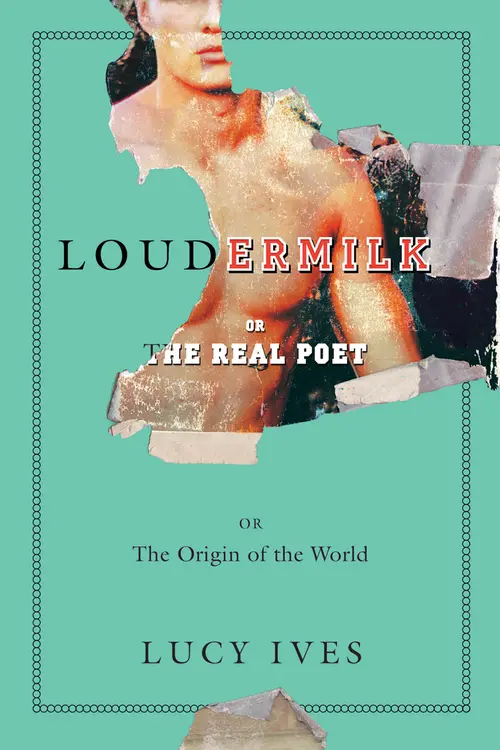
Praise for
LOUDERMILK
“With Loudermilk, Lucy Ives weaves a wryly comic tale set in the insular, masturbatory world of a Midwest MFA program. Dissecting ideas around authenticity, status, and the chronic wish for fame or legacy that plagues or drives aspiring writers and established authors/professors alike, Ives tears down the curtain to unveil the wizard—and here all the characters are implicated in operating the clunky machinery that creates then lionizes the concept of merit or talent in the academic/literary world. The result is this wildly smart novel that hilariously exposes its characters as they try to vault or cement themselves into some literary canon and/or ivory tower, unaware that the canon/tower is an ever-vanishing mausoleum wherein living writers go to get stuck, or lost, or to scrawl their names and draw butts and boobs on the walls.”
—JEN GEORGE, author of The Babysitter at Rest
“Lucy Ives is as deeply funny and ferocious a writer as they come. She’s also humane and philosophical when it matters most. I love Loudermilk.”
—SAM LIPSYTE, author of Hark
“Wonder Boys meets Cyrano de Bergerac meets Jacques Lacan meets Animal House. Something for everyone.”
—Kirkus Reviews
Praise for
LUCY IVES
“Ives . . . infuses even mundane actions with startling imagery.”
—The New York Times Book Review
“An accomplished poet, Ives also knows how to delight sentence by sentence, with turns of phrase that cry to be underlined or Tweeted . . . a voice that is at turns deadpan and warm, shot through with a crisp irony that makes it tempting to declare it the literary equivalent of an Alex Katz painting.”
—Vogue
“I first knew Lucy Ives’s work as a poet, and to have her prose is a gift, too.”
—HILTON ALS, author of White Girls
“A deeply smart and painstakingly elegant writer.”
—WAYNE KOESTENBAUM, author of Camp Marmalade
“A rampaging, mirthful genius.”
—ELIZABETH McKENZIE, author of The Portable Veblen
“Like the paintings of Agnes Martin or the films of Nathaniel Dorsky, the most important character in Ives’s prose is its reader. In the white space underneath these notes my own mind’s wanderings take on what is not exactly an importance, but a space for reading and thinking. I move around in this writing, and become aware of my moving around within it, and consider not only the shape of the writing, but my own shape as its reader. In other words, Ives’s writing encourages its readers to consider their own power and form among the reality they encounter.”
—Make: magazine
“Lucy Ives is smart in that heartbreaking way that can make a spare, suspicious, elegant work of anti-poetry out of the silent treatment between ideas and those who have them.”
—ANNE BOYER, author of A Handbook of Disappointed Fate
“Ives’s exquisite take on ellipsis as realism is a dream, as both vision and something that fully satisfies a wish.”
—MÓNICA DE LA TORRE, author of The Happy End / All Welcome
“Ives . . . is quickly developing into a poet of sentences on par with the poem-essays of Lisa Robertson and Phil Hall for their sharp blend of lyric, thought, and wit.”
—ROB McLENNAN, author of Household Items
“Think of the upkeep of the minotaur at the center of what can only be the labyrinthine mind of Lucy Ives. This particular creature feeds on its own enclosure. Who said time is eternity turned into a moving image? How does this work on the page? As soon as Ives allows things focus, she pulls back, revealing a small component of a larger construct, but never anything objective and irreducibly whole. Thus, effectively her subject and obsession is not the demarcation of time, but the inability of time to be properly or comparatively enacted. What if Stein and Paul Éluard were a single poet? What if Wittgenstein, Elaine Scarry, and Charles and Ray Eames collaborated on a novelization of Terry Gilliam’s Time Bandits? What if Robbe-Grillet and Hélène Cixous were to rewrite The Duino Elegies as an essay? Daedalus never built anything quite like this. Good luck getting out.”
—NOAH ELI GORDON, author of Is That the Sound of a Piano Coming from Several Houses Down?
“Ives’s work is certain in its undoing of certainty; it has an unforgettable voice as it strips itself of voiced identity; it summons a deeply trusted narrator in a work which cunningly challenges that trust.”
—JORIE GRAHAM, author of Fast

ALSO BY LUCY IVES
My Thousand Novel
Anamnesis
Novel
Orange Roses
nineties
The Worldkillers
Human Events
The Hermit
Impossible Views of the World
Title Page
Rilke was a jerk.
JOHN BERRYMAN
Personae
PERSONAE
| TROY LOUDERMILK | First-year student in the Seminars for Writing; poet |
| HARRY REGO | Loudermilk’s companion |
| CLARE ELWIL | First-year student in the Seminars for Writing; fiction writer |
| LIZZIE HILLARY | Daughter of poets; fifteen years old |
| DON HILLARY | Instructor in the Seminars for Writing; poet |
| MARTA HILLARY | Instructor in the Seminars for Writing; poet |
| ANTON BEANS | Second-year poet |
I: Early Days
I
EARLY DAYS
One. Control
One
Control
Troy Augustus Loudermilk has a silver 1999 Land Cruiser with tinted windows and sunroof. He claims he bought it with cash from an out-of-court settlement with the SUNY system. The civil suit stemmed from “repeated unwelcome sexual advances” allegedly made by a thirty-seven-year-old female assistant professor, an anthropologist, during office hours. Loudermilk was adept enough to preserve a number of these encounters on tape. Highlights include an afternoon of rhetorical queries—why Loudermilk “keep[s] coming back for more”; then, “what [he is] so afraid of”—followed quickly on by the professor’s playful mimicry of an exotic felid. She clambers gamely onto her desk and begins to “lap cream” out of a “saucer”/course pack. She yowls and purrs. Even in audio format, it’s pretty damaging stuff.
At one point on the tape, Loudermilk meekly informs his protean instructor that he is “concerned about [his] future.” He says he’s worried about his grades, plus his personal relationships and employment prospects. He wants to know how he can “do better.” He says he’s stressed out about reproducing the bullish America he grew up in. He’s having trouble negotiating the unpredictable “peaks and valleys” of romantic intimacy, not to mention the color-coded shimmy of the terrorism threat advisory scale.
If you think you know Loudermilk, then you think that when he says one thing he really means something else. If you actually know Loudermilk, then you know that when he says something that’s pretty much exactly what he means.
Overall, Harry Rego is not that inclined to pity his friend.
They’ve been driving now for two days.
They have traced the southern hem of Lake Erie and powered past Gary, Indiana, but here in the home stretch the Land Cruiser’s CD player has at last shit the bed. They’ve been reduced to radio and tape deck, which, considering Loudermilk’s need to micromanage the acoustic environment, has been very nearly cataclysmic. In order to maintain a sense of calm within the vehicle, Harry has been forced to shell out twenty dollars to acquire a pair of overpriced but essentially listenable cassettes, one the Breeders and the other from Ike and Tina Turner’s late catalogue, at an Illinois truck-stop establishment called the Bucket. “Nutbush City Limits” is just embarking on its third consecutive rotation when a sign announcing the relative proximity of the city of Crete appears.
Harry’s extremities are at least 99.9 percent zombie meat, due to extended confinement and Loudermilk’s enthusiasm for AC. He should by all accounts be psyched to put this journey behind him, but instead the news of their impending arrival sends a knot of fear into his stomach—which organ commences methodically punching itself—as his tongue takes on an increasingly profound flavor of humid roadkill.
Harry boots violently into an empty Super Big Gulp.
“Dude,” Loudermilk says.
“Pull over.”
“Dude, we’re almost there.”
Harry heaves again.
Loudermilk powers down all four windows. He removes his seat belt and uses his knees to steady the wheel while he leans over and trawls the debris on the back-seat floor.
Harry gags. Something trickles up, and he spits it into the beige half liter he has already produced.
“Fuck!” Loudermilk is proclaiming. He is not having great success in his quest for whatever it is.
The Land Cruiser lists casually into oncoming traffic. Harry, cowed by nausea and dread, attempts to accept his own imminent demise, even as he regrets that someone as life-loving as Loudermilk is about to be deprived of a future, not to mention the innocents they are likely to take with them.
“You see a fucking lid over there?” Loudermilk shouts against the wind and tambourine and blasting climate control.
Harry squints. A big rig with a pale, determined-looking face inside its cab is barreling toward them.
Harry mutters, “This is the whole problem.”
“What?” Loudermilk has his head down, is groping around behind the passenger seat.
Harry quietly reiterates, as the circular logo on the blue hat worn by the driver of the colossal tractor trailer becomes apparent, along with the driver’s expression of baffled rage, that this, their remarkably divergent outlooks on the world, this, Loudermilk’s blasé treatment of a scenario in which multiple tons of steel plus hundreds of gallons of igneous dinosaur juice are hurtling toward them, and they it, on a course of perfect inevitability, THIS, Loudermilk’s insistence on placing his hand on a cup lid at this very moment, none of which there is time to say, is a living, breathing summation of everything that is the matter with their incomprehensibly futile, and now increasingly brief, lives.
“What?” Loudermilk, rifling, repeats.
The semi driver, recognizing that he is in danger of being frontally reamed by a pair of fucktards from the Empire State, deploys his horn.
“Got it!” Loudermilk exclaims, popping back up.
The semi’s horn has become a deafening, uninterrupted blare. The driver’s face is contorted by what looks, at two yards’ distance, to be a mixture of mortal fear and the desire to commit slow, surgical murder.
The Land Cruiser leaps into its designated lane, narrowly avoiding a white Bonneville.
The rig wails by.
Loudermilk swerves to the right and punches the car onto an exit, simultaneously fitting the reclaimed lid over Harry’s warm vomit. Windows rise.
Loudermilk shakes his head. “And we’re in. Now what the fuck were you trying to say?”
Harry balances the Big Gulp in the Land Cruiser’s cup holder and ejects the tape. He scrolls around on FM until he gets some classical. “I don’t remember.”
Loudermilk is like, “That is stellar, dude.”
Harry examines a strip mall. It is in no way promising.
Loudermilk is saying, “I believe we have arrived.”
They overtake a cluster of field-hockey enthusiasts in shorts and shin guards who are waiting for the light to change so that they may pertly advance to a campus athletic field.
It is 2003, August, Friday the 29th.
Two. Doubt
Two
Doubt
This isn’t anyone’s autobiography. What I’ve lost is so easy to name as to make it impossible to speak about.
These are the two terse sentences Clare Elwil has been writing for the past ten weeks. Her notebook jitters on the tray table. Even a single additional three-word phrase would be an improvement. For ten minus three is seven, which is equivalent to three plus four, and three times four equals twelve, which, one plus two equals three, again. Ten divided by three is a little more than three. Ten times three is thirty, and three plus zero is three. The plane, meanwhile, is one. It’s grievously small. Clare is on the plane. It was impossible to fly direct and that of course indicates something about where she is going. It was a good day this morning, light and bright; yet, occasionally, as the plane darts and veers on its descent down the unpleasant roads of the midwestern sky, she fears loss of consciousness. For a few months now her distress has attached itself to background noise; it is no longer “in” her. It arrives. “On catlike feet.” This is someone’s poem, no doubt? A book on the piano in that apartment. Her mother’s apartment, Clare corrects herself. She is headed to the Seminars.
Slumbering beside her is a very pink man in his late fifties. His oblivion gives Clare ample opportunity, if not permission, to study the boyish short-sleeve button-down shirt he must wear in acquiescence to some regional career norm. Gray hairs curl on his speckled arms. His face has collapsed under weight of dream. He sighs. He is a machine for living, simple in conception and construction. In the right breast pocket of his button-down his boarding pass is displayed, as if to signal a belief that it might be reasonable and acceptable, a sensible business practice, that he be asked to leave the plane midflight should he be unable to produce the document at a moment’s notice. Associated with him is a salty scent, a faint musk; essentially inoffensive.
Clare’s body, specifically her head, rebels. Dread is taking on several recognizable shapes—like continents of the northern hemisphere of the planet Earth or, perhaps, she manages to think, these are sheep. Sheep! They lumber toward her, throbbing electrically. Or hogs. Are there three? It is possible there are three of them. Maybe four: a fourth hides behind the body of one of his fellows, seems briefly to merge stickily with the others—viscous and amorphous—before coming unabsorbed once more. “Pigs,” Clare mutters, as the angle of descent is rendered more pronounced by the professional whose gestures control this can.
Clare is a year late. She should have been making this bizarrely perilous short flight, like being thrown across the state of Illinois, at the end of the summer of 2002, when she was still a great writer. Admittedly, she had been a very young great writer, but all magnificently accomplished persons have had to be something before the period of universally acknowledged dominance—and Clare was evidently, tellingly being what she was then, which was very, very promising. It is in description now that Clare has a tendency to become most mired. No, now it is in description that Clare has a tendency to become the most mired. The tendency? Is that the word? Mired? The? She slides back and forth, on wheels, mobile yet unable to pass over the hump that stands between her and poised, proper articulation. What was it she was? Who was there? The very sentence is unnatural. The sentence is very unnatural. Who? Had anyone in fact said or believed this of her? The sense that this had happened somewhere, the naming of her, the praise of her, the walking to the home of the doughty publisher, the short man, his cobbled streets. She was to receive the award before a polished black piano. His piano, not her mother’s. To someone, oh someone, then one Clare Elwil, these events had occurred. “You have a name for a book cover,” an anemic woman in a pair of avant-garde earrings, nests of silver thread, had whispered. Clare was a stylist, a judicious narrator. She sold her story to the room. She was someone, the worthies said, who should be driving the bus, and there were daffodils jangling everywhere in Cambridge.
Here, the plane touches earth. Clare gags. A black star blooms, and she maintains herself in a kind of (obviously wishful) corporeal stillness, by force of will. The pink man stirs.
The plane bounces. There comes a smattering of applause.
Clare Elwil is in the middle of nowhere, where she will remain for the next two years, and what no one knows but they will soon discover is that she can no longer write.
Three. Fate
Three
Fate
Loudermilk and Harry have spent Friday night at a squalid split-level rented by half a dozen rising seniors who have, or so their hosts’ story goes, been lately kicked out of their sororities for various infractions. Four are currently away on a DUI-related sobriety retreat—though utilizing separate cars on separate occasions, they succumbed identically post-finals last spring—and won’t be back until after the holiday.
Harry was placed downstairs on a squealing corduroy couch, while Loudermilk’s non-negligible gifts were shared by the nubile pair who originally picked them up at a downtown bar. Harry cannot remember their names, though the two co-eds are basically distinguishable. For ease of mental reference and to render these alien beings slightly more palatable, he has christened them “Shortstack” and “Skylar.” Shortstack is short (obviously) and deeply, artificially bronzed, with prominent cone-shaped breasts, while Skylar is tall and languid and blond, her face a vivid hybrid of Christie Brinkley and Jean Seberg. Both are, however, in Harry’s less than generous assessment, dumb as dirt and would willingly have mated with Loudermilk in an actual pile of this substance they saw near a parked backhoe on the way back from the fifty-cents-a-cup piss emporium where the initial connection was made.
An attempt to set Skylar up with Harry was of course a complete failure, with Harry staring stonily past her right ear as she droned on about how awesome it must have been to go to college so close to New York City, but how scared she would be, like, if she ever went there, because she had heard that a woman had been dragged for, like, a mile once by a purse-snatcher on a moped who, no joke, literally pulled her into traffic, and she had her entire face torn off. “That is not normal!” Skylar exclaimed, as if there were some chance Harry might be so unfamiliar with the project of human existence that the sensorial implications of being separated from one’s face by means of asphalt-induced abrasion might not be entirely clear.
Loudermilk knew enough not to take Harry aside and demand to know why he did not get how to act when high-quality poontang was being thrown in his general direction. Instead, Loudermilk just tapped Skylar on the shoulder mid-narrative and subtly renegotiated matters.
It is currently 7:34 a.m. by Harry’s watch, and the moaning and sighing and thumping in the room next door finally ceased a little over twenty minutes ago. Harry has not really slept. He has on all of his clothes except for his shoes, and there is a large beach towel depicting a penguin in sunglasses covering him. Not only is it too hot in this room, it also stinks of something all kinds of rank that Harry peevishly identifies as pizza farts plus Vagisil. He is afraid of what he will find if he gets up to go look for the bathroom.
Harry screws his eyes shut and tries again for sleep. In his mind, images of Loudermilk blossom, fade, recur. Loudermilk glides across a lawn in Oswego, New York, nods his head in time, tells Harry to stick with him, it’s going to be cool, they know more than everyone, drives Harry down to Rochester, where they contemplate the lilacs and talk about making it big one day, passes him another beer, convinces him to defer his student loans, is inexplicably but so familiarly there. Of course there was an era before Loudermilk, but it’s only worth remembering insofar as it was a time when Harry was alone. And Harry’s alone no more. What a gift, their unity. It’s more than he’d hoped for. It’s Harry’s fate, maybe. And, as fates do, it demands things.
Four. Same
Four
Same
It’s the morning of her first full day in Crete, and Clare, out of furnished rooms, is on her own recognizance. She has been told the name of the progressive supermarket, and now she’s in it, shopping. Given the prices—like imports in Oslo—it’s unlikely there will be a repeat excursion. One must invest in a membership, plus a monthly work shift, and this seems like an incredibly complex proposition given the ubiquity, at least in Clare’s experience, of food.
In one aisle, Clare’s perverse eye lights on a short middle-aged man, still damp from his shower, who is wrangling a chiming case of wine. Clare is momentarily baffled by the unknown man’s familiarity, but is relieved to recognize him, not as a former professor or family friend inconveniently obscured by the disorienting experience of having just relocated to the center of the country, but rather as a slightly more unhinged version of a character of hers, the protagonist from her prize-winning short story, “The Lift,” written now more than three years ago. It is, unmistakably, him. Or, rather, a him, someone further along in the process. Clare skips to two of her favorite short paragraphs in which the female villain’s triumph is revealed:
“No. It’s OK. We can lend you some money.” Then he says, “You aren’t in trouble, are you?”
Her face turns up. “No,” she says. “I just need money.” And very quickly, so he can’t laugh with her, she laughs.
Clare smiles. Here she had done well. Clare watches the man struggle. He is only living a limited life, a life of deadly certainties, and good for him. She will never be anything like this.
The Story Continues on BooksBarbecue!
Enjoyed this preview? ❤️ Do not stop here!
Read the complete book free online → 🔗
Continue reading now on BooksBarbecue and discover every page!
Love reading? Bookmark BooksBarbecue.com for more amazing books!
Happy Reading!