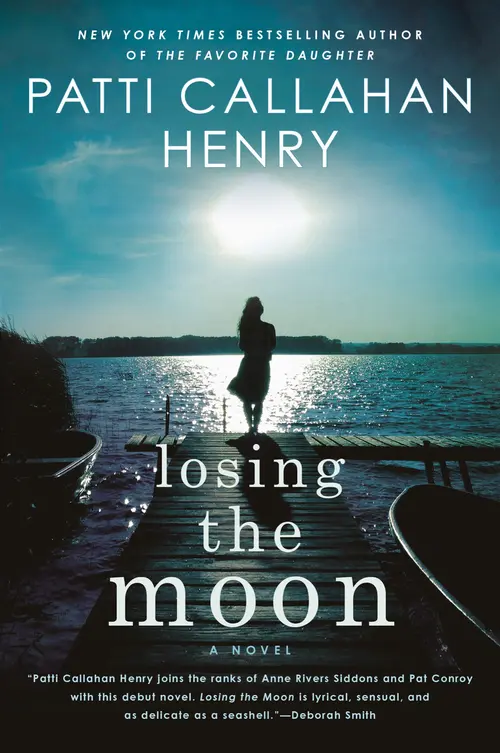
Losing the Moon
Cover
Praise for
Losing the Moon
“Readers who enjoy the lyrical voices of Patricia Gaffney and Mary Alice Monroe will also be drawn to this talented newcomer.”
—Booklist (starred review)
“Dazzling . . . Henry has been hailed as being included first in the ranks of important Southern writers such as Pat Conroy and Anne Rivers Siddons.”
—The Wichita Falls Times Record News
More praise for Patti Callahan Henry and her novels
“Patti Callahan Henry is quickly becoming one of my favorites. [This] is a story of reflection, forgiveness, and surprising twists.”
—#1 New York Times bestselling author Debbie Macomber
“In exquisitely wrought prose, Patti Henry lyrically examines the meaning of forgiveness and the inexorable tug of home.”
—New York Times bestselling author Mary Kay Andrews
“A layered, spellbinding novel about families and lovers and the meaning of home . . . one truly beautiful book.”
—New York Times bestselling author Nancy Thayer
“A great summer read about finding yourself and returning home.”
—PopSugar
“Henry creates a world that feels rich and real . . . [an] atmospheric look at friendship, forgiveness, and second chances.”
—Kirkus Reviews
“Lyrical writing, characters worth rooting for, a surefooted belief in the power of goodness—plus a twisty plot that will keep the pages turning long into the night.”
—New York Times bestselling author Joshilyn Jackson
“A Southern woman’s journey into truth. An emotionally intense, beautiful, and unforgettable novel. I loved it.”
—#1 New York Times bestselling author Robyn Carr
“A great beach read of the Dorothea Benton Frank and Anne Rivers Siddons variety.”
—Booklist
“No one writes about the power of family and friends like Patti Callahan Henry.”
—New York Times bestselling author Mary Alice Monroe
Dedication
With immense love and admiration,
I dedicate this book
to Bonnie and George Callahan:
encouragers, prayer warriors, babysitters,
inspiration and most important—my parents.
Acknowledgements
Acknowledgments
Although a book is written in isolation, it is never written alone. My grateful appreciation spreads wide across the people in my life.
To my dearest friends who always believed and said, “Of course” (you know who you are); thank you for allowing me the space and time to fulfill my dream. Special thanks go to Sandee O, whose creative spirit is my inspiration, and to Susan Clark, whose generosity and inexhaustible service to others are amazing. I love you all.
Innumerable thanks go to some very special women in GRW—to Ann Howard White and Deborah Smith, who believed in me before I did; and gratitude to Dorene Graham, Pat Potter, Stephanie Bond and Haywood Smith.
Deep appreciation goes to my agent Kimberly Whalen. I am consistently thankful for her providential entrance into my life. I offer my gratitude for her enthusiasm and sharp sense of story. Her trust in me has allowed me to write this book from the deepest place of my heart.
I thank New American Library for their trust in me. Special thanks go to Serena Jones and to my extraordinary editor, Ellen Edwards, whose keen eye, patience and dedication to the written word have produced a novel that is deeper and more polished.
No acknowledgment would be complete without mentioning the support, love and undergirding of my family. To my sisters, Barbi and Jeannie, who believed and cried and encouraged. To Gwen and Anna, who believed. I love you.
My heart overflows with immeasurable love for my children—Meagan, Thomas and Rusk. They inspire me to want to be so much more than I am. Their towheaded beauty and fathomless love echo the God who designed them. To my husband, Pat, whose patience with his wife’s dream allowed it to come true. All of you are my heart’s beat.
And to my God in whom I live and move and have my being. If I write anything of worth, it is because His power flows through me. I thank Him for the gifts of story, of writing and of faith.
Contents
Praise for Losing the Moon
Title Page
Copyright
Dedication
Acknowledgements
PART I
Chapter One
Chapter Two
Chapter Three
Chapter Four
Chapter Five
Chapter Six
Chapter Seven
Chapter Eight
Chapter Nine
Chapter Ten
Chapter Eleven
Chapter Twelve
PART II
Chapter Thirteen
Chapter Fourteen
Chapter Fifteen
Chapter Sixteen
Chapter Seventeen
Chapter Eighteen
Chapter Nineteen
Chapter Twenty
Chapter Twenty-one
Chapter Twenty-two
Chapter Twenty-three
Chapter Twenty-four
PART III
Chapter Twenty-five
Chapter Twenty-six
Chapter Twenty-seven
Chapter Twenty-eight
Chapter Twenty-nine
Chapter Thirty
Chapter Thirty-one
Chapter Thirty-two
Chapter Thirty-three
Epilogue
Conversation Guide
Excerpt from The Favorite Daughter
About the Author
PART I
PART I
Here were vermin so muddled in mind, so passively responsive to environment, that it was very hard to raise them to a level of clarity and deliberateness at which mortal sin becomes possible.
—C. S. Lewis, The Screwtape Letters
The danger is that the soul should persuade itself that it is not hungry. It can only persuade itself of this by lying.
—Simone Weil
Chapter One
Chapter One
Torn pieces of sunlight whispered through aged moss, landed on a shattered log. The sea pounded on an unseen shore just steps beyond the dense maritime forest. Each crest and retreat of the waves matched Amy Reynolds’ heartbeat—a beat she once believed sure and steady, a heart cleansed of Nick Lowry. But he resided in the unseen—the syncopated space between each beat, the secret she didn’t hear, but knew existed.
Amy sat on the sea-aged fallen log, rested her head atop her knees and waited. She was now ready to hear what he had to say. Or she believed she was ready.
“All this time—all of it—I’ve been thinking of what to say to you. So many things to say to you.” He touched her mouth, her bottom lip.
Her hands fluttered in the air, butterflies with nowhere to land.
He continued. “And now here you are and I can’t find any of those words . . .” He closed his eyes. “Here you are, and all I want to do is touch that space below your throat.” He opened his eyes and gazed at her neck—heat flared with the memory of his touch.
Her fingers landed gently on the hollow dent between her collarbones. His hand reached to cover hers.
“There. The place your silver cross used to lie, move every time you breathed.”
“I lost it,” Amy whispered.
“Lost what?” He gripped her hand.
“That cross. . .you.”
He moaned, bowed his head in what Amy thought might be prayer or defeat.
And all this time Amy had thought her life as neatly tucked and smooth as the vintage linen sheets on her bed; but wrinkles and folds hid beneath the surface.
The flaws of her life were covered like the thick white paint over the dirt-brown color the previous owner had painted her historic home, in the drowsy southern town where she lived with her husband and children. She’d applied another coat, and then another, until she was unknowingly suffocating in the layers of pretense.
Then Nick touched her. Then she lost the moon and crawled on her hands and knees to find it again.
Nick Lowry entered Amy Reynolds’ life again on a day seductive in its ordinariness, lazy in its soft family comfort.
Late-autumn sun washed the parked sport-utility vehicles, motor homes and Coleman grills in a honeyed afternoon light. The pungent smell of barbecue and grill smoke mingled with the earth-warm aroma of crushed leaves. Every few minutes a stray leaf fell in the stagnant air, released of its own volition, not forced by any breeze from an atmosphere so still and full Amy felt as if she bathed in it rather than moved through it.
Through the afternoon Amy’s limbs felt weighted and luxurious. Days like these—tepid fall days at Saxton University—brought to her heart the same impression every year: a longing—an odd misplaced sense of loss, yet also of promise. So it was a universal setup, her heart already languid and expectant.
Amy stood with her husband, Phil, on the same tailgating patch of grass they had for twenty-three years of home football games: a tradition of cheeseburgers, cold beer, potato salad, Chardonnay and old friends. Today was the day they would meet their son Jack’s first serious girlfriend. Jack spoke little of this girlfriend and yet he talked much more of her than of anyone he’d dated. Amy only knew her first name—Lisbeth—and she thought the name presumptuous, uppity, as if the girl had named herself at birth.
On the two-hour drive to Saxton University from their small hometown of Darby, in south Georgia, Amy had leaned her head back on the headrest of the car, fought her never-ending battle with car sickness, held Phil’s hand and mumbled, “What kind of name is Lisbeth?”
“I think it’s German . . . maybe a form of Elizabeth.”
“It sounds kinda snobby, don’t you think?”
“Ame, let’s not judge her before we meet her.”
“You’re right . . . you’re right. I’m defensive already. Sorry. Jack is just so . . . special, so different, so much more . . . mature than other—”
“You wouldn’t be a little prejudiced, now would you?” Phil squeezed her hand—playful, yet understanding her complete love for their son. It was the same way she loved her entire family, husband, son and daughter—her love a transforming filter to any average quality.
Phil pulled her hand to his mouth and kissed the back of it. “I agree with you, sweetie, but I’m also sure Jack’s sound judgment of people has prevailed here. I can’t wait to meet the girl who has finally stolen his heart.”
Amy opened her eyes and glared at Phil. “She didn’t steal anything yet.”
“Ah, you didn’t hear him on the phone.”
Amy scrunched her nose at her husband. Phil was right. She was prejudging this girl whose last name she didn’t even know. “Well, I wish we could’ve come last night. Her parents were here and they wanted us to go out to dinner.”
“There was no way I could miss yesterday evening’s meeting, Amy. We’ve been over this.”
“I know, I know. Doesn’t mean I don’t wish you could’ve. Who works till eight o’clock on a Friday night?”
“My boss, and therefore me.” Phil tightened his face the way he did when he felt she was questioning his work ethic. Raised in a strict home where work and obligation were the gods to bow to, he didn’t understand her more laid-back, skip-work-for-family approach. Now was not the time to get into it.
“Well,” she said, “my committee seems to be making progress. We did have one hour out on the island. An hour’s better than nothing.”
“That’s great, honey, great.” Phil flipped the AM channels; static from the radio filled the car, increasing her frustration. “I can’t find the game channel. We should be able to get it by now.”
Phil wasn’t interested in her work the same way she wasn’t interested in his job as a stockbroker, in the columns of straight numbers and ragged heartbeat lines of the stock market. But at least she listened. The island project she was working on through her teaching job at the Savannah College of Arts and Design (or SCAD) was an opportunity for her to make a difference in architectural preservation, and she felt Phil thought of it as one more little hobby—no different from the scrapbooks she constructed for the kids.
She rubbed her forehead; she wouldn’t let anything ruin the day they’d meet their son’s first real love.
Phil found the sports announcer’s voice rattling off the football stats and predictions of the day on the AM dial. He circled the coliseum until they spotted Amy’s best friend Carol Anne waving her arms and pointing to the parking spot she’d saved for them. After two hours in the car, Amy was thrilled to jump out the passenger side and hug Carol Anne.
“We’re finally here.” Amy stretched and inhaled the fresh air.
“I had to fight at least thirty red-faced SUV drivers to keep your parking spot. You owe me big.”
Amy laughed and began to unload the packed coolers of food, grateful as her nausea shifted to a dull headache. She scanned the tailgating throng for Jack.
“Who’re you looking for?” Carol Anne craned her neck above Amy’s head.
“Jack. He has some new girlfriend he wants us to meet . . . and her parents.”
“Ooh. Sounds serious.”
Amy looked at the woman who’d been her best friend since first grade; her hair was still the color of fresh honey, her brown eyes still playful and alert-—taking everything in. Today she wore a pair of jeans that Amy’s seventeen-year-old daughter could fit into and an orange T-shirt with SAXTON UNIVERSITY stamped across the top in block letters.
“God, Carol Anne, you look like one of the students. Go away.” Amy made a shooing gesture with her hand, laughed.
“And you don’t?”
“No, I definitely do not.”
Amy stood up on her toes, attempted to look above the crowd for Jack. She spotted him walking through the maze of cars, grills and tangled knots of alumni bartering for tickets to the ultimate rival football game. His arm stretched behind him as he pulled a dark-haired girl through the throng. Amy didn’t call out; she didn’t want to embarrass him. She waved her arms back and forth so he could spot them.
She turned to Phil, who was grabbing blankets and chairs from the backseat. “Here comes Jack.”
“Great.” Phil’s smile widened; he placed a folding chair on the grass, and walked over to stand next to her.
Carol Anne grabbed Amy’s wrist. “I’ll let you say hello to your son. . . . Be right back.”
Amy spoke through a pasted-on smile. “He’s holding her hand.”
Jack had always made time in his college social calendar to stop by with a friend or two, but never, in three years, had he arrived holding a girl’s hand.
“Amy, stop.” Phil patted her denim-covered bottom.
Jack arrived at her side, hugged her. The warmth and firmness of her son washed over her in tenderness. She’d never asked, but she often wondered if other mothers wanted to weep with pure joy each time they hugged their grown-up children.
“Hi, Mom.” Jack kissed her on the side of her face. He always did. “I want you to meet Lisbeth.”
“Hello.” Amy spoke to the small girl who stared only at Jack.
“Lisbeth, this is my mom.”
Lisbeth looked at Amy and smiled. Her blue eyes were so clear they seemed almost see-through. Eyes like this in a girl with pale skin and chestnut curls cascading down her shoulders startled Amy. Lisbeth looked like a picture of an Irish imp—not the German Lisbeth she’d imagined.
Lisbeth spoke with the soft shawl of Jack’s arm flung over her shoulders. “Nice to meet you, ma’am.” Lisbeth blinked. Amy did not. Something about Lisbeth’s jaw caused Amy to feel as though she needed to reach out to touch it.
Jack turned to his father. “And this is my dad, Phil.”
Phil held out his hand. “Nice to finally meet you.”
“You too, sir.” Lisbeth shook Phil’s hand.
Amy stared at Lisbeth’s face: familiar and unfamiliar, nagging. Lisbeth turned, blushed under Amy’s stare. “My parents are on their way, if you don’t mind. I tried to explain where you were.”
“Well, you keep an eye out for them. I’m sorry we couldn’t make it to dinner last night, but we’d love to meet them. We have plenty of food.” Amy reached for Phil’s hand. “We’ll unload the car.”
She turned from her son and his new love; she somehow felt young, their age. It was easy to do on a fall day with gold leaves crackling under her feet, old friends surrounding her on the university campus.
Phil carried the chairs to the other side of the lawn, and before Amy could finish unloading the cooler, Jack called to her.
“Mom, come meet Lisbeth’s parents.”
Amy turned. Lisbeth’s father moved into her field of vision. She tried to speak, but the autumn air gripped her voice in a tight portent fist.
The man hugged Lisbeth. “Lizzy, darlin’, I thought we’d never find you.” He kissed the tip of her nose.
Amy stared at this man, at Lisbeth’s father. He was tall, at least six foot three, tree-trunk solid with hair the color of the burnished leaves under her feet; a scar dented his lower chin. The scar: a slice of open flesh as a beer bottle slit his chin in a barroom brawl—something about whose turn it was at the pool table. Amy reached for the side of her SUV and missed.
Lisbeth giggled and Amy heard it through a long, echoing tunnel. “Daddy, come meet Mrs. Reynolds. Amy, right?”
“Yes . . . yes.” Amy glanced behind Jack for Phil. He was across the lawn with his back turned.
She smelled noises, heard smells; her senses moved and crowded each other for attention, mixed up with their true function as the air wavered with an actual and measurable width. A slow tingle of recognition began as an electric pulse in her stomach, her inner thighs; memory only in body, not yet mind.
“This is my dad, Nick Lowry.”
The air separated, Nick reached out his hand to Amy, as if he’d not just risen from the grave of the past, the coffin of dead promises. He looked at her. His grin broke open to the wide and recognizable face of her Nick Lowry. She held out her hand to greet her old lover as mind’s memory met visceral memory with the internal sound of grinding bone.
His face was wider, thicker on the bottom, the jaw softened, but it was his. Those brown eyes were still like liquid copper in his face. He didn’t look surprised—he must have known she’d be here.
“Well, hello, Mrs. Amy Reynolds.”
“Hello” is all Amy managed to utter. She smiled, grasped Nick’s outstretched hand, amazed at her good manners while the world swam sideways.
“What a coincidence this is . . . what a—”
Nick’s wife interrupted as she appeared from behind a van, tucking her blond hair behind her ear. “Yoo-hoo. Well, hello there, Reynolds family. I have just heard so much about you.” She stepped up to Nick and ran her hand down his bare arm, held the other hand out to Amy. “Hi, I’m Eliza Lowry.”
“Oh.” Amy shook Eliza’s hand.
Eliza looked up at Nick, then back at Amy. “And you are Amy Reynolds? Mother of the adorable Jack Reynolds?”
“Yes. Um, yes.”
“Well, nice to meet you,” Eliza said.
Phil appeared at Amy’s side; she reached for him, grasped him like a life preserver. Phil held out his hand and introduced himself to Nick and Eliza. Eliza gave a curtsy. The ground seemed to dissolve; Amy felt wide, rising.
Eliza wrapped Phil’s hand in both of hers. “It’s nice to meet you.” She tilted her neck a little more to the side, her smile widening just a tad as she swung her hair behind her shoulders.
A stray yellow leaf threaded with red fell into Phil’s hair. Amy plucked it from his head—ordinary motions an antidote to the unexpected.
She glanced at Jack and Lisbeth standing next to Eliza, searched for something, anything to say to Nick and his wife—but she only found a gray swirling space as her mouth opened and closed. God, this woman, Eliza, must think her a mute fool, just standing there with an open fish mouth.
“Aren’t these football games fun?” Eliza said.
“Especially when they’re having a winning season,” Phil answered, squeezing Amy’s elbow.
“Yeah, the last time Saxton won the national championship was when Nick was here.” Eliza giggled. “We won’t say what year that was.”
Jack laughed. “Jeez, that was like, what? Thirty years ago?”
“Oh, thanks for the reminder.” Eliza tickled the side of Jack’s arm. Amy wanted to slap her hand away.
Amy looked up at her son. “No, more like twenty-five years ago.”
Eliza then turned to her daughter, pulled her away from Jack and began to attempt to smooth down her curls while talking to her.
Phil looked at Amy with large eyes, with furrowed forehead. Everything about Phil looked eager, even when it wasn’t. His smooth skin, without freckle or mole, gave the appearance of everlasting youth—soft mouth, wet eyes and rounded eyebrows creating an anticipatory look. Amy had appreciated this when he first came to her—his softness a place to finally lay her wounded self. She brushed his hair back from his eyes, his blond hair always falling in the wrong places.
“Did y’all know each other at school?” Phil said.
“Sure . . .” Nick answered.
“A long time ago,” Amy said, reaching for Phil’s arm.
Nick laughed and smiled at Amy. “Yes, a very long time ago.”
Nick possessed the same goofy “I’m uncomfortable but aren’t I hiding it great” grin that moved across his face in waves, waves she’d ridden . . . before. She smiled—certain she showed nothing of what cracked within her.
“So how have you been all these years?” She found she was speaking.
“I’ve been fine, just fine. And you?”
“Perfect . . . thanks,” she said.
Phil tilted his head and rubbed at a spot between his eyes, at the top of his nose—something he did when he was confused.
Eliza turned her attention back to the group. “So, Reynolds family, where do y’all live?”
“Darby,” Phil said. “And you?”
“We lived up north in Maine for way, way too long, but we moved back to Garvey about eight years ago. That’s where I’m from—grew up there. You know, there’s just no place like home.” Eliza sighed—a long, exhausted sigh as if the journey of her life had finally led her to a place of rest.
The Story Continues on BooksBarbecue!
Enjoyed this preview? ❤️ Do not stop here!
Read the complete book free online → 🔗
Continue reading now on BooksBarbecue and discover every page!
Love reading? Bookmark BooksBarbecue.com for more amazing books!
Happy Reading!