Long Remember
Cover
Title Page
Copyright Notice
The author and publisher have provided this e-book to you without Digital Rights Management software (DRM) applied so that you can enjoy reading it on your personal devices. This e-book is for your personal use only. You may not print or post this e-book, or make this e-book publicly available in any way. You may not copy, reproduce, or upload this e-book, other than to read it on one of your personal devices.
Copyright infringement is against the law. If you believe the copy of this e-book you are reading infringes on the author’s copyright, please notify the publisher at: us.macmillanusa.com/piracy.
Dedication
To Irene
Note
Note
It is worthy of remark that whatever astuteness Abraham Lincoln possessed as a prophet, was not reflected in his address at Gettysburg, on November 19, 1863. With all sincerity he declared, “The world will little note, nor long remember, what we say here, but it can never forget what they did here.” Seventy years later, one realizes that Lincoln’s speech represents the only common and popular knowledge of Lincoln, Gettysburg, or the war between the states.
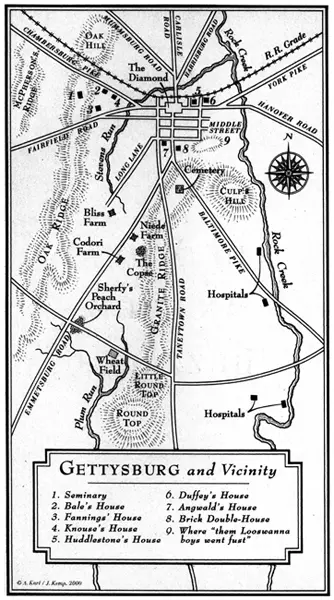
The major characters of this novel are fictitious. To the best of the author’s knowledge, there was no one named Bale, Fanning, Huddle-stone or Duffey living in Gettysburg, Pennsylvania, in June or July of 1863.
M.K.
Introduction
Introduction
There are stories enough to fill great libraries—stories of marching armies, the rattle of muskets, the screams of dying men. We know so much of generals and privates, cavaliers on their fine horses, or the man leading the glorious charge up that famous hill. In these pages is quite another story, drawn with the extraordinary skill of a man who brings us into one small town, in no way unique, and into the life of one man who is considered very much unique by the peole who know him.
Dan Bale is a confirmed civilian, a man with no allegiances, who has a distinct disdain for the chest-thumping passions the Civil War has produced. He returns to the small town of his youth, a journey home for a sorrowful personal business, is searching for nothing, expects little else. He is a man disconnected from his world, a man who could be from any time. He has grown up mildly angry, journeyed far from home, seeking nothing from a life that has given him only a faint nod of kindness. He seems void of passion, annoyed at himself that somewhere in a place he tries to hide he has an inconvenient and unavoidable strain of decency. It is Dan Bale’s astounding misfortune that his return to his family home should in fact be a stumble into a place where madness and fear and the horror of death will engulf a people whose only sin is that they live in a town called Gettysburg.
In our so very modern of times we choose to believe that it is better to become detached, that our world is too annoying, too troublesome to venture into. We read newspapers and watch television, and sit comfortably removed from the horrors of our time, staring dispassionately while images too grotesque to fathom wash over us in a numbing cascade. If we are suddenly uncomfortable, we turn the page, change the channel. To many, involvement means risk. To many more patriotism is an outdated, misguided, and laughable notion. Dan Bale could easily live in our time.
Today, as in 1863, many peole spout noisy pronouncements about the depths of their own courage. Whether we believe our own boasts, or whether the noise is simply a mask for our fear, it is often the soldier who will alone discover the truth. No one shouldering a rifle will be able to predict how he will react under fire. No loud bravado will ever accurately portray how carefully you will aim, how much precision you can muster, how you will truly react to that other man with the gun who thrusts his bayonet at your heart. The hero and the coward may share everything else, may even be friends, brothers. But when they are pulled into the great hell of war, the true character of a man emerges, and only then does he meet his own soul. This is a theme critical to the telling of this story. To Dan Bale, this is meaningless chatter.
Passion is at once liberating and dangerous. More often it is a misguided passion of one kind or another that creates the war itself. But sometimes, it is the war that creates the passion, swirling men and women together with an unexpected fire, transforming the coolness of reason or even propriety into hot lather. For Dan Bale, passion is an unwanted surprise. But there are surprises beyond his control, beyond his own turmoil. In Gettysburg, Pennsylvania, in July 1863, the mosaic texture of small-town life is swallowed alive by the extraordinary hell of a great war. But through the eyes of one man, the lives of the people unfold in a magnificent blend of passion, horror, and discovery.
“Now he lived in a feverish and blasted world, and suffered the knowledge that he had helped to make it feverish and blasted…”
—Jeff M. Shaara
April 2000
Book One: The Woman and the Buzzards
Book One
THE WOMAN AND THE BUZZARDS
Chapter 1
1.
At Hanover Junction it was necessary for him to change trains. For a while he sat alone on the edge of a baggage truck, his luggage on the platform at his feet. He smoked and looked up at the sky. There was a moon somewhat past the full, but brown and serrated under the mackerel scales of thin clouds. At the far end of the platform a squad of loafers stood talking. Bale had avoided them purposely. The station itself was deserted except for a night agent who sat in his little den, clicking mysterious jabbers to a mute length of wire.
Presently the agent came out of the station and moved across the hollow wooden platform, a bloody lantern in his hand. A clicking and a thud of metal marked his pause at the switch-post. He came back, carrying the vivid green lantern which he had replaced with the red.
He spoke to Daniel Bale. “Looks like we might catch a little rain, maybe.”
“Shouldn’t wonder,” said Dan.
The agent stood there, weaving the hissing green lantern back and forth. His shape seemed strangely lop-sided in the darkness. Bale bent his head slightly to bring the man’s body into full silhouette against the soft, kerosene yellow of the station windows … The man had only one arm.
“About this time, first part of June,” said the agent, “we generally get a deal of rain around here.”
More abruptly than he had intended, Bale observed, “I see you’re shy one wing.”
The agent’s warm young voice gurgled. He spoke as one who is expecting pity and veneration to be lavished upon him, and who feels that they are wholly his due. “But,” he concluded, “my wife don’t mind a bit. She says she’d rather have me wanting a chunk of meat than not have me at all. And anyways, when you figure how it happened, I guess I’m not sorry. When I signed the roll I figured I might get killed, maybe. I tell you, friend, there’s a good many better men than I be, lying down there by that crick this minute. Bet your boots.”
Bale watched a crumb of tobacco fall from his pipe and slide into the forest of his beard; it bounded from wiry hair to wiry hair, making its own tiny illumination as it went. He thought, Now it’s coming, he’s bound to ask, and I wish—
“You done a turn with the colors?” blurted the agent.
“No.”
The green lantern jerked at the abruptness of the reply. When the agent spoke again, he was halting and apologetic. “Well, I always say that a man’s first duty is to his family. Course I wasn’t married till I come back … You’re married, friend, I take it?”
“No,” Bale told him. He tapped the bowl of his pipe against the edge of the truck, and a host of red flakes sprayed into the darkness. “I don’t hold with some of your notions. I am not in favor of this war, or any war. I’m sorry you’ve lost an arm, and sorry for most of those who are dead. But I don’t intend to go to war, if that’s what you wish to know.”
He became aware that the rails were checking and crunching under the squeeze of distant wheels. A whistle squawled half-heartedly beyond the black belt of trees.
The agent cleared his throat and spat over his shoulder. “Well,” he said, “some holds one way, some another, I don’t mind saying there’s plenty of Copperheads right in this county.”
“I’m no Copperhead.”
“No, no. I never said you was. Say, you don’t need to be in no hurry to pick up your valise, friend. The train won’t go for twenty minutes—the one heading west. This here one goes north.”
He went into the station, carrying the green-glass lantern with him. A plume of smoke wavered off from the open doorway. Bale could hear the man whistling, Now, Moses, what makes you so strange and forgetful … Steel was banging and frying and torturing itself, not far up the track. The engine rounded a curve and spread its buxom shaft of light down the cindered roadway. It came on like a hissing, malodorous animal, tiny freckles of orange showing through cracks and bolt-holes in a hundred places. The two coaches behind it were rickety, and illuminated by futile, brownish lamps.
Dan jumped down from the truck and pushed his extension-case into the shadows where it seemed reasonably safe and out of the way. He walked away from the train as it gasped terrifically up to the station. There would be more people, and he had seen all the people he wanted to see for a long time. Not many years before, he had suffered recurrent nostalgia for the settled complacency, the solid and ever-present population of even a rural community in the East. That was all past. One could not travel for six days, pushing ever farther into a scrambling and more tightly-peopled country, without seeing all faults, existent and nonexistent in mere men and women.
In his brief conversation with the one-armed agent, he realized that he had been wholly absurd. Six days before, he would not have mentioned that empty sleeve to the man who owned it.
On this train, waiting to transfer to the west-bound coaches, undoubtedly there would be some old friends and neighbors, or at least old neighbors whom he had once regarded as friends. They would talk about the war. Where he had been, the war sank into a civilized phenomenon below the southeastern horizon, a capitalistic trap which waited to seize the unwary. Even so, many men had gone to it voluntarily …
The light of the railway engine, stationary now, hunted past him; he could see it picking out the trampled weeds which grew close beside the roadbed and turning them into artificial, green paper weeds. A rising ripple of human sounds drifted up through the whuff, whuff of tired steam; people were climbing down from the cars and all talking about it … Bale turned aside into the tide of gray darkness. He stumbled across a rusty side-track, down into a dry ditch, and walked squarely against the bones of a rail fence. Beyond that, at the top of a slope, tiny nine-paned windows shone in an invisible house. This spot called Hanover Junction had never amounted to much and never would … He put his boot on the bottom rail of the barrier, and swung up and over, dangling his legs on the inner side. The edge of the rail was sharp and uncomfortable, but he sat there nevertheless with his back to the station, staring up at that skulking moon.
Something in his pocket was hard and bulky. He dug it out: a small apple. He had bought it from a boy at the train window, early in the afternoon. He took the dead pipe out of his mouth and bit into the apple. His teeth told him that the skin was soft and loose and wrinkled, an apple which had survived in some cellar since the previous autumn. The pulp of it was winy, aged, sour-sweet. He rolled the damp morsels over and under his tongue. Close at hand, the tingling June silence encompassed him; he was in a world apart from the stew of the little railroad junction, and in this world there was no sound but the rack of his own jaws, chewing and chewing.
Another engine was moving closer; it had a cracked bell which swung intermittently, a dull and splintery tolling. The brakes began to tighten and fight with the heavy wheels. Mustn’t stay there too long. There would be no other westbound train until the next day.
He thought about his grandfather. Quite possibly the old man was dead, by this time. The letter had been delayed, for Bale was on a trip to the timber with Lucas Mite, hunting for green oak posts, when that letter reached Minnesota. He had come as soon as he could, but perhaps that was not soon enough. There was no reason why he should touch his grandfather’s live flesh again. Already they understood each other thoroughly, with an honesty which needed little affection to bolster it. Cancer, the letter had said, but of course he had suspected that all along. It was a dreadful death; he hoped at this moment that all was done with Pentland Bale.
Closing his eyes to the dried-up, metal moon, he could see only the house and the town which he had left seven years before. He was twenty-five years old; he had been in a far place, and was now drawn back to Pennsylvania by this imminent death. It was not at all as he had imagined his return. He had made no fortune, not even a figurative one. He had a few hundred pages of manuscript, blotted and interlined and crossed out. Probably he would never be able to form those notions according to the pattern in his brain. He had firm, stone-knuckled hands and a brown beard; there had been much hunting and much chopping with an axe, and his shoulders were knotted and spread from the weight of the sacked wheat which they had tossed about. Physically he was a different person. There was no measuring stick by which he could check the growth or shrinkage of the creature who lived inside.
A man’s voice swam up out of the roiling clatter beyond him. Boooord. Dan threw away the apple core, and pressed his feet back over the rail. He ran up the embankment and stumbled across the side-track. Out in front of the station, the one-armed agent was gazing up and down, looking for him. As he ran, Bale could feel a water of pity for this person, pumping in his throat. He thudded up the platform steps and snatched his grip from its hiding place.
“Thought you was lost,” the agent cried.
He said, “Thanks. Is this the one?”
“Hurry up. She’s moving—”
He caught a gritty iron bar and drew himself up on the stairway of the squeaking car. Burning flakes of soot tore past him; he could feel them settling on his cheeks and kissing his hair. Then he stood at the door of the coach, breathing rapidly, and blinking into the face of the tin lamps.
Perhaps they were the neighbors of his childhood, perhaps they were more than that. At this moment they were only heads above the slatted wooden seats; they were bonnets and beards and children asleep. Carpet-bags, haversacks, cloth-wrapped bundles stood along the aisle. Bale picked his way carefully past them. A baby, fat pink lump wound up in an old plaid shawl, was saying earnestly H’la, h’la, h’la, and its mother fumbled with the front of her dress while the father held up a newspaper to shield her. People filled this coach—too many people. The war had unsettled the world; it bubbled the sediment and the froth together and kept them sloshing about. Forever, these motley Americans were riding up and down their land on the cars.
There was a vacant space beside a black slouch hat with a white trefoil and a number on the front. Bale sat down, squeezing his leather case between his feet. The man who wore the slouch hat stared pettishly ahead and did not acknowledge Dan’s nod. He was about twenty-three, beardless, a thick yellow mustache twisting down to cover his long lips. A white silk handkerchief had been stuffed around his neck to keep stray perspiration from soiling the collar of his uniform. Bent across his shoulders were corroded oblongs of gilt braid.
He moved his unbuckled scabbard aside, and flicked a tuft of ashes from his cold cigar. Then, from the corners of pale blue eyes, he seemed suddenly to see Daniel for the first time.
The officer turned, his mouth curving slightly under its tawny brush. “I’m a sucker,” he said, “if you’re not Dan Bale.”
Bale extended his hand. “Hello, Ty.”
“Well,” said the officer. His voice was shrill, taut, weary. He stared at Dan. “Thought you had left Pennsylvania for good.”
“I thought so, too.”
“Are you just coming back, now?”
“Just tonight. You haven’t been home recently, have you?” he added, with an unhappy eagerness. “My grandfather’s near death. That’s why I came back from the west.”
The soldier shook his head. “First time I’ve been home in seven months, and I’m only here now because I’m sick. No sense in my coming. My wife managed it; she had Colonel Baxter send me.”
“You’re married, then?”
“I married a girl from Philadelphia,” said Ty briefly.
They were silent for a moment, their heads bobbing on their shoulders as the car lurched and quivered.
“I see you’re an officer, Ty.”
“Captain. The Seventy-second. Philadelphia brigade.”
“Well, that’s good,” Bale muttered. He wondered what else he could have said.
Tyler Fanning shrugged. “It’s damn hard work, if you ask me. Hardest work I ever did in my life … I got hit with a piece of shell at Antietam Creek. Sick as a dog for weeks. Couldn’t keep anything on my stomach.”
“Are you all right now?”
“Could be better,” Fanning spat upon the floor, and smudged the place with the toe of his glistening boot. “We heard once that you had been scalped by the Indians.”
Bale felt awkward. He began to wish that there had been a vacant seat beside someone other than Fanning. “No,” he said, “they didn’t get me, that time. They came near it. A lot of bad Wahpakootas—those are Sioux—burned everybody out, in our neighborhood.”
“Rebels or Indians, they’re all the same. We’d be better off if they were all dead.”
Bale said nothing. He realized that he was not looking at Ty Fanning, but was frowning intently at a varnished knot-hole in the seat ahead of him. He wrenched his gaze away. Across the aisle a fat, red-faced farmer was snoring with mechanical regularity, a blue handkerchief spread over his bald head. All around, people dozed or snored or whispered or clacked; the air smelled of stables and soot and coal-oil and fried chicken; but sometimes a puff of wind twisted down the aisle, and then you could think of chilly green woods and dark fields where the hay was ripening.
… They were neighbors, boys who lived in the same town, and only a field apart. Two years in childhood are a generation. There is apt, Bale remembered, to be a holy clique of twelve-year-olds deeply scornful of the ten-year-olds who worshipfully trail them. In a smaller town, they would have been pushed together by the narrowness of circumstance. As it was, they met on common ground only at the Willows, and in the pasture between their homes, and at fires.
The Willows were three in number, growing from a common stump that lifted on oozy roots at a bend in the meanderings of Willoughby Run. Bale shut his eyes: he saw Tyler Fanning standing on the roots, warm and muddy water sloshing two inches below his toes, pressing his hands together in front of his ribs for an awkward dive that was more of a fall. Tyler Fanning lived in the second largest house in town, and he wore a blue velvet jacket, and his mother went to drive in a carriage driven by a freedman. But nevertheless he was thin and whining and querulous when you got him naked down at the Willows. He had knobs on his knees … Captain. The Seventy-second … piece of shell at Antietam Creek. Ho! the wars …
Dan felt his jaw stiffen. He tugged nervously at his thick beard.
“Where’d you get the growth?” asked Fanning.
“I left my razors at home when I went to Minnesota.”
“That’s how long?”
“Nearly seven years.”
Fanning grinned, not pleasantly. “Look out someone doesn’t take you for that son of a bitch Stuart.”
“Who?”
“For the moment,” Ty whined, lazily, “I forgot that you’ve been in the backwoods and aren’t conversant with present-day affairs.”
The Story Continues on BooksBarbecue!
Enjoyed this preview? ❤️ Do not stop here!
Read the complete book free online → 🔗
Continue reading now on BooksBarbecue and discover every page!
Love reading? Bookmark BooksBarbecue.com for more amazing books!
Happy Reading!