Liminal
Openers
Also by Jordan Tannahill
Plays
Declarations
Botticelli in the Fire
Sunday in Sodom
Concord Floral
Late Company
Age of Minority: 3 Solo Plays
Books
Theatre of the Unimpressed: In Search of Vital Drama
The Videofag Book
LIMINAL
Jordan Tannahill

Copyright © 2018 Jordan Tannahill
Published in Canada in 2018 by House of Anansi Press Inc.
All rights reserved. No part of this publication may be reproduced or transmitted in any form or by any means, electronic or mechanical, including photocopying, recording, or any information storage and retrieval system, without permission in writing from the publisher.
Distribution of this electronic edition via the Internet or any other means without the permission of the publisher is illegal. Please do not participate in electronic piracy of copyrighted material; purchase only authorized electronic editions. We appreciate your support of the author’s rights.
All of the events and characters in this book are fictitious, and any resemblance to actual persons, living or dead, is purely coincidental.
Library and Archives Canada Cataloguing in Publication
Tannahill, Jordan, author
Liminal / Jordan Tannahill.
Issued in print and electronic formats.
ISBN 978-1-4870-0378-4 (softcover). — ISBN 978-1-4870-0379-1
(EPUB). — ISBN 978-1-4870-0380-7 (Kindle)
I. Title.
PS8639.A577L56 2018 C813’.6 C2017-904727-2
C2017-904728-0
Book design: Alysia Shewchuk
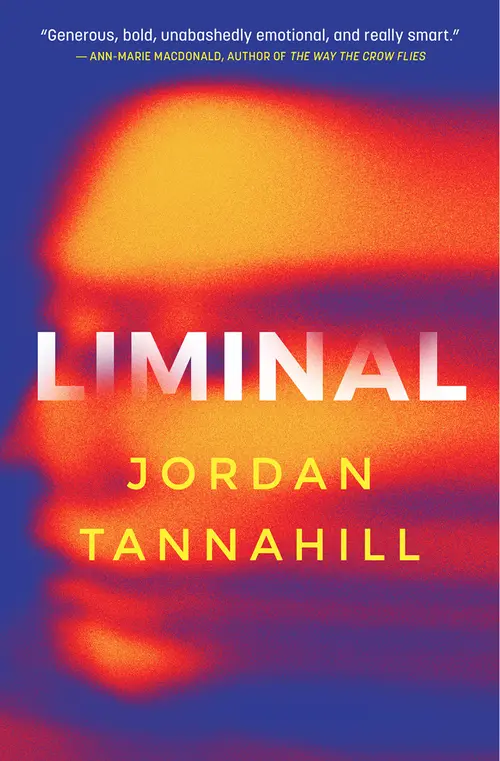
Cover image: Rob Castro / Arcangel Images Ltd.

We acknowledge for their financial support of our publishing program
the Canada Council for the Arts, the Ontario Arts Council, and the Government of Canada through the Canada Book Fund.
For my mother
Author’s Note
Author’s Note
This is a work of fiction. And while I have drawn inspiration from real people I know, I can assure the reader that without exception the real people are better in every way.
Epigraph
“I” is merely one of the world’s instantaneous spasms.
— Clarice Lispector, The Passion According to G. H.
When we speak the word “life,” it must be understood we are not referring to life as we know it from its surface of fact, but to that fragile, fluctuating center which forms never reach.
— Antonin Artaud, Theatre of Cruelty
I
I
On the morning of Saturday January 21, 2017, you didn’t wake up. Not at six thirty or seven, the time you were normally having your coffee and finishing your Sudoku. Or at eight or eight thirty, the time you’d wake after a dinner party with girlfriends, or even nine if you’d managed to get through a few bottles of wine together. By ten I managed to make myself think, Good for her, she’s having a lie-in. You’d gone to bed early the night before. We were watching coverage of Donald Trump’s inauguration when you began to complain of a headache. I joked you could expect to have one for the next four years. As the evening wore on it developed into a migraine, which of course worried us in light of your Transient Ischemic Attack. TIA. What your doctor had called “a warning stroke.”
You said, “I’m going to turn in,” and as you walked upstairs I called, “Make sure to keep your head propped up,” for which I had absolutely no idea if there was any medical basis.
By ten thirty that morning I was sitting on my bed checking emails, waiting for the soft thud of your feet hitting the floor of your bedroom, the creak of the floorboards, the scraping of hangers in your closet. But the usual sounds didn’t come. Not even a cough or the rustling of sheets. Only the occasional passing car punctuated the silence, the spitting of its tires on the asphalt suggesting the snow was melting to slush. I’d made plans to meet Ana downtown for the Women’s March at noon; she was back in Ottawa visiting family as well. She sent me a photo of herself wearing her pink knitted Pussy Hat and a giant fabric banner she’d sewn declaring, I’m So Angry I Stiched This Just So I Could Stab Something 3000 Times. The text was laid out like a rainbow above a raised fist holding a large knitting needle.
“Purrrrrfection,” I texted back, before pointing out that she’d forgotten the “t” in “stitched.”
“Pretty sure Trump can’t read anyway,” she replied.
You’d mentioned wanting to join us but had to see how you were feeling. Should I wake you, then? To give you time to get ready? As it hit a quarter to eleven I jumped in the shower and was expecting to see your door open when I got out; to hear the clinking of your spoon against your cereal bowl in the kitchen. But as I walked into the hallway in my towel your door was still closed. I dressed, combed my hair, and packed my knapsack for the day. At eleven I peeled open a can of Whiskas for Chloe and let Al out into the yard to pee. And as I stood there watching him sniff about I fought an almost overwhelming urge to check on you. You’d been having restless sleeps all week. Maybe you’d had another bad night. You’d resent being woken. I was sure of it. But if I didn’t it would gnaw at me the whole bus ride, at least until I got your text — “Sorry, I slept in. Send photos.” — but what if that text didn’t come? I’d be in the middle of the protest nauseous, ripped through with worry, noon, twelve thirty, one o’clock, Ana saying, “We can go home if you like,” and yes, I’d have to come all the way back, an hour on the bus, always taking a goddamn eternity to get anywhere in Ottawa, calling the house over and over and if you didn’t pick up what then, 911, the ambulance, the medics already outside the house when I arrived…
At three minutes and forty-five seconds past eleven I climbed the fifteen steps to the second floor, walked past the bathroom still humid from my shower towards your bedroom at the end of the hallway, placed my hand on the cool metal of the doorknob, and at four minutes past eleven turned it with the care of a minesweeper, extending my left arm slowly, taking a half-step into your darkened room and glancing towards your bed.
My eyes find your body in the dark. And as your body comes into focus something inside me collapses. Caves in. You are still and unconscious. Eyes closed, mouth agape. Lips parted, like a cheesy perfume ad. I’m looking at your body and I cannot comprehend it. Why?
It is in-between. I cannot understand your body because it is caught between two distinct possibilities:
a) You are asleep.
b) You are dead.
I know you must be one or the other; that you are caught between these states is only my perception. And I know that it’s impossible to know for certain, until I take the three steps towards the bed and touch your hand; until I place my ear to your lips and you startle awake, your head retreating into the pillow. Until I laugh and say, “I thought you were dead.” “Dead?” “You looked dead.” “What are you doing in my room?” “I’m sorry for waking you up. How’re you feeling?” “What time is it?” “Eleven.” “Are you serious?” And so on.
That you’re asleep is definitely the more probable of the two possibilities. After all, every other time I’ve walked in on you in bed you’ve been alive, breathing, sleeping, dreaming, or sitting up reading, on the phone, crying, clipping your nails, or just lost in thought. Every other moment in my entire life you’ve been alive, an infinite number of living moments, why should this one be the exception? Eleven in the morning is not an hour for death. Death isn’t a quiet thing to be happened upon like a bit of cat puke on the rug.
And yet something is different. It’s undeniable. There is something about the room, the quality of the stillness, its breathlessness, the shape of your body, your face, the way it falls, that fills me with a terrible uncertainty. Is this death? Is this is what death looks like? Perhaps this is what death looks like in the light of late morning through beige curtains. What death looks like in the folds of your comforter, the wallpaper, the Moroccan rug, the wicker laundry hamper, your half-opened closet, the stack of historical novels on the floor, a copy of National Geographic on your bedside table, the Ikea floor lamp and its plastic shade. The absence of your life in every texture. The lack of that subtle scent, almost a warmth, of a sleeping body’s breath in the room, a night’s worth of exhalation.
As it comes into focus, your body is a thousand contradictions: the surest force I know and yet somehow almost immaterial; your face a kind of terrible death mask and yet beatific like a pre-Raphaelite Ophelia; the edges of your mouth tracing a smile and somehow a frown at the same time; your body weightless and yet leaden; suffused with light and yet dark.
As I stand here in the doorway in this second, less than a second, an instant between time, a synapse, I’m overcome, undone, suspended in a moment of what? Revelation? No. I hate the word. Anyone claiming revelation is usually a charlatan, ultra-religious, or insane — not that these three types are mutually exclusive. In fact, they rarely are. Perhaps this is a moment of “eureka,” though the word feels burdened by the mythos of masculine scientific discovery, from Archimedes’ fateful bath to Newton’s gravity-weighted apple (why do I always imagine it hitting his head?). A “vision” is perhaps closer, but vision also carries religious undertones and the unfortunate limitations of its sensory association. A vision suggests something that is seen, either literally with one’s eyes in a new way or within the mind’s eye. As the ever-favoured child of the senses, sight seems to get undue credit for every discovery. If anything, like Proust and his madeleine, smell has always been the source of my strongest visions. But this moment of awareness is beyond sight, beyond any one sense. Even before my eyes have had time to fully adjust to the darkness, I am perceiving your body with every fibre of my own.
What I seek is a word that does not suggest a long sought-for answer, but rather a deluge of questions. A word for a kind of illumination that recalls a caver holding a torch up in an underground chamber and apprehending a few dashes of rock wall at a time, uncertain of how far the cavern extends into darkness. The first word in the Book of Revelation is apokalypsis, which in its original koine Greek means “unveiling” or “revelation.” It’s a word that seems to contain the possibility of discovery in the moment of destruction. Just as theatre is revealed in the instant of its disappearance. It exists in the temporal present between being and un-being, in what Plato calls the “something inserted between motion and rest… in no time at all.” I like the almost preposterous gravity of apokalypsis, how its cataclysmic and eschatological associations mirror the way in which one world seems to end and another begins in a moment of newfound awareness.
But as your body comes into focus, “unveiling” somehow feels the most apt. An encounter, smell, sight, sensation that unveils an infinite system of questions and discoveries, which in turn spur more questions. Like a man in white gloves pulling a shroud off a painting, removing a covering that concealed what was there all along. Something which has been rendered ever more extraordinary by the very fact of its concealment. Not a divine conjuring, but a moment of discovery arising from matter-of-fact and mortal circumstances. A new way of experiencing something already in the world.
In this way the world is constantly unveiling itself. A stand of trees seen from a fresh angle, the laughter of a dog, a nameless colour, new patterns of movement, of light, of behaviour, patterns in fabric, in birds, in traffic, in music… In this way “revelation” is not something a bearded white man apprehends once an epoch, but rather a state of becoming that imbues all things at all times. Of course to be in a state of perpetual unveiling is exhausting and disorienting; it’s essentially the way we moved through the world as babies, when everything was revealed and nothing was legible. Gradually, to make sense of the chaos, we fixed things in place, we fixed meaning, we fixed potential, we fixed objects and people and places as knowable and predictable entities and attempted to reduce the instances of unveiling because those upset the order by introducing new variables into the mix. Unveiling, by nature, un-fixes.
As I stand here at 11:04 a.m. on Saturday January 21, 2017, you in bed, me in the doorway in the moment of beholding, something — perhaps everything — is unveiled. And I become unfixed. But I do not yet understand. I am in the moment between awareness and comprehension. The interval between a hand touching boiling water and the pain of its scalding. Between sense and sensation.
II
II
Monica. A name of North African origin. Santa Monica, mother of Saint Augustine. “Until the sun comes up over Santa Monica Boulevard” went the chorus of a song from my childhood. It was the name of a presidential intern-turned-mistress. A sitcom best friend. You hated it growing up. It didn’t sound serious to you. And as a blond in the sixties, being taken seriously was a grail quest. Monica Tannahill. A young feminist in Trudeau’s Canada. Now a fifty-eight-year-old feminist in another Trudeau’s Canada. Single mother. Breast cancer survivor. Suburban jogger. Fitful yoga practitioner. Book club member (always loved a good multigenerational family saga). CBC Radio devotee. Maclean’s magazine subscriber. Christian with new-age tendencies. Humanist. Card-carrying member of the Liberal Party. Gravitational force of a small galaxy of girlfriends. A self-proclaimed “hard-ass.” You saw money and status as forms of emancipation. You saw female colleagues, close friends, ground down in the gears of public bureaucracies and chewed up in the lion’s den of the private sector, and there was no way in hell you were going to succumb to that fate. You believed in getting your due. In tough love. In being a clear and confident boss, the kind that men got called “strong” and women got called “bitches” for being. Your millennial colleagues exasperated you. Raise your voice once and they’ll brim at the eyes; you wouldn’t believe the amount of time I have to spend now just sorting through who said what to whom and what that made them feel; I mean, I’m there to run a lab, not a focus group.
You worked full days in the lab at Carleton before coming home to cook dinner for me and sometimes for your friends, serving nice vintages and playing vaguely Celtic music on low, and on other nights driving me to soccer and T-ball and then increasingly to gymnastics and drama. You drove a mini-SUV because you didn’t want to feel pushed around and wanted traction whenever you needed it. After fighting for every goddamn thing in your life since the late fifties, you never wanted to be denied traction. Overworked, undervalued, burnt out, anxious. The holotype of the helicopter parent, amending school release forms in red pen and sealing pizza-day money in envelopes marked Pizza Day. Rocking up to school assemblies in intimidating shoulder pads in the early nineties, no-nonsense bob-cuts in the late nineties, and don’t-fuck-with-me black thick-frame glasses in the aughts, arriving five minutes late but always in time to catch my cameo. You drank your coffee black, three cups in the morning and at regular intervals throughout the day.
It was a shock to see you felled by your own brain. The one thing you thought you could always rely on, the one thing that had always gotten you through. It had begun with your right hand. It was morning. You were in the kitchen. You had poured yourself a glass of water, but when you made to drink it you couldn’t see the glass in your hand anymore. More specifically, you couldn’t tell where the glass ended and your body began. You unclenched your fingers and heard the glass shatter on the floor. You looked down and saw the shards and spattered water.
Your Airbnb guest walked in, a young Spanish tourist. He found you on your hands and knees, cleaning up the mess.
You turned and looked up at him. “I couldn’t see the glass.” Except he couldn’t understand what you were saying, and not because he was Spanish. He ran to the phone and called the ambulance.
During your TIA, you later told me, you felt like a piece of furniture. Like a couch or a chair. Immovable. Depersonalized. Detached. As if you were somehow outside observing the object of your own body. You said that feeling of detachment was likely due to the fact that the TIA had been localized in your left parietal lobe, the part of the brain that reconciles one’s sense of self with the body. That confirms you are your body. That you are, in fact, human and not a table or a refrigerator. Or that your body is not mine. That when I touch your arm or your face you know where I stop and you begin.
I was in London when I got the call from the hospital. I landed in Ottawa Sunday night on what was probably the most expensive trans-Atlantic flight they could legally sell. They discharged you on Monday and you took the week off to rest. Your speech came back almost immediately, but you were tired. Depleted. You read, finished a book of Sudoku, ate a lot of fish as per the doctor’s suggestion. You liked to double down on anything you deemed productive, and because you believed in the power of regimes it became haddock for breakfast, tuna salad for lunch, and sole for dinner.
On Thursday you had a follow-up appointment in the middle of the afternoon.
“I hate this; it just cuts up the whole day,” you said as you locked the front door of the house.
“Well, it’s not like you have anything else planned.”
“I do, actually, thank you. I have errands.”
“Like what?”
“I need to pick up a birthday card for Carol’s son Luke and a card for Javier from work. His wife just gave birth.”
“Okay, well, we can stop at Dollarama on the way.”
As we paced the wall of cards at Dollarama, I asked if you were Javier’s boss.
You shook your head. “We’re both project leaders.”
“On NEST?”
You nodded. “NEST is just one of our projects though.”
“And NEST is the artificial brain, right?”
You took in a deep breath, as if to say: This is the last time I’m going to explain this to you so please fucking listen this time. “It’s an artificial neural network of about two billion nerve cells, which simulates just a fraction of the neurons in a human brain.”
“Which is like —?”
“About eighty to a hundred billion.”
“Right. Wow.”
“About as many stars as there are in the Milky Way.”
I recalled that was where our last conversation about your work ended up — with you trying to explain inconceivably large numbers to me with the aid of various cosmological analogies.
“So you’re making an artificial brain.”
“What we’ve made, it takes forty minutes to generate the equivalent of a second of an average human brain’s processing time,” you explained as you pulled your reading glasses out of your purse. “And that’s with about eighty-three thousand processors. The simulation — each one eats up about a petabyte of system memory, which is one quadrillion bytes.”
“That sounds like a child making up a big number.”
“So you know a terabyte?” I nodded. “It’s a thousand of those.”
“So then how much processing power does a human brain have?”
“Your question is flawed,” you said, adjusting your glasses to read the inside of a card as if it were a legal document. “First of all, what is a human brain? You’re presuming all human beings have the same brain.”
“An average brain, then. Like, the median human brain.”
The Story Continues on BooksBarbecue!
Enjoyed this preview? ❤️ Do not stop here!
Read the complete book free online → 🔗
Continue reading now on BooksBarbecue and discover every page!
Love reading? Bookmark BooksBarbecue.com for more amazing books!
Happy Reading!