Chapters (20)
Oz told me that as a young man Robert found it strange that science had no way to quantify what seemed self-evident: all living things were sentient. But how sentient? In what varying degree? Robert eventually arrived at his quotient, which suggested defining sentience as the relationship between the information-process rate of reach individual processing unit (the neuron), the weight and size of that single unit, and the total number of those processing units. Running on a logarithmic scale from –70 up to +50, the quotient was proposed as a measure of sentience for all organic and inorganic entities, from plants to computers, from a single neuron up to a hypothetical being with the computational limit of the entire universe.
Robert took out a pen and quietly wrote the equation on a napkin for me.
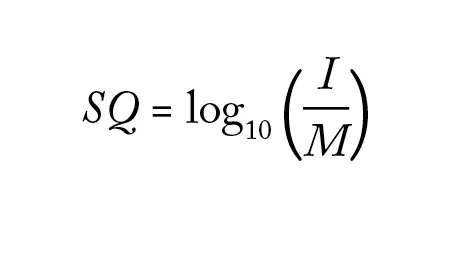
As Robert passed me the napkin, Oz took it and began explaining what it meant — not for my sake, but for Robert’s. “SQ is the sentience quotient, I is the information-processing rate in bits per second, and M is the mass of the brain in kilos.” He explained that in this equation the lowest sentience quotient possible — essentially the dumbest creature imaginable — would have just one neuron with the mass of the whole universe and would require a time equal to the age of the universe to process just one bit, giving a minimum SQ of −70. Humans clocked in at a rating of +13. Plants clustered around an SQ of −2, while carnivorous plants had an SQ of +1.
I tried to catch Will or Ana’s eye, but they were avoiding it; they hadn’t had their coffees yet, and I could tell there was no way in hell they were going to let themselves get sucked into this. A waitress arrived and took Robert’s and Oz’s orders — they both asked for the pancake stack. Were two more American words ever uttered? Pancake stack.
Robert broke open a creamer and mixed it into his coffee. He dipped his spoon into the white mug, clinked it around a few times, and licked it before putting it down on his napkin and informing me that an alien civilization whose consciousness operated through non-biological hardware, such as quantum-mechanical circuits, could have a sentience quotient of +23, or ten orders the magnitude of humans.
“That kind of gap would really affect our ability and, really, the desirability of communicating with aliens,” he said, with an air of genuine consternation. “It may be that there is a minimum SQ communication gap, an intellectual distance beyond which no two entities can meaningfully converse.”
He said that an alien civilization could, for instance, form a black hole and communicate using neutrinos or gamma-ray bursts at bandwidths completely exceeding our receiving capabilities.