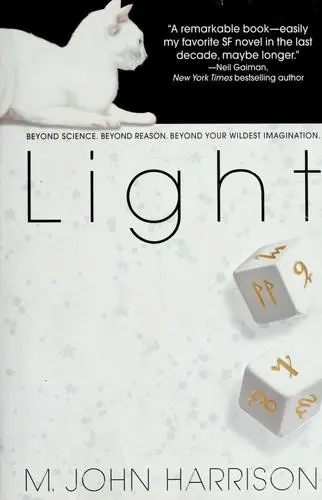
Light
Dedication
To Cath, with love
1
Disillusioned by the Actual
1999:
Towards the end of things, someone asked Michael Kearney, “How do you see yourself spending the first minute of the new millennium?” This was their idea of an after-dinner game up in some bleak Midlands town where he had gone to give a talk. Wintry rain dashed at the windows of the private dining room and ran down them in the orange streetlight. Answers followed one another round the table with a luminous predictability, some sly, some decent, all optimistic. They would drink until they fell down, have sex, watch fireworks or the endless sunrise from a moving jet. Then someone volunteered:
“With the bloody children, I expect.”
This caused a shout of laughter, and was followed immediately by: “With somebody young enough to be one of my children.”
More laughter. General applause.
Of the dozen people at the table, most of them had some idea like that. Kearney didn’t think much of any of them, and he wanted them to know it; he was angry with the woman who had brought him there, and he wanted her to know that. So when it came to his turn, he said:
“Driving someone else’s car between two cities I don’t know.”
He let the silence develop, then added deliberately, “It would have to be a good car.”
There was a scatter of laughter.
“Oh dear,” someone said. She smiled round the table. “How dour.”
Someone else changed the subject.
Kearney let them go. He lit a cigarette and considered the idea, which had rather surprised him. In the moment of articulating it—of admitting it to himself—he had recognised how corrosive it was. Not because of the loneliness, the egocentricity, of the image, here in this enclave of mild academic and political self-satisfaction: but because of its puerility. The freedoms represented—the warmth and emptiness of the car, its smell of plastic and cigarettes, the sound of a radio playing softly in the night, the green glow of dials, the sense of it as an instrument or a series of instrumental decisions, aimed and made use of at every turn in the road—were as puerile as they were satisfying. They were a description of his life to that date.
As they were leaving, his companion said:
“Well, that wasn’t very grown-up.”
Kearney gave her his most boyish smile. “It wasn’t, was it?”
Her name was Clara. She was in her late thirties, red-haired, still quite young in the body but with a face already beginning to be lined and haggard with the effort of keeping up. She had to be busy in her career. She had to be a successful single parent. She had to jog five miles every morning. She had to be good at sex, and still need it, and enjoy it, and know how to say, in a kind of whining murmur, “Oh. That. Yes, that. Oh yes,” in the night. Was she puzzled to find herself here in a redbrick-and-terracotta Victorian hotel with a man who didn’t seem to understand any of these achievements? Kearney didn’t know. He looked round at the shiny off-white corridor walls, which reminded him of the junior schools of his childhood.
“This is a sad dump,” he said.
He took her by the hand and made her run down the stairs with him, then pulled her into an empty room which contained two or three billiard tables, where he killed her as quickly as he had all the others. She looked up at him, puzzlement replacing interest in her eyes before they filmed over. He had known her for perhaps four months. Early on in their relationship, she had described him as a “serial monogamist,” and he hoped perhaps she could now see the irony of this term, if not the linguistic inflation it represented.
In the street outside—shrugging, wiping one hand quickly and repeatedly across his mouth—he thought he saw a movement, a shadow on the wall, the suggestion of a movement in the orange streetlight. Rain, sleet and snow all seemed to be falling at once. In the mix, he thought he saw dozens of small motes of light. Sparks, he thought. Sparks in everything. Then he turned up the collar of his coat and quickly walked away. Looking for the place he had parked his car, he was soon lost in the maze of roads and pedestrian malls that led to the railway station. So he took a train instead, and didn’t return for some days. When he did, the car was still there, a red Lancia Integrale he had rather enjoyed owning.
Kearney dropped his luggage—an old laptop computer, two volumes of A Dance to the Music of Time—onto the rear seat of the Integrale and drove it back to London, where he abandoned it in a South Tottenham street, making sure to leave its doors unlocked and the key in the ignition. Then he took the tube over to the research suite where he did most of his work. Funding complexities too byzantine to unpack had caused this to be sited in a side street between Gower Street and Tottenham Court Road. There, he and a physicist called Brian Tate had three long rooms filled with Beowulf system computers bolted to equipment which, Tate hoped, would eventually isolate paired-ion interactions from ambient magnetic noise. Theoretically this would allow them to encode data in quantum events. Kearney had his doubts; but Tate had come from Cambridge via MIT and, perhaps more importantly, Los Alamos, so he had his expectations too.
In the days when it housed a team of neurobiologists working on live cats, the suite had been set on fire repeatedly by extreme animal rights factions. On wet mornings it still smelled faintly of charred wood and plastic. Kearney, aware of the science community’s sense of moral outrage at this, had let it be known he subscribed to the ALF and added fuel to the fire by importing a pair of oriental kittens, one black and male, the other white and female. With their long legs and savagely thin bodies, they prowled about as unassuagedly as fashion models, striking bizarre poses and getting under Tate’s feet.
Kearney picked the female up. She struggled for a second, then purred and allowed herself to settle on his shoulder. The male, eyeing Kearney as if it had never seen him before, flattened its ears and retreated under a bench.
“They’re nervous today,” he said.
“Gordon Meadows was here. They know he doesn’t like them.”
“Gordon? What did he want?”
“He wondered if we felt up to a presentation.”
“Is that how he put it?” Kearney asked, and when Tate laughed, went on: “Who for?”
“Some people from Sony, I think.”
It was Kearney’s turn to laugh.
“Gordon is a prat,” he said.
“Gordon,” said Tate, “is the funding. Shall I spell that for you? It starts F-U.”
“Fuck you too,” Kearney told him. “Sony could swallow Gordon with a glass of water.” He looked round at the equipment. “They must be desperate. Have we achieved anything this week?”
Tate shrugged.
“It’s always the same problem,” he said.
He was a tallish man with mild eyes who spent his free time, to the extent he had any, devising a complexity-based architectural system, full of shapes and curves he described as “natural.” He lived in Croydon, and his wife, who was older than him by a decade, had two children from her previous marriage. Perhaps as a reminder of his Los Alamos past, Tate favoured bowling shirts, horn-rimmed glasses and a careful haircut which made him look like Buddy Holly.
“We can slow down the rate at which the q-bits pick up phase. We’re actually doing better than Kielpinski there—I’ve had factors of four and up this week.”
He shrugged.
“After that, noise wins. No q-bit. No quantum computer.”
“And that’s it?”
“That’s it.” Tate took off his glasses and rubbed the bridge of his nose. “Oh. There was one thing.”
“What?”
“Come and look at this.”
Tate had installed a thirty-inch superflat display on a credenza at the back of the room. He did something to a keyboard and it lit up an icy blue colour. Somewhere off in its parallel mazes, the Beowulf system began modelling the decoherence-free subspace—the Kielpinski space—of an ion-pair. Its filmy, energetic extensions reminded Kearney of the aurora borealis. “We’ve seen this before,” he said.
“Watch, though,” Tate warned him. “Just before it decays. I’ve slowed it down about a million times, but it’s still hard to catch—there!”
A cascade of fractals like a bird’s wing, so tiny Kearney barely noticed it. But the female oriental, whose sensory-motor uptake times had been engineered by different biological considerations, was off his shoulder in an instant. She approached the screen, which was now blank, and batted it repeatedly with her front paws, stopping every so often to look into them as though she expected to have caught something. After a moment the male cat came out from wherever it had been hiding and tried to join in. She looked down at it, chattering angrily.
Tate laughed and switched the display off.
“She does that every time,” he said.
“She can see something we can’t. Whatever it is goes on after the part we can see.”
“There’s not really anything there at all.”
“Run it again.”
“It’s just some artefact,” Tate insisted. “It’s not in the actual data. I wouldn’t have shown you if I thought it was.”
Kearney laughed.
“That’s encouraging,” he said. “Will it slow down any further?”
“I could try, I suppose. But why bother? It’s a bug.”
“Try,” said Kearney. “Just for fun.” He stroked the cat. She jumped back onto his shoulder. “You’re a good girl,” he said absently. He pulled some things out of a desk-drawer. Among them was a little discoloured leather bag which contained the dice he had stolen from the Shrander twenty-three years before. He put his hand inside. The dice felt warm against his fingers. Kearney shivered over a sudden clear image of the woman in the Midlands, kneeling on a bed and whispering “I want so much to come” to herself in the middle of the night. To Tate, he said: “I might have to go away for a while.”
“You’ve only just come back,” Tate reminded him. “We’d get on quicker if you were here more often. The cold-gas people are on our heels. They can get robust states where we can’t: if they make any more progress it’s us who’ll become the backwater. You know?”
“I know.”
Kearney, at the door, offered him the white cat. She twisted about in his hands. Her brother was still looking at the empty display.
“Have you got names for them yet?”
Tate looked embarrassed.
“Only the female,” he said. “I thought we could call her Justine.”
“Very apt,” Kearney admitted. That evening, rather than face an empty house, he called his first wife, Anna.
2
Gold Diggers of 2400 AD
K-captain Seria Mau Genlicher was up in the halo with her ship, the White Cat, trolling for customers.
Up there, a thousand lights out of the galactic Core, the Kefahuchi Tract streams across half the sky, trailing its vast invisible plumes of dark matter. Seria Mau liked it there. She liked the halo. She liked the ragged margins of the Tract itself, which everyone called “the Beach,” where the corroded old pre-human observatories wove their chaotic orbits, tool-platforms and laboratories abandoned millions of years previously by entities who had no idea where they were—or perhaps anymore what they were. They had all wanted a closer look at the Tract. Some of them had steered whole planets into position, then wandered off or died out. Some of them had steered whole solar systems into position, then lost them.
Even without all that stuff, the halo would have been a hard place to navigate. That made it a good hunting ground for Seria Mau, who now lay at a kind of non-Newtonian standstill inside a classic orbital tangle of white dwarf stars, waiting to pounce. She liked this time the best. Engines were shut down. Coms were shut down. Everything was shut down so she could listen.
Some hours ago she had lured a little convoy—three dynaflow freighters, civilian ships carrying “archeological” artefacts out of a mining belt twenty lights along the Beach, hurried along anxiously by a fast armed yawl called La Vie Féerique—into this benighted spot and left them there while she went and did something else. Her ship’s mathematics knew exactly how to find them again: they, however, tied to standard Tate-Kearney transformations, barely knew what day it was. By the time she returned, the yawl, overburdened by its duty of care, had got the freighters into the shadow of an old gas giant while it tried to calculate a way out of the trap. She watched them curiously. She was calm, they were not. She could hear their communications. They were beginning to suspect she was there. La Vie Féerique had sent out drones. Tiny actinic spangles of light showed where these had begun to encounter the minefields she had sown into the gravitational subcurrents of the cluster days before the freighters arrived.
“Ah,” said Seria Mau Genlicher, as if they could hear her. “You should be more careful, out here in empty space.”
As she spoke, the White Cat slipped into a cloud of non-baryonic junk, which, reacting weakly to her passage through it, stroked the hull like a ghost. A few dials woke up in the manual back-up systems in the empty human quarters of the ship, flickered, dropped back to zero. As matter, it was barely there, but the shadow operators were drawn to it. They gathered by the portholes, arranging the light that fell around them so that they could make the most tragic picture, looking at themselves in mirrors, whispering and running thin fingers across their mouths or through their hair, rustling their dry wings.
“If only you had grown like this, Cinderella,” they mourned, in the old language.
“Such a blessing,” they said.
Don’t let me have to deal with this now, she thought.
“Go back to your posts,” she ordered them, “or I’ll have the portholes taken out.”
“We’re always at our posts—”
“I’m sure we never meant to upset you, dear.”
“—always at our posts, dear.”
As if this had been a signal, La Vie Féerique, running fast upside the local sun, blundered into a minefield.
The mines, two micrograms of antimatter steered on to station by hydrazine engines etched into silicon wafers a centimetre square, weren’t much more intelligent than a mouse; but once they knew you were there, you were dead. It was the old dilemma. You daren’t move and you daren’t stop moving. The crew of La Vie Féerique understood what was happening to them, even though it was very quick. Seria Mau could hear them screaming at one another as the yawl split lengthwise and levered itself apart. Not long after that, two of the freighters ran into one another as, dynaflow drivers clawing at the spatial fabric, they broke cover on desperate, half-calculated E&E trajectories. The third slunk quietly away into the debris around the gas giant, where it turned everything off and prepared to wait her out.
“No, no, this is not how we do it,” said Seria Mau. “You tubby little thing.”
She appeared from nowhere on its port stern quarter and allowed herself to be detected. This produced an explosion of internal coms traffic and a satisfying little dash for safety, to which she put an end with some of her more serious—if less sophisticated—ordnance. The flare of the explosion lit up several small asteroids and, briefly, the wreckage of the yawl, which, locked into the local chaotic attractor, toppled past end over end, wrapped in a rather beautiful radioactive glow.
“What does that mean?” Seria Mau asked the shadow operators: “La Vie Féerique?”
No answer.
A little later she matched velocities with the wreckage and hung there while it wheeled slowly around her: buckled hull plates, monolithic items of dynaflow machinery, what looked like mile upon mile of slowly weaving cable. “Cable?” Seria Mau laughed. “What kind of technology is that?” You could see every strange thing out there on the Beach, ideas washed up a million years ago, modified to trick out tubby little ships like these. In the end, the bottom line was this: everything worked. Wherever you looked, you found. That was everyone’s worst nightmare. That was the excitement of it all. Preoccupied by these thoughts, she eased the White Cat further in, to where the corpses turned in the vacuum. They were human. Men and women about her own age, bloated, frozen, limbs at odd, sexual angles, slowly cartwheeling through an atmosphere of their own possessions, they streamed past her bow. She nosed between them, looking for something in their expressions of dull fear and acceptance, though she was not sure what. Evidence. Evidence of herself.
“Evidence of myself,” she mused aloud.
“All around you,” whispered the shadow operators, giving her tragic glances from between their lacy fingers. “And look!”
They had located a single survivor in a vacuum suit, a bulky white figure windmilling its arms, trying to walk on nothing, opening and closing on itself like some kind of undersea life as it doubled up in pain or perhaps only fear and disorientation and denial. I suppose, thought Seria Mau, listening to its transmissions, you would close your eyes and tell yourself, “I can get out of this if I stay calm”; then open them and understand all over again where you were. That would be enough to make you scream like that.
She was wondering how to finish the survivor off when a fraction of a shadow passed across her. It was another vessel. It was huge. Alarms went off all over the K-ship. Shadow operators streamed about. The White Cat broke right and left, disappeared from local space in a froth of quantum events, non-commutative microgeometries and short-lived exotic vacuum states, then reappeared a kilometre away from her original position with all assets primed and ready. Disgusted, Seria Mau saw that she was still in the shadow of the intruder. It was so big it could only belong to her employers. She put a shot across its bows anyway. The Nastic commander edged his vessel irritably away from her. At the same time he sent a holographic fetch of himself to the White Cat. It squatted in front of the tank where Seria Mau lived, leaking realistically from the joints of its several yellowish legs, stridulating every so often for no reason she could see. Its bony-looking head had more palps, mosaic eyes and ropes of mucus than she preferred to look at. It wasn’t something you could ignore.
“You know who we are,” it said.
“Do you think it’s so clever to surprise a K-ship like that?” shouted Seria Mau.
The fetch clicked patiently.
“We were not trying to embarrass you,” it said. “We approached in a perfectly open way. You have been ignoring our transmissions since you did . . .” It paused as if searching for a word; then, clearly at a loss, concluded uneasily: “This.”
“That was a moment ago.”
“That was five hours ago,” the fetch said. “We have been trying to talk to you since then.”
Seria Mau was so shaken she broke contact and—as the fetch faded away into a kind of brown smoke, a transparency of itself—hid the White Cat in a cloud of asteroids some distance off, to give herself time to think. She felt ashamed of herself. Why had she acted like that? What could she have been thinking of to leave herself vulnerable like that, insensible out there for five hours? While she was trying to remember, the Nastic vessel’s mathematics began stalking her again, making two or three billion guesses a nanosecond at her position. After a second or two she allowed it to find her. The fetch reformed immediately.
The Story Continues on BooksBarbecue!
Enjoyed this preview? ❤️ Do not stop here!
Read the complete book free online → 🔗
Continue reading now on BooksBarbecue and discover every page!
Love reading? Bookmark BooksBarbecue.com for more amazing books!
Happy Reading!