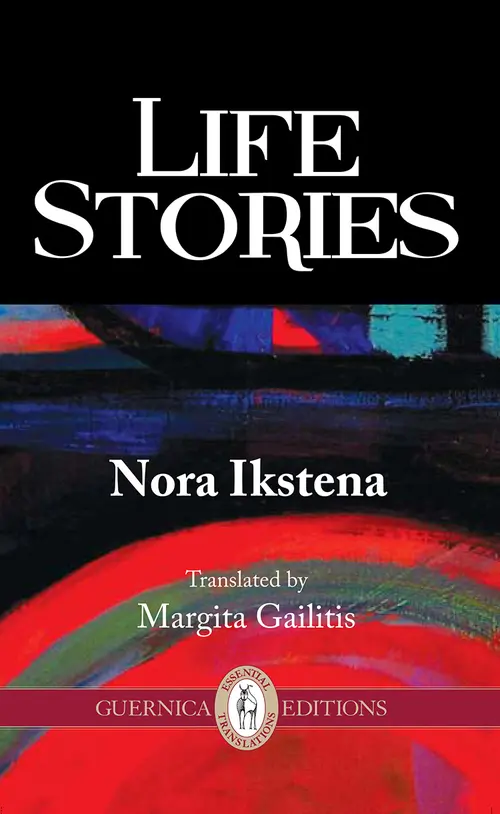
Life Stories
ESSENTIAL TRANSLATIONS SERIES 11

Nora Ikstena
Translated by
Margita Gailitis
Edited by Vija Kostoff
GUERNICA
TORONTO – BUFFALO – BERKELEY – LANCASTER (U.K.)
2013
Contents

The Orange
Still Life with Death
Amaryllii
The Son
Naģe
The Shame of Gaveiki
Elza Kuga’s Old Age Dementia
The White Handkerchief

The Orange

It is a cold winter night. They have turned on several electric heaters in their three room flat in one of the city’s apartment buildings. The heating system alone does not suffice. When the children get up in the morning to go to school, they squabble over who will get into the bathroom first, because it has the largest radiator and is always the warmest. If one fills the bathtub full-blast with hot water, then steam rises and it is very like a sauna. After almost suffocating from the constantly turned on gas stove in the kitchen, they had changed over to electric heaters. It is more expensive of course, but the air is better.
The children are asleep; the dog is snoring away on a doormat in the narrow corridor. Her husband has not yet come home. Leaning against the pantry door in the dark kitchen, Ada gazes at the winter skies through the flowers of ice frosted on the windowpane. The refrigerator hums now and then in an otherwise total silence. It is so long since she has seen these flowers of ice. Probably the last time was in her childhood, when they – three children, her mamma and papa – lived in one room in a factory workers’ barrack. With her breath or the tip of a finger, she could melt a hole in the flowers of ice. Jack Frost rattled the corners of the wooden building. The fire in the woodstove burned and in her cosy and warm den of a bed Ada and her sister beat up on their little brother. He always had to suffer because mamma dressed him in the hand-me-downs of the two girls. Dressed in a girl’s double breasted coat with its two rows of buttons, he sat, always somewhat dirtied on the barrack steps and ate his afternoon snack with a spoon from a tin bowl. Mamma wanted the boy to grow big and strong so, when she put him to bed, she crammed his mouth so full of cottage cheese. He would wake in the morning like a hamster storing nuts – with cottage-cheese puffed cheeks.
Ada opens the small ventilating window and lights up a cigarette. How abnormally bright the stars are! Even in the warmth of the kitchen, looking through the flowers of ice, she can sense how cold it is. In the winter more than ever she would like to be at her mother’s in the country. She hates the trolley buses, on which she has to commute to work. People in their winter clothes are twice as fat, sullen and ill-tempered, especially in the mornings. The air is hot and smelly. If she is pushed into a seat by a window, then she freezes. It is even worse going on the bus with the children, because then she must worry all the time, that someone might step on them or crush them. It is cold in the office. They have begun to warm themselves drinking Balsam liqueur. She very much likes the taste of coffee with Balsam. From somewhere, one hears the never-ending sound of old, used up heating pipes breaking down. One can break one’s neck on the street; in some places there is only a narrow path tracked between the road cleared for auto traffic and gigantic heaped mountainsof snow. Ada understands that these are the grey mundane dues paid for freedom, acquired relatively peacefully. There were, of course, sacrifices, but there was also an undeniable and unforgettable euphoria.
Her life seemingly is simple. She gets up, prepares breakfast, sees her husband off to work and her children off to school, commutes to work, has a cheap lunch in a café, a cigarette, a coffee with Balsam, commutes home from work, roams through stores, takes the children out from extended day-care, waits for her husband to come home, prepares supper, looks at TV and has quiet sex, so the children do not wake. Saturdays and Sundays they go to the country to one or the other of their mother’s homes. Back to the city with bacon, preserves and pīrāgi, which help to stretch the family budget until the next week. There is a constant lack of money. In the last little while, she suspects her husband has some other interests. Often there is joy regarding the children. Fun and love-filled get-togethers with her brother and sister, and their children. Parties with friends. Drives with relatives to graveyard festivities honouring the souls of the dead as custom would have it. Now and then she has a pain in her side. It perhaps sounds simple. But she very much loves her life. She is delighted with this simplicity. The day-to-day activities, waiting for the holidays. She knows how to motivate people. Since she has not gotten used to complicating anything, she takes her life as it is.
Nonetheless, late in the evenings, smoking and gazing through the flowers of ice at the starlit sky, she gets carried away in her thoughts. She remembers – even though they were always fed and clothed, they lived their childhood and school years very frugally, bordering on poverty. But the factory people were likeone large family. Sincere, generous people without hidden agendas. Simple like her every day. On Saturdays and Sundays, in that same one room relatives gathered from everywhere. They ate, drank, sang. And they felt good, because they had survived the war and deportation. Once her father brought very refined city people to their home. They offered as a gift coffee beans for her mother and said that they would very much like to drink some. Mamma had never seen such beans. She boiled water in the large kettle on the wood stove, threw in a handful of the beans and, in tasting her concoction, did not understand what possessed these people to drink such a thing. Probably they were totally mad – she decided.
After work in the factory, papa used to write poetry in the evenings. In those instances when he went on a bender and played a card game called zolīte with the neighbours, mamma placed herself in the doorway and told him once and for all to stop living in a dream world. His poems rhymed and were very sincere, and he was particularly good at dedications.
Once a very famous artist came to the factory. He was looking for working people to paint. But he saw the teen-aged Ada in the factory yard. He asked for permission from mamma and papa to paint Ada. They didn’t object. The artist stayed for a whole month. Mamma made simple meals for him, which he very much enjoyed. Apparently he had had a great deal of success with his city exhibition of Ada’s portraits. One Saturday he arrived together with his wife in his black Volga car. He had brought along all sorts of housewarming gifts they had never seen before. Drinks, food and clothes for the children. Mamma got very flustered and told them that they had enough themselves. Then the children were shooed outside, because it wastime for adult talk. When they were finished, mamma, flushed red from anger, stood on the doorstep and repeated: “I, ne pasacīsi, I ne pasacīsi” – meaning “It’s unspeakable!” This is what she always said, when she couldn’t find what to say. The artist and his wife left immediately afterwards. When Ada was older, mamma told her that the very fine couple had wanted to take Ada to live with them. That here she was living in poverty and that they promised to lay the world at Ada’s feet. When mamma told this story, she always broke into uncontrollable tears and repeated: “I ne pasacīsi, I ne pasacīsi …”
On evenings like this, Ada loses herself in thought, wondering what it would have been like if the artist couple had taken her. But she doesn’t pursue it. She is stricken with qualms of conscience, because just thinking such thoughts would hurt her mother deeply. Her simple, dear mamma, who from her very meagre pension puts money aside for her children and grandchildren, takes care of neighbours poorer than herself and every day feeds the woman next door who is raising her granddaughter on her own.
The children are already fast asleep. The dog comes into Ada’s kitchen and lies down, resting his nose on his paws. Her husband is still not home. Ada’s left side is hurting again, and it occurs to her that perhaps the world would not be the worse if she would no longer be here. Would everything continue as before? She becomes frightened by such thoughts; her heart pounds fast and, to calm herself, she trickles some drops of valerian tincture into a glass of water. During the time that the Russians were here, mamma on the quiet had taken the children to the catholic region of Latgale to christen them in that faith. There people have great respect for the dead, but they don’tspend much time thinking about dying. But why does her left side hurt so?
Ada finally goes to bed, having in vain waited for her husband to come home. She dreams of a gigantic mountain of snow. With her brother and sister, she is tumbling down the mountain, then climbing back up and tumbling down again. In her dream she can even taste the little balls of snow matted in her mittens. Her brother, wearing father’s old pile cap with the ear flaps, is the first to reach the mountain top. He offers a helping hand to Ada. She tries to grasp his hand but no matter how she tries, can’t reach it. It’s so very close, so close. Her little brother pulls off his mitten and reaches once more with his bare hand, but he still can’t reach Ada. Why oh why can’t he reach her when she is right there, close by. Her brother stretches out his hand in vain
– Ada can’t reach it.
Ada sits bolt upright in bed. There is no one, nothing beside her. Her heart is pounding like crazy, and it feels as if all the left side of her body is aching. Ada has decided not to go see a doctor. She is strong, full of life force. The pain comes and goes. Especially after taking some Balsam it ceases. She does her daily chores. These help her not to think …
… She braids her daughter’s hair, irons the creases in her husband’s and her son’s pants, fries four eggs, serves mamma’s cucumber salad with oil for breakfast, does the wash on laundry day, bleaches the whites, rinses the socks twice, vacuums the rugs, deals with the dust dreadfully collected on the television and the book shelf, makes stroganoff for supper with mashed potatoes to be served with mamma’s marinated beets, perhaps prepares a fruit compote – the liquid-y kind, without potato starch. Work at the office is almost like rest, limited pay but steady … has a cigarette with the girls, a lunch of wieners with peas, cheese salad, tomato juice, coffee with Balsam. When she scours the stores, she can always find something modern, even with the lack of money, she always manages to be “with it.” Perhaps her husband has some new romantic infatuation, but he still loves her. Last night, when she was crying, he hugged her and gently caressed her head. Saturday they will go to mamma’s, meet up with her brother and sister and their children there, eat mamma’s delicious food, sit and chat a while, slide down a hill, throw snow-balls. But again she feels that pain in her side …
Ada buys a medical encyclopaedia. Sometimes the pain appears when she pees. Therefore, it must be her kidneys. If she only has the pain when she pees, then she simply must have caught a chill. If the pain persists all the time … Ada reads the word “tumour.” A short while ago one of her young colleagues at work died of cancer. His heart was strong but he spent a year bed-ridden. All his relatives had been totally worn down from taking care of him. They borrowed money in all sorts of places for the medication and other treatment expenses. The wife walked around as grey as last year’s snow, with blue circles under her eyes. The only good thing was that they had no children.
From the moment she opens the encyclopaedia, she is beset by the Tormentor. The evil one weighs her down in the mornings, evenings, afternoons and nights. She has life-force to spare; she is strong. She imagines how horrendous her dying would be. She would be a burden to her husband, children, sister, brother and mother. They, who already are stretched to the limit making ends meet, would each in their turn have to look after her. She would have to bear long, protracted suffering. She would wither away and deteriorate in front of them all. Not being able to get to the toilet by herself any more, she would have to pee and shit in pampers. She would vomit from the radiation treatments. Her hair would fall out. To alleviate the unbearable pain she would be shot full of pain-killers until she would be in a trance-like state and not herself when she eventually died. She has cancer for sure. Because she has the precise symptoms described in the encyclopaedia. Why should she go to a doctor, who will tell her exactly the same thing? Probably very soon blood will appear in her urine. And that will be a certain sign.
… Ada is peeling potatoes; the Tormentor pounds at the back of her head. Ada eats wieners with peas, the Tormentor pounds at the back of her head. Ada is sewing a carnival costume for her daughter, the Tormentor pounds at the back of her head. Ada is cutting her son’s hair, the Tormentor pounds at the back of her head. Ada is sitting with her brother and sister at her mother’s set table, the Tormentor pounds at the back of her head. Ada kisses mamma good-bye, the Tormentor pounds at the back of her head. Ada is drinking coffee with Balsam, the Tormentor pounds at the back of her head. Ada goes shopping, the Tormentor pounds at the back of her head. Ada is falling asleep, the Tormentor pounds at the back of her head. Ada gets up in the morning, the Tormentor pounds at the back of her head …
It is as if there are two Adas. One, who continues to live her daily life; the other, who knows the dreadful truth, but has not yet decided what to do about it. The second Ada totally rules the first. She torments, tires, and does not allow her to breathe. No one would ever understand or believe it if she tried to tell them what is happening to her. She is surrounded by bright people, but she is full of darkness. She feels guilty that she can’t get a grip on herself. Sometimes she, run down and tormented beyond belief, finds herself at the door of the out patient clinic, but she never has enough courage to enter. No, once she did go in, saw a long corridor and worn-out people sitting by the doors to the doctors’ offices. It seemed like a totally hopeless scene. She could not bring herself to join the people waiting.
When in the evening she smokes her cigarette at the small ventilating window, her husband comes into the dark kitchen and asks her:
“What’s wrong with you?”
One of the Adas wants to throw her arms around her husband, to have a good cry and to tell him everything, about the pain in her left side when she pees, about her dreadful fear and certainty that she has cancer and will soon die, about the Tormentor that does not leave her for even one blessed moment. But the second Ada wrestles her arms behind her back and presses her hand against her mouth so that she can barely breathe. When Ada is set free, she takes a puff of her cigarette and answers her husband:
“It’s nothing, just a bit of a stitch in my left side …
“Sometimes one gets a stitch here and there,” her husband concludes, taking a beer from the refrigerator and going to watch television.
She is left alone in the dark kitchen. In wild beast snares, fish nets, and wolf pits. Her side is aching unbearably and her heart beats savagely. She would like to tear open the kitchen window, taped tight against winter draughts, and jump into the cold air. Anywhere but here. She is her own jailor. The sentence has been passed; no one will ever set her free. She downs the bottle of Valerian.
Her sleep is full of nightmares. In her dream she is walking barefoot to her mother’s. The road is long and it is freezing cold, so very cold. But in her dream she is only one Ada. The other – the Tormentor – has vanished. Ada knows that the road will be long and hard, but she will get to her mother’s, will tell her everything and it will all be much, much easier. Perhaps mother will be able to help Ada. Oh, how her feet are freezing! Ada starts to run to warm up. On entering the yard, she wants to throw her arms round her mother, but her mother is standing on the doorstep, crying and wringing her hands, repeating over and over: “I ne pasacīsi, i ne pasacīsi, i ne pasacīsi …”
In the morning she tells her husband that she does not feel well and remains in bed. She gets up late and somehow manages to get to work. Her supervisor tells her that she looks ill, she should go home. Walking to the trolleybus stop, Ada accidentally meets her brother and literally collapses in his arms. She bursts into tears, hanging onto his dear, strong body. Her brother tries to calm her as they go to the furthest corner in a café, order coffee and Balsam and Ada, choking and sobbing, tells her brother about the other Ada, who is killing her. About the pain when she pees, the pain in her left side, about the cancer …
Her brother takes her in his lap, embraces her, pats her head with his large palm and, to comfort her, assures her that all will be fine. Already tomorrow they will go together to the best kidney specialist in the city. He will explain all and cure all that is curable.
Her brother takes Ada home, draws her husband aside for a private chat, plays with the children and leaves until the next day.
Ada’s husband makes a soothing tea and brings it to her in bed.
“I still love you, everything will be fine,” he says, speaking these simple, calming words.
She falls into a peaceful sleep and has a beautiful dream. She together with her brother and sister, the three of them are making angels in the snow. They are children, then adults, then old people. The sun is shining on the snow covered field; time does not exist; everything happens simultaneously. They get up and fall, get up and fall, grow old and grow young again, grow old and grow young again. The whole field is covered with small and big angels. A cold, sunny, endless field of angels.
The Story Continues on BooksBarbecue!
Enjoyed this preview? ❤️ Do not stop here!
Read the complete book free online → 🔗
Continue reading now on BooksBarbecue and discover every page!
Love reading? Bookmark BooksBarbecue.com for more amazing books!
Happy Reading!