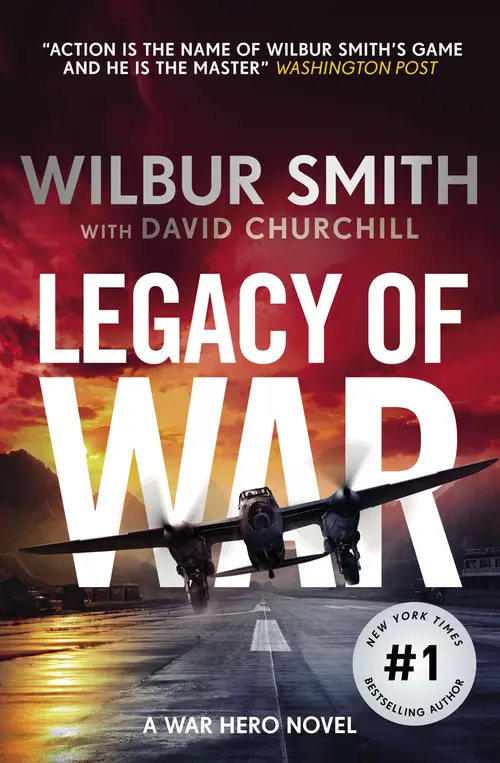
Legacy of War
Cover
Praise for the novels of Wilbur Smith
Praise for the novels of

‘Read on, adventure fans.’
THE NEW YORK TIMES
‘A rich, compelling look back in time [to] when history and myth intermingled.’
SAN FRANCISCO CHRONICLE
‘Only a handful of 20th century writers tantalize our senses as well as Smith. A rare author who wields a razor-sharp sword of craftsmanship.’
TULSA WORLD
‘He paces his tale as swiftly as he can with swordplay aplenty and killing strokes that come like lightning out of a sunny blue sky.’
KIRKUS REVIEWS
‘Best Historical Novelist — I say Wilbur Smith, with his swashbuckling novels of Africa. The bodices rip and the blood flows. You can get lost in Wilbur Smith and misplace all of August.’
STEPHEN KING
‘Action is the name of Wilbur Smith’s game and he is the master.’
WASHINGTON POST
‘Smith manages to serve up adventure, history and melodrama in one thrilling package that will be eagerly devoured by series fans.’
PUBLISHERS WEEKLY
‘This well-crafted novel is full of adventure, tension, and intrigue.’
LIBRARY JOURNAL
‘Life-threatening dangers loom around every turn, leaving the reader breathless . . . An incredibly exciting and satisfying read.’
CHATTANOOGA FREE PRESS
‘When it comes to writing the adventure novel, Wilbur Smith is the master; a 21st century H. Rider Haggard.’
VANITY FAIR
Dedication
I dedicate this book to my wife, Niso.
From the day we first met she has been a constant and powerful inspiration to me, urging me on when I falter and cheering me when I succeed. I truly do not know what I would do if she were not by my side. I hope and pray that day never comes. I love and adore you, my best girl, words cannot express how much.
Kenya, June 1951
KENYA, JUNE 1951
In the flickering, smoky light cast by torches of burning brushwood, Kungu Kabaya looked past the slaughtered goat lying in the middle of the abandoned missionary chapel towards the men, women and children watching in fearful expectancy.
There were around sixty of them, members of the Kikuyu tribe and ‘squatters’, as the white farmers called their black labourers. For no matter how hard a squatter worked; no matter how long he, or his father, or even grandfather had lived on the farm; no matter how skilfully he had built the hut in which he and his family lived: he only stayed on the farm with the farmer’s blessing and could be expelled at any moment, with no right of appeal.
Kabaya cast his eye towards a separate group of around twenty squatters, men and women alike, who had been selected to take part in tonight’s ceremony, and he nodded to the one at the head of the line. He was thin and gangly, no more than eighteen years old. With a young man’s reckless bravado he had volunteered to be the first to take the oath. But as the gravity of his decision weighed upon him, his courage was giving way to anxiety and trepidation.
Kabaya approached him and put a fatherly arm upon his shoulder.
‘There’s nothing to fear,’ he said, speaking quietly so that only the youngster could hear him. ‘You can do this. Show them all that you are a man.’
The five men Kabaya had brought with him to the ceremony glanced at one another and gave nods or smiles of recognition as they watched the young man straighten his back and hold his head up high, his confidence restored. They had all served with Kabaya in the King’s African Rifles, a British colonial regiment, during World War Two, campaigning in Ethiopia against Mussolini’s Italian armies and then in Burma against the Japanese. They had watched as he had been promoted from private to company sergeant major within five years. And for each of them there had been times when Kabaya had found the words to keep them going in times of hardship, or given them courage when the fighting was most fierce.
When they came home to East Africa to discover that their military service had earned them neither human rights, nor decent jobs, Kabaya and his men had turned to crime. Their gang was one of many that emerged in the teeming shanty towns that had sprung up around the Kenyan capital, Nairobi, but it swiftly became the most powerful. The gangsters had become rebels and still they followed Kabaya. Whether a soldier, a criminal or a terrorist, their boss had a genius for leadership.
Kabaya stepped back to leave the young man alone in the middle of the floor. As he did, his second in command, Wilson Gitiri, sat beside the goat, placing the wickedly sharp, long-bladed panga knife with which he – like all of Kabaya’s men – was armed, on the floor by his right hand.
Kabaya was a tall, handsome, charismatic man. He was highly intelligent, confident in his ability to win people over by reason and charm as well as fear. Wilson Gitiri was malevolence personified. He was shorter in stature than his commander, but he was as barrel-chested as a bull. His face was criss-crossed with thick welts of scar tissue. His eyes were permanently narrowed, forever searching for possible threat. His hair was plaited into tight braids that were gathered in a ridge that ran from the back to the front of his scalp like a soldier’s forage cap. His presence in the chapel was an act of intimidation.
An earthenware jug, a battered tin cup and a length of rope had been placed by the head of the goat. Gitiri poured a small measure of thick, dark, viscous liquid from the jug into the cup, before replacing both vessels in their original position.
Minutes earlier, Gitiri had removed one of the goat’s legs with a single blow from his panga. He had skinned the severed limb, cut the muscles away from the bone and diced the uncooked flesh into twenty cubes, which he piled in a wooden serving bowl. This, too, sat on the floor beside the animal’s body.
Kabaya glanced at Gitiri to ensure he was prepared.
Gitiri nodded.
Kabaya said, ‘Repeat these words after me . . . I speak the truth and vow before God, and before this movement of unity . . .’
‘I speak the truth and vow before God, and before this movement of unity,’ came the response, like a parishioner following his pastor’s lead.
The oath-taking began as Kabaya spoke and the young man repeated the next lines:
That I shall go forward to fight for the land,
The lands of Kirinyaga that we cultivated.
The lands which were taken by the Europeans
And if I fail to do this
May this oath kill me . . .
Gitiri stood, holding the tin cup in one hand and the wooden serving bowl in the other. He held out the bowl. Kabaya took a piece of raw, bloody meat and offered it to the young man, saying, ‘May this meat kill me . . .’
The young man, whose eyes kept darting towards Gitiri as if he dared not leave him out of his sight, hesitated. Kabaya glared at him, his eyes fiercer, more demanding this time. The young man took the meat, repeated, ‘May this meat kill me,’ and put it in his mouth. He chewed twice, grimaced, then downed it in one swallow.
Gitiri held out the cup. Kabaya took it from him and said, ‘May this blood kill me . . .’
The young man repeated the words and drank a sip of blood from the tin cup.
The other Kikuyu tribespeople in the hall looked on in awed, horrified fascination as two separate strands in their culture were woven into a single binding cord.
Solemn blood-oaths had long been central to Kikuyu life, though in the past they had been restricted to elders rising to the highest councils of the tribe. Within the past seventy years they had been converted to Christianity and were familiar with the rite of Holy Communion: the blood of Christ and the flesh of Christ, expressed in wine and wafer. This was a darker, deeper, more African communion. It spoke to the very core of their being and everyone, from the youngest child to the most snowy-haired grandparent, knew that any oath taken under such circumstances was a sacred, unbreakable vow.
Kabaya intoned the last lines of the oath, and the young man repeated after him . . .
I swear I will not let the white men rule our land forever . . .
I swear that I will fight to the death to free our lands . . .
I swear that I will die rather than betray this movement to the Europeans . . .
So help me God.
Kabaya dismissed the young man, who walked back towards the main mass of his people. A knot of other youngsters grinned at him and applauded their friend. But he did not share their joy. He had looked into Kabaya’s eyes and understood that the words he had sworn were deadly serious. He would only live as long as he obeyed them.
One after another, the chosen squatters took the oath, some with enthusiasm but most because they were too terrified to refuse. There were only five men and women left to be sworn in when Kabaya pointed to a man in late middle age and said, ‘You next. What is your name?’
‘Joseph Rumruti,’ the man said.
He was not a tall man, nor strongly built. He had thin, bony limbs and a small pot belly. His scalp was almost bald and his beard was mostly grey. When he said his name he did so diffidently, as if he were apologising for his very existence.
‘I am his wife, Mary Rumruti,’ the woman next to him said. Like her husband, she seemed meek and submissive.
Kabaya chuckled. ‘Mary and Joseph, eh? Is your boy Jesus here tonight?’
The men on either side laughed at their leader’s wit.
‘No, sir, we have no son,’ said Joseph. ‘The Lord did not see fit to bless us with children.’
‘Huh,’ Kabaya grunted. ‘So, Joseph . . . Mary . . . it is time for you to swear the solemn oath. Repeat after me—’
‘No.’ Joseph spoke as quietly as before.
A tense, fearful silence descended upon the hall.
‘Did I hear you say “No”?’ Kabaya asked.
‘That is correct,’ Joseph replied. ‘I cannot take your oath for I have already made a pledge, in church, in the sight of God, that I will have nothing to do with you and your renegades, or any other men like you.’
‘Woman,’ Kabaya said, looking towards Mary. ‘Tell your man to swear the oath. Tell him to do this, or I will make him swear.’
Mary shook her head. ‘I cannot do that. I have taken the same pledge.’
Kabaya stepped up close to Joseph, towering over him, his veneer of civility falling away to reveal the iron-hearted warrior within. His broad shoulders seemed to swell beneath his khaki shirt, his fists clenched like the heads of two blacksmith’s hammers. Kabaya’s eyes glowered beneath his beetling brow.
‘Swear the oath,’ he said, speaking as quietly as Joseph had done, but with a chilling undercurrent of menace.
Joseph could not look Kabaya in the eye. His head was bowed, his body trembling with fear.
‘No,’ he repeated. ‘I cannot break my word to God.’
‘You are not the first person to defy me,’ Kabaya said. ‘They all swore the oath in the end, and you will too.’
‘I will not.’
The tension in the hall tightened still further. One man shouted, ‘Take the oath, Joseph! For God’s sake, take it!’
‘Listen to your friend,’ Kabaya said. ‘Heed his words.’
Only those closest to Joseph could hear him say, ‘I will not.’
Kabaya heard.
‘I have had enough of this foolishness,’ he said. ‘I will make you swear.’
To Gitiri he said, ‘The rope.’
Gitiri walked to where the dead goat lay. He put down the cup and bowl. He picked up the rope. Each movement was slow, deliberate, almost as if they too were solemn components of the oathing ceremony.
He faced Kabaya and tied the rope into a noose with about two feet of its length protruding from the knot.
Kabaya nodded.
Gitiri put the noose over Joseph’s head. He tightened it until it was snug against Joseph’s throat, then he stepped behind Joseph, holding the end of the rope.
‘One last chance,’ Kabaya said. ‘Will you swear?’
Joseph shook his head.
Kabaya said to Mary. ‘Take the oath and I will spare you.’
Mary stood taller, squared her shoulders, looked up at Kabaya and, to his face, declared, ‘No.’
Kabaya gave a shake of his head and shrugged, as if he did not want to take the next step but had been left with no choice. He nodded at Gitiri.
Gitiri closed the noose more tightly against Joseph’s neck. Gitiri’s expression betrayed no emotion.
Joseph was struggling to breathe.
‘Look at me,’ said Mary, and he obediently turned his eyes towards her.
‘This can stop now,’ Kabaya said. ‘You can go free. Just swear.’
Joseph did not respond.
Again Gitiri pulled the noose, slowly constricting Joseph’s throat, completing the task in tiny fractions.
Kabaya looked over to the rest of his men, picked out three of them with his finger and nodded in Mary’s direction. They took up station around her, brandishing their machetes.
The two remaining men, the ones armed with rifles, raised their guns at the crowd, which recoiled, pressing closely to the mission walls.
‘If you will not save yourself, save her,’ Kabaya said to Joseph.
‘Don’t!’ Mary cried. She started intoning the words of the 23rd Psalm. ‘ “Yea, though I walk through the valley of the shadow of death, I will fear no evil . . .” ’
There was a murmur from the crowd, a rumble that formed the word, ‘Amen.’
‘You prepare a table before me in the presence of my enemies. You anoint my head—’
Kabaya lost his patience. ‘Do it,’ he ordered.
The soldiers obeyed their commanding officer. Gitiri gave a brutal tug on the rope, tightening the noose so violently that it smashed through Joseph’s larynx and crushed his windpipe.
As his body collapsed, Mary screamed. The other three men hacked at her with their machetes, slicing into the arms she raised in a futile attempt to protect herself, and butchering her body. Within seconds she was lying dead beside her husband and her blood was bathing them both.
Kabaya looked at the corpses with indifference. He glanced at the final three oath-takers. They were huddled together, their arms wrapped around one another’s bodies.
‘Take the oath,’ Kabaya said.
In desperate voices that cried out to be believed, they did what they were told.
London
LONDON
‘Before we go any further, I’d like to propose a toast,’ said Saffron Courtney Meerbach, raising her glass of champagne. ‘To Gubbins . . . who brought us all together, and without whom none of us would be here today.’
‘To Gubbins!’ chorused the other five men and women seated around the table in the small French bistro.
They had met there at her invitation as a nod to days gone by. The restaurant was an old haunt for them all. It was off Baker Street in central London, a stone’s throw from the headquarters of the Special Operations Executive, the wartime intelligence agency in which all but one of them had served. Brigadier Colin Gubbins was their commanding officer.
‘By God, he was scary though, wasn’t he?’ Leo Marks, a small man with a puckish smile added. ‘I still have nightmares about the first time he fixed those eyes of his on me. Classicists among us will recall the basilisk, the mythical Greek snake that could kill with a single glance. Well, dear old Gubbins made the basilisk seem like the Sugar Plum Fairy.’
Of all the people at the table, only one had joined in the toast out of politeness, rather than enthusiasm. He was tall, with the chiselled features, tousled dark-blond hair and perfect tan of a Hollywood star. But there was a slight hollowness to his cheeks and, occasionally, a haunted look to his cool, grey eyes that spoke of a man who had seen and experienced horrors beyond any normal human imagination. He was not the only one around the table of whom that was true.
‘Tell me, my darling,’ Gerhard Meerbach said in a light German accent, as he reached across the table and took his wife’s hand. ‘I understand how Gubbins links you all together. But how do I owe my presence here to him?’ Gerhard gave a wry shrug of the shoulders. ‘I was on the other side.’
‘Because, dearest,’ Saffron replied, ‘it was Gubbins who packed me off to the North German plain in late April ’45, to try and find our missing agents, including Peter . . .’
Peter Churchill gave a modest nod of his bespectacled head as Saffron continued, ‘Had I not been there, I should never have followed the trail of the high-value prisoners that the SS were hoping to trade for favours with the Allies all the way to . . .’
She was about to say ‘Dachau’, but stopped herself. She didn’t want that hellish nightmare intruding on their gathering.
Instead she said, ‘All the way across Germany and into the Italian Tyrol, where . . . where I found you, my darling . . . and thought I’d arrived too late . . .’
The sudden, vivid memory of Gerhard’s skeletal, feverish wreck of a body lying on what seemed to be his deathbed took Saffron unawares. She could not speak for the lump in her throat and had to blink back the tears before she could mutter, ‘Sorry,’ to the rest of the table. She pulled herself together, took a deep breath and with a forced briskness added, ‘But I hadn’t . . . and everything was all right, after all.’
Silence fell across the table. They all had their own bitter memories and understood how shallow the emotions of war were buried, how the pain could creep up on one at any moment.
Peter Churchill knew what a decent English gentleman should do at such a moment: lighten the mood.
‘I say, Saffron,’ he piped up. ‘It seems to me that you’re hogging the limelight in the matter of the Gubbins–Meerbach connection. After all, if I hadn’t been stuck in the same concentration camp as Gerhard, we wouldn’t have been on the same grim charabanc ride across the mountains. Thus I wouldn’t have been able to keep him more or less alive . . .’ He glanced towards Gerhard. ‘You were in the most terrible state, old boy, we thought you were a goner for sure . . . And I only happened to be on the bus thanks to Baker Street’s determination to keep sending me into Occupied France until I finally got caught. Ergo, the Law of Gubbins applies to me too.’
‘Then I agree, I must also thank Brigadier Gibbins,’ Gerhard said. ‘And I thank you, Peter, from the bottom of my heart. I would have died without you.’
‘Think nothing of it, old boy. Anyone in my shoes would have tried to help. Inhuman not to.’
Gerhard nodded thoughtfully. He frowned as he collected his thoughts and the others gave him time, knowing that there was something on his mind. Then he said, ‘Here we are, talking about the war. I can’t help but think of the terrible things I saw . . . You know I was imprisoned, but before that I spent three years on the Russian Front. I was at Stalingrad, almost to the very end. I saw what was done to the Jews – the firing squads, the gas vans. All my closest friends were killed.
‘Sometimes I feel cursed by fate to have had to endure so much horror, so much suffering and death. But then I tell myself, no, I am blessed, truly blessed, for I have experienced a miracle. I stumbled to the edge of the grave, but I did not fall in. I lived.’
Gerhard looked at the others, knowing that they had suffered as much, or more than him, and that they shared his feelings in a way most ordinary people could never do. He went on, ‘And when I awoke from the sleep of death, the first thing I saw was an angel . . . Saffron, my true love.
‘I would like to propose a toast. And I have been wondering what we should be drinking to . . . Good fortune, maybe – or love, or friendship, or peace – but what I would like to toast is what we all share . . .’ He raised his glass. ‘To life, the greatest blessing of all.’
They drank again and then their food was served. Up to this point, Peter Churchill’s wife Odette, a slender, dark-eyed brunette had been happy to listen while the others talked. Now she spoke in a French accent.
‘I am sure you will understand, Gerhard, that it was not easy for me, the thought of having lunch with a German . . .’
‘Of course,’ Gerhard replied.
‘But then Saffron wrote to me and I learned how you two had met before the war and fallen in love, and Peter told me that you had both been at Sachsenhausen at the same time. I realised that you had been a victim of the SS, just like me. Now we have met and, well, I can understand why Saffron fell in love with you.’
‘Merci beaucoup, madame,’ said Gerhard, with a nod of the head.
Odette gave a quick, sparkling smile before composing her features and replying with equal formality, ‘Je vous en prie, monsieur . . . But there is one thing of which I am curious. Did you ask Saffron’s father for permission to marry his daughter? I would very much like to know how he reacted when he heard his daughter was marrying a German.’
Gerhard grinned. ‘Good question! And I am not just any German. My family and Saffron’s have a certain . . . ah . . . history . . .’
‘My father killed his,’ said Saffron, in such a casual way that no one was sure how to respond.
That process was made all the more tricky when Gerhard remarked, in an equally offhand tone, ‘It is only fair to say that my father had been trying to kill her mother, who was at that time, his mistress.’ He paused for a beat and then added, ‘Though she was actually in love with Mr Courtney.’
‘Well, that’s Africa for you,’ said Saffron casually, while the others were trying to work out who had been killing, or loving, whom.
‘My dear, this is too fascinating, and one day you must tell me the whole family history,’ said Odette. ‘But for now I would like your husband to answer my question.’
The Story Continues on BooksBarbecue!
Enjoyed this preview? ❤️ Do not stop here!
Read the complete book free online → 🔗
Continue reading now on BooksBarbecue and discover every page!
Love reading? Bookmark BooksBarbecue.com for more amazing books!
Happy Reading!