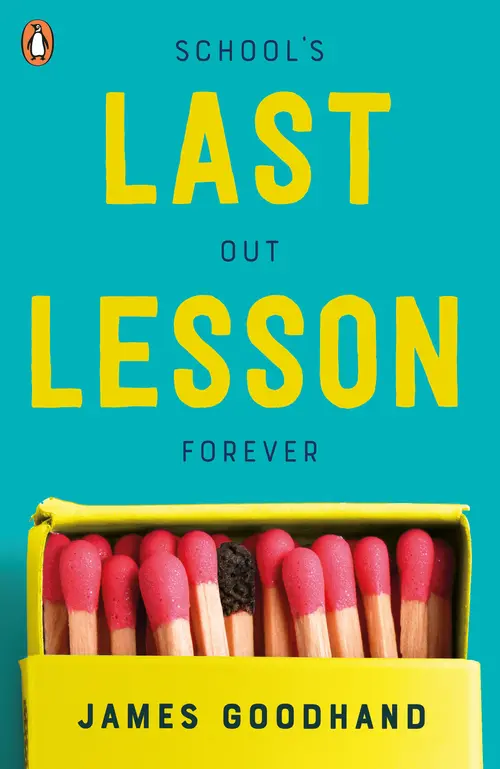
Last Lesson
Cover

About the Author
James Goodhand lives in Surrey with his wife and young son. A mechanic by day, much of his work has been written at an oil-stained workbench whilst ignoring a queue of broken cars in need of his attention. James is also a keen musician, regularly gigging as a rhythm and blues pianist.
Dedication
For Vikki

4.52 a.m.
I’ve slept for close to five hours. I almost congratulate myself. My sleep is black and it soaks the bedsheets, but it’s a mechanical necessity for a mind that’s screaming to rest. Being in constant fear for your life is every bit as tiring as you’d imagine.
I perch on the edge of the bed, clawing at the carpet with frozen toes. The first thoughts after waking are, of course, not to be trusted. Doubts have this way of worming themselves in during the small hours, leaving you to face each morning in the belief that you can’t achieve anything above the ordinary.
Can I really do this?
As I do every morning, I squeeze my eyes closed and picture Aunty Kaye’s face. Some days the image comes easily, sometimes so slow I panic that I’ve lost it. Today she appears with the clarity of a photograph almost immediately. My breathing steadies. Calm descends.
I begin my imaginary appeal to her; run through my reasons, one by one, as if we’re just chatting over iced lattes at that jazz bar overlooking the marina – the one we hung out at last summer. I explain to her why this is the best solution. The only solution. She isn’t fazed at all; her expression shows no judgement or shock. She just listens; she just understands. She always understood. I imagine her voice, still clear despite the time that’s passed. It’s the voice of birthdays, of Christmas Eve, the voice of the best memories.
‘Well then, you have no choice,’ she says, nodding, aware of just how huge the consequences will be.
Smearing my soles dry across the carpet, I stand and draw the faded floral curtains apart. A late May dawn has begun its rise over the slate roofs and chimneys that stagger down the hill from our house. The only hint of a woken world is the distant rush of a London-bound train. All the work vans are still parked in the shade. The place looks peaceful. You might even think it pretty in a rugged kind of way – pretty for the sort of estate people are born in and never leave.
For a moment, I can ignore thoughts of my fellow members of Class 11C, dotted about the town, enjoying the sleep they’ve long deprived me of. Instead, I think of Sophia.
Something close to a smile forms. She’s due at work in an hour; she’ll be leaving home soon. Is she as nervous as I am? It’s hard to imagine. Does she even believe that I’m going to go through with it? She’ll have her doubts, I’m sure of that. My stomach burns as I imagine our plans for tonight – for when this is over. For the first time today, I am certain.
This is happening.
5.11 a.m.
I’m halfway down the stairs when I see it. I stop dead. This is what I have to put up with.
Clinging to the banister holding my breath, I cock an ear up towards the landing. I listen for confirmation that Gramps is still asleep. There’s a lengthy silence, then a desperate gasp for oxygen as his snore resumes its rattle. Relief – chronic back pain from a lifetime of laying lawns and patios makes him prone to unpredictable early risings. The thought of him stumbling on this doesn’t bear thinking about.
I creep the rest of the way downstairs, shaking my head as I stare at the front door. My own jerky breathing seems deafening; the creak from each stair makes me wince. I’m certain I’ll wake him any second.
On the mat, in the soft blue glow through the frosted glass, lies one unlit match. As I crouch, the now-familiar stench of lighter fuel fills my nostrils. Level with my eyes, a couple of tiny spheres of the liquid dangle from the sharp edge of the letterbox.
This is the third time. I’m furious that it still freaks me out so much; that my hand still trembles as I lay a palm on the bristles of the doormat and study the shiny coating it leaves on my fingers.
‘Fuck you,’ I hiss, my teeth digging into my bottom lip as I spit the words. The heat comes fast to my eyes; the floor becomes a blur. I swipe the sleeve of my dressing gown across my face. ‘Why the fuck do you do this to me?’ The words leave my mouth as a whining whisper. ‘What did I ever do to you?’
It’s not that they don’t have the balls to light the match. They do. They will. This is just another warning shot, a little reminder of what’s to come today. This is their game. Think of an executioner: when does he feel at his most powerful? As the axe slices through his victim’s neck, or as he stands, wielding that axe far above his head?
This phase of their campaign is three weeks old now. Nate Mackie’s whisper from behind me in that school assembly replays in my head. ‘We’re going to burn your house down, Morcombe,’ his speech slow, no intonation to the words. ‘We’re going to burn it down when your grandad’s asleep.’ His hot breath was millimetres from my ear, the rancid waft of stale Marlboros curling round me. ‘He’s getting cremated, Ollie.’
The fight, once contained within the school’s perimeter before sprawling out into the parks, alleys and pavements of my route home, had now reached my own front door.
I ease the key round in the lock, lean my shoulder into the door and noiselessly yank it clear of its frame. The mat bows under its sodden weight as I step outside, the dewy front lawn freezing beneath my bare feet. I angle it to dry in the low sun. Only a little of the solvent has spilled over on to the carpet, nothing a sheet of kitchen towel won’t soak up. This brings me an odd sense of relief. The first time there’d been a lot more of the stuff. And the carpet was only laid a few months back. It’s a brown-and-white swirly affair, like it was inspired by the icing on a vanilla slice. ‘Won’t show the dirt,’ Gramps had enthused as he thumbed a musty book of samples the guy in the shop had taken ages to find.
I cried myself dry that first time – not out of fear, but out of concern for Gramps’s new carpet. Why the hell was that the most upsetting thing? I fight an aching in my throat even now, as I massage at the pile, absorbing every last trace of lighter fluid.
The silent clean-up complete, I sit on the bottom stair with the unburnt match in my palm. An idea comes to me. It’s perfect.
‘Have it your way then,’ I mouth, slipping it into my pocket. There’s only one thing to be done with this little match. It’s unnecessary, but I’ll do it anyway. Because then I can tell Sophia that I did. She’ll love it. And what matters more than that?
6.29 a.m.
‘Looking very dapper, Ollie-wally,’ Gramps says, tossing half a pig’s worth of bacon in the pan with a TV chef’s flourish.
I’m hardly dapper; it’s just that I’ve bothered to wear the fresh shirt he ironed and hung in my room a week ago, and I’ve run some of his Brylcreem through my hair. I tug on the yellowed cord to start the extractor fan – the smell of cooking is doing nothing to help my nausea.
‘Not sure I’m hungry actually, Gramps,’ I say, watching him assemble a tower of rashers on to four slices of bread.
‘Such nonsense,’ he replies, pouring the fat evenly to dress the sandwiches. He passes me a pan of steaming milk. ‘Do the honours, lad.’
We take our coffee the same way: four spoons of instant from a catering drum of the stuff, three spoons of sugar, mixed with Gold Top warmed on the stove. It may not be the breakfast of champions, but it is the breakfast of insomniacs.
‘Got to keep eating the bacon,’ he muses. ‘Only thing that keeps my mind off those terrible pains in my chest.’ He makes this gag about twice a week, but I manage a chortle all the same.
Gramps takes the plates through to the living room where he’s laid the table with the red-check cloth usually reserved for Sunday roast and Friday night Chinese. Talk radio waffles from the portable stereo on the sideboard. Today they’re taking calls on the topic of depression and anxiety.
‘That old chestnut again,’ Gramps says with a smirk and a glance in the direction of the speaker as he tucks a sheet of kitchen roll into his shirt collar.
It’s always talk radio with Gramps, never music; he’s not really a music man. He owns just two albums – one Elvis Presley and one Michael Bublé, and he only has the latter because he found the CD in the little Vauxhall he bought when he retired. There was a time when there’d be an unspoken pre-breakfast race to the radio: the blues and roots hour on Gold if I beat him, angry people ranting down a phone if I didn’t. These days, I just leave it to him.
‘Last day of school, Ollie,’ he says, shaking his head. ‘Can’t believe it. How on earth have twelve years gone by since I dropped you off for your first day? Remember it?’
‘Sure.’ I remember it well. It was not long after I’d come to live with Gramps. Riding up front in his creaky gardener’s pickup truck that smelled of diesel and grass cuttings, my feet only just making it to the edge of the bench seat, feeling like I was a mile up in the air. As my fellow kindergarteners were extracted from boosters in boring hatchbacks, they stared in envy. It was like turning up in a Ferrari. ‘For elevenses,’ I remember him saying, handing me a half-packet of ginger nuts from the top of the dash. Such a generous supply had made me immediately popular come break time.
I smile at Gramps as he scoops a run of brown sauce off his chin. My appetite has appeared from nowhere, and I take a massive bite of sandwich before it has a chance to evaporate.
‘It’s not really the last day,’ I say. ‘Still have to go in for exams.’
‘But everything’s your choice now. It’s all different from here.’ He tips his coffee mug in a cheers gesture.
He has no idea how right he is. I’ve known for a while now that I won’t be taking my GCSEs. I think of the stack of study guides Gramps has bought me, lying among the squalor of my room, unread, but cracked at their spines and gnarled at their corners so I don’t appear ungrateful. They must have cost him a fair few quid.
‘I’m proud of you, Ollie,’ he says, from absolutely nowhere.
This is not how we communicate. My once-best-friend Amit and his family used to hold mealtime conversations as if they were in some secretly filmed soap opera. Gramps and I, we do nothing of the sort. My mouthful of food seems to dry out, resisting all attempts at being swallowed. It’s eventually sluiced down with a gulp of coffee and a jaw-aching amount of chewing.
‘Thanks,’ I say, looking at the table.
He tips his head forward and fixes me with his stare. ‘And your Aunty Kaye would be very proud indeed.’
I force myself to hold his gaze, giving him a single nod in reply.
‘Just a few more weeks of graft and you’ll be made.’ He looks over to the wall behind him – the Wall of Ollie – expecting no doubt that he’ll soon have something to add to it. The centrepiece is the upright piano that I played every night from the age of seven. The lid remains open – for some reason, neither of us have thought to close it. The keys would be blanketed in dust were they not clearly part of Gramps’s cleaning routine. Arranged chronologically above are my school photos, one per year, ranging from age five to fifteen. The grin gains self-assurance with the passing years; the stance gets cockier. It’s a look that I couldn’t begin to fake these days. My music exam certificates are framed and hung, grades one to eight. There’s an enlargement from the local paper – me shaking hands with the mayor when she handed out awards at the end of middle school. Biggest of all, one of Gramps’s own snaps: I’m hunched over a baby grand, awash with the reds and magentas of stage lighting, the night I closed the showcase at the playhouse in town.
The report from my mock GCSEs is this year’s only addition to the shrine. It displays just my name, a list of subjects, a column of As. Nothing to hint at how close those grades came to breaking me, how I barely slept that week, how I had to learn everything word for word and shout it in my head over and over to hold it there until each exam was done, all so I could scrape the marks that everyone’s come to expect. And the ten years’ worth of previous reports covering that wall – nowhere do they tell you how easy it all used to be.
‘I’ll do my best,’ I say, because it seems the right thing. But I can’t bring myself to look at him now. My eyes defocus over the red squares of the tablecloth as though I’m waiting for some hidden 3D image to reveal itself. Whatever everyone at school says, I am not a compulsive liar. And lying to Gramps hurts every time I have to do it.
‘Let’s show your mother what you can do,’ he says. There’s unconvincing laughter in his voice now. ‘Prove how her old dad’s doing a half-decent job in her absence.’
‘She knows,’ I mumble.
As I raise my head, he winks at me. I set my remaining sandwich to one side.
‘I see the doormat has taken itself for a walk again this morning,’ Gramps says, with an off-centre smile, like this is a running joke of ours.
‘Spilled some coffee on it.’ I try to look right at him as I say it, but our eyes become locked for too long.
‘I’m not having a pop at you, Ollie-wally. It just made me chuckle, that’s all. How many times has that happened now? Four? Five?’
It’s three times. Definitely three. Or it could be four. I shrug.
‘You’re a daft old stick, aren’t you?’ He playfully jabs my arm with his fist. I give the weakest, fakest laugh I’ve ever heard.
It’s gone seven now. I have some important cargo to pack. I savour the last of my syrupy coffee, clamping the mug between greasy palms, staring down into the muddy liquid as it slops around.
Gramps has assumed the look of a man unimpressed, his head tilted towards the radio. The guy calling in sounds bright and articulate as he talks about failing to hold down two jobs in succession because some days the panic attacks are so bad he can’t even leave the house. Gramps ejects a noisy stream of air from the corner of his mouth.
His attention snaps back to me. ‘What time you home tonight, lad?’
The question jars every one of my muscles. This is the one conversation I’d hoped to avoid, even if he does ask it over breakfast nearly every day.
‘Got a piano lesson. A bit late, I guess.’ The piano lesson bit is true at least.
‘Nothing else? I’d have thought you might be doing something with all your pals as it’s your last day.’
My pals. The word makes me cringe. I imagine my entire class being in the room as he uttered it. How deliciously hilarious they’d find the suggestion.
‘Don’t think so. Not heard anything.’
‘I dare say there’ll be something on.’
‘Maybe.’
‘Well, I’ll hold off dinner just in case.’
Dinner. The image of his dutiful preparation of a Special Meal creeps into my mind. I force a door closed in its face. Such thoughts risk derailing me. Already a strange sort of inertia is keeping me at the table – a reluctance to sign off what will be our last breakfast together, for some time at least.
Remember why you’re doing this. Remember why you’re doing this.
Do nothing and I die. Do nothing and they’ll come for Gramps. And there’s something else; something I can’t even bring myself to imagine right now.
Just remember why the fuck you’re doing this.
‘Maybe just chippy tea then?’ he suggests.
I shake away the invading thought. ‘Chippy tea. Yeah.’
Gramps points his thumb towards the stereo, inviting me to pay attention. The caller’s voice falters as he explains how helpless he feels. ‘In your own time,’ the host says smoothly. The guy says how sometimes he goes days without eating because he’s so anxious he daren’t step outside to go shopping for food.
Gramps rolls his eyes. ‘Incredible,’ he says, looking at me for agreement. ‘Ever heard anything like it? Bloody incredible. Pull yourself together, for Christ’s sake. Get out of your house and be a bloody man.’
I thank him for my breakfast, and I take his advice.
7.19 a.m.
The cold air of the night still fills the shed as I slip inside and bolt the door behind me. It takes a moment for my eyes to adjust to the half-light, the sun struggling to cut through the film of green on the windows. Among the mowers and machine tools, the place is full of the homemade projects of my childhood: the pedal car, the petrol go-kart, the motorized raft that sank and never ran again, the various stunt kites in need of repair. Dropping my rucksack to the floor, I grasp Gramps’s toolbox with the sticker on the lid declaring Happiness is a Comprehensive Toolkit, and wrestle it to one side. Behind stands a pyramid of old paint cans, deliberately selected for their rustiness to ensure that none are at risk of being looked for.
I feel light-headed as I draw in a lungful of air and begin to dismantle the tower. When I piled them up here at the weekend, I’d thought about the ceremony of their removal, how this would finally be it. My hands shook then as they shake now.
The dull steel is freezing to the touch as I lift it from its bed of rags on the floor. To the casual observer, it looks no more menacing than an offcut of scaffold tubing, which is exactly what it is. A little bigger than a beer can, the tube is capped at both ends, and there’s a little hole that I’ve drilled in the wall of the cylinder – the detonation hole. Anyone expecting a black bowling ball with a sparking fuse poking out of the top would be very disappointed. Make no mistake – this is what a bomb looks like.
There’s this little book that lives on the top shelf in the spare bedroom. Issued to Gramps’s uncle, it has an olive-green hard cover and nicotine-yellow pages. It smells of history. In an unassuming typeface no bigger than all the text that follows, it is titled, The Home Guard Guide 1940. Among the tutorials on digging trenches in a hurry and sabotaging enemy communications, it’s full of advice on improvising explosive devices. I’ve browsed through it a few times over the years, idly imagining that it might be fun to build something from its instructions, but in recent weeks it’s become my bible. People understood back then. While men of fighting age were sent to the front, those too young still had a duty. It’s no good blindly going about your business when the enemy is among you – you have to fight.
I rest the thing on the workbench – pipe bomb number four.
My first attempt was a dud; I spent half an hour watching it do nothing at all from fifty metres away. Number two fired, but just shot a sheet of angry flame out of the detonation hole. The pair of them share a shallow grave in Perrett Woods. Number three is responsible for a crater a metre and a half wide, and a series of posts on Facebook asking if anyone else heard that noise. I still have the remains of it: a blackened and jagged sheet of steel that was once a sealed cylinder, smelling like rotten eggs, looking like a torn tatter of the thinnest fabric.
Standing on the edge of that blast hole, under cover of darkness and a wood in fresh bloom, I came face to face with the destructive intent of what I’d been building. My delight at a successful firing ebbed as the minutes passed, replaced by a swelling panic. I’m certain I would have just levelled the ground and left the project behind right then, filed in my mind as an idea too bold for my weak self, had it not been for Sophia. Her wild-eyed smile never abated the whole time we stood there. She squeezed my hand in hers, small and soft. ‘You’re so brilliant,’ she said.
My current version shares the blueprint, only it’s bigger.
The Story Continues on BooksBarbecue!
Enjoyed this preview? ❤️ Do not stop here!
Read the complete book free online → 🔗
Continue reading now on BooksBarbecue and discover every page!
Love reading? Bookmark BooksBarbecue.com for more amazing books!
Happy Reading!