Lara
Cover
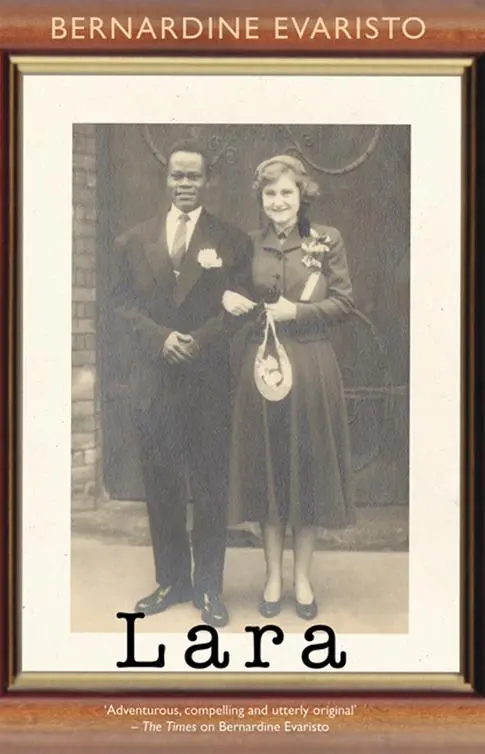
BERNARDINE EVARISTO
LARA
Lara is a powerful semi-autobiographical novel-in-verse based on Bernardine Evaristo’s own childhood and family history. The eponymous Lara is a mixed-race girl raised in Woolwich, a white suburb of London, during the 60s and 70s. Her father, Taiwo, is Nigerian, and her mother, Ellen, is white British. They marry in the 1950s, in spite of fierce opposition from Ellen’s family, and quickly produce eight children in ten years. Lara is their fourth child and we follow her journey from restricted childhood to conflicted early adulthood, and then from London to Nigeria to Brazil as she seeks to understand herself and her ancestry.
The novel travels back over 150 years, seven generations and three continents of Lara’s ancestry. It is the story of Irish Catholics leaving generations of rural hardship behind and ascending to a rigid middle class in England; of German immigrants escaping poverty and seeking to build a new life in 19th century London; and of proud Yorubas enslaved in Brazil, free in colonial Nigeria and hopeful in post-war London. Lara explores the lives of those who leave one country in search of a better life elsewhere, but who end up struggling to be accepted even as they lay the foundations for their children and future generations.
This is a new edition of Bernardine Evaristo’s first novel Lara, rewritten and expanded by a third since its first publication in 1997.
‘Lara is a wonderful piece…extraordinarily beautiful… rich and evocative… fascinating in its span of time and continents. Like all the best writing, by the end I felt not only a little older, but a lot wiser’ – ANDREA LEVY.
‘A short, lyrical, vividly real novel-in-verse, dipping 150 years into the past to explore the family history of a British woman with a Nigerian father and English mother. It’s funny, touching, informative, passionate and very easy to read. If you’re tired of novels that all seem the same, this one’s a complete original’ – Daily Telegraph (Books of the Year).
BERNARDINE EVARISTO
LARA
‘the family is like water’

Dedication
For Jack (Obayomi), Charlie (Oladimeji),
Natasha (Iyabo) and Marlon (Akinola)
Inheritors of this history…
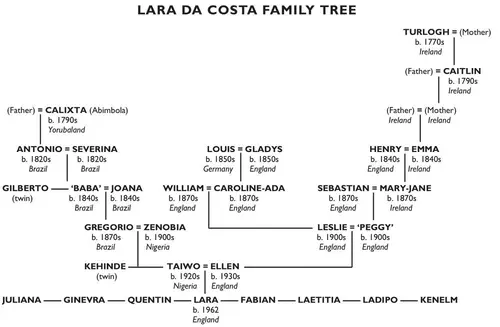
LARA DA COSTA FAMILY TREE
Epigraph
However far the stream flows,
it never forgets its source
YORUBA PROVERB
INDEX OF FIRST LINES
- Title Page
- Dedication
- LARA DA COSTA FAMILY TREE
- Epigraph
- Part One
- PROLOGUE
- Sugar cane, damp musky earth, saccharine vanilla
- CHAPTER 1
- Oh Mama! Your pride when I boarded the Apapa
- Sam says this country is like fishermen’s bait, Mama
- My nickname is Bill now, after William the Conqueror
- Winter’s arthritic tress lace evening’s broody sky
- Ellen thought British boys danced like ironing-boards
- Ellen wanted to marry the Heavenly Bridegroom
- The supreme test of submission to the Will of God
- You will go to your husband as an uncrushed flower
- CHAPTER 2
- Baby Ellen was the cherished, cuddled, coddled
- I pour dreams onto Ellen like syrup on treacle tart
- My husband Leslie walks like a subaltern on parade
- Peggy invested in the future, the past – a pit to fall down
- Emma was delivered into her mamaí’s dying arms
- ‘They want to make us suckle Sasanach words’
- Sure it’s a peat hovel, but it’s our home
- I awoke cuddling a chilly bough
- CHAPTER 3
- Chintz, carpets, mahogany, marquetry
- I’m the scullery maid, the skivvy, the flunky
- Only way to escape is through marriage
- I’ve already won some green ribbons at the staff fair
- The miracle of his wet tongue in combat with mine
- He was so dashing marching in the parades
- CHAPTER 4
- The sweaty armpit of London: the seven septic
- Everything’s all right
- ‘Henry Robbins of Brackley, Northamptonshire’
- Twenty of us last time in the Black Maria
- One hundred children in this classroom and still
- My hands are crab’s claws
- No pleasing the narky wife
- Sebastian Aloysius Burt
- CHAPTER 5
- Mary Jane and Sebastian got hitched in Holborn
- The Picture of Dorian Gray by Oscar Wilde
- Mary Jane stitched food into her children’s mouths
- The past framed itself into a child-crowded doorway
- ‘The sky’s a bowl of dirty washing-up water’
- CHAPTER 6
- The sirens sounded, an eerie deafening wail
- I was in the kitchen slicing ham for afternoon tea
- Dew shivers on wild grass blades, tremulous tears
- Redcurrant, blackcurrant, blackberries, gooseberries
- Visitors glide through the folly like woodland fairies
- Dear mummy and daddy, thank you for the choklate
- Dear Gerard, London is full of broken buildings
- Dear Gerard, I am now at St Joseph’s Convent
- CHAPTER 7
- The year Lizbet is crowned, Everest conquered
- My dear boy, praise the almighty that you are safe
- I burn up all night. I burn up
- Tears are for sissies, women and Nancy-boys
- ‘Oh! He’s not too dark, is he?’ Edith grimaced
- A workman’s drill reverberated in Ellen’s head
- Hope rises with the sun over London’s spring streets
- Two veiled alabaster Madonnas reside as mantelpiece
- Gossiping locals are incensed. A nigger! A darkie!
- Sky rips its sagging grey hymen with a fingernail
- A rainbow flashes the exhausted sky
- Peggy’s duck pillows become ponds when Ellen visits
- ‘And how many wives do you have, Bill?’
- Disloyalty slimes into my kitchen like slugs at night
- CHAPTER 8
- ‘Was born in a fog and been in one ever since’
- Came into this world covered in boils
- Peggy’s such a dainty, doll-like little thing
- My wife and my mother can’t stand each other
- So when Ellen brought this coloured fellow home
- CHAPTER 9
- Louis Wilkening felt like a Teutonic titan
- Robbed of his clogs, rats chewed his toes, bats
- The Asylum for the Houseless Poor
- Sugar baking is ze chit vurk of ze devil
- Ich bin ein Master Baker, Louis would proudly declare
- Edwin and George Huxtable, my chums next door
- A man is not a man until he has produced sons
- Gladys dreams of a Royal Doulton flushing toilet
- When hoardings declare war with Germany
- One sticky summer’s night Woolwich seethed
- I am a man not a nation, Louis was given to say
- Part Two
- CHAPTER 10
- ‘Ellie, marry me soon, you are of age now’
- Snowflakes sprinkled down that cold Christmas eve
- My hands cup two creamy breasts
- I shot into creation as sperm from my father’s penis
- I got two big googly eyes an’ tufty hair
- A fizzy-eyed beauty with Ovaltine skin, Juliana,
- 173 Eglinton Road, ‘Atlantico’, sits like a fat Victorian
- If I were a poet, Ellen muses, I’d say life’s a mangle
- A cats’ chorus rains onto corrugated dustbins
- CHAPTER 11
- Dawn released London from anonymous night
- My children will not swim in a lake of lost dreams
- The key turned, the front door
- He called me downstairs, potatoes were boiling
- I want Mummy Cake! I want Daddy Cake!
- By the sloping woods daffodils bloom in the spring sun
- Notre Dame’s regime was run by Mother Superior
- Nineteen Sixty-seven, our father is crying
- I am a strong man but pain is a warrior too
- CHAPTER 12
- An emerald Raleigh cycled through Lara’s childhood
- Lara’s skin oozed honey in late summer’s oven
- Tank tops, Curly Wurlys, blue mascara, Top 20
- ‘Wanna bite, Soos? Wanna bite, La?’
- ‘Wish I had hair like yours, Soos. It’s so nice’
- Beneath the squawking eaves of her attic retreat
- ‘Where’re’you from, La?’ Susie suddenly asked
- ‘You didn’t do it with him, did you?’
- His hairy tentacles grope under a silver lurex halter
- Groovers Disco shimmied with skinny teenagers
- Home. I searched but could not find myself
- CHAPTER 13
- The National Front juggernaut braked in our street
- Thor Heyerdahl’s books sailed me to Fatu Hiva
- O to cartwheel knickerless into spring
- ‘Don’t say hello then, you miserable lot’
- Evening hit the skyline, diffused the light
- ‘Yes, you can yawn all right, it suits you’
- ‘If your Uncle Sam was alive he’d have a story’
- CHAPTER 14
- Laudate Dominum, Mozart’s quavers were brown
- I stand for hours, still Madonna, lachrymose
- Hidden in the moist entrails of Atlantico
- ‘There was a child went forth every day’
- ‘My tribe is Yoruba, that is my language’
- As Lara approached the terraced box, she chucked
- No da Costa photos memoried the mantelpiece
- Your mother should have married Stephen Brown
- Sunday’s winter powdered suburbia with snow
- CHAPTER 15
- I began to dip into my skin like a wet suit
- Josh, your limbs were waves. I swam
- I was jelly, you were my mould, yet
- ‘You’ll not marry a Nigerian if you can’t obey me’
- Lautrec posters, blue lamps, Portobello pub
- Fury rode me. A wild buckjumper
- Ablaze with the sharp and the syrup, yeh
- I nightmare, damply scream into silence
- ‘You’re an undressed genius, Lara.’ Trish unwraps
- It’s pissing down out the jeep, out the door, pissoir
- Empty roads guzzle us up, frazzled tarmac
- He smelt of the sea. Hakan. And fish
- CHAPTER 16
- I was her daughter for fifty-four years
- Drizzle. Reluctant Wednesday. Smoker’s sky
- When Nana died the sea began to surge
- CHAPTER 17
- Lara descended fearfully over desert into Lagos
- Sliced dodo browned, crisped in hot oil pans
- Central Lagos. December ’93. Sweltering
- Dazzling. Whitewashed. He leans on the balcony
- ‘Dead bodies in the streets for days, open sewers’
- Henrique Oliveira’s cottage is dead
- CHAPTER 18
- Lagos Island cooking. It simmers all day long
- No wind. No air. Red-necked lizards crawl up walls
- Far from her Sowemima family in Abeokuta, Zenobia
- The twins grow into podgy little puddings
- Kehinde will die young, like a butterfly
- Gregorio, a face serene as a Benin bronze
- White square room, plastered walls, curtains drawn
- Cruel harmattans conquered the south, sweeping
- I am a boy, I go like fire, why walk when you can run
- Sea-black, wave-curved lips and decayed yellow teeth
- CHAPTER 19
- The gods born me on a fazenda in the hills of Brazil
- Children forget what is too painful to remember
- Ten blistered summers raised me on that remote fazenda
- Like a sun-dried tobacco leaf, prematurely aged
- When Africans came from the coast, I dreamt the ocean
- We were emancipados, with papers to prove it
- I took off for the jungle where I could lose myself
- ‘Candomblé has always been in my blood’
- My son swam into this world, cooked in Joana’s juices
- Was this the land of my great-grandmother home?
- CHAPTER 20
- Shakespeare, Keats, Socrates and the Romans’
- Gourd-belled, guava-sweet, crisp as custard apple
- Sometimes a child drowns in a storm drain
- She stood there, in her best blue wrapper and head-tie
- EPILOGUE
- Corcovado, Christ the Redeemer holds flirty Rio
- Salvador grips its Yoruba mother like a shawl
- I cross the state line into Amazon country at 4 A.M.
- A rainstorm hammers Manaus, rivering streets
- GLOSSARY
- ACKNOWLEDGEMENTS
- About the Author
- Copyright
PART ONE
PROLOGUE
Brazil, 1849
SUGAR CANE, damp musky earth, saccharine vanilla
journeys in from Eighteen Forty-Nine, scenting Lara.
Disembodied chords pluck the air.
‘Severina
- the scarred one. They took me while my boys slept,
my bones had shivered all day, I could barely think.
When I bent to work I imagined vultures clawing
my back. When his men came I heard my bones jangle
like wooden sticks shaking in a bowl. His chamber,
sunk in the cellars of that great house, kept for us
women, only. There he pierced me with a bayonet
as I lay on a marble slab, bound. My screams
ricocheted the walls, he ejaculated on my ruptured
body but by then I had become the fire of a naked torch,
until he put me out. Then I jumped a spider,
crept deftly through the warren of cellars into daylight
where a bird swooped me up. I became that bird,
circled the fazenda until a baobab seed rooted
from my droppings. When it broke through earth
into life, I lived in that tree, grew quickly, saw one
of my seeds planted by my stronger son over my husband
Antonio’s dead body, and so it continued. I was carried over
the ocean, burst into life, watched over Baba until
he joined us nearly a century after my death.
So you have it.’
CHAPTER 1
Liverpool, England, 1949 –
TAIWO
OH MAMA! Your pride when I boarded the Apapa.
Your son, a man now, riding the whale to paradise.
Remember the man’s voice from Broadcasting House
calling us over the air waves from England?
‘London calling The Empire! Calling The Empire!
Come in Nigeria.’ I’m coming! I’m coming!
I shouted at night into the warm winds on deck.
Mama, my dreams have been my fuel for years,
all those British films for sixpence at the movie house.
See London, then die. I was desperate to get here.
When I finally landed in Liverpool it was Heaven,
I had hoped for snow but it was just very cold.
These people run everywhere and wear mufflers.
Older cousin Sam came to greet me at the docks,
just as well because I thought the fast automobiles
would kill me. I asked Sam if many people are killed
by cars. He laughed, ‘You will get used to life here.’
The Africans have European wives and sailor’s children.
Sam has a house in Princess Park in Toxteth District,
his wife Maureen is Irish and their six-year-old
daughter is Beatrice. I said, ‘Why a white wife, Sam?’
He replied, ‘When in Rome do as the Romans do.’
Mama, I will write a letter soon, I promise you.
SAM SAYS this country is like fisherman’s bait, Mama.
It attracts, you bite, then you are trapped. I told him
I’d be here five years, get my degree and leave.
Tomorrow I head for London. Centre of the Empire!
Sam drinks stout every night complaining that John Bull
only gives him work on the railways, and I’ve met elders
in the Yoruba club in Croxteth Street who came
in the last century as stowaways and seamen,
fought in two world wars for Britain, but believe
back home is paradise. I argue Nigeria is small time.
Why eat rice and stew when you can taste Yorkshire pud,
meat and two veg? You can buy anything here,
there are so many shops, pubs on every street corner
and houses have all the modern conveniences.
Many people are respectful but some idiots shout
‘Oi! Johnny! Sambo! Darkie! Nigger!’ at us.
The elders tell us to take no nonsense from them,
so if I am abused I say quietly, ‘Just call me Taiwo,’
and boof! I fight them. Even the West Indians say
‘Do you people still live in trees in the bush?’
Mama, in this country I am coloured.
Back home I was just me.
MY NICKNAME is Bill now, after William the Conqueror.
I have found that an African name closes doors.
You would not believe the size of London, Mama,
but people live like mice, scurry into their houses
at night and draw the curtains. The streets are quiet
as cemeteries. You think they are dead, but come
morning they unlock their doors, charge back down
the pavement as if life is somewhere else. If I say
‘Hello’ they are frightened or angry or cross the road.
When we coloureds laugh freely they scowl at us
and on the Underground everyone stares into space.
I need warm clothes because it is so cold and heating
is expensive: the sun avoids this country, Mama.
I found a room in Kilburn for one pound a week,
the family were nice, the wife gave me Sunday dinner
but now I rent a cheaper room in Brixton where many
immigrants live. The landlord is Polish, the wife – Irish
and strict. No phone calls in or out. No visitors.
It is so hard to find a good place to live here
because they do not want us in their houses.
Mama, I have not written you a letter yet but
you must know that I think of you and Kehinde often.
WINTER’S arthritic trees lace evening’s broody sky,
miniature waterfalls mid-motion frozen from sloping
roof gutters; window frames display icicles –
January’s modern sculptures; bushes drip ephemeral jewellery,
coughing coal fires steam quartered panes like frost.
Chimneys, ordered as sentries, discharge bulbous smoke;
buses crawl through blizzards past snow-filled bomb craters,
faceless back-to-backs, timbers dangling mid-air
like dismembered limbs, winds creaking, no-man’s-land.
For men are needed
to replace the fallen dead. In the War like cards
stacked one by one they fell. A clarion call bugled
the colonies, and to a city burnt out from doodlebug
and Luftwaffe, they doffed cap, donned greatcoat,
dreams of prosperity, milk and gold, they were sold.
Now the emperor’s disowned sons
congregate in Commonwealth dance halls.
At the Catholic Overseas Club, Victoria, Taiwo,
proud of his zoot suit and loafers, partners the excited,
nubile paleskins who flock in from the snow
for the heat brought in from the tropics.
Kensington, London, 1953
ELLEN thought British boys danced like ironing-boards.
The students from Strawberry Hill’s Jesuit College
sought the pristine convent ladies of Maria Assumpta
at Kensington’s balls, tantalised by copious layers
of pink sequinned tulle, boned strapless tops, stoles,
corsage, lace gloves, silk purse and score cards.
Fearful of being lumped with the miserable wallflowers,
Mary with the hare lips and Deirdre with the hairy lip,
Ellen waltzed under the ballroom’s cut-crystal chandeliers
with earnest, pallid suitors to bland, suited dance bands
but before the stroke of twelve, Assumpta’s flushed
Cinderellas were gliding exquisitely through hushed
lamp-lit streets to curfew and their rooms in the Square.
Sunday mornings in the refectory, Ellen relished tales,
along with tea and buttered toast, of the Overseas Club, Victoria,
brimming with foreign students of the darker variety,
and before long her twitching antennae led her
to the jumping church hall where she jitterbugged
to rock ’n’roll, did the quickstep to swing, while Taiwo,
from his discreet observation post by the door, beamed
at the homely type in polka dot dress, a shy dimpled smile,
and knew she was the girl he would take for a wife.
ELLEN wanted to marry the Heavenly Bridegroom,
imbued from birth in the sanctity of the Catholic Church,
she worshipped Her Lord in daily prayer, did penance
for man’s original sin and her inherent wickedness.
She embraced suffering for infinite Love and Happiness
awaited her at the Eternal Bridal Feast in the Sky.
A life of love, duty, self-sacrifice to God and souls
would be embodied in her role as a White Sister,
a teaching missionary enlightening the dark continent.
This Assumpta virgin bought black babies from photographs,
paid for their upkeep, for they who were born in the southern wild
(she read) were bereft of light, though their souls were white,
although white as an angel was the English child.
She adored the choir nuns of the Assumption, well-to-do
women who as postulants gave their wealth to the convent,
striking medieval figures in purple habits, lush as drapes,
topped by a cream wimple, leather belt, rosary, crucifix.
Unlike the lay nuns in plain black and white, consigned
to stir the stewing pot with floor-scrubbed hands.
Ripe for the plucking, Her Purity, small wonder, then
that Ellen’s divine lover came in the guise of Taiwo
and in His Vivacious Company her heart was elevated
by cherubim and seraphim who trilled sweetly in her ears
and she was thrilled to be in his Noble Presence.
THE SUPREME test of submission to the Will of God
was the acceptance of pain; life was not to be a joyride,
but during the spring of Nineteen Fifty-two, Ellen,
hitherto shaped in the fashion of clay spun into a pot,
lived with a passion she’d reserved for the hereafter.
With Taiwo umbilically attached she bubbled, unbearably
excited like a five-year-old on Christmas Eve; to him
she revealed the goodies of a country he’d only known
as a stranger peering through snug windows on icy nights.
His tour began with Seven Brides for Seven Brothers
in the neon-lit cinema of London’s Leicester Square;
boating on the Serpentine’s waveless waters filled
Sunday afternoons along with rambles on Hampstead’s
wild city heath; trains to Epping Forest – picture postcard
picnics of cheese, pickles, apples, orangeade,
under fairytale ancient trees; cycle rides over London’s
evening bridges following the liquid curve of the Thames
from the Tower to the glamorous lights of Chelsea Bridge;
Soho’s tempting finger beckoned on busy Friday nights
to Hi-life basement dives replete with émigrés and sailors,
or quiet tea-sipping at Lyons Corner House on the Strand.
Soon, betrothal to The Son was replaced by devotion
to potential husband and dreams of a huge brood
of children so lots of souls could be saved in Heaven.
ELLEN
YOU WILL go to your husband as an uncrushed flower,
I fondly recall Mother Superior’s eloquent sermon,
delivered to the sixth form, my last day at school.
I am so proud to know that simile will prevail for me.
It is a summer evening, warm as I imagine Taiwo’s land.
I write at my oak desk overlooking Kensington Square;
the scent of honeysuckle travels in through my open window
from the flower-filled gardens where young lovers linger.
I think I have always felt worthless, really, of no account,
yet he makes me feel so important, I am so loved by him.
He phones me every day and I feel cherished.
I cannot believe how my love for Taiwo grows daily.
I love him with every limb, every bone, each beat of my heart,
every thought of my weak brain, every living part of me.
I love him more than life, until I die and go home to God.
I wanted to help Africa but Africa was brought to me.
My friends Mavis, Gwennie and Amy are overjoyed.
We will graduate as teachers, marry our beloveds,
go forth and multiply. My childhood has now been shed
as a caterpillar leaves its chrysalis, only to be recalled
as witty anecdotes to entertain my darling Taiwo
on winter’s cosy, married, muffin-toasting nights.
CHAPTER 2
Abbey Wood, London, 1935 –
BABY ELLEN was the cherished, cuddled, coddled,
much-loved child born to Peggy and Leslie Brinkworth.
Pampered with soaps, creams, powders; babyhood
was a perpetual playpen of squeezy, squeaky, squirty,
soft, fluffy and furry things. Nursery rhymes
seduced her to sleep, tinkering bells roused her awake,
oohs, aahs and eyes followed her every movement.
After seven years of a scrimping and saving courtship
to purchase a new house, cash down (£560) and furnish it,
the wedded two were overjoyed with their reproduction
ensconced each morning, horizontally gurgling,
to take air in her black bassinet perambulator in the garden.
At No 31 Manton Rd in the new town of Abbey Wood,
Peggy, slight of build, sleight of hand, mind revolving
like a Spinning Jenny, was bent all hours over her noisily
whizzing sewing-machine until her vertebrae stiffened
and the usually punctilious stitches ran into themselves.
When Peggy lifted her screaming infant to becalm her,
she felt no dividing line between their warm bodies,
mother and daughter were seamlessly inseparable –
she knew their paths would be overlocked forever.
PEGGY
I POUR dreams onto Ellen like syrup on treacle tart,
she’s growing up a real lady with her bows and ruffles.
Her manners are impeccable, she minds her Ps and Qs,
there are no temper tantrums in public or private
and no playing in the street – she’s not common.
A little on the clumsy side, she’s given to stubborn moods
but I’ll iron that out of her over the next two years.
She’s at St Saviour’s Primary, then she’ll pass the 11 Plus,
get a scholarship to St Joseph’s private grammar in Erith,
then university, God willing, and a successful career.
I’m one of life’s triers. I don’t give up. My home is spotless.
A quick flick with the duster each morning keeps dirt down
then a thorough going-over of a Saturday gets at the invisible.
I detest sloppiness, there’s not a thing out of place in No 31.
From the bay window in my living-room I see ninety degrees
of clear sky. In the summer at sunset it’s so beautiful –
the purples, reds and golds, all smouldering like a coal fire.
If you work hard your dreams do come true, I’m proof.
The neighbours are a bind, a nosy lot, as soon as I step
outside nets start twitching. But I’m no cause for complaint.
I make sure my windows are as spotless as anybody’s.
MY HUSBAND Leslie walks like a subaltern on parade,
stiff as wood and sticks his chest out like a peacock.
German, on his mother’s side – the Wilkenings.
As for his father’s side: uncouth with no table manners.
Leslie’s a Master Dairyman, clippity-clops
his horse and cart at dawn. Likes the silence, he says.
He wears thick glasses so I can’t always read his thoughts.
He’s sweet but ineffectual. No ‘Get-up-and-go,’ I tell him.
One of his sisters, Vera, died before he was born.
Always one who dies. Our Edna went at twenty-three,
When I visited the hospital with little Ellen, Winnie
cried because she couldn’t cuddle her. Contagious.
We were all screened. It was a terrible time.
I’m closest to Violet, she works in the Gillette factory.
Dora’s the youngest, we pay her fees for teachers’ training college.
She’s being courted now by Jacob: a doctor, a German, a Jew.
You should’ve seen Ma when she met him. She almost fell
on her knees and kissed his hands like he was the Pope.
A doctor in the family. Well, we’re all hoping.
Clerkenwell, ‘Little Italy’, London, 1911
PEGGY invested in the future, the past – a pit to fall down,
but sometimes memory was stronger than the mind
and there she was, sweet Margaret ‘Peggy’ Robbins,
whose long brown ringlets bounced down to her waist,
whose white cotton petticoats were always starched,
whose button-up boots were always hand-me-downs,
looking up as the strange Zeppelin bird glided overhead,
or the wonderful Corpus Christi procession paraded
before her in Little Italy where they lived, the dazzling
monstrance held up by the priest, golden rays shooting
out from The Host, older Italianate girls from church
wearing white veils and walking ceremoniously behind
a statue of Our Lady on a stretcher, scattering petals.
Or long-dead Gran appeared at No 31, Old Emma Robbins –
an apparition in front of the front parlour’s coal fire,
come to pull Peggy back to a childhood where Gran
was a shapeless sack of black in front of the hearth:
black bonnet, rustling skirts, gnarled, brown-spotted
hands knitting blankets. Not talking to anyone – ‘living’,
muttering in a language only she could understand.
Birr, Ireland, 1849 –
EMMA was delivered into her mamaí’s dying arms
in a damp cottage in the frozen wasteland of winter
just as the reign of the Great Hunger was coming
to a close. Its monster jaws had ravaged the island
for four murderous years, masticated the emaciated
bodies of a million poor souls, sucked the flesh
off them and buried their bones in earth blighted
with potatoes rotting with black and green mould.
Britannia, the Protestant Conqueror, who’d long ago
throttled Catholic Hibernia between her two
mammoth hands and stamped it to the ground,
did little to help, inventing scapegoats instead.
Ireland is a human swinery, an abomination,
a black howling Babel of superstitious savages –
like Widow Caitlin, who raised her grandchild Emma
in the iron crook of her arm; who’d lost five daughters
to the Hunger, her husband to Typhus, her only son Lorcan
to the exodus to find work overseas. But oh no not she.
Caitlin swore to the Good Lord that she would raise
at least one grandchild in her beloved homeland
and she made young Emma swear on the Holy Bible
never, ever to abandon Ireland.
‘THEY WANT to make us suckle Sasanach words,
to cut out our own sweet Gaelic tongue at the root,’
Caitlin told Emma, gripping the skipping child
in the vice of her hand as they crossed the sun-sprinkled
fields after Sunday’s long morning service,
their bare feet sinking into the swill of the rains.
‘A curse be upon those that invented laws
to persecute Catholics in this, God’s own country.’
In the woods, Emma ran ahead to pick bluebells,
the sun dappled her tattered cream smock,
long black hair a twisted rope down her back.
‘How dare they rob us of our right to Home Rule.
The Story Continues on BooksBarbecue!
Enjoyed this preview? ❤️ Do not stop here!
Read the complete book free online → 🔗
Continue reading now on BooksBarbecue and discover every page!
Love reading? Bookmark BooksBarbecue.com for more amazing books!
Happy Reading!