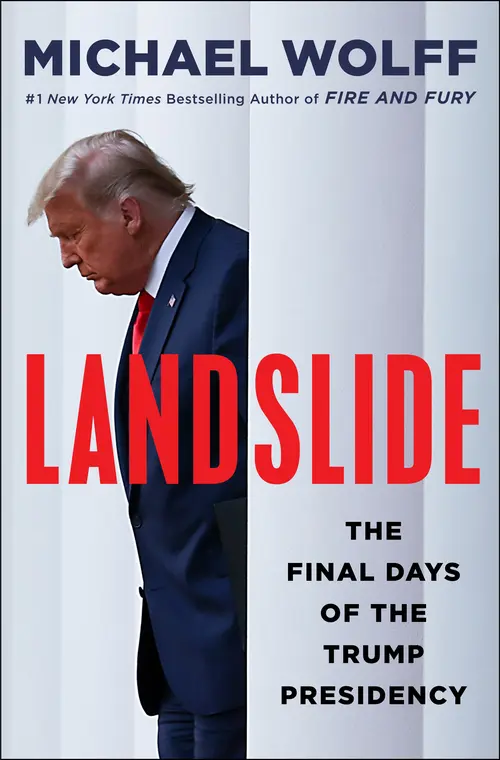
Landslide
Copyright Notice
The author and publisher have provided this e-book to you for your personal use only. You may not make this e-book publicly available in any way. Copyright infringement is against the law. If you believe the copy of this e-book you are reading infringes on the author’s copyright, please notify the publisher at: us.macmillanusa.com/piracy.
Dedication
For Paolo Lanapoppi
Epigraph
“We won. Won in a landslide. This was a landslide.”
—PRESIDENT DONALD J. TRUMP, JANUARY 6, 2021
INTRODUCTION
From the New York Times:
… [an] examination of the 77 democracy-bending days between election and inauguration shows how, with conspiratorial belief rife in a country ravaged by pandemic, a lie that Mr. Trump had been grooming for years finally overwhelmed the Republican Party and, as brake after brake fell away, was propelled forward by new and more radical lawyers, political organizers, financiers and the surround-sound right-wing media.
In the aftermath of that broken afternoon at the Capitol, a picture has emerged of entropic forces coming together on Trump’s behalf in an ad hoc, yet calamitous, crash of rage and denial.
But interviews with central players, and documents including previously unreported emails, videos and social media posts scattered across the web, tell a more encompassing story of a more coordinated campaign.
Across those 77 days, the forces of disorder were summoned and directed by the departing president, who wielded the power derived from his near-infallible status among the party faithful in one final norm-defying act of a reality-denying presidency.
January 31, 2021
Except …
In the days and weeks after Election Day on November 3, the president was deserted by his aides and staff. The legal establishment, at least anyone in it with a promising career, abandoned him. His hapless band of co-conspirators were too crazy or drunk or cynical to develop a credible strategy or execute one. It was all a shit show—ludicrous, inexplicable, cringeworthy, nutso, even for the people who felt most loyal to him. The election challenge never had a chance of success.
Trump’s presidency was a mirror image of good government and the normal workings of the bureaucracy, but his final days were a further quantum-leap departure from any system capable of achieving support or successful results—or, for that matter, even an underhand and sham result.
The second impeachment trial of Donald Trump was to charge him with explicit plans and strategy and intent—his final days in office a calculated effort to do anything to remain in office. But for those who saw Trump up close, even for those who believed he was profoundly guilty of so many things, this was not getting it at all. Rather, the opposite: Trump’s true assault on democratic norms was to have removed organization, strategy, method, rationale, and conscious decision making from the highest level of government.
From the beginning of Trump’s intrusion into American political life, the striving, orderly, result-oriented, liberal world and its media were unable to fathom his carelessness and cluelessness or understand him or his supporters by any standard political measures. Hence, what might appear to be crazy and self-destructive must in fact have been a plan.
Politics could not be pure caprice or farce, could it?
This insistence on specific intent, on the calculated and “coordinated” misuse of power, keeps Donald Trump in the realm of knowable politics. But what if it was precisely the absence of intent and, instead, the swings of irrationality and mania that managed, even as his government collapsed, to hold so many people in thrall?
The fundamental modern assumption is that a crazy person cannot be elected president—a bad person, a corrupt person, an incompetent person, a mendacious person, a bigoted one, yes, but not someone who has completely departed reality. The age of modern bureaucracy demands, at the very least, being able to sit through a meeting without barking like a dog.
From the careening and calamitous last stage of his reelection campaign through the preposterous election challenge and the deadly mayhem of January 6 to the improbable buffoonery of his second impeachment trial, there emerges a much different picture from the one much of the media has painted of a corrupt, cynical, despotic effort to hold on to power and to subvert democracy. Here, instead, is a far more complicated human and political tale of desperation and delusion.
It is one that should by any logic have ended on January 6. But the most striking and determinative fact of the political age is that the Trump story continues, even in defeat, to be inspirational to so many—and why all Republican roads now lead to Mar-a-Lago. “Mr. President,” said the pollster Tony Fabrizio, trying to explain to Trump what even he might have had trouble fully grasping, “your voters believe whatever you tell them to believe.” Indeed, by mid-May 2021, new polling showed 67 percent of Republicans were of the view that Joe Biden was not the legitimate winner of the 2020 presidential election. Trump does nothing right. Cannot put one pants leg on at a time. His ham-handed, doomed, blundering, and embarrassing efforts to undo that election, together with his heedless call to arms on January 6, showed him once more to be the naked emperor, evident not only to his enemies but, with ever-deeper sighs of incredulity, also to his allies. And yet, here we are, him with his grip on the heart of only slightly less than half the nation, the once and future Donald Trump, licking his wounds and, eyeing his public, figuring what new, absurd, and rash exploit to embark on.
This is the third book I have written about Donald Trump in as many years. It’s a chronicle that has put me in close touch with almost every phase of the Trump White House and with nearly every member of the revolving cast of characters around him. A great many of them, in the West Wing, the campaign, and in the greater Republican Party, have contributed to this account, including Donald Trump himself.
The former president’s office has been supplied a detailed summary of much of the material set forth in this book. His staff has either confirmed events, conversations, and various details of Trumpworld life as I have portrayed them or offered corrections. In the event that factual matters have been disputed, they have been included only if confirmed by multiple sources.
Many who have discussed these events with me have asked to remain anonymous for reasons that will be evident from this tale.
PROLOGUE
THE TRIAL
Typos drove him wild. He might lash out for days when he found one, or when someone else, more likely, pointed out a mess-up in a letter or document prepared under his name—the infuriated concern of someone thinking somebody else’s laziness might reveal his own weaknesses.
He was spitting furious now because the legal brief was filled with botches, the second time in a week this had happened—the Unites States! In the first line! A violent overthrown! And plenty more. The press was already on him—complete ridicule, somehow a higher indignity and reason for fury than the second impeachment trial he was being subjected to.
He wanted someone fired—whoever had proofed it, fired. He wanted them gone immediately! He placed call after call to his remaining aides. “What is fucking wrong with these people? They can’t hit spell-check?”—spell-check, in the mind of a man who did not use a computer, was the solution.
The miscreant here, however, could not, practically speaking, easily be fired because it was the president’s lead impeachment lawyer, Bruce Castor. On the job for only days in the most important professional engagement of his life, Castor had rushed through reading the brief at 3:40 a.m. that morning, February 8, 2021, and had filed it straightaway. Nobody had proofed it.
Castor was trying to explain this to the former president, who kept interrupting, his voice sharp, curt, sneering, unabating, dismissing Castor’s excuses. “Spell-check, Mr. President, doesn’t pick up italicized words,” said Castor, another man who did not perhaps use a computer much.
“What? That’s the stupidest thing I’ve ever heard. Fix it! Get it back! Fix it! NOW!” the incredulous president yelled, not unusually losing his shit.
That’s what the group huddled on the frozen sidewalk outside the Trump International Hotel in Washington, DC, later that Monday morning, headless chicken–like, was trying to do—while at the same time, without preparation or, really, forethought, trying to defend a president from gross ignominy. They were fixing the typos. NOW!
“Are these lawyers the stupidest?” Trump fumed on the phone to anyone who would listen. “Are they the stupidest?”
Quite the larger problem, now overshadowed by the typo drama, was that the fourth impeachment trial in U.S. history, scheduled to start the next day, was to be argued by lawyers who’d entered the case only a week ago. Of the three main lawyers, Castor, David Schoen, and Mike van der Veen, Trump hadn’t personally met any of them and had not even spoken to van der Veen (who, indeed, would be the only lawyer to emerge with some lasting respect from Trump).
Castor sat in the Mercedes G Wagon waiting to go to the Capitol for a walk-through and to meet the Republican Senate staff. In addition, there were a Jeep Rubicon and a Range Rover waiting to take the new team to the Senate trial. Castor was still wounded because the Trump guys on the ground wouldn’t let him drive his beloved Corvette to the Capitol door. That was how he had imagined it happening. That was one reason he’d taken the case: that image. “The Corvette is me. It’s like my business card.”
The Trump aides still hanging in—at this point, largely beyond surprise—could hardly believe it. Reading the room had often, to say the least, been a problem in Trump circles, but a Corvette at the U.S. Capitol still reeling from the violent attack being laid at the president’s feet?
Trump’s lawyers—not these lawyers, but the lawyers who had been Trump’s lawyers, some on the first impeachment, but who were trying to be nowhere near out front on this impeachment mess—were, in turn, being reamed out by the former president over these new lawyers: “Who are they? Where did they come from? Who hired them? How come I always get the worst lawyers?”
Somehow, for no reason that seemed particularly clear to anybody, especially to Castor and Schoen and the rest of Trump’s new lawyers, Trump’s legal point person was Eric Herschmann. Herschmann had appeared in Trumpworld a year ago, during the last impeachment, and he’d continued to hang around, variously assigned to oversee the White House Counsel’s Office and then as a campaign and West Wing political advisor—he was one more of the people the president’s son-in-law and senior-most aide, Jared Kushner, had designated as a presidential babysitter.
Herschmann, too, was attached to his cars, parking his Lamborghini incongruously next to the government cars in the White House parking lot. But after the January 6 attack on the Capitol, and before the second impeachment, Herschmann had gotten himself out of Dodge. In fact, every single lawyer who had worked on Trump’s first impeachment was conveniently unavailable. Still, like Trump’s old lawyer Michael Cohen, who had remained with the president through all the offenses he, Cohen, had ever since been recanting, you did not relinquish Donald Trump so easily. Perhaps because he was always carping at you on the phone, or just because the drama, the runaway-train drama, called you back. How could you not stay to see the end: the most incredible train wreck ever?
And indeed, Schoen and Castor were now furious at Herschmann, who, even while taking cover, was still trying to hold on to his Trumpworld place and run everything. Or, really, more to the point, nobody was running anything; Herschmann was just running it more than they were because he was more often on the phone with the ex-president—who was furious, steaming, nonstop in his hectoring, ever certain in his certainties, as it was always thus.
Trump was ranting to his legal team that he didn’t want this trial going down this way—technicalities, free speech, jurisdiction baloney. He wanted his defense to be that the election was stolen from him. It was stolen! Everybody knew it was stolen. Here was the chance to lay out the case! Indeed, the former president proposed he make the case himself on the Senate floor!
But here was the one argument Herschmann and virtually everybody else associated with the case had no doubt would get the former president convicted. Once more, everybody was trying to save Trump from himself, never a promising proposition.
There were more immediate problems. The unwieldy group, nobody necessarily speaking to anyone else, was stuck outside the hotel in the freezing weather. The Trump guys, the remaining retinue or remnants of Trumpworld, were trying to move everybody forward as a group—and get there ASAP to fix the typos. But after January 6, the Capitol had become a veritable DMZ. There were new roadblocks and checkpoints to navigate everywhere. It was thirty degrees Fahrenheit, bone-cold, and they’d been standing outside (except for Castor, in the G Wagon with the heat running) for twenty minutes. And nobody seemed to know why, except that somebody had said they needed to wait; Adam wasn’t here.
Who, somebody finally asked, is Adam?
Adam was the legal intern who was going to drive the Jeep.
And why isn’t Adam here?
“He’s doing a law school quiz on Zoom.”
A Trump wag noted: “We’ve gone through all the lawyers and are now down to law students.”
The Trump guys finally piled everyone into two cars, leaving the Jeep and Adam behind.
At the Capitol, two dozen people crammed into Room S-211, the Lyndon Baines Johnson Room, across the hall from the floor of the Senate. Here was a scrum of Trump lawyers, support staff, comms team members, and people from the office of the Republican leader Mitch McConnell: David Popp, McConnell’s comms director; Stefanie Muchow, his deputy chief of staff; and Andrew Ferguson, the minority counsel, all three sheepish in their sudden roles as Trump hand-holders, as unsure of their function here as everybody else.
This was the first in-person meeting of the Trump defense team and of the Republican leadership upon whom Trump’s fate depended. To say that nobody on the defense side had the slightest idea what approach anyone else had in mind for the fourth impeachment trial in history and the second in thirteen months would be an understatement. Once again here was a familiar Trump nexus: everybody hoping that somebody else could make sense of the lack of plan and purpose that at all times attended Donald Trump, or at least step forward to try.
The McConnell people, who would somehow have to summon the pretense that there was a reasonable defense here and who, indeed, had four years of experience dealing with the radical peculiarities of the Trump White House, nevertheless seemed slack-jawed and stunned: the Democrats had a new majority, a righteous cause, and in addition, they had just done the impeachment-and-trial drill a year ago. The Trump team, for its part, rustled up from no one knew where, was certainly looking like a gang that couldn’t shoot straight—indeed, they seemed likely to shoot one another.
Bruce Castor, who was still trying to fix the typos, was also micromanaging the seating of the defense in the Senate Chamber, where everyone would be positioned for the fixed television camera there. Television time was the payoff.
David Schoen, a solo practitioner from Montgomery, Alabama, had been designated by Trump as the lead lawyer. But then Bruce Castor announced to the team that he would in fact, damn it, be the lead lawyer. This was after the first set of lawyers, a group of local boys from South Carolina corralled by that state’s senator Lindsey Graham after a golf date with Trump, had been dismissed within days of signing on.
Schoen now had gone into a sullen, alarming funk—a strike of sorts, it suddenly seemed, only a day before the trial was to begin. Here was the stop-the-trial crisis: Castor had not provided a place for Schoen’s college-age son, Simon, to sit on the Senate Floor.
It was hard to know why someone would take on the defense of Donald J. Trump. Most lawyers—over and over again—had run from the opportunity. But now here might be an understandable reason: Schoen wanted to impress his offspring.
“Where is Simon going to sit? There’s no place for Simon. I was told I could have Simon with me.” Schoen seemed about to hyperventilate, as the McConnell aides stared in shock.
In the cold orbit of Donald Trump, where only one man’s feelings usually prevailed, this was a weird human meltdown, and no one knew what to do.
“I was told I could have Simon,” Schoen repeated, refusing to move on.
The room reflected a collective uh-oh, everybody trying not to look at anyone else, more confounded than ever about the basic mechanics of how Donald Trump was going to defend himself with one of his lead lawyers about to cry.
“You have assistants. I don’t have anybody.” Schoen folded his arms.
“But there are limited places, and your son doesn’t have direct involvement with the case,” Castor said, trying to mollify his new colleague.
“That’s not the point. That’s not the point!” Schoen said, his voice breaking. “I was told I could have him out there. I want him out there,” said the indignant father—a greater role than defending the former president.
“Dad, Dad, it’s okay,” said the son, finally, moments before the second impeachment trial of Donald Trump looked about to collapse into absurdity, dysfunction, and tears, with each person in Room S-211—like all people who had found themselves in Trumpworld—wondering how they had arrived at this freaky place.
1
DEATH STAR
The president had heard something that filled him with fear and brought his campaign to a sudden standstill. The 2020 race was about to enter the key summer months. Joe Biden was sheltering in his basement while the president was taking all the grief for COVID-19, and without his fighting rallies. But attacking Joe Biden, really slaughtering him as only Trump believed he could, was just what the Dems wanted him to do—so he wouldn’t do it. He wasn’t that stupid.
Brad Parscale, the Trump family–appointed campaign manager, who had built one of the biggest political money machines in history, a true Cadillac campaign, was seeing poll numbers sink and everything going south because Donald Trump was afraid to go on the attack. Because the Democrats were fucking with him.
Jared Kushner, the president’s son-in-law and the behind-the-scenes power in the campaign, told Parscale to make the call. They needed a new strategy. They needed the ultimate strategist. Call Karl Rove!
Parscale implored Rove to come to Washington ASAP. He had to sit down with the president. The Dems were screwing with his head. The Dem strategy was diabolical. Trump and the party needed him.
Rove was the political mastermind of the George W. Bush administration, and was on top of the Trump list of party doyens targeted for frequent slurs. (“He looks so fucking stupid up there with that white board,” Trump would reliably mock Rove for his election night appearances doing hand tallies on Fox News.) But he was a professional, something in short supply in Trumpworld.
At the raging high point of the coronavirus pandemic, Rove, from his home in Texas, got himself to Washington, DC, for what was to be a secret meeting with the president. Except that, when he was shown into the Oval Office, a dumbfounded Rove found fifteen people there. Rove had spent eight years in an office near the Oval when it was a place of formal and select purpose. This was a bus station. Or, as Trump aides, as confounded as anyone by the Oval Office’s crowds, ado, and unlikely characters, often put it, the Star Wars bar scene.
There was Parscale and Kushner; Ronna McDaniel, the Trump-picked head of the Republican National Committee; Mark Meadows, the newly appointed chief of staff; Dan Scavino, who managed the president’s Twitter accounts; Hope Hicks, the president’s personal advisor and hand-holder; and a slew of others Rove didn’t know.
The president—to Rove’s ear, sounding like Alec Baldwin’s Saturday Night Live impersonation of him, an impersonation (of the impersonation) that Rove himself would often perform—outlined the dilemma: He had come to understand that the Democrats wanted him to attack Biden so as to weaken and destroy him. And then, when he had destroyed “Sleepy Joe” as only Trump could, the Democrats’ plan, he had it on super-secret authority, was to replace Biden as the nominee with … Andrew Cuomo. The governor of New York had been leading a popular daily television rebuttal to the White House’s COVID response—a constant affront to the president.
“Even assuming they wanted to do this,” said Rove, astonished by the ludicrousness of the assumption, “why would Bernie Sanders”—the clear Democratic runner-up—“allow it to happen?”
“Because,” the agitated president said, lowering his voice, “this is all being coordinated by the Obamas. And,” Trump added, more darkly “there is a very good chance that Michelle will go on the Cuomo ticket as VP.”
As respectfully as he could, Rove offered that he found this to be, to say the least, a bizarre theory. Trump, with his signature shmear of flattery, acknowledged Rove’s reservations, piling it on about his being the smartest, and yet the president was dead set on believing that here was an exceedingly clever conspiracy to bring him down—yet another one!
The Story Continues on BooksBarbecue!
Enjoyed this preview? ❤️ Do not stop here!
Read the complete book free online → 🔗
Continue reading now on BooksBarbecue and discover every page!
Love reading? Bookmark BooksBarbecue.com for more amazing books!
Happy Reading!