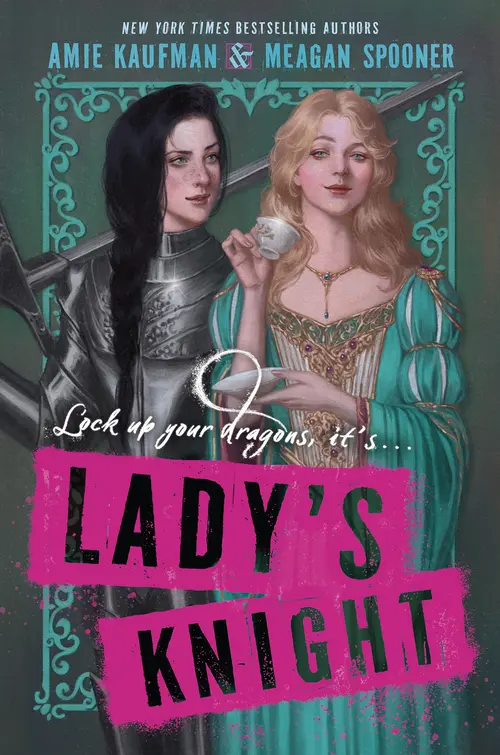
Lady's Knight
Cover
Dedication
For Freya.
You are never alone.
Interstitial
Imagine a castle.
You’ve probably done this before, but in case you need a bit more guidance, imagine there are towers and spires and jagged crenellations made of gray stone. Colorful pennants fly from the rooftops, bearing a vicious-looking bronze dragon against a scarlet backdrop. There’s a drawbridge on thick iron chains and a moat, because so long as we’re imagining a castle, we might as well imagine a cool one with a moat. Maybe there are even crocodiles in the moat—no one told you this had to be realistic, after all. If you want crocodiles, you can have them.
The castle sits on a slight hill, overlooking several acres of fields, kept clear to make sure no one can creep up on anyone inside the castle walls. At the base of the gently sloping grassy rise is a reasonably sized town spread out in a ring full of all the sorts of shops you might expect. Places to buy and sell equipment. An alchemist, tucked underneath a subtle sign bearing the mark of a hedge witch selling love potions. There’s the tavern, where all the heroes go to drink mead and recount their adventures, which sports a big sign proclaiming “On Thor’s Days We Have Ladyes Night.”
The streets are packed earth, and the buildings are roofed with thatch, and it all looks a bit nerve-rackingly flammable. This, by the way, is what people refer to as foreshadowing. But more on that later.
Today, it just so happens, is Market Day. The streets, already crowded with shops, have sprouted tents and stalls and colorfully draped wagons belonging to vendors from far and wide. The lord of the castle has recently reopened the gold mine on the other side of the forest, and the influx of wealth has brought every able-bodied and able-wagoned merchant for miles around to this spot. Every inch of space on the outskirts of the market is filled with horses and donkeys, as well as a pair of extremely anachronistic llamas. Nobody is sure who they belong to, and they spit if you go too close, so we’ll avoid them. Nobles and peasants alike walk down the haphazardly formed aisles of cloth and wagon wheels, while town criers offer to shout about the wares on display for a penny a word.
Market Day is always a riot of colors and sounds and the smells from baking treats and horse dung. But this time there’s a particular buzz in the air, and an extra dozen or two merchants crammed in among the regulars. It’s the last Market Day before the qualifiers begin for the Tournament of Dragonslayers—the first time it’s ever been held in the little county known as Darkhaven—and people are pretty well psyched.
But let’s real quick go back up to the castle gates, because something’s happening there that will prove extremely relevant to our story. There’s a commotion by the entrance to the inner castle, a flurry that builds on itself until the huge oak doors burst open with all the force and inevitability of a hurricane.
Out comes a group of girls, leaving the somewhat baffled and helpless guards to stare after them as they fall into a perfect V formation that any troop of soldiers, or flock of geese, would envy. Their leader, at the pointy end of the V, is a petite blonde wearing a fuchsia gown and an expression of absolute self-assurance, the kind of don’t-even-with-me that the other girls in the group can only dimly imitate. She might as well have the words “Queen Bee” embroidered on her perfectly tailored pink bodice.
They breeze right past the guards on the outer gate, having built up enough momentum that nobody even tries to stop them. They appear to have a single destination in mind: the market.
Let’s all take a moment to wish the market, and everyone in it, the very best of luck.
Chapter One
The sort of thing that gets a girl burned at the stake
Gwen ducked out the back flap of the stall, gulping a breath of fresher air and reaching for another string of horseshoes from the boxes stacked there.
She hated Market Day. It meant dealing with an endless parade of farmers, coopers, farriers, and miners, all of whom demanded to speak to her father. They assumed she couldn’t possibly know what she was talking about when it came to negotiating prices, let alone when it came to the technical specifications of the tools they were looking at.
It certainly never occurred to them that every single nail, pickaxe, and barrel hoop had been made by the blacksmith’s teenaged daughter.
Steeling herself, she slipped back through the flap and busied herself setting out a new row of horseshoes to replenish the few she’d managed to sell. All their customers today were regulars—not a single new face had approached her stall, though the population of potential customers had easily doubled since last month’s market.
At this rate, she’d never make enough to pay the entrance fee for the jousting tournament.
It had been a mad idea, one she knew was mad even as she fashioned armor to fit her lighter frame, even as she practiced with her sword, even as she trained with her horse against trees and fences.
It was bad enough for a peasant to risk posing as a knight—impersonating nobility could deliver you to a very nasty end indeed if you were caught. Worse, in order to pose as a knight, she’d be forced to pose as a man.
And that was the sort of thing that gets a girl burned at the stake.
Somehow, though, it wasn’t the thought of being arrested or roasted that felt maddest of all. The part that kept her awake at night with wanting was the idea that she thought she could be, even for a moment, good enough to be a knight.
So much for one day of glory, she thought, trying to swallow the lump rising in her throat.
A ragged chorus of gasps from the stall across the way made Gwen look up. The blacksmith from two counties over, in town for the pretournament Market Day, was demonstrating a flashy figure-eight slashing pattern with an ornately decorated sword. The whooshing, whistling noise of the blade cut right through the din of the crowds.
Gwen felt her brow furrowing, too annoyed to control the scowl she’d been told made her particularly unapproachable as a vendor. The only reason the sword was making such a racket—and drawing such a crowd—was because it was poorly balanced. A properly made weapon wouldn’t be half so noisy.
A swirl of color at the end of the makeshift row of vendors drew Gwen’s attention. A gaggle of vibrantly dressed noblewomen were sweeping their way down the aisle, people scattering back from them like frogs before a flock of colorfully plumed herons.
Gwen found herself watching them, safe in the relative anonymity of her profession—nothing at her stall would interest these girls. Their obvious leader was a girl in a blindingly pink dress—how does one even dye fabric that color?—with her blond hair in intricate braids coiled around her head.
She was absolutely beautiful, in that put-together fashion that waved like a big red flag to Gwen’s eye. Even if she weren’t a noblewoman, and entirely off-limits, her whole demeanor would’ve warned Gwen off flirting or even approaching her to talk. Different worlds, Gwen thought, continuing to watch her through her lashes. The girl’s face was shapely, her skin flawless. Her nose was perfect and pert, her lips a generous pink pout, her blue eyes huge.
Of course she’s got blue eyes, Gwen thought, allowing herself a bit of petty annoyance at the girl’s classic beauty. And yet, for some reason, she couldn’t quite make herself take her eyes off the ringleader of the ladies and go back to work.
And then the blond-haired, blue-eyed beauty turned and met Gwen’s gaze.
Gwen found herself frozen with surprise—and a certain amount of panic at having been caught staring. Then she jerked her head down so fast her neck popped audibly.
“Ooh,” came a clear, sweet voice, straight through the crowds to her ears. “Let’s go here!”
Gwen didn’t look up. Just keep going. If I have to try to sell a pickaxe to a noblewoman, I’m going to throw myself into the lake.
“Um,” said a somewhat less sweet voice. A glance told Gwen it belonged to a square-jawed man in an impeccably tailored jacket and hose, equally as handsome as the queen of the ladies. Gwen hadn’t even noticed him there—easy to miss amid the flock of jewel-toned gowns around him. He was gazing longingly at the whistling sword demonstration across the way. “Maybe this one would be better, Lady Isobelle.”
Lady Isobelle frowned at him, the expression so perfect she must have practiced it in front of a glass. “Why that one?”
The young nobleman glanced between the burly, bearded blacksmith wielding the noisy sword and Gwen with her single black braid and plain gray dress. “He, uh . . . looks like he might be more experienced.”
Gwen clenched her jaw. How many times had she heard that one?
Hurriedly, the young man added, “He’s, um, older, you know.”
The lady’s frown had deepened, her eyes narrowing. She paused only for an instant before dismissing him with a toss of her pretty blond head. “You go over there if you like. The girls and I are going to this stall.”
Dammit.
Gwen self-consciously smoothed down her skirt, rearranging the pocket hanging from her belt so it covered up the hole burned into the side of the fabric. “Good afternoon,” she said, keeping her eyes down as the group of ladies swept toward her. She wanted to say, There’s nothing here for you—you’ve made your point, now move on. What she said was: “How are you enjoying the market today?”
“Oh, so much!” bubbled the blond girl—Isobelle, the nobleman had called her. “It’s such a gorgeous day, and I could honestly people-watch for hours. What about you?”
Gwen lifted her gaze, which turned out to be a terrible mistake. The eyes waiting for her were even bluer up close. “I, uh.” She could feel the heat rising, starting somewhere in the small of her back and creeping ever upward.
The lady Isobelle waited, and when no further reply seemed forthcoming, she cheerfully leaned forward, bracing her perfectly manicured hands on the edge of the stall. “My goodness, what a selection of . . . things.” The other three noblewomen stayed clustered around Isobelle, though none were feigning the kind of interest their leader was. A fifth woman was with them, a few years older than the ringleader, but her dress was far plainer than the others.
Lady’s maid, Gwen’s mind decided.
A snort and a choke from behind her announced that her father, sensing the presence of customers, had woken from his doze.
“Do the thing, Gwen,” he suggested in his soft, but firm, way, as he rubbed his hand over his face.
The mortified heat had reached Gwen’s shoulders, and she hunched them, trying to keep the blush at bay through sheer force of will. “Dad,” she protested, “these ladies have no . . . er. They’re not here to buy anything.”
Lady Isobelle made a noise of contradiction.
Gwen’s father lifted his head and met her eyes, his eyebrows rising. “The demo,” he insisted. “The new kitchen knives.”
Gwen looked up at the clear blue sky, wishing a lightning bolt would magic itself down from the heavens and vaporize her. She wanted to point out to her father that these women had never set foot inside a kitchen in their lives.
Instead, she turned back to the counter and stepped over toward the end, where their array of kitchen knives was fanned out against a cheery red display cloth. Picking up the floor model, she launched into the speech that had been one of her father’s few contributions to their business these past few months.
“Welcome to Amos’s Armaments and Sundries,” she said, picking a puffed fold of Lady Isobelle’s sleeve to address. “Allow me to demonstrate our new line of kitchen knives, stronger than Spanish steel and capable of holding a sharp edge five times longer than the leading competitor’s blades. Each purchase comes with a lifetime guarantee and free sharpening, though with our innovative design, you’ll almost never have to sharpen your knives again.”
She could feel those intense eyes on her as she spoke. A giggle from one of the other ladies was quickly stifled—evidently, Lady Isobelle was kind enough not to let her friends laugh at the poor blacksmith’s daughter running through her memorized lines.
“Gather round,” Gwen went on, “and I’ll show you how our knives can cut through the toughest of materials—even an old leather drinking flask.” She held up the flask in question—they got them cheap from the local tavern once they’d begun to wear out to the point of leaking—and then drove the knife down into the leather. Truthfully, it required far more strength to do smoothly than any of these ladies would have, but Gwen spent her days forging iron and could make it look easy.
“See how easily the knife cuts,” she said, as the bottom of the flask fell onto the counter. “See how smooth the edges are.” She turned the top of the flask over to show off the even edges of the leather.
“Amazing!” exclaimed Lady Isobelle. Her tone was so genuinely lacking in patronization that Gwen glanced at her, startled. Her gaze was lowered as she ran her fingertips just beside Gwen’s against the cut leather. Gwen fought the urge to jerk her hand back, for reasons she could not quite identify.
Then Isobelle looked up, the force of her stare lessened somewhat by the gentle curiosity in her expression. “Is it important that they can cut through leather?” she asked.
In all the times Gwen had run through this particular demonstration for customers, not once had anyone asked her that. She groped for a response, any response, that wasn’t the truth. “Uh,” she said.
“I’ll take four,” the lady announced, her perfectly symmetrical features alive with enthusiasm. “One for each of us. Right, girls?”
The rest of her friends had wandered off a few paces, their attention on another group of nobles strolling by. But just behind and to Isobelle’s left, the lady’s maid cleared her throat.
“Oh, you too?” Isobelle beamed. “Five, then!”
“Ah, no, my lady . . .” The maid’s expression betrayed very little, but for the tiniest flicker of alarm. “I was going to suggest you try buying something a little less . . . lethal.”
“Oh, come now, Olivia. I’m not going to cut myself.” Lady Isobelle paused, lips pursing. “Not again, anyway. Oh, fine. What about these?” She took a tiny step to the side, her gaze falling upon the rows of horseshoes.
Gwen blinked at her, and then glanced again at Olivia, whose poker face was of absolutely no help. “These . . . horseshoes?”
“Oh, is that what they are?” The blue eyes flitted back up, and Gwen felt a strange sense of vertigo, as if gravity wasn’t operating quite right—she couldn’t tell if the lady was teasing her, or if she truly had no idea what a horseshoe was.
“I don’t . . .” Gwen floundered, as the blush began rising again with a vengeance, swarming up her neck and threatening to choke her. “Surely the castle farrier would . . . I mean, you can tell him to see us if you need . . .”
Isobelle traced a fingertip along the curve of one of the horseshoes. “I’m thinking hung on the wall, for decoration. Any decent hedge witch says iron is the thing. We could call them good luck charms. Do you have any with some decoration on them?”
“Decoration?” Gwen echoed weakly, feeling like someone had cut her legs out from under her.
“Maybe a floral pattern, or something artsy and modern and geometrical?”
Numbly, Gwen shook her head.
Isobelle pursed her lips again. “Does your father ever do anything more ornate?”
“My father?” Gwen was beginning to sound like one of the town criers, repeating what they hear over and over.
“He’s the one who makes these, no? Amos himself?” Isobelle’s eyes dipped, falling on the spot where Gwen’s fingers curled around one of the horseshoes, her grip familiar and possessive.
Gwen let go, then immediately wished she hadn’t.
The other girl’s gaze, suddenly shrewd, met hers again. “Well, if your father ever does make any with decorations, they’ll go like hotcakes the next Market Day. I guarantee this time next month, every girl will want one for her own wall.”
She knew. Somehow, this airheaded noblewoman with her pink dress and perfectly sculpted hair knew. The people in Gwen’s village pretended not to notice that Amos’s daughter had taken over his smithing tasks with increasing frequency these past years—with her dad unable to work with any consistency, it was either accept Gwen or live without a blacksmith at all. Don’t ask about the blacksmith girl, and we won’t tell you about the blacksmith girl.
It wasn’t technically against the law for women to be tradesmen, but men didn’t find the idea particularly comfortable. A lot of female crafters tended to find themselves thrown into debtors’ prison after guards confiscated their “ill-gotten” wealth by calling it stolen.
Panic interrupted the rising blush, threatening to drain all that blood away again.
Then Lady Isobelle smiled, delight radiating from her every perfect pore. “I’ll take five of them,” she said. “How much?”
Gwen was beginning to feel like a fence post in a raging tempest—clinging to the tiniest scrap of dry ground while the hurricane that was Lady Isobelle threatened to tear her loose and swirl her all about.
“That’ll be five . . .” she began, but then stopped. Behind Isobelle, the lady’s maid—Olivia—was shaking her head and signaling to catch Gwen’s attention. While she watched, the other woman stuck out her thumb, turned it upward, and bounced it. “Uh, I mean, ten . . . ? Ten pen—” The thumb bounced again.
Gwen hesitated again, unwilling to raise the price more than double what it ought to be.
“Ten pennies?” Isobelle asked. “Or ten shillings?”
The bottom dropped out of Gwen’s stomach.
Isobelle flashed her that radiant smile. “Ten shillings it is.”
Olivia cleared her throat again. “And we’ll need nails to hang them on,” she reminded her lady.
Isobelle nodded vaguely. “Oh, yes. Add another five shillings onto that, would you, Liv? Thanks.”
While her maid dug in a fat purse jingling with coins, Isobelle leaned forward, palms flat on the counter, and beamed at Gwen, who’d lost all ability to move or speak.
“It’s been an absolute pleasure meeting you and perusing your wares,” she said. “Your father’s wares, I mean.” The smile turned decidedly impish. One of the other ladies made an impatient sound, prompting a roll of Isobelle’s eyes. “Oh, all right. Olivia will pay you, and I’m sure Sir Orson will be only too pleased to carry the horseshoes back.” Then she paused, winked—actually winked—at Gwen, and whirled away, the storm sweeping on across the market, the other ladies following in her wake like bits of colored fabric swirling in the gale.
Gwen stayed where she was, standing utterly still, staring down at the handful of coins the lady’s maid deposited into her hand.
It was enough to buy her way into the qualifying round of the tournament.
All she needed now was the courage to show up among the knights and ladies and pageantry—and enough luck that no one would notice she could never really belong in that world. To hide long enough to prove to herself, just once, that she was good enough.
Chapter Two
Ridiculously, fabulously pink
Most of Lady Isobelle’s attention was currently devoted to a particularly good slice of cheesecake on a stick. The vendor had tried to market it as being dragon-shaped and impaled on a knight’s lance—everyone was merchandising around the tournament—but if it had ever resembled that legendary beast, that resemblance had ended when she’d nibbled its head off.
The others had wanted one of those potato-on-a-stick snacks, where they cut it into one enormous spiral, impaled it (quite the theme, she mused), and fried it. It was outrageous that the superior cheesecake had the shorter line, but it did mean she had time on her hands. Even dear old Orson, slightly puzzled to find himself weighed down by a bag holding five horseshoes, was lining up with the ladies, listening with a polite expression to Hilde’s firm opinions on the proper treatment of potatoes.
Isobelle’s maid, Olivia, was watching her back away into the crowd with a stern eye. Isobelle wrinkled her nose in reply, wordlessly signaling that she wouldn’t go far, and ducked behind a passing wagon.
And so Lady Isobelle of Avington, jewel of her absent father’s eye, setter of fashions, center of the castle’s famed gossip network, and most eligible bachelorette of the king’s court, vanished into the bustling crowd.
As much as she could ever vanish, anyway. The owners of the stalls and carts tended to track Isobelle’s progress, recognizing instantly that she had wealth to spare. Isobelle often imagined someone would be able to follow her all throughout the hubbub of the market, just by listening for the rise and fall of voices from the merchants.
One voice penetrated the din, sweet but demanding, and Isobelle found her steps turning toward the stall even before she realized what she was doing.
The woman behind the counter was a hedge witch. Her plump cheeks creased in a smile as Isobelle approached, and stretched even wider when Isobelle stopped, frowning. It was never particularly clear how much magic a witch actually wielded, if any at all. Had Isobelle turned toward this stall because of a spell, or simply because the woman had honed her vocal instrument to such a degree that she could derail just about anyone?
“A charm for the lady,” said the hedge witch, the offer far more command than question, gesturing to an array of attractive baubles made of wicker, braided wire, and polished stones.
The Story Continues on BooksBarbecue!
Enjoyed this preview? ❤️ Do not stop here!
Read the complete book free online → 🔗
Continue reading now on BooksBarbecue and discover every page!
Love reading? Bookmark BooksBarbecue.com for more amazing books!
Happy Reading!