Kingdoms of Elfin
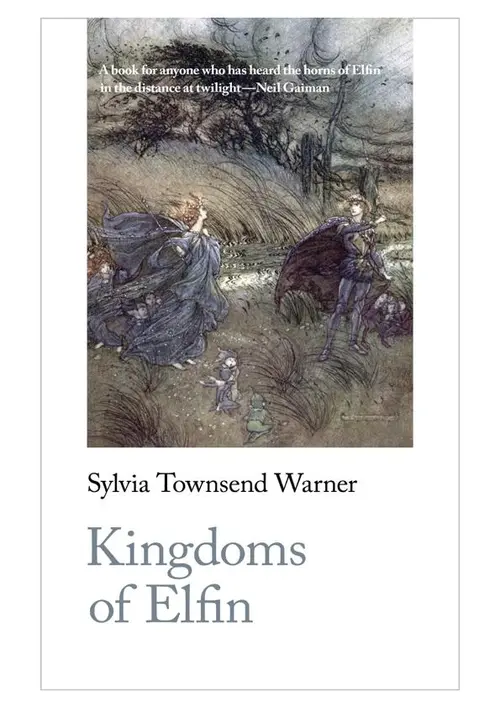
Title Page Content
Kingdoms of Elfin
Also published by Handheld Press
HANDHELD CLASSICS
1 What Might Have Been: The Story of a Social War by Ernest Bramah
2 The Runagates Club by John Buchan
3 Desire by Una L Silberrad
4 Vocations by Gerald O’Donovan
HANDHELD MODERN
1 After the Death of Ellen Keldberg, by Eddie Thomas Petersen,
translated by Toby Bainton
HANDHELD RESEARCH
1 The Akeing Heart: Letters between Sylvia Townsend Warner,
Valentine Ackland and Elizabeth Wade White by Peter Haring Judd
2 The Conscientious Objector’s Wife: Letters between Frank and
Lucy Sunderland, 1916–1919, edited by Kate Macdonald
Kingdoms of Elfin
by Sylvia Townsend Warner
Foreword by Greer Gilman
with an Introduction by Ingrid Hotz-Davies

First published in the UK in 1977 by Chatto and Windus.
This edition published in 2018 by Handheld Press Ltd.
72 Warminster Road, Bath BA2 6RU, United Kingdom
www.handheldpress.co.uk
Copyright of the Stories © the Estate of Sylvia Townsend Warner
Copyright of the Foreword © Greer Gilman
Copyright of the Introduction © Ingrid Hotz-Davies
Copyright of the Notes © Kate Macdonald
All rights reserved. No part of this publication may be reproduced, stored in or introduced into a retrieval system, or transmitted, in any form, or by any means (electronic, mechanical, photocopying, recording or otherwise) without the prior written permission of the publisher.
The moral rights of the authors have been asserted.
ISBN 978-1-9999448-2-7 (epub)
ISBN 978-1-9999448-3-4 (MOBI)
Series design by Nadja Guggi and typeset in Adobe Caslon Pro and Open Sans.
Acknowledgements to the first edition
Except for ‘The Climate of Exile’ and ‘The Late Sir Glamie’, these stories first appeared in The New Yorker.
Acknowledgements to the 2018 edition
The text of the stories reproduced here was taken from the 1978 Penguin paperback edition. The punctuation has been restyled, and some proof-reading errors have been silently corrected.
Cover image: ‘Oberon and Titania’ by Arthur Rackham, Mary Evans Picture Library/Arthur Rackham
Contents
Foreword
Introduction
1 The One and the Other
2 The Five Black Swans
3 Elphenor and Weasel
4 The Blameless Triangle
5 The Revolt at Brocéliande
6 The Mortal Milk
7 Beliard
8 Visitors to a Castle
9 The Power of Cookery
10 Winged Creatures
11 The Search for an Ancestress
12 The Climate of Exile
13 The Late Sir Glamie
14 Castor and Pollux
15 The Occupation
16 Foxcastle
Greer Gilman is the author of Moonwise and Cloud & Ashes, and two critically-acclaimed novellas about the poet Ben Jonson, as well as poetry and criticism. Her fantasy fiction, rooted in British myth and ritual, has won the Tiptree, World Fantasy, and Shirley Jackson Awards. Her essay ‘The Languages of the Fantastic’ appears in The Cambridge Companion to Fantasy Literature.
Foreword
Sylvia Townsend Warner. She saw herself as ‘Frau Noah leaning out of a window with a coffee cup in her hand admiring last night’s flood’; I can see her as a clear-eyed river goddess, or the numen of a spring. Wise-hearted and well-tempered, she began as a scholar of early music, and her prose is formally Baroque. ‘Her heart was with the hunted always’, said her friend William Maxwell. Yet at eighty, when her mortal love had died and she was ‘tired of the human heart’, she wrote on the unkindliness of faerie. Kingdoms of Elfin is a last book as ruthlessly exquisite as a silver frost.
Her first is autumnal: Lolly Willowes (1926) is on the fierce joy of unleaving. Laura escapes the prison of a useful spinsterhood — life as an occasional table — to become a witch. She does no great magic — turns milk, stirs a wasps’ nest — only dares to set herself outside her family and society: to walk the woods at her will, to travel wind-borne, as a leaf does, and to sleep where she settles, in contentment at the roots of things.
Over and again in her writing, Warner would return to fugue. Her stories of Elfin, brilliantly witty and disquieting, are of captivity and flight. The cages here are courts, Gormenghastly in their etiquette; but glittering. There are no marvels here, save wings, which Elfins share explicitly with lower creatures, and so disdain. Yet rarely, they take flight. Here’s Tiphaine, the Queen of Elfhame, with her Thomas:
Once, they came to a wide rattling burn, with a green lawn on the further bank. He leaped across, and held out his hand for her to catch hold of. It was too wide a leap for her and she took to her wings. It was the first time in her life she had flown, and the sensation delighted her. She rose in another flight, curling and twirling for the pleasure and mastery of it, as a fiddler plays a cadenza. She soared higher and higher, looking down on the figure at the burnside, small as a beetle and the centre of the wide world. He beckoned her down; she dropped like a hawk and they rolled together on the grass. (23)1
They are not us; unless they are — at times — the wrong side of our weaving: turn the figured silk and we can trace the bloodknots of cruelty, the blind entanglements of custom. At times, they meet us with aplomb, as at the funeral of the gipsies’ Queen Jocasta: ‘As a mark of respect, visibility would be worn’ (191). They are not fey: not mysterious, uncanny, twilit, but ‘straightforward as the scent of a rose, as a wasp sting’. A ‘race of pragmatists’ (257), they see their glamour through our borrowed eyes, and break us in their curiosity: ‘when the brown bed-hangings from the Librarian’s bed-chamber are hung on the line and the dust beaten out of them, they are discovered to be cloth-of-gold and fall to pieces’ (199).
Winged creatures are ephemeral. The Elfins, not immeasurably long-lived, are spooked and fascinated by these shadow-selves, their analogs, which Warner studies with the silver-eyed dispassion of a Leeuwenhoek. ‘No one fancies the thought of being cut in two like a wasp in the marmalade’ (242). Moths, bats, dragonflies are portents; five black swans will come for Tiphaine, who will be the sixth. Gulls are nemesis itself: ‘Blood ran through their breast feathers, their beaks were red with blood ... The ship moved silent as a ghost under her crown of beating wings and incessant furious voices’ (159).
Unspoken, save in one prophetic vision, and most dreadful, is their fear that mortals — butcher’s meat — will triumph over old creation. Transient, uncouth, our human kind will conquer by outbreeding, by infernal engines. One such terrible device — a bicycle — comes crashing into Castle Ash Grove with its riding harbinger: a drunken midwife who uncorks apocalypse, a disinfectant with a fearful smell. But let Dame Bronwen speak:
‘When I fainted it was because of what was shown me. I saw trees blighted and grass burned brown and birds falling out of the sky. I saw the end of our world, Morgan — the end of Elfin. I saw the last fairy dying like a scorched insect.’ She was mad. But she spoke with such intensity it was impossible not to believe her. (119)
Take heart. It is not yet; it is not fate. Futurity means nothing to the Elfins. No clock will strike for them; the horses of their endless dusk run free. Those mortal lovers who can meet them in their endless now here nowhere are fortunate: they know a brief but absolute felicity. Here is Thomas of Ercildoune at play with Tiphaine:
Love was in the present: in the sharp taste of the rowanberries he plucked for her, in the winter night when a gale got up and whipped them to the shelter of a farm where he kindled a fire and roasted turnips on a stick, in their midnight mushroomings, in the long summer evenings when they lay on their backs too happy to move or speak, in their March-hare curvettings and cuffings. For love-gifts, he gave her acorns, birds’ eggs, a rosegall because it is called the fairies’ pincushion, a yellow snail shell. (23)
The mortal of the pair is wiser than the Queen of Elfhame; he refuses ‘to make trial of the elixir of longevity’, to stall and harness time, and put it, jaded, to the plough:
He flung away from her, saying she must love him now, instantly, before the lightning broke cover. A time would come when he would grow old and she would abhor him: he could tell her that without any exercise of prophecy. The storm broke and pinned them in the present. When it moved away they built a cairn of hailstones and watched it melt in the sunshine. (24)
Tiphaine is rare among Elfins. Most are fleetingly diverted by such pretty things as Thomas, gathered with the dew on them, at their perfection, and discarded as they wither. Otherwise, Elfins much prefer still life. They see no moral in a memento mori, only the beauty of the thing itself.
In Bourrasque, the mortal servant Gobelet gives Lady Fidès an exquisite token: a ‘crow’s skeleton, wrapped in a burdock leaf. Every minutest bone was in place’. It is carrion, transfigured by its burial. ‘In her rapture she forgot to thank him, and he went away thinking she was displeased’ (140).
Gobelet had been a gift himself, at seven, when ‘Fidès’ husband
... took a fancy to his roly-poly charm, and had him stolen, giving him to Fidès for St Valentine’s Day. Gobelet grew up short-legged and stocky, and inexpugnably mortal’ (140). Fidès finds him repulsive: he is not her kind. Yet she repudiates her own chance-got child because Grive is ‘just another Elfin: he had never been, he could never become, a bird’ (141). Only ‘Gobelet pitied the pretty child who had suddenly fallen out of favour’ (142).
He becomes Grive’s inseparable playfellow. As much for himself as for the Elfin child, he gives him toys of transience:
He cut him a shepherd’s pipe of elder wood, taught him to plait rushes; carved him a ship which floated in a footbath. By whisking up the water he raised a stormy ocean; the ship tossed and heeled, and its crew of silver buttons fell off and were drowned. On moonlight nights he threw fox and rabbit shadows on the wall ... When these diversions were outgrown, they invented an interminable saga in which they were the two last people left alive in a world of giants, dragons, and talking animals. (142)
That romance is unfinished: like all mortals past their prime, Gobelet is too unsightly to be kept. Fidès discards him. Grive thinks of his old servant dead in a ditch ‘with the crows standing round like mourners’ (143), but the peasant will live by his wits.
Grown old, he halts his way across a devastated world, through pestilence and famine, to renounce his fairy overlords: ‘to look … and turn away’ (149). But all the court has fled — all but Grive, who is dying, and so must be saved. Gobelet has walked into their old fantasy of endless rescue and escape. He picks it up again, as easily as a cat’s cradle, turn and overturn between their hands:
With Grive ‘high overhead, circling while Gobelet walked, sailing on the wind’ (150), they go east and south, disputing where the swallows winter. Grive ‘was master. It was part of Gobelet’s happiness that this was so’ (151). He lives at first by ‘pell-mell pleasures: a doubled rainbow, roasting a hedgehog’ (150). But imperceptibly, their picaresque and pastoral is changing genre, quickening toward the sea, the ship, the fury of the gulls: Grive’s terrible apotheosis.
Other mortals fall in love, not with a fey, but with faerie: the idea of it, the unobtainable. Take James Sutherland, MA of Aberdeen—‘spoken of behind his back as Fairy Sutherland’ (245). As a scholar, he has channeled his desire into research. ‘Ever since he could remember, they had fascinated him. His nurse sang him to sleep with ballads about them; he pursued the hinds and shepherds on his father’s estate for stories ... read everything he could find on their subject’ (244). He ‘was not above examining Pictish remains, in case they afforded a small footprint’ (245). Taken sleeping on Foxcastle, he wakes in captivity, a specimen for study:
The fingernail explored the convolutions of his ear, left it, traced the lines on his cheek. Other hands were fingering him, lightly, delicately, adroitly. His shoes were taken off, his toes parted, the soles of his feet prodded. His coat was unbuttoned, his shirt opened. Fingers tweaked the hair in his armpits. The watch was pulled from his fob pocket. He knew they would not stop at that. (247)
It is as if he had been buried in an ant-hill, like Gobelet’s crow: an object for their cabinet of curiosities, much handled.
It was impersonal, the traffic of water flowing over a stone. And one day, when they were finished with him, he felt a pat on his shoulder. It intended him no harm, no good — and it almost destroyed him. It was as if he were falling apart with happiness. For the first time, a fairy hand had rested on him with the wastefulness of a caress. He froze, he burned; he was immortally awake, he was overwhelmingly sleepy; he experienced all the vicissitudes of love simultaneously. (251)
But ‘it was impossible to love them: they were too inconsistent to be loved. It was unavoidable not to be drawn to them’ (257). If he could only connect. Let to wander at last in their society, he finds himself eluded. For this man of the Enlightenment, ‘accustomed to a methodical social order where time is respected and persons occupy the portion of space where you expect to find them’, Elfin vagaries exemplify the Rabelaisian principle of Fay ce que vouldras: Do what thou wilt.
Some devoted themselves to astronomy. Others practised the French horn. Others educated squirrels. Some, he presumed, made measurements. [He has, appallingly, been measured.] ... Whisking from one pursuit to the next, they never collided. The best comparison he could draw from the outer world was the swarm of mayflies, indivisibly borne aloft, lowering, shifting, veering, like a shaken impermeable gauze veil over the face of a stream. (254)
Elfins are unknowable, a cloud of bright particularities. Or particles, perhaps, with charm and strangeness — Huons? Their otherness is sharp, if only you could pin it down; they are unshadowy as lightning, as elusive.
Abandoning time — his watch, ‘sole ally of his rational man’ (248), stopped long ago — Sutherland ‘lived a tranquil truant, dissociated from himself as though by a slight agreeable fever — such a fever as one might catch by smelling a flower’ (255).
The fever cannot last. He is cast off, quite literally, by the knitting Queen: ‘”And one purl. And break off”’ (259). He fell asleep in a wig and small clothes; and emerges, then and there, into an alien future:
The speaker … carried a most peculiar hat in a gloved hand. He had spoken to a group of ladies, who were even more oddly dressed than he, wearing white shifts down to the ground. Their waists were under their arms, the shifts fluttered in the wind and showed the shape of their legs. A couple of young men made up the party; they, too, had waists under their arms, and a general resemblance to clothes pegs. But all these were mortals. (260)
Clear-eyed, dispassionate, impartial — ah, but never cold, not unkind — Warner casts him off. She finishes the pattern that she had in mind, ‘everything exactly as it is’, the folly of both kinds intermingled, purl and plain. Like Elfindom itself, she means him no harm, no good. You could weep for him, standing on that cold hill’s side. You could weep — not for the faerie that he found and lost, but for the faerie that eludes us, that is always elsewhere. Take heart: you have this book.
Greer Gilman
Cambridge, Massachusetts
Ingrid Hotz-Davies is Chair of English Literature and Gender Studies at the University of Tübingen. Her most recent research publications have been about gender performativity and modern women’s writing.
Introduction
by Ingrid Hotz-Davies
She started with the short story ‘Something Entirely Different’ in the early 1970s, and from then on wrote in an astonishing rush, producing more and more stories set in the world of fairies. In this way, after the devastating loss of her beloved partner Valentine Ackland, and towards the end of her own life, Sylvia Townsend Warner entered new territory: Elfindom. She was keenly conscious that she was embarking on a new journey, a challenge and an adventure. As she remarked in an interview, ‘I suddenly looked round on my career and thought, “Good God, I’ve been understanding the human heart for all these decades. Bother the human heart, I’m tired of the human heart. I’m tired of the human race. I want to write about something entirely different”’.2 To William Maxwell, her friend, fellow writer, and long-time editor from The New Yorker, she wrote that she was pleased that The New Yorker would print ‘Something Entirely Different’ (renamed ‘The One and the Other’ in Kingdoms of Elfin): ‘I admire the story myself, and feel justified by it: justified, I mean, in supposing that something entirely different is still possible for me, that I can still pull an unexpected ace out of my sleeve’.3
The sixteen stories that were for the most part first published in The New Yorker would come together in Kingdoms of Elfin (1977), the last of her books that Warner would see published in her lifetime. They are indeed different, though her willingness to be intrigued by the fairy world dates back to the 1920s, anticipating much of what was to concern her in the 1960s and 1970s.4 Warner was prodigiously productive and versatile, as well as a consistently stubborn writer. Her works include seven novels, roughly 150 short stories, many essays and lecture scripts, a biography, and the moving collection of the letters exchanged over a lifetime between herself and Valentine Ackland, which she prepared for publication after Ackland’s death.
Kingdoms of Elfin displays Warner’s characteristic command of meticulous narrative technique, but it breaks a fundamental rule for fiction. Warner insisted that these stories were skeletal writing: ‘there is practically no flesh on it at all, and no breath of human kindness. But it seems to me that the bones live’.5 Kingdoms of Elfin is an experiment in reduction: the excision of all empathy from the narrative. The stories do feature creatures endowed with a variety of emotions, and empathy may well reside in the heart of the reader, but at no point must there be any ‘breath of human kindness’ in the narrative itself. ‘The One and the Other’ gives us a good sense of what lies ahead in its opening paragraph:
When the baby was lifted from the cradle, he began to whimper. When he felt the rain on his face, he began to bellow. ‘Nothing wrong with his lungs,’ said the footman to the nurse. They spread their wings, they rose in the air. They carried the baby over a birchwood, over an oakwood, over a firwood. Beyond the firwood was a heath, on the heath was a grassy green hill. ‘Elfhame at last,’ said the nurse. They folded their wings and alighted. A door opened in the hillside and they carried the baby in. It stared at the candles and the silver tapestries, left off bellowing, and sneezed. (1)6
Within a few lines, we come to understand that what appears comfortably familiar and even dated — a baby, a footman, a nurse — is no such thing, as this baby is being taken away by creatures who take to their wings as easily as you or I would walk down a road. The baby, at first a ‘he’, very subtly mutates into an ‘it’, and a little further on we learn that the first procedures to be visited on this baby are invasive and denaturing (‘denaturing’, that is, from a human perspective), designed to ‘abate the human smell’ (1) and finally render ‘it’ ‘sufficiently inhumanized to be given its new name’ (2). Within a few sentences, ordinary points of orientation come loose, and this disorientation is pursued systematically to the story’s end as we follow the changeling human in Elfhame as well as the changeling fairy among the humans. The story is a hall of mirrors in which the different sides reflect each other disconcertingly:7 we see humans from fairy perspectives and fairies through human eyes, and the environments of both changelings are defamiliarised and challenged by their very presence.
When Adam, the fairy child left in place of the baby, is told that the cat that suckled him as a baby has died, his first response is to dissect it in order to understand mortality, a very reasonable obsession for someone half remembering the near-immortality of his species. The family’s servant Ailie is dismayed, but how sentimental should one’s attachment be to a suckling cat, even if one weren’t an elf? Throughout these stories, casual cruelties abound in both worlds — famines, wars, exploitation among the humans, and the cruelties of aristocratic boredom among the fairies. These arise sometimes from veritable inhumanity (though what can ‘(in)human’ mean in these stories?), and sometimes out of the necessities of life. In ‘The One and the Other’, for example, the baby’s mother fails to notice the theft of her baby because ‘she was busy making sausage meat and pork pies that day; and this was not her first child, to be studied like a nonpareil. Indeed, it was her ninth, though not all of them had lived’ (2). The fairy baby left behind in the cradle needs to be de-elfinised for the transition as much as the changeling needs to be inhumanised, in his case by having his wings ‘extirpated’ and his blood ‘dosed with an elixir of mortality, compounded from tears and excrement of changelings’, and finally we come to understand one of the mysteries of spiritualism: ‘The transfers die, but tardily and with extreme difficulty, and some have been known to hover briefly in the air — a phenomenon called levitation and usually ascribed to saintliness’ (6).
The Story Continues on BooksBarbecue!
Enjoyed this preview? ❤️ Do not stop here!
Read the complete book free online → 🔗
Continue reading now on BooksBarbecue and discover every page!
Love reading? Bookmark BooksBarbecue.com for more amazing books!
Happy Reading!