Khaki Town
Cover
About the Book
It seems to have happened overnight, Val thought. How extraordinary. We’ve become a khaki town.
It’s March 1942. Singapore has fallen. Darwin has been bombed. Australia is on the brink of being invaded by the Imperial Japanese Forces. And Val Callahan, publican of The Brown’s Bar in Townsville, could not be happier as she contemplates the fortune she’s making from lonely, thirsty soldiers.
Overnight the small Queensland city is transformed into the transport hub for 70,000 American and Australian soldiers destined for combat in the South Pacific. Barbed wire and gun emplacements cover the beaches. Historic buildings are commandeered. And the dance halls are in full swing with jazz, jitterbug and jive.
The Australian troops begrudge the confident, well-fed ‘Yanks’ who have taken over their town and their women. There’s growing conflict, too, within the American ranks, because black GIs are enjoying the absence of segregation. And the white GIs don’t like it.
As racial violence explodes through the ranks of the military, a young United States congressman, Lyndon Baines Johnson, is sent to Townsville by his president to investigate. ‘Keep a goddamned lid on it, Lyndon,’ he is told, ‘lest it explode in our faces …’
Khaki Town, Judy Nunn’s exciting new novel, is inspired by a true wartime story that has remained a well-kept secret for over seventy years.

Dedication
To the memory of my brother Robert Nunn
I miss you, Rob
This book was inspired by the story ‘Ross River Fever’
by Michael Roberts
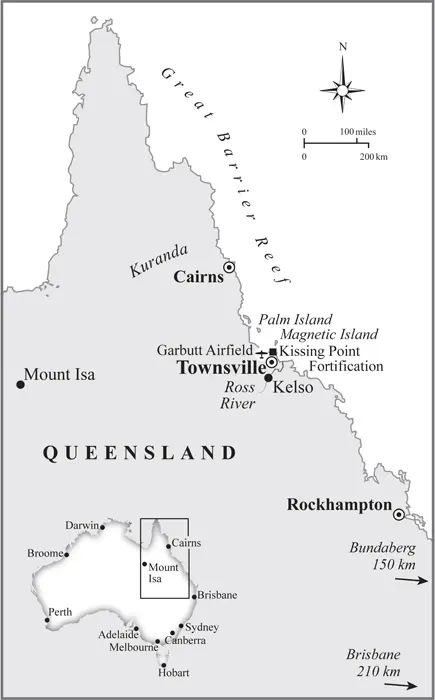
Map
A NOTE TO READERS
Khaki Town is about racism and there are some passages that readers may find offensive and even shocking. I have made no attempt to soften this. Even in sections of the narrative where I am referring to government and military views, I have chosen to write in the language of the times because to modernise the vernacular would not be true to the era, both historically and dramatically.
PROLOGUE
1964
There was a tap at the north-east door.
Seated behind his desk by the windows, he looked up expectantly, knowing who would be announced.
The door opened, not fully, just ajar, and the secretary popped his head in. ‘Senator Kennedy is here, Mr President.’
He rose from his chair and stood erect, back ramrod straight, a big man, around six feet, three inches in height, an imposing figure. And he knew it.
‘Yes, yes, of course,’ he said in his Texan drawl.
The secretary opened the door wide, Kennedy stepped into the room, and the secretary retired wordlessly, the door closing behind him with a gentle click of the latch.
‘Robert …’ He circled the desk, hand extended, and greeted the younger man with a welcoming smile. ‘Good to see you, so glad you could come.’
‘Mr President.’ Kennedy returned his own boyish smile, albeit a little tightly. Close to six feet tall himself, he was dwarfed by the president, both in height and build.
The men shook hands.
‘Do sit, please.’ Lyndon Baines Johnson gestured affably to one of the two carvers on the visitors’ side of the desk facing the bay windows that looked south over the leafy grounds of the White House.
Bobby sat. He loved this view. How often had he sat in one of these carvers, no-one else in the Oval Office except him and his brother, sharing a Scotch, talking about anything but politics, escaping the pressure that stifled them daily. He felt a stab of melancholy. God he missed Jack.
‘I thought we might share a drink,’ Johnson said, lowering his burly frame into the other carver and gesturing to the bottle of spirits and the two tumblers on the desk before them. ‘We’ll raise a toast to the memory of your brother, what do you say.’
Bobby was startled. Had Johnson somehow divined his thoughts? Was this a show of sympathy? If so, how strange, he told himself with more than a touch of cynicism. Lyndon’s hardly known for his sensitivity.
Johnson went on, blithely ignoring the younger man’s air of antagonism, which didn’t in the least bother him. ‘I know we haven’t always seen eye to eye, Robert …’ he said, picking up the unopened bottle of spirits and breaking the seal.
Something of an understatement, Bobby thought.
‘But this is a moment I rather wanted to share with you.’ Johnson poured them both large shots of a dark-brown liquor, more the colour of brandy than Scotch, from a bottle the label of which Bobby didn’t recognise. ‘It’s a moment I’d like also to share with John,’ he added, handing one of the glasses to Bobby, ‘or rather to the memory of John, knowing how close the matter was to his heart.’
Both men remained poised, glasses in hand, while Bobby awaited the explanation that was obviously coming.
‘I have right there,’ Johnson announced, stabbing a dramatic finger at the file that sat in the centre of his desk, ‘the final version of the Civil Rights Act.’ He paused for further dramatic effect. ‘I am about to sign those papers, and the Civil Rights Act of 1964 will become law tomorrow. I thought it only fitting you should be with me and that we should share a toast to your brother on such an occasion.’
Bobby was puzzled by this uncharacteristic act of generosity – Lyndon rarely gave credit to others. The announcement had been delivered with the man’s customary arrogance certainly, but Bobby was touched nonetheless. How could he fail to be? The gesture was magnanimous.
‘That’s very thoughtful of you, Mr President,’ he said, ‘very thoughtful indeed. It was a piece of legislation Jack cared for deeply.’
‘As did you,’ Johnson replied, ‘as did all three of us, I swear.’ He raised his glass. ‘To the Civil Rights Act and to John,’ he said.
‘To the Civil Rights Act and to John.’
They clinked glasses and drank.
Bobby gasped at the sting of the liquor. ‘Good God, what the hell is that?’ he queried, gazing down into the contents of his glass, where even the fumes held a certain threat.
‘Yeah, pretty lethal, isn’t it?’ Johnson agreed. ‘Grows on you though. Aussies mostly drink it with ginger ale and ice, or Coca-Cola these days, so I’m told, but I prefer it neat.’ He downed another hearty swig. ‘Got a kick like a mule.’
‘Aussies?’ Bobby was understandably baffled.
‘Yep, that’s right, Australians.’ Johnson picked up the bottle and poured himself a second slug. ‘This here’s Bundaberg Rum, all the way from Queensland, Australia,’ he said, flashing the label at Bobby. ‘It was given me as a gift when I was serving there during the war in the Pacific and I’ve been carting it around for over twenty years, just waiting for the right occasion to open it. Well, I figure that right occasion is right now and right here. Can I top you up?’ He offered the bottle.
‘No thanks,’ Bobby said hastily, rather wishing he had some Coke and ice. ‘I’ll sit on this for a while.’ His interest was piqued. What the hell is Lyndon up to, he wondered. Is he going to tell me all about his active service in the Pacific? Does he really think I believe that story?
Bobby took another tentative sip of his rum, not sure what to say by way of reply. He and Jack had often talked over the years, and always derisively, about Johnson’s military award. The Silver Star for gallantry in action had been presented to him by none other than General Douglas MacArthur himself.
‘The whole thing was a beat-up,’ Jack had confided to his younger brother. ‘I heard Lyndon volunteered as an observer on an air-strike mission to New Guinea – B-26 bombers. His aircraft wasn’t hit as reported, it turned back because of generator trouble; at least that’s what I heard. The plane never reached its objective, it never came under fire. A couple of the guys even said the official flight records showed that when their aircrafts were near the target and under fire, Johnson’s plane was recorded as having landed back at the airbase.’
To many in the know, it appeared common knowledge that, despite being in the military, Lyndon Johnson had never seen active service. But his official war record did not show that.
Bobby answered with care. ‘Jack also served in the Pacific during the war,’ he said tentatively, wondering where all this was leading.
‘Yes, yes, of course he did,’ Johnson agreed with a hearty nod and a salutary wave of his hand, ‘and most nobly. My active service was limited to the one mission only, but the truth is, on this particular occasion I was ordered to Australia for a purpose far broader than combat duty. A purpose that remains secret to this very day,’ he added, tapping a forefinger to the side of his nose in classic conspiratorial manner and even lowering his voice, although there was not a soul within earshot. ‘And there’s a certain synchronicity between that purpose and the toast we just made to the Civil Rights Act. Which is why I decided to open my bottle of Bundaberg and share my story with you, Robert.’
Bobby was now very much intrigued. It appeared Lyndon was not about to boast of his citation and his dubious war record, but something altogether different.
As Johnson raised his glass, Bobby followed suit and both men took a further sip of their rum, acknowledging this rare moment of camaraderie.
‘I was called into this office when I was several years younger than you are right now,’ Johnson went on to explain. ‘The year was 1942 and I was to receive orders directly from President Roosevelt. General Eisenhower was also present, just the three of us. That was actually the first day I’d met Ike. He was here in the Oval Office when I arrived and FDR introduced us personally, quite an honour. As you would well know,’ he added, ‘Eisenhower was coordinating the Pacific War strategy from our end while MacArthur was commanding the forces in the field.’
Johnson gave a smile that was intended to be a mix of humility and self-deprecation, neither of which worked. ‘As a young congressman, you can well imagine I was somewhat overawed at finding myself alone in the company of FDR and Ike.’
He hadn’t been overawed at all. He’d recognised the magnitude of the moment for exactly what it was – a God-given opportunity for the advancement of his career. The young Lyndon Baines Johnson’s ambition had been boundless.
And I was proved right, wasn’t I, he now reflected with pride. Just to think, three US presidents together, here in this very room! Well, two of us didn’t know at the time we were destined for presidency, he told himself a little smugly, but in hindsight the memory of us three together sure as hell is impressive.
Lyndon could recall every moment of that meeting with vivid clarity.
‘I have a job for you, Congressman,’ Franklin D. Roosevelt had said, wheeling his chair out from behind the desk and gesturing for the other two to sit, which they did.
‘A rather serious incident has occurred in the South Pacific – in Australia of all places – an incident that requires discreet investigation. This investigation must be conducted by a highly trusted political aide, Lyndon, and I intend that political aide to be you.’
The words had been sweet music to young Lyndon Johnson’s ears; he could still hear to this day the president’s every syllable and every nuance. FDR had been his hero, the man he’d hoped and prayed to one day emulate. Which was exactly why he’d decided, should that day come, he too would be known by his initials.
And so I am, he now thought with an overwhelming sense of satisfaction. And so I am. Why, my whole god-damned family is LBJ, every darn one of us. His wife’s childhood nickname had always been ‘Lady Bird’ – how fortuitous was that? They’d named their two daughters Lynda Bird and Luci Baines, and they’d even had a dog they’d called Little Beagle Johnson. And the name of his property? Why, the LBJ Ranch, of course. Cufflinks and clothes and household items like ashtrays and mugs all proudly bore his initials. ‘LBJ’ was a loud and clear statement to the world.
‘This incident involves trouble with our black troops in a large, northern Australian port called Townsville,’ FDR had continued, ‘and if it were to become public knowledge the consequences could be disastrous. Despite the fact that as a society we are not yet integrated, our army must be perceived as a united front, black and white soldiers serving our great country side by side. Which is why this most unpleasant incident must be thoroughly investigated. When it has been and the full truth is known, correct action will be taken, of course, but all findings are to be kept strictly confidential. And we need to bear in mind,’ he’d added with a touch of derision, ‘there’s the damned Australian Government we have to contend with. Although given their stance on racial issues, I’m sure they’ll be only too happy to have the whole wretched business swept under the carpet.’
Lyndon had looked a little blank, so Roosevelt had given a nod to Eisenhower for a succinct explanation, which Ike had been happy to deliver in his customary blunt manner.
‘They have down there what they call “the White Australia policy”,’ he said. ‘When we first raised the prospect of sending Negro troops they said they didn’t want them.’
‘Hell,’ this was news to Lyndon, ‘what did we say to that?’
‘We said if no black troops,’ Roosevelt barked, ‘then no US troops! Period!’
‘Needless to say, they changed their tune,’ Ike went on, ‘but the situation remains tense. They need all the help they can get. The bulk of their army is either serving in North Africa or captured by the Japs in Singapore.’
‘I see. How many black troops do we have there?’ Lyndon asked.
‘Currently in excess of three thousand Negro soldiers,’ the general replied, ‘and more on their way; there’ll be over seven thousand by August. They’re employed as work units – building airstrips and infrastructure needed for defence-and-attack bases in the Pacific conflict zone. MacArthur is fully aware he needs a plan to get them off the Australian mainland as soon as possible.’
‘So, Congressman,’ FDR said, ‘I want you down there to investigate. As a courtesy, upon arrival in Australia you’ll notify MacArthur, who’s currently at GHQ in Melbourne, after which you’ll proceed to Townsville, where you’ll get to the bottom of this mess and report directly back to me. You’ll report to me and no-one else, you understand?’ He shared a look with Eisenhower, who nodded, the two men having obviously reached an agreement.
‘Yes, Mr President.’
‘And keep a goddamned lid on it, Lyndon, lest it explode in our faces.’
Johnson scoffed back the remains of his rum and poured himself a third healthy measure. He’d enjoyed reliving that long-ago scene, which he firmly believed had been the first major stepping stone in his rise to the top.
‘C’mon, Robert, keep up,’ he urged, ‘you haven’t even finished your first slug of the stuff.’
‘Sure.’ Bobby obediently drained his glass, the alcohol no longer having an abrasive effect, but rather producing a warm glow. ‘It does kind of grow on you, doesn’t it?’
‘Sure does. And you want to know why I decided to open this bottle today of all days? You want to know why the synchronicity between my trip to Australia in forty-two and the toast we just made to the Civil Rights Act?’ He didn’t wait for an answer. The younger man’s interest was evident and his questions had been rhetorical anyway. ‘Well, I’ll tell you.’
LBJ settled comfortably back in his chair. ‘Roosevelt sent me out to Australia to investigate a race riot, the findings of which were to be kept top secret. As I told you, that secret remains to this very day, and I’ll tell you something else – the few Aussies in the know are only too happy for things to stay that way. Ever heard of the White Australia policy?’
‘Can’t say I have,’ Bobby answered, a little bewildered by the apparent non-sequitur.
‘It’s not officially referred to in international circles as the White Australia policy,’ Johnson admitted, ‘but I can promise you, that’s what the locals call it, and that’s just what it is. A discriminatory policy intended to deny entry to the country of all races non-Caucasian. It was the first legislation passed when the country formed a Federal Parliament and it was called the Immigration Restriction Act of 1901.’ He shook his head in whimsical fashion. ‘By golly, those Aussies really are something, a breed apart you might say.’
Bobby looked a query.
‘We’ve long been criticised for our segregationist policies, Robert, as you well know, so in some ways we haven’t been all that different from the Australians. We put black people in boxes; we don’t give them the same advantages as white folk; we view them as inferior —’
‘That may have been true once,’ Bobby interrupted, ‘but it’s about to become a thing of the past.’ He indicated the all-important file that sat on the presidential desk.
‘Exactly,’ Johnson agreed with enthusiasm. ‘We are on the eve of monumental change in this country, which makes our current conversation particularly pertinent in my opinion, and I’ll tell you why. In these enlightened times the White Australia policy is still alive and well.’ He raised his glass as if in triumph. ‘Like I said, those Aussies are a breed apart.’ A swig and he went on. ‘You want to know why I was sent down there in forty-two?’
Another rhetorical question, so Bobby merely nodded, although he was keen to hear the story Johnson appeared so eager to share. What exactly was this well-guarded war secret?
‘Ever been there yourself, Robert?’
‘Nope.’
Johnson swirled the dark liquor in his glass, studying it intently, remembering the first time he’d had a slug of ‘Bundy’ as the rum was fondly known in Australia. At least that’s what Val had told him. He’d only been in Townsville for those several days of his investigation, but he remembered too when Val had given him the very bottle that now sat on the desk before him.
‘Well, it’s something else I can tell you,’ he said, ‘particularly a place in Northern Queensland. A place they call Townsville.’
PART ONE
THE CIVILIANS
CHAPTER ONE
1942
Val Callahan gazed about the main bar of her pub, marvelling at the surrounding sea of khaki. It was half past four in the afternoon and she’d only just opened up – beer rationing already a force to be reckoned with, there was no point in opening earlier. Good thing she had Baz on side with his black-market contacts; she’d need to be calling on him soon.
She joined young Betty and Jill behind the bar in order to help out with the influx of drinkers streaming through the open doors that led to the busy corner of Stokes and Sturt streets.
Khaki wherever you look, she thought as she started pulling beers. Here in The Brown’s Bar, the mob queued up outside, passers-by in the street, barely a civilian to be seen, just military everywhere. Army, navy, air force, you name it, and all in khaki. Various shades and styles sure, but khaki nonetheless.
It seems to have happened overnight, Val thought. How extraordinary. We’ve become a khaki town.
No-one could argue that the military invasion had happened quickly. The citizens of Townsville had been taken by surprise, as had those in many other North Queensland townships. Unlike the civilians of the Northern Territory, the local population had not been evacuated south in order to create a restricted military area. Those in North Queensland had been left to carry on as usual, as if somehow the war in the Pacific was something that needn’t concern them.
None of us gave things much thought really, did we, Val mused, counting out a bloke’s change. Well, we bloody well should have! She was actually surprised that she of all people had been caught so unawares. A tough old broad like me who’s been around the traps, I should have known better, she told herself. But crikey, there was only a handful of Aussie troops stationed here, and watching them drill was a joke. Hell, they wore shorts and sandshoes and no shirts, and when one lot had finished they’d hand their rifles over to the next lot so they could have a go. No wonder we didn’t take things seriously.
She grabbed a bottle of bourbon from the shelf and started pouring another bloke’s order, a Yankee officer with the rank of major, giving him a saucy smile as she did. Even at the age of fifty-three, Val always flirted. It was good for business and she knew she could get away with it. Old broad she might be, but she looked after herself; kept her hair blonde, never a strand of grey to be seen, still had good tits, she could pull a trick if she wanted to. Not that she did – that part of her life belonged in the past. She was a respectable pub owner and had been for many a year. But old habits die hard, don’t they. At least that’s the way Val saw things.
‘There you go, mate,’ she said, handing the major his two bourbons on the rocks – he was buying a round for his buddy – and giving him another special smile.
Of course, it was the fall of Singapore that did it, she thought. Then four days later they bomb bloody Darwin! Some wake-up call! No wonder we all had the fear of God put in us. The Japs were on our bloody doorstep. And they’re getting closer by the minute what’s more. Thank God for the Yanks.
Leaving Betty and Jill to man the bar, she weaved her way through the khaki throng, collecting empty glasses here and there, playing hostess and generally spreading bonhomie.
Just look at them, she thought, her eyes once again roaming those in the bar and through the windows those in the street. Some Aussies, sure, but mostly Yanks; they’ve taken over the whole place, and Christ alive it’s not even mid-March!
The Story Continues on BooksBarbecue!
Enjoyed this preview? ❤️ Do not stop here!
Read the complete book free online → 🔗
Continue reading now on BooksBarbecue and discover every page!
Love reading? Bookmark BooksBarbecue.com for more amazing books!
Happy Reading!