Chapters (81)
- Cover
- JONATHAN STRANGE & Mr NORRELL
- Dedication
- Preface
- Volume IMr Norrell
- 1The library at Hurtfew
- 2The Old Starre Inn
- 3The stones of York
- 4The Friends of English Magic
- 5Drawlight
- 6“Magic is not respectable, sir.”
- 7An opportunity unlikely to occur again
- 8A gentleman with thistle-down hair
- 9Lady Pole
- 10The difficulty of finding employment for a magician
- 11Brest
- 12The Spirit of English Magic urges Mr Norrell to the Aid of Britannia
- 13The magician of Threadneedle-street
- 14Heart-break Farm
- 15“How is Lady Pole?”
- 16Lost-hope
- 17The unaccountable appearance of twenty-five guineas
- 18Sir Walter consults gentlemen in several professions
- 19The Peep-O’Day-Boys
- 20The unlikely milliner
- 21The cards of Marseilles
- 22The Knight of Wands
- Volume IIJonathan Strange
- 23The Shadow House
- 24Another magician
- 25The education of a magician
- 26Orb, crown and sceptre
- 27The magician’s wife
- 28The Duke of Roxburghe’s library
- 29At the house of José Estoril
- 30The book of Robert Findhelm
- 31Seventeen dead Neapolitans
- 32The King
- 33Place the moon at my eyes
- 34On the edge of the desert
- 35The Nottinghamshire gentleman
- 36All the mirrors of the world
- 37The Cinque Dragownes
- 38From The Edinburgh Review
- 39The two magicians
- 40“Depend upon it; there is no such place.”
- 41Starecross
- 42Strange decides to write a book
- 43The curious adventure of Mr Hyde
- 44Arabella
- Volume IIIJohn Uskglass
- 45Prologue to The History and Practice of English Magic
- 46“The sky spoke to me …”
- 47“A black lad and a blue fella – that ought to mean summat.”
- 48The Engravings
- 49Wildness and madness
- 50The History and Practice of English Magic
- 51A family by the name of Greysteel
- 52The old lady of Cannaregio
- 53A little dead grey mouse
- 54A little box, the colour of heartache
- 55The second shall see his dearest possession in his enemy’s hand
- 56The Black Tower
- 57The Black Letters 1
- 58Henry Woodhope pays a visit
- 59Leucrocuta, the Wolf of the Evening
- 60Tempest and lies
- 61Tree speaks to Stone; Stone speaks to Water
- 62I came to them in a cry that broke the silence of a winter wood
- 63The first shall bury his heart in a dark wood beneath the snow, yet still feel its ache
- 64Two versions of Lady Pole
- 65The ashes, the pearls, the counterpane and the kiss
- 66Jonathan Strange and Mr Norrell
- 67The hawthorn tree
- 68“Yes.”
- 69Strangites and Norrellites
- Acknowledgements
- Notes
- A Note on the Author
- By the Same Author
- Also Available by Susanna Clarke
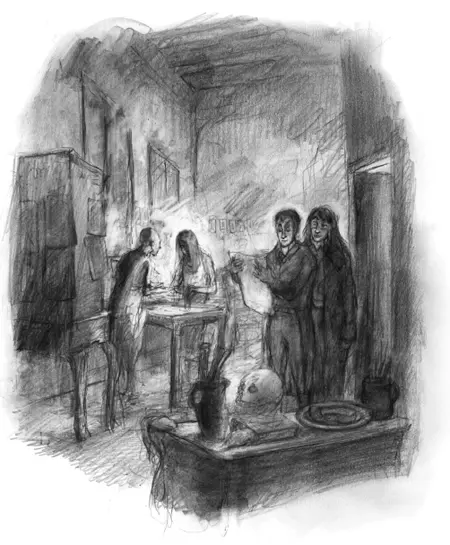
There were sheets of thick paper on every surface and inky rags. There were pewter dishes containing ancient cheese rinds and pots containing pens and pieces of charcoal. There was an elderly bunch of celery that had lived too long and too promiscuously in close companionship with the charcoal for its own good. There were engravings and drawings pinned directly on to every part of the panelling and the dark, dirty wallpaper – there was one of Strange that was particularly good.
At the back of the house in a smutty little yard there was an apple tree which had once been a country tree – until grey London had come and eaten up all its pleasant green neighbours. Once in a fit of industriousness some unknown person in the house had picked all the apples off the tree and placed them on all of the windowsills, where they had lain for several years now – becoming first old apples, then swollen corpses of apples and finally mere ghosts of apples. There was a very decided smell about the place – a compound of ink, paper, seacoals, brandy, opium, rotting apples, candles, coffee – all mingled with the unique perfume exuded by two men who work day and night in a rather confined space and who never under any circumstances can be induced to open a window.
The truth was that Minervois and Forcalquier often forgot that there were such places as Spitalfields or France upon the face of the earth. They lived for days at a time in the little universe of the engravings for Strange’s book – and these were very odd things indeed.
They shewed great corridors built more of shadows than any thing else. Dark openings in the walls suggested other corridors so that the engravings appeared to be of the inside of a labyrinth or something of that sort. Some shewed broad steps leading down to dark underground canals. There were drawings of a vast dark moor, across which wound a forlorn road. The spectator appeared to be looking down on this scene from a great height. Far, far ahead on that road there was a shadow – no more than a scratch upon the road’s pale surface – it was too far off to say if it were man or woman or child, or even a human person, but somehow its appearance in all that unpeopled space was most disquieting.
One picture showed the likeness of a lonely bridge that spanned some immense and misty void – perhaps the sky itself – and, though the bridge was constructed of the same massive masonry as the corridors and the canals, upon either side tiny staircases wound down, clinging to the great supports of the bridge. These staircases were frail-looking things, built with far less skill than the bridge, but there were many of them winding down through the clouds to God-knew-where.