Jonahwhale
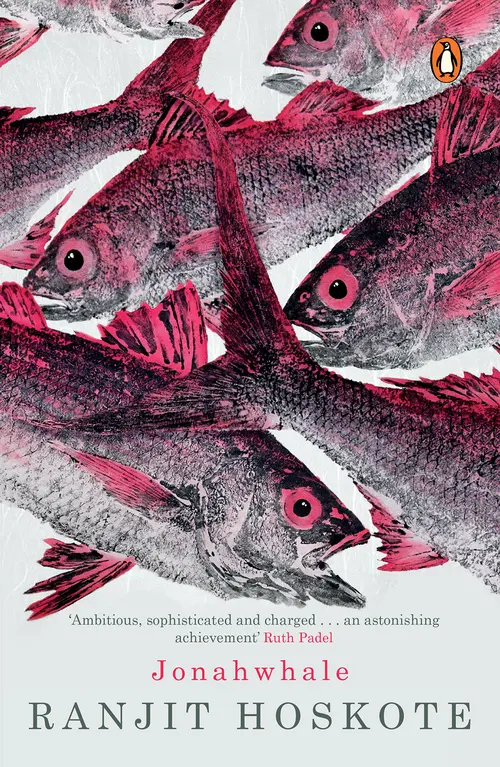
Cover
Also by Ranjit Hoskote
Poetry
Zones of Assault (1991)
The Cartographer’s Apprentice (with drawings by Laxman Shreshtha, 2000)
The Sleepwalker’s Archive (2001)
Vanishing Acts: New and Selected Poems 1985–2005 (2006)
Central Time (2014)
Poetry (In Translation)
Die Ankunft der Vögel (in German, 2006)
Feldnotizen des Magiers (in German, 2015)
Poetry (As Editor)
Reasons for Belonging: Fourteen Contemporary Indian Poets (2002)
Dom Moraes: Selected Poems (2012)
Translation
A Terrorist of the Spirit (1992)
I, Lalla: The Poems of Lal De?d (2011)
Art Criticism and Cultural Theory
Pilgrim, Exile, Sorcerer: The Painterly Evolution of Jehangir Sabavala (1998)
The Complicit Observer: Reflections on the Art of Sudhir Patwardhan (2004)
Atul Dodiya: Antler Anthology (2004)
The Crucible of Painting: The Art of Jehangir Sabavala (2005)
Baiju Parthan: A User’s Manual (2006)
The Dancer on the Horse: The Art of Iranna G.R. (2007)
Bharti Kher (2007)
The Crafting of Reality: Sudhir Patwardhan, Drawings (2008)
Praneet Soi: Still, Life (2009)
Zinny and Maidagan: Compartment/ Das Abteil (2010)
The Dialogues Series (with Nancy Adajania, 2011)
Mohan Samant: Paintings (with Marcella Sirhandi and Jeffrey Wechsler, 2013)
Atul Dodiya (2014)
Future Publics (The Rest Can and Should Be Done by the People) (co-edited with Maria Hlavajova, 2015)
In the Presence of Another Sky: Sakti Burman (2017)
Cultural History
Kampfabsage (with Ilija Trojanow, in German, 2007)
Confluences: Forgotten Histories from East and West (with Ilija Trojanow, English version, 2012)
Artist Books
Pale Ancestors (with Atul Dodiya, 2008)
What’s He Going to Be Next? (with Sakti Burman, 2016)
Advance Praise for Jonahwhale
‘The poems in Ranjit Hoskote’s Jonahwhale are brilliant annotations on the giant landmass of history. With wisdom and erudition in plenty and a masterly grip on the quiet but lethal drama of verse, Jonahwhale is, on any measure, a major achievement.’—George Szirtes, poet and translator; author of The Burning of the Books and Bad Machine
‘A wonderfully ambitious, sophisticated and charged collection: a symphony of the sea in three great movements. The first explores history, language, geography, the Indian Ocean and colonization, with Shakespearian echoes of The Tempest. Then comes contemporary and personal human “traffic’’ – and urban alienation; and the third delves deeply into art. The forms, exquisite lyrics, philosophical insights, prose poems, epics with still moments of pure simplicity, are as multiple and shape-shifting as water. An astonishing achievement.’—Ruth Padel, professor of poetry, King’s College, London; author of Darwin: A Life in Poems and The Mara Crossing
‘What is each poem in the world but a speck of land lost upon the ocean of language itself? We must then navigate ourselves through poets like Ranjit Hoskote and books like Jonahwhale. As ever before, through his imagistic, complex, dazzling poems, Hoskote’s grand grounded intelligence, and the width of his learning, comes concentrated into brilliant meditations on what poetry can do when reflecting upon an essential theme of human culture. For, reading Jonahwhale, it is clear to any reader the poet’s name is Ocean, and these poems are both the water and the sea creatures, with this book as our raft.’—S.J. Fowler, poetry editor, 3:AM Magazine; lecturer in creative writing at Kingston University; curator, ‘The Enemies Project’
‘Epic in scale, yet written with curatorial precision, Jonahwhale is Ranjit Hoskote’s magnum opus. Here is a poet with extraordinary sensory awareness – especially hearing and sight/vision – who applies a poetics/poethics of listening, one that is consistently generous and open to the world, therefore truly of the world. Linguistically innovative, but always social and ethical, these poems are, above all, sensitive to the precariousness of human knowledge and existence. The whale evades capture as we stand “on this narrow island of what we know” (or presume we know). Ranjit is one of the great connoisseurs of English language poetry, someone who holds up each word before him with the care of a jeweller. His mastery of form and lineation is constantly impressive (read the long-form poems like “Cargo and Ballast” and “Poona Traffic Shots” amid several short lyric poems, many dedicated to others). Poems like these reappropriate the love poem in an age often lacking friendship and compassion. Jonahwhale is an essential and humbling reaction to the world we live in and it should be read widely.’—James Byrne, editor, Wolf; author of Everything Broken Up Dances
Dedication
In memory of Chandra Hoskote (1934–2015), my mother, my first reader
the great fish glides through the river
touching the near bank
and the far
the self swims the currents
of dream
and waking
—Brihadaranyaka Upanishad (4.3.18)

I
MEMOIRS OF THE JONAHWHALE
The Churchgate Gazette
I.
Last word on the subject, I promise.
I walked into the train station and it was terrifying.
Like nerve gas had laid the architecture out flat,
the tall glass columns bloodshot and the booking clerks
slumped over, all dead at the till.
A plaster Gandhi with sulphur-rimmed eyes
stopped me (what a substitute for kohl and why?).
You missed the last train, it said, he said,
you missed the last and only train that was safe
for a man who’s left half his life behind.
II.
A straggler from a late-night movie had more advice.
You could so easily gag on a wine-red, tasselled silk scarf
stuffed in your mouth, he said, you could so easily gag
on sour saliva or a shard of bay leaf
or a letter swallowed just after the bell has rung
and before the door opens.
III.
I thought of the possibilities as I left the station without a compass.
Walk straight enough, said Gandhi, and you could walk into the sea.
At the wharf, the sailors’ wives were keening together:
they were singing the last songs of the whales.
I was their brother and I had killed them
with my broken harpoon and my rusted smile.
IV.
Find affection, I told myself. That’s fundamental.
Find a voice that doesn’t draw blood
each time you hear it. I walked past myself,
I rippled across lean men and sleek women
laughing behind plate glass, their hands caught
in pools of light, wine gleaming in brittle flutes.
V.
Birdsong disturbs the king of incomplete lives.
He wakes up in the middle of the novel he’s writing
in the Midnight Hotel. His eyes need shielding
from the raw clarity of neon. He is back
where he began, with a plate of waxy grapes
and a blunt silver knife on his bedside table.
VI.
Break, ice, for me.
Let me fall through stinging water
in my skin of rust and flame.
I’ve jumped from a tree
that’s branched into the clouds.
It’s sucked up all the reality
I’ve watered it with.
Its fruits are red and wrinkled.
I plunge into drowned gardens
where I walked once.
Sinking, the water stroking
my crown of leaves
as it comes apart,
dark tribune, archaic clown,
I open my eyes.
The Map Seller
for Nikola Madzirov
The roof’s dripping with pigeons and I’ve just escaped
the worst of the sun, strapped on my scuffed leather bag,
and in a moment – this shade’s delicious – and before
the pedlars start shouting, Say your piece! Say your piece!
I’ll start calling out names and pulling countries from it:
big countries, small countries, countries broken in two,
countries the size of handkerchiefs and countries engorged
with other countries, buffer zones jostled by failed states,
island republics sinking by degrees. Even nuclear powers
that started as papaya plots or guano archipelagos.
Whatever you like, I’ve got a map that looks like it –
and you can have any piece of my flaking jigsaw atlas,
if only I could reach you across this accordion sky
that’s billowed open to rain on all the hats I wear:
tribune of nowhere, midnight’s newscaster,
out-of-work weatherman, all-terrain refugee.
And across this trench that a JCB’s dug along my street:
tomorrow’s avenue, today’s wide sludge grave.
The Atlas of Lost Beliefs
Without waking up, turn to page thirty-seven
in the Atlas of Lost Beliefs
and surround yourself
with apsaras, kinnaras, gandharvas, maenads,
satyrs, sorcerers, bonobos, organ grinders,
stargazers, gunsmiths, long-distance runners,
gravediggers, calligraphers, solitary reapers,
beenkars, troubadours, rababias, ronin,
nagas, pearl divers, Vandals, Goths,
mummers, snipers, collectors of moths,
hobos, dharma bums, bauls, drifters,
djinns, mahjubs, marabouts, qalandars,
griots, mad hatters, speakers in tongues,
trippers, star angels, batmen, punks,
eggheads, buffoons, lay preachers, agitators,
friends of the court, friars minorite, agents provocateurs,
bird-spangled shamans, fainting oracles, screeching owls,
wise men of Gotham, and women who run with wolves
all blessed by the blue hand of a reckless dancer
who spares a thought or two for the world but no more
as she poses, heels in the air, Cossack-kicking on a crumbling reef.
Seven Islands
sand-wrought storm-humped
these islands
never complain
they take what comes
craft
one name for seven
from dropped iron lost rivers and
spits of reclaimed land starved
ocean
wind-ripped light-riveted
gravel-spun overrun
roads that take you step by step
to where the water is
sweet and deep
the only way up
until help arrives
is south
Ocean
my name is Ocean
I shall not be contained
my tides spell
starting gun and finish line
afterwards only shells
and scattered roofs
will remind you I was
there
my combers wash away the roots of trees, towns, the shaken heart
but mortals there’s hope
my breakers hurl seeds back at your shores
after the flood the chroniclers will write
in Konkani, Sabir, Aymara, Tulu, Jarawa, Krio, Tok Pisin:
after the flood the beach exploded with giant peacock trees
in whose branches on windy days you could hear
the surge
and swell
of Ocean summoning whales, whalers who chased blood-wakes,
red-haired women who fought pirates, sleepless harpooners
who sailed from fjordlands to where
volcanoes splintered the sleeping ice,
furies who choked pearl divers, drove catamarans aground,
voyagers who fell into the sea and grew wings
Ocean reciting from his depths
every drifting epic of pursuit, every song of shipwreck,
every trace of raft and sail and trailing anchor
flotsam jetsam buckram vellum
he could remember
Ahab
Captain of castaways, the pilot calls out and his curse carries
across docks, derricks, opium factories:
a typhoon in the horse latitudes.
He’s hurled his ship after the whale
that swallowed him and spat him out.
The monster is the only system he’s known.
At the bridge, he’s drenched in the dark:
locked on target, silent, furrowed,
Saturned to stone.
*
Across steep tides, through walls of water, his life has always been pursuit.
As the ship splinters on the reef,
the rigging becomes his noose.
Brine blistering his throat, he thinks:
If only I’d harpooned this monster on a page.
Spelling the Tide
We drew near the island, the surf a cannonade on its stony beaches,
no landing.
We dropped anchor.
Some fishermen came down
to the water’s edge and called out. We called back.
The surf roared in our ears, no one
heard no one.
The skirling wind shredded our voices and danced on them.
We pointed
at the canoes
they’d hauled out of tide’s reach.
Come get us.
They didn’t get us
or didn’t want to.
We made signs.
The skirling wind shredded our signs and danced on them.
They melted away in the rain.
Water in your sails, shirts, socks is wet lead.
Prayer in that storm
was just a mouth gone wrong.
We tried our hands instead.
We made all
the signs we knew.
The skirling wind shredded our sails and danced on them.
Cape Caution
When you’re swimming from Cape Caution to Impulse Bay,
don’t miss the line where jade touches turquoise and recoils:
this is the jolt where nerve end meets salt,
this is the neverskin,
this is where you grow knife-edged fins and plunge:
you’re one light tremor away from sabre teeth.
The Heart Fixes on Nothing
Zafar
The heart fixes on nothing in this wasted province.
Whoever made anything of a kingdom of shadows?
Go find another home, my smothered hopes.
This stained heart has no roof to offer you.
I prayed for long life and got four days:
two were spent in desire, two in waiting.
Gardener, don’t rip these thorns from the garden:
they were raised with the roses by a gentle spring.
The nightingale doesn’t blame the gardener or the hunter:
Fate had decided spring would be its cage.
Fate’s real dupe: that would be you, Zafar, your body denied
two yards of spaded earth in the Loved One’s country.
And Sometimes Rivers
And sometimes rivers
that run in your veins
change course.
Silt marks the spot
from where you set sail
to circumnavigate the globe
and where someone wearing your sunburned face
stopped thrashing about in mangroves that wouldn’t let go
and stood still, bleached hair ruffled by the wind,
as if, after a voyage charted across fevers and hurricanes,
riding at anchor.
Risk
The earth here is glass, the wind the sting of a thousand wasps.
Whoever is driven north wishes he could burn in the fires of hell.
On this sea without horizons we do not sail by the magnet.
Of wisdom, the deep says, ‘It is not in me.’
As It Emptieth It Selfe
I.
At the mouth of the dog river
foam words foam words
currents of sand arrowing after fog birds
slack shadows engraved on the veil of the tide
that shimmers in and sags out
for the twentieth the thirtieth the emptieth time
the river going with the sea the sea going homewards
As It Emptieth It Selfe
You shall build your citadels on silt said the preacher
and sink your pride in spice currents
take your parakeets and painted cormorants
with you but leave the coconut palms and the Inca silver
leave behind a bloodful of curses
with strands of indigo wet bales of cotton
on this parched delta these dragged fields of salt
sweet strained with brack
For the Emptieth Time
II.
Splayed in his planter’s chair, the saboteur of silences toys
with a breech-loading Bible, cocked in defiance of treaties.
Nib sharpened by monsoon hungers, the chronic ache
of working in a country without plums or Bordeaux,
he writes home:
In this damnable climate, steel rusts, razors lose their edge.
Thread decays, clothes fall to pieces. Books moulder away.
Plaster cracks, timber rots,
the matting hangs in shreds. Fungus inscribes itself
on vellum bindings as the tattoo of rain on the roof
drowns out the mind’s arias.
The clouded mirror’s been my only proper companion
since Ovid and Seneca fell apart.
I’ve been reading palmleaf manuscripts with sour pandits
and picking up opium and Tamil from sallow lascars
in this pidgin district, waiting for the mailboat
to bring me the necessities:
sherry, walnuts, Trichinopoly cigars.
I have hidden in the houses of the bibis who breed
our scabby byblows, who run around the gullies
with their tow hair and improbable grey eyes:
their fortunes will be the fortunes of Homer’s sailors.
Before they indenture themselves
to war or shipwreck or sirens or mutiny,
we’ll tame the little devils, give them Greek
or Irish names, teach them a respectable tongue.
Then we’ll lop them off the family tree
and send them out on battered frigates
to fight and die for King and Country.
III.
Try mangrove instead of watercress.
Try chameleons instead of retrievers.
The earth webs your feet here, and look out
for rivers that bite.
Stone in the veins.
This country smelted from copper
and scented with mustard
has secret names that only
its lovers can nose out.
IV.
The river stabs the sea.
Water, salt and fresh, bursts up
through the splintered ribs of the scuttled boat
that’s trailed a wake of belly-up fish.
Thalassa. The compass bird points to the coast:
to a rivermouth disgorging crumbled islands,
to the tidewash that numbs the wounds
by which conquerors named it.
Trapped by the trader’s sovereign eye,
by the surveyors of revenue lands,
the purveyors of clove and camphor,
the coast signals its own tongue:
breaking with the horizon’s grammar,
a stutterance.
Lascar
Bombay–Liverpool–London, 1889
The lascar was always sallow. It didn’t help
that his name anagrammed rascal. He carried
a whiff of scurvy, a hint of rats in the hold,
hulls battered by typhoons.
He was never far from dirty work.
Here’s what the detective said:
There’s a trapdoor at the back of that opium den,
near the wharf, which could tell strange tales
of what passes through it on moonless nights.
Here’s what the good wife said:
At the foot of the stairs I met this lascar,
who thrust me back and, aided by a Dane,
pushed me out into the street.
Meanwhile her husband:
Only one man knew my secret. He was the keeper
of a low den in which I used to lodge.
A lascar, well paid by me for his rooms,
my secret was safe with him.
Neither detective nor wife nor husband knew
the bleached village on the Konkan coast,
or had seen the forced parades at tropical noon,
the forts locked in rising silt, the standing crops burned.
History gave you one name. Fear
gave you and your cousins others.
To novelists: Savage.
To pamphleteers: Cannibal.
To scholars: Anthropophage.
To your captains: Seacunny, tindal,
syrang, topaze. Or mostly
as you swabbed the deck:
Cocoa-faced rascal!
You call yourself names
in the three tongues you speak in your sleep:
Lashkar. Tandel. Jahaazi.
They crowd us into the damp, shallow cradle
they call the fo’c’sle. Silly name. Phana, we call it,
phana: the hood. The wide fan-spread hood
of this coiled sea-cobra we’re sailing.
At the Belvedere
for Sandeep Parmar
The seaweed farmer from last evening
swung into the Belvedere again tonight,
this time asking for a Liverpool Gin
– citrus not watermelon, he specified
as he pulled the moonless key
to the alphabet lock
from his frayed trench pocket,
the hurricane lamps loud behind his glasses.
He dropped the key and a sand-crusted trowel
on the bar. His fingers had guttered out.
‘Let’s call it quits, shall we, mate?’
he nudged me. ‘I give up. I don’t know what
to call it, this mewling, this barking,
this mad overhead windwhack cackle of the gulls.’
Sycorax
Woke up trapped in a tree trunk,
speech slurred, though all I’d drunk
was berry-blood. It must have been the old man
with his cursed and cursing stick, which spanned
my rainbow-shored island in tight, cunning sweeps:
swamps, jungles, rivers all measured in leaps
and leached, cropped, dammed to suit his will,
the magus in his coracle, his eye fixed on the kill.
He has caged my bright-billed birds in new names,
mapped ash from his crucible across the flames
of my volcano, tamped it down. My skin is bark
on which his steaming slaves will carve his dark
memoirs of war. He will claim eternity as his own,
raise his monument on my stabbed muscles, my powdered bones.
A Constantly Unfinished Instrument
for Brian Eno
Begin with the creeper.
Follow its rustle
as it uncurls across brick, bark and thorn.
Go out in all weathers, craft a score
from the grunts and growls
that escape the world-beast in its sleep.
Stay the course until you’ve caught
the quick, true surge of the ocean
that’s felt the fire harpoon pierce its hide:
until you’ve heard the ocean flail, lash and roar
through the creeper,
heard it again, and heard it right.
Night Sky and Counting
for Teju Cole
You are in the dark
looking up at constellations and shooting stars
finding traces of adobe roofs and walls
at the eye’s radium rim while grass
tickles your back. You notice
some celestial objects move faster than others
sorting red shift from blue note
You are the samurai of wide open spaces
they scan you in their eyes you’re a ninja
betrayed by body heat you’re that grey-
glowing-to-orange smear in minutes
you could evaporate
leaving heat shadow
printed on the ground to mark the spot
You thought you were the subject the locus of consciousness
when the shooting stars look down they see
an object with eyes a moving threat
under the black mirror at which you point
to finger-link faint trails that might be a hunter
his belt his faithful dogs or a raven a boar
a river of eyes you have no cover
You are in the dark
Render
to provide a service, do [someone] a favour
to give, supply, make available for inspection
to submit an account or accounts
to deliver a judgement
to give up, surrender
to translate
to translate into form, give shape
to represent in a painting or motion capture
to perform a piece, animate a score
to create an image from binary code
to colour and shade that image
to make it solid
to melt fat down to clarify it
to hand [someone] over to [someone] in another country or territory
to extract protein, fat and other usable parts of a dead animal
the first coat of plaster applied to a brick or stone surface
before it’s whitewashed
Pompeii Mural
the colours have sunk
to evening whispers
the hours have spun out
across the bowl in fine cracks
these poems weren’t written in my garden
I’m driftwood in the wash of a winter sea
in the bowl a globe of honey gleams
the age and shade of amber
brushed with mint leaves
dark tides threaten my pages
this storm could drown out my music
lost avatar of nectar
the harbour I’m steering for is a reef
land holds more terrors than the angry sea
those dusty brown plums
were gorgeous enough once
for senators to eat
before the emperor’s scouts
marked them for the picking
Fly Away, Swim Closer
for Sunil Gawde
The blind lamp is a promise of dawn.
Fly closer, scorch your wings with praise,
grow a skin of distrust.
Somewhere, an insect is drinking the tears of a sleepless bird.
Somewhere, a boy has wormed himself into the roaring jet
that will take him across ice and rain to heaven.
Somewhere, reporters are shrieking as elephants rampage
through cities that used to be grasslands, looking for home.
Light can stun you. Light can sting.
Fly away, swim closer.
Marine Drive
There’s a colour whose name I’ve lost
to the ash fleece of cloud, the grackled light
of a monsoon sky seesawing in the gaze,
unframed, a trap for the sailboat wheeling in the bay:
this colour that hovers between tenses,
some call it violet, others squeeze their eyes shut
when it surges through slate-grey folds of water,
either not-yet or too-late, never tame at your heel.
But look, the rocks are coming into view,
dazed seals resurrected from the waves.
The tide’s worked itself loose of the shore
and drifted out. There are no explanatory notes.
What’s left behind is not the remainder.
There’s a colour whose name I cannot speak.
Natural History
A history of mammoths
salted away in warehouses
scrawled in chalk.
The Story Continues on BooksBarbecue!
Enjoyed this preview? ❤️ Do not stop here!
Read the complete book free online → 🔗
Continue reading now on BooksBarbecue and discover every page!
Love reading? Bookmark BooksBarbecue.com for more amazing books!
Happy Reading!