Joan
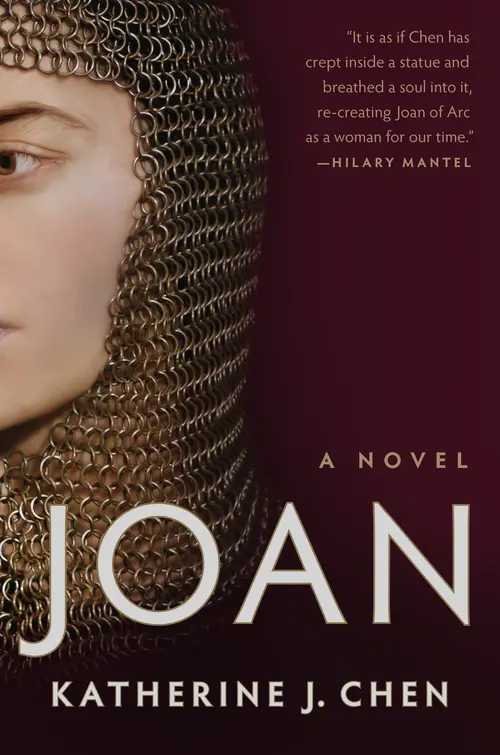
Cover
Epigraph
I will make a war cry that will be remembered forever. And I am writing this to you for the third and final time; I will not write anything further.
Joan of Arc (from a letter dictated to the English)
CAST OF CHARACTERS
JOAN AND HER FAMILY
Joan, a girl from the village of Domrémy in Armagnac France
Jacques d’Arc, Joan’s father
Isabelle Romée, Joan’s mother
Catherine, Joan’s elder sister
Jacquemin, Joan’s eldest brother
Jean, Joan’s second brother
Pierre, Joan’s younger brother
Durand Laxart, Joan’s uncle
Salaud, Joan’s dog
OTHERS IN THE VILLAGE OF DOMRÉMY
Hauviette, Joan’s friend
Jehanne, Hauviette’s mother
The priest
FRENCH ROYALTY
Charles VII, the Dauphin, the eldest surviving son of the French king and the dispossessed heir to the French throne
Marie of Anjou, the Dauphine, Charles VII’s wife, and Yolande of Aragon’s daughter
Yolande of Aragon, the Duchess of Anjou and Queen of Four Kingdoms, the Dauphine’s mother, and Joan’s ally
Jean de Dunois, “the Bastard of Orléans,” the illegitimate son of the former Duke of Orléans, and Joan’s friend
Charles, Duke of Lorraine, an early supporter of Joan’s
Charles VI, the Dauphin’s father and King of France until his death in October 1422
Isabeau of Bavaria, the Dauphin’s mother and much-despised Queen of France
CLERGY AND COURTIERS
Robert le Maçon, a trusted advisor to the Dauphin and Joan’s ally
Georges de La Trémoille, the Dauphin’s favorite at court and Joan’s rival
Regnault de Chartres, the Archbishop of Reims and Joan’s rival
Colet de Vienne, a royal messenger of Yolande of Aragon
SOLDIERS
Robert de Baudricourt, the captain of the garrison at Vaucouleurs and a reluctant supporter of Joan’s
Bertrand de Poulengy, a knight and Joan’s traveling companion from Vaucouleurs to Chinon
Jean de Metz, a squire and Joan’s traveling companion from Vaucouleurs to Chinon
Étienne de Vignolles, better known as La Hire, an infamous soldier and Joan’s friend
Jean d’Aulon, Joan’s squire
Raymond and Louis, Joan’s young pages
FRANCE’S ENEMIES
Henry V, King of England until his death in August 1422
Henry VI, the young son of Henry V and Catherine of Valois (the Dauphin’s elder sister) and heir to the English throne
John the Fearless, the former Duke of Burgundy, an enemy of the Dauphin’s; assassinated by the Dauphin’s men in September 1419
Philip III, Duke of Burgundy, John’s son, and England’s ally
John, Duke of Bedford, regent of England, and Burgundy’s ally
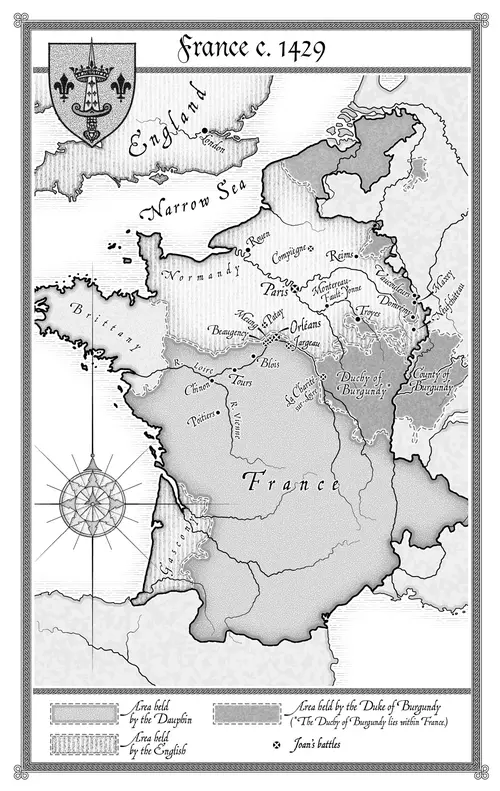
Map
Part One

The kingdom of France has been at war with England for nearly one hundred years, the result of an ancient feud steeped in land and blood.
The current King of France is Charles VI, also known as Charles the Beloved or Charles the Mad. He is a delicate man who suffers from intermittent psychotic episodes and believes he is made of glass. The current King of England is Henry V, who is the very opposite of poor mad Charles. A hardened and energetic warrior determined to subsume France under English rule, Henry is a monarch to be reckoned with and feared, a man with a true fixity of purpose. Under Henry V’s military leadership, England enjoys a succession of victories, including the Battle of Agincourt in 1415, and controls Normandy, Paris, and nearly all of the territories north of the Loire River.
In the vacuum left by an incapacitated French king, two individuals grapple for power: Charles VII, the Dauphin, or the eldest surviving son of the King of France, and his father’s cousin, John the Fearless, the influential and ambitious Duke of Burgundy. In May 1418, John seizes Paris, driving the Dauphin out of the capital. However, only a year later, Charles VII finds himself embroiled in John’s assassination during a meeting of truce on a bridge in the town of Montereau-Fault-Yonne. This is a grave political misstep, setting off a disastrous series of events for the Dauphin. As a result of his father’s death, John’s only son, Philip III, the new Duke of Burgundy, swears vengeance on Charles VII, his cousin, and pledges to aid the English against the French. There are thus three forces at play during this time, with England and Burgundy allied on one side, and France on the other.
In 1420, in a great political coup, the Treaty of Troyes is signed between Henry V of England and Charles VI of France. By this treaty, the disgraced Dauphin falls out of the line of succession to the French throne, and a marriage is arranged between Henry V and Catherine of Valois, Charles VI’s youngest daughter. The Treaty of Troyes declares that the son (and future descendants) of Henry V and Catherine of Valois will rule over both kingdoms, and that Henry will replace the Dauphin as heir to Charles VI’s throne.
These events drive the now “illegitimate” Dauphin, a young man of seventeen, to take sanctuary in the Loire Valley, where he establishes his own court. This is a time of turmoil. A town seized one day by the English may be recaptured the next by the French, and vice versa. Though Charles VII has his supporters—those who do not recognize or accept the terms of the Treaty of Troyes, believe his claim to the throne is valid, and have no wish to live under English rule—it is a miserable period for France and its people. The Dauphin has much against him. His mother, Isabeau of Bavaria, no longer recognizes him as her son. His sister Catherine is allied in matrimony to his English enemy. And England has taken a great deal of French land, albeit at no small cost to its own purse. Though he is heir by blood to the French throne, the Dauphin must end the war with England and Burgundy if he is ever to fully assert his kingship and reign in peace.
This is where our story begins.
I

DOMRÉMY, SUMMER 1422
Her job is picker-upper of stones. Not pebbles but rocks of heft and edges and sharp corners. As the boys of Domrémy gather in the field, Joan is bent-backed over the ground, digging missiles out of the earth with blackened fingernails. From her skirts, the ends gripped in a tight fist, she makes a bundle weighted down with hard treasures.
At her brother Jacquemin’s whistle, the others come padding over, a shuffling and uncertain army of which he is captain, being the eldest—sixteen—and tallest. From his mouth, a stem of wheat curves in a long arc like a single whisker. He looks out at the scorch of afternoon sun in a clear blue sky and stretches a leg, shakes a foot as if to wake it. Above them, a hot wind exhales, stirring a few hairs on every head. A stillness eases into the grass. One boy opens his mouth to yawn.
She shows Jacquemin her collection, and he nods. As captain, he has first pick of stones. He takes two of the largest for himself and flicks his eyes in the direction of the rest of his men. She goes slowly, deliberately, down the line. What she distributes is not randomly given. She examines each outstretched hand, assessing whether it is one accustomed to splinters, cuts, and scrapes, to dusty fights in yards and haystacks, or as yet uninitiated in the rites of boyish scuffles and hard labor. You don’t want to give a boy a rock that is bigger than his palm, that he cannot clutch in his fingers and throw with precision. So, she gives her brother’s friends, the square-shouldered boys of twelve and thirteen, rocks she thinks suit them: stones blunt and heavy.
For the smallest of this makeshift army, a boy she knows only by sight and by name, she saves the best. He is aged seven years to her ten and chewing the fingernails of one hand carefully, even thoughtfully, while the other dangles at his side. When she holds out her prize, he does not take it, so she has to grip the hand that isn’t in his mouth and press the two rocks allotted to him into his palm. As far as rocks go, one is ordinary. But the other is smooth and narrow and easily held. Unlike the rest, it features a jagged edge. She’d smiled when her hand had grazed its sharpness in the warm earth.
“They may not show their faces,” Jacquemin tells them, already bored. He tosses a rock like a juggler about to put on a show, catching it with a small flourish.
“They are cowards,” he adds.
But even now, behind them, at the edges of the clearing: a rustle, a stir so subtle they jump, and she can hear her heart beat inside her ears. The enemy has come, and for a moment, just a moment, they are struck dumb by what they see. It is as if they are looking into a mirror, and for every boy from French Domrémy who is here, there is his counterpart, his twin, from the Burgundian village of Maxey, their neighbor less than half an hour’s walk away on a fine day, their sworn enemy. Ten against ten.
As number eleven, she stands out: a girl dressed in faded red wool with dark hair in knots swinging past her shoulders. Jacquemin says, in a low snarl, “Get out of the way, Joan,” and she glowers at him before moving, at her own pace, to the periphery of the battleground. She leans against a tree, folds her arms, regards the scene. Her brother does not know it, but in her pocket she has kept back three stones, and when she looks down, she spots a thick branch, like a club, at her feet. It is good to be prepared.
They are, on both sides, a ragged bunch. You can tell where their mothers or sisters have patched up their tunics and trousers, the discolored squares sewn onto knees and elbows, where fabric easily wears thin. You can hear, almost, the collective grumbling of stomachs. Boys are always hungry, though their portions are often larger, and in her house, you have to eat quickly if you want your share of bread and pottage. She knows this, having three brothers (two older, one younger) of her own. When food is scarce, they talk on and on about what they would eat if they could: the cuts of dripping beef, the smoking fillets of fresh-caught trout, the banquets they would hold if they were lords. Sometimes, when they are in good spirits, they let her crouch nearby and listen, and her mouth waters, for her appetite is no less than theirs, and she, too, is always hungry. But usually, they chase her away, and if they cannot chase her away because, like a wall, she will not shift from her place, then they will stop talking until she grows tired of the silence and leaves of her own accord.
No one knows with certainty how these mock battles started or why the boys of French Domrémy and Burgundian Maxey should take up stones when their fathers are able to hold a watchful peace between themselves. But here they are, these boys, on the field. Here they are, face forward, wiping final threads of milky snot onto their sleeves, ruddy-cheeked not from anger but from the warmth of a summer day. Here they are, flint-eyed, faces blank, jaws set. Only a few, she thinks, look like born fighters: you can always pick them out; it is the way they stare across at their enemy without blinking, their stillness and quiet, how they lift and hold their heads. The Maxey boys come ready. From their pockets, they show their hands, palms full of dark rocks. She wonders which of their sisters helped them pick out these stones and whether missiles selected by another girl, a Burgundian equivalent of herself—perhaps her name is also Joan—will be as good as the ones she has found in this place, though she thinks not. She has picked the best stones for her brother’s army.
How does a battle begin? Which side will strike the first blow? Or does it commence all at once, like the meeting of hands for prayer? This is a question she and her uncle Durand Laxart have turned over during his many visits. Despite his low birth, his lack of learning, her uncle is a thinker, a teller of stories, a wanderer who has lived the life of a dozen men in his forty or fifty years. No one knows his precise age. When he smiles or laughs, showing off his good teeth, each one intact, not chipped or missing or a blackened stump, he could easily pass for thirty. He says he has been a ship’s boy, a cook, a tanner’s assistant, a one-hour, one-day, and one-month laborer, in the fields, on the docks, even, he claims, on the scaffold as the hangman’s helper.
So, how does a battle begin? He has told her stories of battles, legendary battles, that start with a song. A scream. A curse. A prayer. But on this fine summer afternoon, on a good-sized plot of neutral land wedged between their two villages, the battle starts with a question.
“Who is that?” the leader of Maxey asks, pointing in her direction.
She answers before Jacquemin can: “Are you talking to me, Burgundian filth?” Perhaps it is the rocks concealed in her skirts that make her bold. Or the stick she knows is lying within reach of her foot, which she can roll into her hand at a moment’s notice.
Jacquemin shoots her a death glare, a look that says, Go before I tell Father you were here, and then you’ll be sorry, just as the enemy captain spits on the ground. He spits with such force, you expect a front tooth or two to roll in the grass. He is a safe distance away—his spit lands nowhere near her—but Joan is startled. Usually her voice alone is enough to ward off her brothers, to make them shrink back. She moves closer to the tree, anchoring herself against it. “Armagnac cunt!” the Burgundian captain shouts, and a rock is tossed in the air—she can’t tell from which side. Not necessarily thrown, she observes, at any particular target. She hopes, for the boy Guillaume’s sake, that he hasn’t wasted his prize with the sharp edge so soon.
Stones fly, launching themselves through the air like angry, whizzing birds. Every time a rock hits a target, a shoulder or a stomach, there is a yelp of pain.
When the stones are exhausted, fighting follows, though it is more like a brawl, each boy gripping another of similar height and weight and rolling through the dirt as one body. Teeth sink into ankles. Thumbs press into shut eyes. Everywhere, a tangle of gangly limbs, a wobbling, lurching dance through clouds of kicked-up dust. The high-pitched shrieks of younger children splinter the shouts of older ones. She would join, except she doesn’t know where to begin, and she can’t tell the enemy from her own side anymore. Next time, she thinks, it would help for the boys from Domrémy to mark themselves somehow, perhaps to wear a piece of cloth tied around their arms in the same color. Or the Burgundians could dress as horned devils. That would do the job, too. At the thought, she smiles.
When they’d first arrived, Joan had noted the dark borderline of trees that rimmed the land and said, Look, Jacquemin, look up. In the voice that never failed to put a murderous glint in her father’s eye, she’d told her brother, You should have begun collecting stones weeks ago. Every mock battle, its date and hour and location, is determined by the captains well in advance. We—she includes herself in this we—could have found the best rocks and put them in sacks to raise, by rope, to the tops of the trees. Then each boy would climb to a covert branch, and from his perch, he could ambush the enemy as soon as they arrived. The boys of Maxey, they’d believe the sky or God was pelting rocks at them. They’d piss themselves. They’d run.
But her brother had only glared at her. A lad of few words. Her father thinks this is one of his strengths; she thinks he’s just slow. “If you want to stay…” he’d said, not finishing the sentence. He’d extended an arm and gestured carelessly at the field. Look for rocks.
From a distance, she spots Maxey’s captain in a deadlock with Jacquemin, which makes her want to reach out to her brother with a long arm and shake him. Not five minutes have passed, and already you need my help! But she bends. The stick fills her right hand. She runs in the direction of the enemy’s exposed back, the head like a wisp of orange flame, catching the sunlight. She raises the stick to strike, as well as to fend off anyone who might think of attacking—
A scream stops her.
She hasn’t yet reached the fight, but the branch tips out of her hand. She turns and stares in the direction of the noise, not knowing at first what she is looking at. Then she sees: in the midst of the fighting, there is a patch of silence. The quiet feels strange; it does not belong here. In a corner of the field where two boys should still be throwing fists and kicking, one boy has detached himself. The other is lying on the ground. She observes, even from this distance, the white terror of the moving boy’s face as he stumbles backward and nearly trips over his own feet. He covers his mouth, wipes whatever is there across the front of his shirt, as others, too, begin to look up from their pummeling. Her gaze returns to the boy who doesn’t move.
Already she knows who it is before her eyes can make out the face. Guillaume: seven years to her ten. The light that heats the back of her neck is the same light as before, but different. There is an edge to it now, like the point of a sharpened knife held against her skin. The boys step aside to let her pass. Perhaps they think, because she is a girl, she can do something to help.
Now the enemy is moving again: faces bewildered and pale, fleeing in the direction of Maxey, where they will close their Burgundian ranks and admit to nothing. No one calls out or runs to stop them. By the time she nears Guillaume, they are gone, cutting through grass and the shadows of trees as nimble as thieves in the night.
When she reaches him, she exhales with relief; he is alive. Then she kneels, and it is as if she has swallowed one of her own rocks. She tries to convince herself that the wound isn’t as bad as it appears, that a flesh wound, a clean cut, can release a surprising amount of blood. She sees that Guillaume’s eyes are open, that they are the gray-blue of clouded skies and fixed on a spot in the far-off distance.
Behind her, she hears Jacquemin swear revenge. She turns; this is not the time for blood feuds. Now it is she who gives flinty looks and blunt directions. “Get help,” she orders. Her brother makes a sound, a stifled cry like a dog that has been stepped on, and begins to run. Three of his followers tag behind him. Those who remain look like they might be sick. They turn their eyes away; the blood, she would guess, frightens them. There is so much of it.
The Story Continues on BooksBarbecue!
Enjoyed this preview? ❤️ Do not stop here!
Read the complete book free online → 🔗
Continue reading now on BooksBarbecue and discover every page!
Love reading? Bookmark BooksBarbecue.com for more amazing books!
Happy Reading!