Jericho
Cover
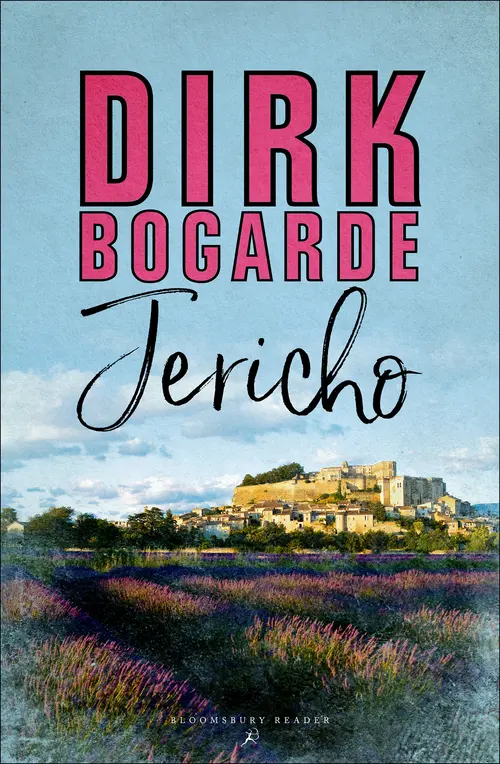
Dirk Bograde
JERICHO

Dedication
For
MARY DODD
with endless love
for Thursday teas
Chapter 1
Helen came into the breakfast-room that morning in her familiar way. I was pretty well used to it: dressing-gown, frill of nightdress below, hair pulled back roughly and secured with an elastic band, slippers which she had long since trodden down at heel.
She carried a tray with a jar of instant coffee, two mugs, a pot of yoghurt for herself, sugar, milk and a small dish of jam.
‘Down early. Couldn’t you sleep or something?’ She set the tray on the table.
I was reading the Guardian, I remember, but just photographed, in a blinding instant, her appearance. The normal morning arrival.
I said the kettle had already boiled, so she slopped across, switched it on, stood by the draining-board, hand on the kettle handle.
‘You didn’t say.
Couldn’t you sleep?’
‘Like a top.’
‘Lucky you, I must say, but I didn’t exactly turn and toss about. Bloody worn out.’
‘Giles all right this morning?’ A mild question. I was folding the Guardian more times than was necessary. Anxiety perhaps; the end of a union is always unsettling.
She poured hot water into the mugs, then spooned in instant coffee. ‘He’s fine. Just one of those things kids get.’ She switched off the kettle. ‘Probably eaten something disgusting at school. School dinners: all chips and jelly-stuff.’ Took the kettle back to the stove, stirred the mugs, pushed mine across the table towards me.
Mine had a Mucha print on it, hers a clown with a red nose and a pointed hat. We always used the same mugs: it had become a habit from the start, fourteen years ago.
Her mug and mine. Amazing, considering how much she broke generally, that they had lasted so long. But it was her idea, not mine. Like the whole dreary kitchen: a mixture of the twee and the dreadful. Pitch pine, jars of pasta, bunches of crumbling herbs, a trug basket hanging from the ceiling filled with dusty dried flowers, a rack of graded saucepans, chipped and burned, on one wall, and on another a set of unused jelly moulds, one a fish, one a wreath of fruit and flowers, another a sort of lobster-thing. Tarnished. The tiles which we had chosen together in high euphoria all that time ago for the work-tops no longer gleamed with bright-sparkling light: they were dimmed now by years of fry-ups and quick wipes down with a dishcloth.
‘We’ll make a country cottage kitchen in dreary old Parsons Green, won’t that be super! So cosy.’
She had said. And I agreed. There wasn’t much point in discussing things anyway; I was very much in physical love at the time and she could have turned the wretched room into a clinical operating-theatre or a copy of Versailles for all I cared.
The one window looked out on to the ‘garden’, or, to be more accurate, a yard, thirty foot long with two battered dustbins, a sad May bush, and the rest all concrete, with cracks grown green with moss and damp like an aerial view of the mouth of the Amazon or the Nile Delta.
We hacked it up in the first spring, with great effort, laid turves on fresh earth and made raised flower beds where she planted honeysuckle, fuchsias and some sort of clematis. But it all faded away after a couple of seasons and was neglected. It faced north anyway, and was dank and sunless. We never sat out in it, the cats peed everywhere and it was really all over by the time that Giles and Annicka were born.
I always thought Annicka was a silly name, and said so, but she said it was very unusual and romantic, and screw what the child thought when she was eighteen. Anyway, it would probably be called Anne or Annie – which it was.
I folded the Guardian again, watched her eat her yoghurt; she stirred a spoonful of strawberry jam into it.
I didn’t like her much.
She looked up as if I had said it aloud, lips sticky with the pink slosh stuff, some sliding down her chin.
‘If looks could kill,’ she said, wiping the muck off her face with her sleeve.
‘I’m not looking. Not killing,’ I said.
She hunched her shoulders, tossed her scraggy pigtail, grinned at me across the pitch pine table.
‘No need for a killing, is there? I’m going away, willingly, longingly, and you do as you like.’
‘Right. I’ll do as I like.’
She raised the coffee mug with the clown to her lips, both hands holding it. ‘Shan’t miss a thing about this place. You’re very welcome to it all, every tile and brick. Just my books, a few odds and ends you wouldn’t want anyway. I’m very glad we talked things to a head last night, no good dragging on like this, not when love, as they laughingly call it, has dried up like an old pond.’
‘No point at all. But you’ll let me see the children?’
‘It’s a friendly separation, sweetie, no harm has been done. You come and see them whenever you want to. Give me a bit of warning; school and all that, you know? Just come down to Mother’s when you feel like it, and as this is your house, paid for from your parsimonious pocket, you’ll be snug as a bug here, won’t you? No kids banging about to disturb your scribbling, and I won’t be driven dotty by your ruddy typewriter. Mrs Nicholls will stay on, I bet. Do better for you than I could. And with more enthusiasm. You’ll have to give her extra, of course, for meals and so on. She’s fab with Lancashire hot pot and mutton stew. You’ll get huge.’
‘I’ll eat out, I expect. Go down to the Grapes.’
‘Super potato salad there.’ She set down her mug. ‘I’ll get on to solicitors and things when I’m settled. Or you can. As you like. I’d better see if Annie is awake. She’ll be late again. That child has sleeping-sickness.’
She got up, tied the belt of her dressing-gown tightly, and the front-door bell rang. She turned and looked at me accusingly.
‘Now, who’s that? At this time in the morning?’
‘Mail perhaps. It’s his time.’
She went out into the hall leaving me looking at the pot of yoghurt with the spoon sticking in it.
The sooner she’d packed and gone and cleared off to her wretched mother in Chalfont St Giles the better. Then I’d be able to think, to try and sort things out, to salvage something from the crumbled debris of a once apparently happy union.
I’d miss the kids, in a way. But nothing else. I could flog the house for a good price and clear off somewhere smaller, without pitch pine kitchens, the chintzy bedroom, the mushy little flowers spattering about the wallpaper.
Falling out of love was every bit as easy as falling in love, it seemed to me. As far as I was concerned, Helen was an empty yoghurt pot … there weren’t any scrapings left. Love, as she called it, had died over a pretty short period of time. Almost as soon as the carnal interest dried up. Pity. Finally expired for good last night in the sitting-room with its striped walls, Knole settee, tiddly little tables with bits of Royal Doulton, some fake Louis-junk, and a Magicole fire in the Adam fireplace she’d found in the Portobello Road.
‘Real piece of Adam, that. Came from the Adelphi.’
Adam my backside. But she’d liked it and bought it, and had it fitted. So.
‘It’s the post. A packet for you, hence doorbell. No duty to pay, and a gas bill. That’s all.’
‘Why no duty?’
‘I don’t know why no duty.’
She looked at the small Jiffy bag in her hand, turned it over a couple of times. Squinting. She’d need glasses soon.
‘French stamps. Can’t read the postmark … Barg-something. No value. It says so on the Customs thing. “Sans Value”. It rattles.’
She threw the gas bill and the packet on to the table and went up to wake Annie.
Oh, I had loved her. Fourteen years ago she was vital, attractive to an alarming degree, and knew it with that quiet complacency sexually attractive women have: aware, smiling easily, contained, knowing what she could offer. She was hard to get, which made the chase the more exciting: men were after her like chickens with scattered corn, fighting, scrambling, pushing. She chose me, to my astonishment. I’d not really expected it. Perhaps because I didn’t join the others, just stayed quietly away, I intrigued her by my apparent distance – but I wanted her.
And she scented this in an animal way. I thought.
‘You’re a writer or something?’ she had said one evening at some awful party we both found ourselves attending. The Marshalls’ place, I remember, celebrating his new book published that week. Poor champagne and lump-fish roe caviar and a fowl in glazed something-or-other.
‘I write.’
‘Novels? Or terribly erudite biographies of dead people?’
‘Bit of both. Depends. Mostly novels.’
‘Ought I to know you?’
‘Only if you read.’
‘I don’t. Much. Haven’t the time really. I’m with Wright and Steinberger, commercial television. I arrange the “shoots”, you know? Locations everywhere, budgeting. I’m out of my mind with travel and figures. One week the Canaries for a Ford commercial, another week Welwyn Garden City for Fairy Liquid – it’s all go with me.’
‘It sounds hectic. But fun.’
‘It’s hell. Really. Can you get me a refill of this muck?’
A hired waiter handed us a tray with spilling glasses – not ‘flutes’ – those god-awful wedding champagne glasses, like inverted umbrellas.
‘I’d give it up in a flash, really. I’m getting on, you know; time I had children, a nice little house, get on with a settled life … all this careering about is for the birds.’
‘Plenty of willing gentlemen about, I’d guess.’
‘Guess right. But they are all arse-holes this lot. Commercial TV is the pits. I find it demeaning. Know what I mean? I’m worth more than that.’
She didn’t specify.
‘The money must be good. Surely?’
‘Money’, she said with slow deliberation as if she had just discovered the fact, ‘is not everything in life. I’d settle for less, really. I mean, look at this lot, all guzzling, red in the face, slapping each other on the back, self-congratulation at every turn, stuffing down that dead bird in aspic as if it was manna from heaven. Couldn’t we clear off, quietly? No one would notice if we did, they are too caught up in themselves and Bob Marshall’s bloody book. Somewhere peaceful, just us?’
The invitation was clear, the challenge met, we got away easily enough.
‘You’re not leaving, darling!’ Mrs Marshall with backcombed hair and sequins, a glass in her hand, distraction in her eyes.
‘I’m off to Malaga at dawn. Must. It’s been lovely, really, and this kind man says he’ll see me to a taxi. Daren’t risk a mugging.’
Mrs Marshall laughed rather loudly so as to be heard above the noise. ‘You don’t get mugged in Eaton Square, darling. But off you go. Sweet of you to come. How lovely! Malaga and all that sun …’ She turned away from us when someone called her name and we got out.
‘Really off to Malaga at dawn?’
‘No. The day after. Just an excuse. All right? You mind fibs?’
‘Not those kinds.’
We had supper together in a small restaurant in Mount Street, and then went back to my flat near by, and made love all night. Or it seemed all night. She was very good and very experienced, un-shy.
‘Practised, I see.’
‘Disappointed?’
‘A lot seems to have worn off on those trips to Welwyn Garden City, Malaga and the Canaries …’
‘You mind? What am I supposed to do stuck among a herd of thirty men. Sit alone in some ghastly unit hotel and watch them swill the local beer and brandy and carry on with my crochet in the lounge? Come on, be fair. I’m twenty-seven, I know my way about, I know how to survive too – the hand on the thigh, the arm round the shoulder that slowly slips down to my breasts. I know the messages. “We could make a deal, you and I? £30,000 a year, for full devotion to … the job, got it?” I got it. They came from hell those bastards, but you have to play along at my age.’
‘I know every nook and cranny of your highly desirable body, but…’
She looked at me with lazy indolence, head on the pillow, the morning light just filtering through the curtains.
‘But what?’
‘I don’t know your name!’
‘Christ, no you don’t, do you? Helen Wiltshire, spinster of Chalfont St Giles, parents’ place, and 169 Upper Cheyne Place. And your name?’
‘William Caldicott. Writer. Bachelor of Faringdon, Oxfordshire, parents’ place, and 687 Mount Street, Wl.’
She pulled herself up to a sitting position, dragged her hair back from her forehead.
‘Oh Christ! Caldicott! I should have known. I have read your books. A book. Paperback. About Incas or something?’
‘About Argentina actually.’
‘Same thing. Oh! Will you ever forgive me? How dreadful! How rude!’ She threw warm naked arms around me, and we slid back into euphoria.
Six months later she chucked the job, married me, and we bought the house in Parsons Green and didn’t live happily ever after.
I mean, that, in a nutshell so to speak, is that. Over ten years we had. Well past the seven-year-itch time, as they say. Slowly the bed-part began to fade … the kids had arrived. Well, Annicka was first, a love child, and Giles a patch-up job. We tried for the poor little sod and made him a sort of bicycle-patch on a slow puncture.
But the tyre went flat anyway.
She missed her crowd, missed the travelling in the end. She’d have traded Parsons Green any day for a trip to anywhere, Corfu, Easter Island, the Falklands even, and she missed the male conversation, still using, as she always had, the coarseness of a unit’s language sitting in a bar.
Couldn’t blame her really. I’d given her what she thought that she wanted, the house, security, children, before she grew too old. But it really wasn’t what she was after, and she gradually found it out. Breast-feeding, disposable nappies, cooking (very badly), yearning for the telephone to ring. For her. One of her predatory gentlemen in television. They seldom did.
And my work suffered too. She hated my being locked away up in the attic I’d converted into an office. Wasn’t interested in anything I tried to discuss with her, plot development, characters, research, that sort of stuff. And we foundered, that’s all. I hate clutter, and she was a clutterer, careless, letting her hair go, grey streaks, slogging away at the vodka from time to time.
‘What else do I do? I’m not constructive like some people.’ This said with sour heaviness. ‘All I am is a bloody nanny-cum-cook-cum-bottle-washer. ‘
‘Not very original.’
‘And don’t tell me, again, that I talk in clichés, I bloody know I do. I’m a living, walking cliché or whatever it is. Screw you.’
‘Well, chuck it. Clear off. Take the kids and go back to mother. Cliché number 1.’
‘I bloody well might just do that. Poor Mother. But there’s plenty of room since Dad died, a garden for the kids. I could get back to work somehow. I know things have changed, all those Bright Young Bitches in Harper’s and the Tatler have taken my place. Still, I’d hire a proper nanny. I could –’
‘Well, do. There is no point in going on like this.’
‘None at all. We don’t even …’ She had the grace to look at the floral carpet at her feet when she came up with the body blow. ‘We don’t even like each other any more. Do we? I mean, honestly?’
‘Honestly. No. Really, I suppose.’
‘Amazed that you took notice. Stuck up there all day with the sodding typewriter, trolling off to your ruddy book-signings, taking that poncey agent of yours out to lunch. At the Caprice, if you please!’
‘What’s wrong with the Caprice?’
‘Nothing’s wrong. You’ve only taken me there a couple of times in all our married bliss, that’s all that’s wrong.’
‘You said that it was too smart, your dress was wrong, and that the food was too rich.’
‘Liar! Liar! Liar! I never did. You invent all this guff, the privilege of the novelist, I suppose. Over-active imagination. Lies, all of it, lies.’
‘You’ve had half the vodka.’
‘And I’ll have the other half, sod it.’
And so it went on. Until last night when we really got down to – cliché – brass tacks: reasonably, sensibly, kindness and understanding smothering my dislike. I refused to lose my temper, took all the blame willingly, admitted wrongs which were not of my doing, offered her a reasonable settlement for herself and the kids for the severance which we both, by this time, desperately desired. When love dies the ashes are cold indeed. Dust. They stick in your craw, like charcoal.
Upstairs, I heard her talking to Annie, the ‘understanding mummy’ bit she did so well; when she felt like it.
‘And we’ll have super Hymettus honey with the cornflakes, shall we? It’s the stuff I brought back from Greece, remember? When you stayed with Gran in the country last year. Yes, there’s enough … No. Not for Giles … Giles has a beastly tum-tum … and two rashers and a poached egg? Or scrambled? Poached … okay, and hurry, don’t leave the soap in the water, and come down as soon as maybe … I’m going to start the eggs. Right? Mummy’s lovie.’
All this shouted in a kind voice on the landing. A reminder to me? A warning to Annie.
I picked up the scuffed Jiffy bag. French stamps, of ‘No Value’, postmark hard to read, Bargemon-sur-Somewhere, Var. Nowhere I knew, nowhere I had heard of. Pulled off the little yellow plastic sealer and emptied the packet on to the table.
A metal key, five inches long, ancient, not rusty, polished with years of use; wired to the loop at the top, a note.
A page torn from an exercise book, judging by the squares marked on the paper, handwriting rather sprawled, but clear, and disquieting. There was no date.
Mas du Pigeonnier
Bargemon-sur-Yves
Var, France
? Sunday night
Dear William,
A key, you will undoubtedly say. From whence, from whom? From little brother James is from whom.
The key to my house here. You have never seen it, don’t know of it, but it has been my refuge, my sanctuary and my life-work (if one can say that) for the last few years. It’s rented with three more years to go, all paid in advance. I send you the key because it is now yours, I no longer have need of it, I’m leaving shortly. If you want some years of delight come and get it, but don’t come looking for me because you’ll never find me, I’m not about any longer, or won’t be by the time this falls on your front doormat.
I shall have drifted into the blue, as they say, leaving no trace behind me. Not a sudden impulse; a thought-out determined action. All I touch seems to turn to dross – my work, my love, my life – so before I take the road to sweet oblivion I will mail this to you and leave you to do fit as you see it.
I have no will, this bit of paper will have to suffice, and if the lawyers grumble and fuss tell them to bugger off. This is my last will and testament. I am of sound mind and in good health; just got weary of it all.
Show this to my landlord (lady, rather), Mme Sidonie Prideaux, 11 rue Émile Zola, Bargemon-sur-Yves. She’ll be fair, she’s all paid up. Sad we never really knew each other; but life is like that and the twelve years’ difference in our ages didn’t help much, did it? You are all that is left of the family, so I leave what I have, not much (nothing in the bank either), to you. Blood is thicker etc., etc. … I had a poor innings, but they tell me that the runt of the family usually does. And runt I was!
Goodbye,
James.
He had signed it James Caldicott, officially, presumably for the legal business.
I let it fall against my coffee mug with the Mucha print. Stared out into the hallway, heard Annie hurrying down the stairs, Helen behind her.
‘You haven’t done my eggs!’
‘No. But I’ve done my face. I’ll do your eggs while you eat the cornflakes.’
They clattered into the kitchen. ‘And some barley-water for poor Giles …’
The door slammed and cut off the wearisome conversation. I stacked the two mugs, the yoghurt pot and the jam on to the tray to give myself time to think before Helen would return, as she was bound to do.
The Story Continues on BooksBarbecue!
Enjoyed this preview? ❤️ Do not stop here!
Read the complete book free online → 🔗
Continue reading now on BooksBarbecue and discover every page!
Love reading? Bookmark BooksBarbecue.com for more amazing books!
Happy Reading!