Jaws: The Revenge
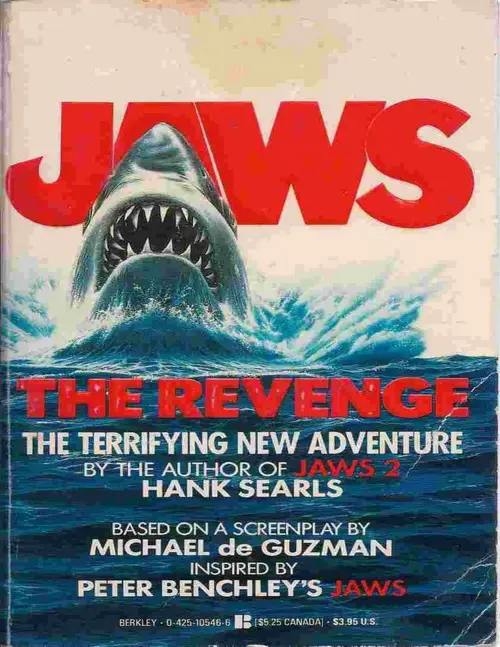
Epigraph
"The sea never changes and its works, for all the talk of men, are wrapped in mystery."
-Joseph Conrad, "Typhoon"
"In addition to eyesight that is better than we thought it was, a phenomenal sense of hearing, and the ability to sense vibrations in the water, sharks have chemical and electrical receptors that are unequaled in the animal kingdom."
-Richard Ellis, The Book of Sharks
Part I
PART I
Chapter 1
Chapter 1
On an evening a week before Christmas a famished gull stood on an icy piling in Amity Harbor. For a moment, gold from the setting sun touched its sleek white breast. It pecked at its gilded feathers, as if surprised, then glimpsed the flash of cod in the depths.
Instantly it gathered itself to forage. But it sensed something it did not like beneath the surface. It cawed sharply, spread its wings, and swooped off hungry toward its nest on Amity Rock.
The light on the Rock—untended now for many years—was turning tirelessly. On the cliff below it an automatic sensor felt the evening fog gathering, and every three seconds the Amity horn began to moan.
***
Random impulses had lured the great white shark to warmer, shallow water from his feeding grounds off Montauk Point, as man himself was sometimes tempted to the sea.
He moved slowly through the ebony waters of Amity Bay. He was twenty-eight feet long and weighed three thousand pounds.
His flat dish-eyes were as black as the night. They were entirely without pupils but strangely knowing. Though they were as useless after dark as the eyes of any other fish, he had no need for them.
For, day or night, he was exactly attuned to his surroundings. He knew within centimeters how far it was to the rusting hood of an ancient car half buried in the mud, and where a sunken dory lay. He sensed a moray slithering from its cave a thousand yards away, and lobsters stirring in the co-op's lobster pots.
All of this he knew from receptors refined from three hundred million years of evolution. Though his kind had diminished in size—his ancestor, Megalodon, had jaws wide enough to swallow a modern cow—its senses had only improved.
A female fur-seal circled the Amity outer bell buoy, evaluating it as a haven. She was en route with her little one from her Arctic rookery to her winter fishing grounds off Sandy Hook.
Now, for reasons she could not understand, she was uneasy. She wanted suddenly to leave the water, but she doubted that her baby had the strength to mount the buoy.
She could only demonstrate, and hope. Gauging the swell, she dived and crested on a wave. In a surge of power she heaved herself aboard, scraping belly fur on rusted rivets. She barked at her little one to follow.
The baby missed the swell, pawed with her flippers at the edge, flopped back, and tried again. Above them, the deep bell gonged.
The great white lazed below, at thirty feet. With a swish of his tail he turned sidewise, spiraling upward. His jaws opened at ten feet, and by five feet he was making a good ten knots, straight up. He took the baby whole, rose into the black night, and scissored the tail from the mother on the buoy.
He waited while she thrashed and fell from her perch, then engorged her in one piece.
With half his hunger satisfied, he glided for a while.
Because he was so heavy and because his kind had no air bladder like other fish, he would sink to the bottom if he ever stopped swimming. There he would drown when the water stopped flowing past his gills. He was doomed to a life of restless motion, like a bird with no place to alight.
Hearing a piling bumping against a channel buoy, he turned toward the lights of the harbor and swam in.
***
Ellen Brody, carrying a grocery bag from Fieldstone's Market, crossed the square, glancing up at the township Christmas tree.
The last of the sunlight glittered from the bedraggled angel teetering on top. Her son Sean, an Amity policeman, had put it there the previous week, rather poorly, and she was surprised that it had survived yesterday's snowstorm.
SEVEN SHOPPING DAYS TILL XMAS, flashed a sign on Lautzhauser's Men's Store.
The Christmas-tree lights flickered on, off, and on again. The same lights that had always seemed so cheerful and full of hope seemed suddenly drab and dreary. A lonely silver bell tinkled in the boughs, dangling in the sea breeze, and the foghorn groaned.
She sighed. All day long she had been filled with sadness and some nameless dread, perhaps of loneliness. This was the first Christmas she would bear without Marty. Her elder son, Michael, was in the Bahamas, and Sean and she would be alone.
Martin Brody had first placed the angel on the tree, forty feet above the ground, when Sean was a child. Marty, with his silver star glittering in sunlight and his visored cap askew, had climbed the volunteer fire company's hook and ladder. Singing "Silver Bells" at the top of his voice, he teetered wildly at the peak, pretending drunkenness. The aldermen had shaken their heads below, muttering darkly. Michael had burned with embarrassment, and she and Sean had cheered.
Almost twenty years ago. And then, each year he had made a better show of it, until finally she grew frightened that he really would fall down.
All that before the Troubles, before the sharks. The first of the Troubles—the shark that had almost wrecked the town—had come twelve years ago, and the next, which had all but finished the job, two years after that. Sean had been barely ten. After that shark there had been no more climbing of the Christmas tree for Marty: His heart would not permit it, nor would she.
Now Sean wore his father's badge: number one. In his holster, when he remembered to wear it, swung Marty's battered revolver, drawn only once in his father's career, at a fellow policeman shooting seals. Sean sat daily in his father's squealing swivel chair and wrote parking tickets in the same scuffed citation book.
A dead-end job, his brother Michael said. But somebody had to do it. There were worse role models than his dad, and God knew what would become of her if he ever decided to leave.
She passed Nate Starbuck's Pharmacy, where the second of the Troubles had begun. The freshly developed photo of the great white lying on the counter, of the idiotic scuba diver leering at the camera while the monster ran him down, had started it all and lost her the only man she had ever truly loved.
It was Amity's second shark—which had died in a searing flash of voltage on the Cape North Light power line—rather than the first, which had ruined Martin's heart. Dr. MacIntosh had said, "That thing killed him, Ellen, just as if he'd torn him limb from limb."
Marty had fought the beast for the town, which didn't give a damn once the evil thing was dead. Sean's job was a sop, an insult. No one wanted it, anyway, except Sean, who would be wearing red suspenders if he thought his father had.
And they hadn't even made Sean chief.
The dread she had known all day was overpowering. Quickly she crossed the square, entered the town hall, and stepped into the police station.
Sean looked up from his desk. He had sent Polly, the clerk and dispatcher, home and was there alone. "Hi, sweetheart! What brings you here on this cold and dreary night?"
She shrugged. "I was passing." She moved closer to the radiator, swinging her hands. "The town is absolutely, positively dead. Fieldstone's is a morgue."
"Um..." He was eyeing the bag. They were having his fiancée, Tiffany, to dinner that night, and to decorate their tree. "What you got?"
"I'll never tell. Look, we're about to have a fallen angel in the square."
He shrugged. "I hope so. That damn thing's older than I am."
She stared at him, shocked. Didn't he care? She felt her eyes misting. Suddenly he was on his feet, folding her into his arms, rubbing the back of her neck.
"Mom, Mom, I'm sorry. I was thinking of something Tiffany said, and I forgot... That act he used to pull..."
She was being silly. "Sean, it's me, not you. I turn everything into a crying spell. I've got to get over it, that's all."
He stepped to his desk and drew a tissue from his drawer. "You're going to." He glanced at the clock on the wall. "I let Polly go home to wrap presents. Lenny won't be here until six. And I have to pick up Tiff. Seven, maybe?"
She dabbed at her nose with the tissue. She must quit sniffling every time she thought of Marty or Sean would never come home to dinner anymore.
The radio cackled. It was Lenny, Amity's other police officer, nominally the chief. "Sean, there's a big old piling drifting in the channel."
"Ten-four." Sean picked up the phone and dialed the Montauk Point Coast Guard. Amity owned, Ellen was sure, the last dial phones in America. He grimaced and covered the phone. "I hear a Christmas party, they'll love this." He reported the menace to navigation, listened, and sighed. "Well, as soon as you can, okay? Our fishing boats are coming in, and we're going to have fog tonight."
He hung up and shook his head. "Damn hooligan Navy. They claim they're all tied up." He moved to the window and looked out. "Probably are too. To the Montauk dock."
"You're not going?" Ellen murmured. "Let Lenny go." Damn! Why do I do this all the time? He's a grown man! "I mean," she finished lamely, "he's better with the boat."
"Mom," he warned, and then grinned. "Okay, if the coast guard doesn't show, I'll con Lenny into going."
She squeezed his hand and stepped back onto the street.
The mist was drifting in. The foghorn mourned from Amity Rock. The nameless dread returned.
She got into her car and drove home.
***
Sean pushed his chair away from the table and belched softly.
"Sean!" Ellen tried to sound outraged but couldn't: Marty had done the same thing.
Tiffany, brown eyes sparkling with wine and angel face shining, giggled. "How gross!"
God, Tiff even loved his belches! Ellen began to clear the table, a little jealous. She tried to remember if she had been so helplessly smitten when she was Tiffany's age. No, her love for Marty had dawned slowly.
Her passion for Hooper, back at the time of the first Troubles? No, for she'd taken Hooper in anger, at Marty's bullheaded dedication to the town and to the job. Sean was just as stubborn when he wanted to be.
Now he was sitting back, being male until they cleared the dishes. He eyed the naked tree and the familiar boxes of decorations, some as old as he.
"When we finish decorating, let's open some presents!" he said suddenly.
Ellen looked at Tiff. "You won't need to have a child," she said softly, "you're marrying one."
"I know." Tiff sighed. "No, Sean. You have to wait for Santa. And all you'll probably get will be a lump of coal."
Ellen and Tiffany finished the dishes, and the three of them began to decorate the tree.
***
The great white had a wide range of hearing. He could pick up sounds at half the frequency a human could and was equally attracted to a struggling fish or a banging oil drum. Fine veins filled with liquid, running from his head to his tail, sensed differences in water pressure around him. Through them he could detect the presence of a swimming seal or a drifting boat or a pelican in the waves.
His head was covered with pores that were electrical sensors, and his body with many more. Like a minesweeper, he could find targets beneath the mud: skates, stingrays, and tin cans, which he sometimes scooped up with the rest and which caused him no digestive problems at all.
The Amity foghorn blasted; the bell buoy clanged distantly. He accepted the sounds above the surface passively: They were simply there. He was listening to the log jostling the channel marker, thumping, squeaking, scratching.
The seals had taken the edge from his hunger, but the sound of man-things in the water angered him, for he owned the sea.
***
Ellen sat cross-legged under the Christmas tree, brushing tinsel from her hair.
The tree was not as tall as the past year's—she hadn't seen much point, with just Sean and her, in getting a big one.
And tonight the decorations, even the recent ones, had somehow lost their glitter.
Sean's sweater from Lautzhauser's Men's Store, and Tiff's lace tablecloth that had come to America from County Clare with Marty's great-grandmother, Catherine, lay wrapped on cotton snow. Ellen's presents for Mike, her older son; his wife, Carla; and her five-year-old granddaughter, Thea—all had been sent two weeks ago to the Bahamas where Mike worked as a marine biologist.
All she had to do was wait for Christmas.
She jumped when the phone rang. She was jittery tonight.
Sean got up and answered it. When he put it down, he said, "Old Larson damn near hit that log by the starboard entrance buoy." He called the coast guard. "That's what I figured," he growled into the mouthpiece. "No, I don't believe you, Chief. It's too cold for you, is all."
He yanked Marty's old Navy pea coat from the closet, angry and quick.
"What's going on?" demanded Tiffany. "Where are you going?"
"It's a log in the channel," Ellen told her. She remembered something. "You said you'd ask Lenny to do it!"
"No way." He zipped up his father's fleece-lined leather boots. "I forgot he was Joseph the Carpenter. He's rehearsing tonight for the Christmas show."
She followed him to the porch. "Please don't! Not in the fog."
"Would Dad go in the fog?"
In the orange glow of the porch light she met his eyes. They were shadowed and very dark. She knew how he hated the water, and boats of every kind. But yes, Marty would have gone, and they both knew it. It was something he had to do.
She nodded. "I guess he would."
"Okay." He touched her lips and smiled. "Look, it's just a log!" He zipped up the jacket and shivered, smiling. "It's too cold for man or beast. Damn it, Mom, this winter you've got to do it."
"Fly down to see Mike?" She sighed. "Maybe, if real estate picks up next year."
"Promise?"
"I promise." She nodded, watched him go. Tiff was suddenly standing beside her, an arm around her waist.
"Come on, Ellen," she said softly. "Let's finish up the wine."
The foghorn growled and the dread returned. They turned and went inside.
***
Bump...scrape... bump... scrape... In Amity Harbor the restless thumping of the piling on the channel buoy had caught the attention of the great white shark. The sound drew the creature toward the buoy as a magnet draws a nail.
Its tail, shaped like a boomerang in flight and as tall as a man, swept lazily from side to side, stirring the bottom and raising great clouds of silt. A vortex like a minor whirlpool followed it on the surface.
The shark continued, turned away, drifted awhile, and turned toward the buoy again.
***
The Old Pavilion on Amity's waterfront—a relic of the early 1900s and long-gone tourist days-was awash in floodlights. Its sweeping veranda would act next week as a stage for the Amity Christmas Show, and parents and friends would shiver on the lawn below, wishing the thing were done.
But tonight was only rehearsal. Sean could hear the high school band for blocks. He eased his jeep through the teenage beauties preening their hair and parked as closely to the dock as he could get. He took his stocking cap off the seat, checked his six-celled flashlight, and climbed out.
He passed beneath the age-worn banner: AMITY ANNUAL CHRISTMAS PAGEANT. On the porch, Emil Tarkanian, the band instructor, led "The First Noel." Most of the assembled angels in the girls' chorus behind him would be squirming tonight in backseats of cars along country roads, but now their fresh faces shone with piety and their voices were sweet and clear.
Below, two little girls stood on a stepladder, decorating the papier-mâché hump of a camel—Justin Barlow's riding horse—with ribbons of red and green.
Amity, Amity...A picture-perfect town with a picture-perfect name, and beneath the surface, currents as foul as any anywhere on earth.
The elders had turned against Sean's father in the Troubles, when it suited them, and now that Martin Brody was dead, he was a hero to them all. If Sean could ever get his mother and Tiffany to leave, the town would never see him again.
He sighed, boarded the police boat, and turned the key, hoping it would not start. The ancient engine labored for a moment, then fired. While it warmed, he drew a rusty boat hook, a grappling hook crusted with salt, and some worn three-quarter-inch nylon line from the gear locker in the cockpit. Everything he needed, unfortunately, was there.
There was no excuse to quit. He took a deep breath and looked out at the harbor waters.
The fog was holding just outside the entrance. No excuse there, either.
He hated the sea, and slimy pilings, and the salt that ate at tools and ships and men.
He cast off his lines and eased away from the dock, switching on the spotlight. Over the rumble of the old Perkins diesel he heard the high school band pounding "The Little Drummer Boy" into the dirt.
He set a course for the green light on the starboard channel buoy.
***
The great white had heard the high-pitched squawking of the starter, and now he heard the growl of the diesel. He began to track it, closing in on it as it moved away from the wharf, which he saw with his receptors as if it had been bathed in light.
He was a scavenger as well as a predator, and the survival of his kind had depended for three hundred million years on curiosity.
His energy needs were enormous. If he was not where the action was, he starved.
***
Sean stared at the floating piling. The dark, water-soaked wood glistened in the spotlight. He could hear it thumping and rubbing the buoy, following the regular rhythm of the swell.
It was more than a simple log. Torn from some ocean wharf by a winter storm, it trailed its own debris: a rusted cable, a slimy hawser, the remnants of a painted sign. Faintly he made out the sun-bleached letters: DANGER.
Danger, all right, and a pain in the ass. Carefully he eased the boat alongside the creaking mess. The current was sweeping into the channel from Amity Bay. Boards nailed to the piling embraced the buoy. Sean could see the whiskered wire trailing toward the shore like the tail of a kite.
He knelt by the gunwale and leaned over the side with the line, plunging his arms up to his biceps to retrieve the line from below the thick log. He couldn't make it around its girth. All right, if he simply freed it, it would drift up the channel. Then, if it didn't stave a hole in a boat en route, he could handle it near the wharf.
He heard faint childish voices from the pavilion: "Silent night, holy night..."
Stretched over the side of the boat, with his ear near the water, he heard the thumping of the piling against the buoy. The sound—a soggy, lifeless rasp of wet wood on metal—made him nervous.
The freezing water filled his gloves. His fingers ached. He tugged on the two-by-fours that clasped the buoy. They let go with a shriek of rusty nails. Only the sign kept the piling snagged.
"All is calm, all is bright..."
The mass of wreckage suddenly shifted, as if jerked by a giant hand from the deep. The violence of it ripped the nails in the two-by-four through his canvas gloves. His hand was impaled on a spike. For an instant he was silent with horror, and then he screamed in pain.
He glimpsed an enormous shape, silhouetted against the lights of the Pavilion, and caught the glitter of ivory teeth.
"Holy infant, so tender and mild..."
He screamed again. He was engulfed in a sheet of freezing water. One hand went up to ward off the nightmare.
The other was caught on the sign.
Chapter 2
Chapter 2
The great white sank to the depths. It had ingested a good part of the starboard cockpit rub rail, along with the human torso, a section of hemp, and a fire extinguisher. The latter it regurgitated, but the channel to its stomach was unhindered. Digestive juices that could sear a lobster shell began to work instantly on all the rest.
Above, a human hand and forearm thrust skyward, nailed to the danger sign, swaying in the swell. Below it, a streak of red swept toward the shore.
Across the water drifted high, clear voices: "Sleep in heavenly peace...”
The foghorn moaned, and at last the fog rolled in.
***
She sat with Tiffany sipping the dry California Chardonnay she had splurged on at Fieldstone's. The embers glowed blood-red. She fought the rising certainty that something was going very wrong.
"He's so sensitive and gentle." Tiffany sighed.
"Yes..." Her prospective daughter-in-law, sitting cross-legged on the throw rug and staring into the fire, turned and smiled at her with her great brown eyes. There was such love for Sean within them that Ellen felt her throat grow tight.
"Go on, Ellen," Tiffany murmured. "I want to hear more about him."
Ellen, fighting panic, tried to keep her voice steady.
"Well, he was such a gentle boy, it's no wonder he's a gentle man."
"I know. He loves Candy as much as he loves me."
Candy was her cocker spaniel puppy. Ellen forced a smile. "I doubt that." She got up and poked the fire. As long as they talked about him, he was here with them and everything was fine. After all, he would never leave the harbor, and even if the worn-out engine died, the tide was coming in. Besides, he had a radio on the police boat.
"Tell me another Sean story," Tiff urged her, like a kid begging for a fairy tale. Ellen cast back in memory. "Sammy the Seal," she said suddenly.
"Who was Sammy the Seal?"
A summer visitor—a fat policeman from Flushing—had shot a baby seal. Doc Lean expelled it from his animal hospital for exciting his canine patients, and the Brody garage became an intensive care unit, and Sean the seal's nine-year-old nurse.
The Story Continues on BooksBarbecue!
Enjoyed this preview? ❤️ Do not stop here!
Read the complete book free online → 🔗
Continue reading now on BooksBarbecue and discover every page!
Love reading? Bookmark BooksBarbecue.com for more amazing books!
Happy Reading!