Intimacies
Landing Page

iii
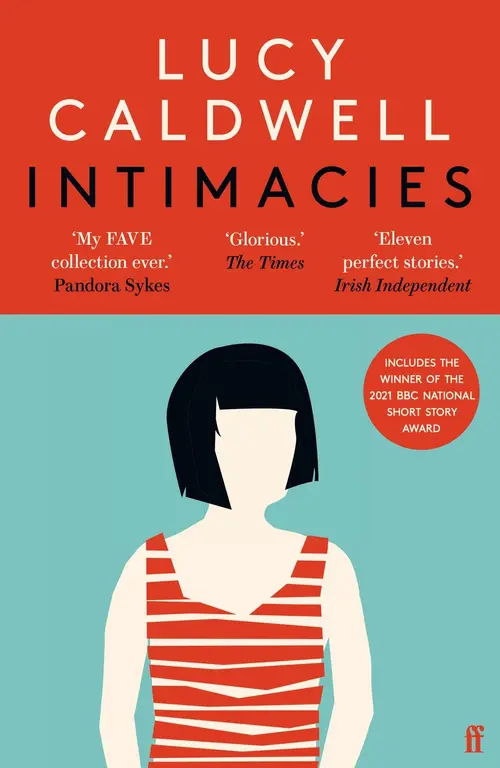
INTIMACIES
Eleven More Stories
LUCY CALDWELL

Dedication
v
for Orla Rose
and all the places we, you, will go
Epigraph
vii
And
always embrace things, people earth
sky stars, as I do, freely and with
the appropriate sense of space.
Frank O’Hara, ‘A True Account of
Talking to the Sun at Fire Island’
Contents
- Title Page
- Dedication
- Epigraph
- Like This
- Mayday
- People Tell You Everything
- Words for Things
- Jars of Clay
- Night Waking
- The Children
- Lady Moon
- All the People Were Mean and Bad
- Devotions
- Intimacies
- Acknowledgements
- About the Author
- By the Same Author
- Copyright
xi
INTIMACIES
1
Like This
It happens like this.
It’s a Tuesday or Wednesday, one of those amorphous midweek days not quite the weekend, but at least not Monday. November. Grey rain coming down too vertically to pretend much longer, to yourself or anyone else, that it isn’t really raining; impossible to cadge a minute’s interest longer in the sad-mouthed, slightly ragged goldfish in the shallow ornamental pond. The pond is opposite a corporate law firm with a Dickensian name and persistent rumours of being built on Europe’s largest medieval charnel house. There is a Perspex floor that you can walk or crawl over, peering giddily down to where old Roman walls and bronze-cast statues lie. The layers beneath; the bones. The fish and the floor are usually enough to kill half an hour; there is sometimes a bus too, an old red double-decker, repurposed into a puppet theatre, but not today.
You’re running out of ideas.
The toddler is grizzling, the baby is grizzling. Any moment now one or both of them will go nuclear. You lift the flap on the rain hood and reach in to stroke the baby’s soft 2damp cheek and she turns her head and blindly rootles, trying to suck your fingers. You fed her before you left the house, less than an hour ago. She can’t be hungry. Unless she’s due a new growth spurt – how old is she again?
Poor second-born. You counted her brother’s age religiously, days, weeks, months, until the months flipped more pragmatically into years. But you’ve lost count already of how many weeks the baby is. Twelve, you think, or maybe thirteen? First time round you agonised, laughed in disbelief, joked grimly, about the tiredness. This time there isn’t the energy even for that.
‘You’re hungry,’ you say. ‘Poor wee thing, you’re hungry.’
‘And I,’ your toddler says indignantly. ‘I hungry too. Naughty Mummy,’ he adds, because you forgot to refill the snack box before leaving home. All it contained when you snapped it open was a long-suffering banana, blackened and bumped and rejected with affront, and some crumbs of rice cake currently disintegrating in the law firm’s pond.
So although you can’t justify it now you’re a family of four on one salary and a maternity pittance, into Frankie’s in the covered market it is; one of the few places round here likely to be vaguely tolerant of little boys and babies, even in combination, at least until the lunch rush starts, for normal people who don’t eat lunch at 11.17.
Into Frankie’s, order at the counter, today’s lotto of foods that will or won’t be eaten, choosing a table, wrestling with a stack of recalcitrant highchairs, highchair rejected, menu, 3crayons, layers of nursing vests and stubborn clips of nursing bras and the howling baby finally latched on. Cutting up food left-handed, coaxing aeroplane mouthfuls in, baby breaking off and crying, burping baby, switching her sides, broken crayons, one more mouthful, sorry-I-mean-cargo-plane, into the hangar. Transferring baby to buggy, easing her down, coaxing the straps over her shoulders (why didn’t we get a buggy with a proper bassinet) and clicking them tight. Now finally your cup of tea, still warm because they make it with bloody steam—
‘I need a wee-wee,’ your toddler says.
You turn to him helplessly. The disabled toilet is out of order again, you can see the yellow sign on the door from here. The unisex loos aren’t wide enough for the buggy and if you take the baby out now, she’ll wake and howl, you’ll have to feed her back to sleep, and she’ll be sick because she’s already gorged herself milk-drunk.
‘I need a wee-wee now,’ he says.
‘Ok,’ you say. ‘Hang on.’
‘Mummy!’ he shouts in anguish. ‘It’s popping out so fast!’
‘Go,’ the woman beside you says. ‘I’ll keep an eye on the pram. Just go.’
‘Are you sure?’ you say gratefully, already reaching for your toddler’s hand, ‘thank you so much, thank you,’ and you’re hurrying with him to the toilets, and there, it’s already happened, just like that, not even a second’s split shiver of thought. 4
You have exchanged polite, distracted snatches of conversation with this woman, it should be said. In the midst of your caravanserai of chaos, she’s commented on the baby, said hello to the toddler and asked him what he’s drawing. Good on you for breastfeeding. Best start for them, no doubt about it. I couldn’t stick to it with mine. An obvious cue that you politely took up: Oh, you have children too? Oh, long grown up now. A boy and a girl. Just like you. It flies by. Really? Believe you me. It doesn’t feel that way in the trenches, but yes, it does. I’ll take your word for it.
It hits you while you’re in the cubicle, bent holding him, back aching, over the too-tall toilet because he refuses to sit down, insists that boys wee standing up. You have left the most helpless, precious thing you own with a complete and utter stranger.
No, you tell yourself. No. She has children too. She said so. And then you think: You don’t even know the first thing about her. Of course you’d say you have kids. That’s the first thing you’d say. And why was she so keen to strike up conversation with an obviously harassed and beleaguered new mum, so quick to insist that you leave her with the buggy?
‘Hurry up,’ you snarl at your son. You couldn’t even say what the woman looked like now. Brownish hair, and glasses – did she have glasses? Fifty, sixty? Wearing something … dark? You yank up your son’s pants and trousers, bundle him out through the cubicle door and past the sinks.
‘But, Mummy!’ He is outraged. ‘I hasn’t washed my hands. You has to wash your hands. You has to!’ 5
‘Not this time,’ you snap, ‘come on,’ and you haul the protesting mass of him through the door.
Your heart, slamming into your chest.
The buggy is still there.
For a moment, your limbs turn to jelly. You clutch your toddler’s hand and steady yourself on the metal edge of someone else’s table. The buggy is still there. The beating wing of some great, ancient, thwarted creature brushes past and through you. Sick with relief, you kneel and hug your son.
‘Mummy’s sorry, sweetheart. Mummy didn’t mean to be cross.’
He blinks at you, unsure, uneasy, this little barometer of your every mood and thought, disturbed and confused by the sudden rush of conflicting pressures.
‘I am very cross,’ he says. ‘I am crosser than you. You has to wash your hands.’ His face like thunder, little chin still jutting out in the ominous way that precedes a meltdown.
‘I know,’ you say, ‘I know, pet, Mummy’s sorry, Mummy’s very sorry. Let’s get your baby sister and then would you like a cookie? Or a milkshake? Which would you rather, a milkshake or a cookie?’
He glares, suspicious.
‘A milkshake and a cookie,’ he says.
‘Ok,’ you say, ‘a milkshake and a cookie.’
‘A stawby milkshake,’ he says, sensing the upper hand, and you’re suddenly overcome with love for him, this two-foot tyrant who can’t yet pronounce ‘strawberry’.
‘A strawberry milkshake, of course. Come on.’ 6
You weave back through the tables to thank the woman. You can’t see her, at first, in the early-lunchtime throng, a queue for the counter that snakes past your table. Excuse me. Excuse me, please. Your son chiming in: Beep-beep!
The muslin draped over the buggy hood to shade the sleeping baby has fallen to the floor. Almost before you have registered it something shivers through you. Those wings again, not defeated after all, not even retreating, just turning to make a closer circle, slow ripples in the air.
They never find the woman, or the baby. CCTV, Newsnight, the front page of the Evening Standard: nothing. Friends and well-meaning strangers say, It’s not your fault, or, It could have happened to anyone, but of course it is, and of course it couldn’t, wouldn’t. The policewoman at the station: I’m sorry, just to clarify, she was a stranger to you? A complete stranger? Someone you’d never seen or spoken to before?
Your sweet, sweet baby, and the cluster of things you know about her. Her hands still in fists, and the way she’d started to laugh. The cracked, tender patches on her feet and elbows where you nightly rubbed in emollient. The way it felt to lay the warm soft bundle of her down in her Moses basket, bottom first, then gently lolling head. The way she gazed in wonder at the mobile of aeroplanes above her changing mat. The nights after vaccinations where her temperature rose and her little body twitched and trembled and you held her, rocked her, bounced her. 7Her Babygro with the flamingos on, and her little vest with dinosaurs. A tiny hand on your chest as she fed. Still, nightly, year after year after year, your body aches for her.
The years slip by. They are three and one, and chasing each other through the glittering fountains in a park. They are four and two and feeding the swans, eating oversized ice creams side by side. They are seven and five, on a trampoline. Eight and six, nine and eleven. Twelve, thirteen, fourteen, teenagers, allies and enemies, officially adults, going, going, gone.
The marriage doesn’t survive, or rather, it does until the new baby’s born and you feel too guilty and wracked with anxiety to hold it, let alone risk loving it. Your husband goes for full custody of both and you don’t fight it. You stay together for the sake of the boy, but separate by mutual agreement once he turns eighteen, and of course you never have another baby. He doesn’t remember his baby sister at all, though he sometimes pretends he does.
‘Mummy,’ your son says. ‘Mummy,’ tugging on your hand.
‘My baby,’ you say, to the cafe in general. ‘Have you seen my baby?’
Asking. In general and at random, too loud at first and then even louder. My baby, have you seen my baby.
Some faces look at you, cease talking, wary, blank.
‘Your mother took her,’ someone says.
‘My mother,’ you say. Your mother. Your mother is across the water, hundreds of miles away. 8
‘No,’ you say, ‘no, no, my mother’s not here, she’s not my mother, where did she go, did you see her, where did she go?’
The faces, blank.
‘Just over there, I think?’ The direction of the doors.
The mass of people: faces, talking. Dark jackets everywhere, brownish hair. A teenager, spots still on her cheeks, wearing the Frankie’s baseball cap and badge.
‘Excuse me, can I help you?’
‘She’s lost her mother.’
‘She’s not her mother.’
And suddenly you can no longer speak, and suddenly: there she is. Wearing a navy jacket and jeans, tortoiseshell glasses – yes – and a bright silk scarf knotted round her neck (how could you have missed the scarf?). Grey-brown hair in a bob, jiggling the baby in her arms.
Your baby.
‘We woke up,’ she says, ‘didn’t we? We woke up, so we went for a little walk, yes we did.’
‘Is everything ok?’ the Frankie’s girl says, looking between you, as you scoop the baby back into your arms. And oh, the warm heft of her, this is how she feels, this. The soft downy hair on her head, her neck, the milky smell of her, this.
‘Everything’s good?’ the Frankie’s girl says again.
‘She never wakes up,’ you say.
The woman blinks at you.
‘She never wakes up,’ you say, feeling the pitch of your voice rising. ‘Once she’s fed and asleep like that, she never wakes up unless she’s disturbed.’ 9
‘Well, she woke up,’ the woman says, ‘and I didn’t want to leave her crying, so I lifted her.’
Trudging home, drenched, unwieldy buggy-board bumping down and up the slick kerbs, already the thought of anything other than this, implausible. The veil between worlds, the skin closing over. A wanderer who visits another world and spends a lifetime there, only to return to their own and not a minute passed. Just wanting this day to end now, that moment when, the children bathed, tucked into bed or zipped and poppered into duvet bag, flush-cheeked and open-mouthed, asleep and peaceful, you exhale.
It’s only just beginning.
10
Mayday
Ten days later, the package finally comes. It is a small brown padded envelope, her name and address typed on a white label. The postmark is the Netherlands. Inside is a blister pack of tablets, one round and four oval. No instructions, no warnings, and nothing to identify the sender. She pops out the round tablet there and then, in the hallway, and tries to swallow it down but her mouth is too dry. She feels it stuck at the back of her throat. She makes it into the kitchen and pours a pint glass of water, drinks the whole thing down. The glass has a dried scum of lace at its neck and the water tastes stale. She can still feel the sensation of the tablet, lodged. There was a fresher, a geography student, who died after taking diet pills that he bought online. Boiled alive: that’s what the newspapers said. There was a photo of him in his hospital bed, face so swollen he appeared to have no eyes, the skin on his torso and arms peeling off in raw red patches the size of sycamore leaves. His parents had released it as a warning, a deterrent to others.
It is the last day of April and she has, by repeated calculations, less than one week remaining. 11
A memory: aged eleven, a Junior Strings weekend away in Carnlough. On Sunday morning the Catholic children go to Mass in the big church on the Bay Road; the handful of Protestants are supposed to stay in Drumalla House and sing hymns with the cello teacher. She goes with the Catholics: the walk along the rocky shore, the sweet shop in the village afterwards. The sense of something forbidden. Her friends line up to receive Holy Communion and she copies them, kneels and opens her mouth and lets the priest place the dry disc of wafer on her tongue. She chews, swallows. Afterwards they tell her she’s going to Hell. They are falling over themselves to tell her. She’s committed a Mortal Sin, and because she can’t go to Confession she can’t be forgiven. And she chewed. They are beside themselves with glee. She cries. The cello teacher tells her it’s nonsense, tells the others they’re being silly. Tells them that, incidentally, the word used in John Chapter 6 to describe the consumption of the Eucharist can be understood as ‘to gnaw’ or ‘to munch’, so there they go, and now enough of all that. They say they were only joking.
She hasn’t thought of it for years but it surfaces now. The dusty room they practised in, the bars of sunlight. The pebbles on that little rocky shore. The gules of light in the stained-glass windows of the Catholic church. 12
She doesn’t know what to do with herself now, with the hours remaining. She checks her phone. 11.11. Tomorrow, at this time exactly, the other pills, all four of them at once. It would still be possible, if she hurried, to make the midday seminar. But she hasn’t been to lectures all week, hasn’t done the seminar prep. She likes the module, likes the tutor, wants to do well. Last term her supervisor said her idea had PhD potential and she replayed the words in her head for weeks. So she goes up to her room now and sits at her desk and flips through the handout and reading lists. Gender, Family, Faith: Norms and Controversies. Paradise Lost in Context. Civil Wars of Ideas: Politics vs. Religion. You can’t get away from religion, in the seventeenth century. She reaches for the Norton anthology, opens it at random. A ballad. She skims the first couple of stanzas:
Farewell, rewards and fairies,
Good housewives now may say,
For now sluts in the dairies
Do fare as well as they.
Lament, lament, old abbeys
The fairies lost command;
They did but change priests’ babies,
But some have changed your land.
And all your children stolen from thence
Who live as changelings ever since
13She stops, heart pounding. Sluts. Illegitimate children. Changelings, and fairies to blame them upon. Nothing feels neutral any more, she thinks. It never will again.
And then: Wise up, she tells herself, and then she says it aloud. Wise up. Wise yer bap: that’s what they used to say in school. Wise yer bap. She forces herself to tap her laptop awake and type out a few lines of the ballad. It’s going to be fine. It’s all going to be fine.
She closes her laptop and lies down on her bed, scans her body for any signs it’s starting to feel different. What if nothing happens? What if it is too late? The thing is, you find out and you think, ok, nine weeks, that’s ages. But then you do the online calculator and realise with a horrible rush that it’s already more than six weeks, coming up to seven. It doesn’t feel fair, the way they count it. Nine weeks is nothing. Nine weeks gives you little more than a fortnight. She found the website that night, Sunday, and by the Tuesday had made up her mind and placed the order. But it still might be too late. If she hadn’t found out until a few days later. Or if it had happened while she still lived at home, or before she had a credit card or a PayPal account. It doesn’t bear thinking about but the thoughts keep marching back, a fortnight’s well-worn grooves. If you were in England, the GP would have prescribed it to you, the exact same thing. You’d have taken it already, under 14medical supervision. It would already be over. If this doesn’t work she still has options. London, or Manchester: she’s researched the clinics online. She wonders will she tell her mum, if it comes to that. Her mum would make the appointments, book the flights, pay for the hotel. Hold her hand in the waiting room and hug her afterwards. Her mum wouldn’t rage at her, or weep, like mothers do in films. Her mum would be pragmatic, calm: her mum would handle it all. Why hasn’t she told her mum? Her mum has raised the three of them to believe that they can do whatever they want, that they’re as good as men, that it’s a woman’s right to choose. Her mum would help her. Her mum would be here, now.
She aches for her.
Another memory: the Junior Debating Club, fourth year or maybe fifth. Kerry Ferguson passing round A4 pictures of babies smiling in the womb, sucking their thumbs. The women should just have them, Kerry Ferguson says. They should have them and give them to people who want them. Almost nobody voted For. Afterwards, when her mum asks how her day was, she’s too ashamed to mention it.
The Story Continues on BooksBarbecue!
Enjoyed this preview? ❤️ Do not stop here!
Read the complete book free online → 🔗
Continue reading now on BooksBarbecue and discover every page!
Love reading? Bookmark BooksBarbecue.com for more amazing books!
Happy Reading!