Incident On the Kalka Mail
Cover
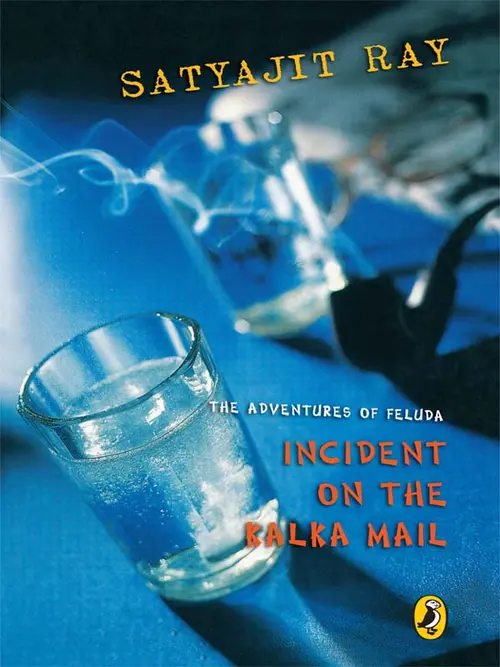

SATYAJIT RAY
The Adventures of Feluda
The Incident on the Kalka Mail
Translated from the Bengali by Gopa Majumdar

PUFFIN BOOKS
PUFFIN BOOKS
THE ADVENTURES OF FELUDA
THE INCIDENT ON THE KALKA MAIL
Satyajit Ray (1921-1992) was one of the greatest filmmakers of his time, renowned for films like Pather Panchali, Charulata, Aranyer Din Ratri and Ghare Baire. He was awarded the Oscar for Lifetime Achievement by the Academy of Motion Picture Arts and Science in 1992, and in the same year, was also honoured with the Bharat Ratna.
Ray was also a writer of repute, and his short stories, novellas, poems and articles, written in Bengali, have been immensely popular ever since they first began to appear in the children’s magazine Sandesh in 1961. Among his most famous creations are the master sleuth Feluda and the scientist Professor Shonku.
Gopa Majumdar has translated several works from Bengali to English, the most notable of these being Ashapurna Debi’s Subarnalata and Bibhutibhushan Bandyopadhyay’s Aparajito, for which she won the Sahitya Akademi Award in 2001. She has translated several volumes of Satyajit Ray’s short stories and all of the Feluda stories for Penguin Books India. She is currently translating Ray’s Professor Shonku stories, which are forthcoming in Puffin.
Read the other Adventures of Feluda in Puffin
The Emperor’s Ring
Trouble in Gangtok
The Golden Fortress
The Royal Bengal Mystery
The Mystery of the Elephant God
The Bandits of Bombay
The House of Death
The Curse of the Goddess
The Secret of the Cemetery
A Killer in Kailash
The Criminals of Kathmandu
Chapter 1
I had only just finished reading a hair-raising account of an expedition by Captain Scott. Who knew I would have to travel to the land of mist and snow so soon after this? Well no, I don’t mean the North or the South Pole. I don’t think Feluda would ever be required to help solve mysteries in such remote corners. The place I am talking about is in our own country. Here I saw snowflakes floating down from the sky like cotton fluff. It spread on the ground like a carpet, dazzling my eyes as the sun fell on it; yet it stayed soft enough to be scooped and gathered into a ball.
This particular adventure started last March, on a Thursday morning. By this time, Feluda had become fairly well known as a detective, so his number of clients had grown. But he didn’t accept a case unless it was one that gave him the chance to sharpen his remarkable brain. When I first heard about this case, it did not strike me as anything extraordinary. But Feluda must have sensed a great challenge, which was why he agreed so readily. The only other factor that might have influenced his decision was that the client seemed to be pretty well off, so perhaps he was expecting a fat fee. However, when I mentioned this to Feluda, he gave me such a glare that I had to shut up immediately.
The client was called Dinanath Lahiri. He rang us in the evening on Wednesday and made an appointment for eight o’ clock the following morning. On the dot of eight on Thursday, we heard a car stop and blow its horn outside our house in Tara Road. The horn sounded strangely different from other cars. I sprang to my feet and moved towards the door, but Feluda stopped me with a gesture.
‘You must learn,’ he said, ‘to play it cool. At least wait till the bell rings.’
It rang in a few seconds. When I opened the door, the first thing I saw was a huge car. Never before had I seen such a big car, except for a Rolls-Royce. The gentleman who emerged from it was equally impressive, though that had nothing to do with his size. A man in his mid-fifties, he had a remarkably fair complexion and was wearing a fine dhoti and kurta. On his feet were white nagras with an upturned front. In his left hand was a walking-stick with an ivory handle; and in his right hand he held a blue square attaché case, of a type which I had seen many times before. There were two in our own house—one was Baba’s, the other belonged to Feluda. They were handed out by Air-India as free gifts to their passengers.
Feluda offered the gentleman the most comfortable armchair in the living-room and took an ordinary chair himself to sit opposite him.
‘I rang last night,’ said our visitor. ‘My name is Dinanath Lahiri.’
Feluda cleared his throat and said, ‘Before you say anything further, may I ask you a couple of questions?’
‘Of course.’
‘First of all, would you mind having a cup of tea?’
Mr Lahiri folded his hands, bent his head politely and replied, ‘You must forgive me, Mr Mitter, I am not used to having anything except at certain hours. But please don’t let me stop you from having a cup of tea, if you so wish.’
‘All right. My second question is—is your car a Hispano Suiza?’
‘Yes, that’s right. There aren’t too many of those in this country. My father bought it in 1934. Are you interested in cars?’
Feluda smiled, ‘Yes, among other things. But my interests are chiefly related to my profession.’
‘I see. Allow me now to tell you why I’m here. You may find the whole thing totally insignificant. I am aware of your reputation, so there’s no way I can insist that you take the case. I can only make a request.’
There was a certain polish and sophistication in his voice and the way he spoke, but not even the slightest trace of arrogance. On the contrary, Mr Lahiri spoke gently and quietly.
‘Let’s hear the details of your case,’ said Feluda.
‘You may call it my case,’ said Mr Lahiri with a smile, pointing at the blue object in his hand, ‘or the tale of my attaché case … ha ha. You see, my story revolves round this attaché case.’
Feluda glanced at the case and said, ‘It seems to have gone abroad few times. The tags are torn but I can see the elastic bands on the handle—one, two, three, four …’
‘Yes, the handle of my own case also has elastic bands hanging from it.’
‘Your own case? You mean this one isn’t yours?’ ‘No. This belongs to someone else. It got exchanged with mine.’
‘I see. Where did this happen? In a plane, or was it a train?’
‘It was a train. Kalka Mail. I was coming back from Delhi. There were four passengers in a first class compartment, including myself. My attaché case must have got mixed up with one of the other three.’
‘I assume you do not know whose it was …?’
‘No. If I did, I don’t suppose I’d need your help.’
‘And you don’t know the names of the others?’
‘There was another Bengali. His name was Pakrashi. He travelled from Delhi, like me.’
‘How did you get to know his name?’
‘One of the other passengers happened to recognize him. I heard this other man say, “Hello, Mr Pakrashi!” and then they got talking. I think both were businessmen. I kept hearing words like contract and tender.’
‘You didn’t learn the name of this other man?’
‘No. He was not a Bengali, though he was speaking the language quite well. I gathered he came from Simla.’
‘And the fourth passenger?’
‘He stayed on one of the upper berths most of the time. I saw him climb down only during lunch and dinner. He was not a Bengali, either. He offered me an apple soon after we left Delhi and said it was from his own orchard. So perhaps he was from Simla, too.’
‘Did you eat that apple?’
‘Yes, certainly. It was a good, tasty apple.’
‘So you don’t mind eating things outside your regular hours when you’re in a train?’
Mr Lahiri burst out laughing.
‘My God! I’d never have thought you’d pick that up! But you’re right. In a moving train I am tempted to break my own rules.’
‘OK,’ said Feluda, ‘I now need to know exactly where who was sitting.’
‘I was on a lower berth. Mr Pakrashi was on the berth above mine. On the other side, the man who gave me the apple sat on the upper berth and below him was the businessman who knew Mr Pakrashi.’
Feluda was silent for a few moments. Then he rubbed his hands together and said, ‘If you don’t mind, I am going to ask for some tea. Do have a cup if you want. Topshe, would you please go in?’
I ran in to tell our cook, Srinath, to bring the tea. When I returned, Feluda had opened the attaché case.
‘Wasn’t it locked?’ he asked.
‘No. Nor was mine. So whoever took it could easily have seen what was in it. This one is full of routine, ordinary stuff.’
True. It contained little besides two English dailies, a cake of soap, a comb, a hairbrush, a toothbrush, toothpaste, a shaving kit, a handkerchief and a paperback.
‘Did your case contain anything valuable?’ Feluda wanted to know.
‘No, nothing. In fact, what my case had was probably of less value than what you see here. The only interesting thing in it was a manuscript. It was a travelogue, about Tibet. I had taken it with me to read on the train. It made very good reading.’
‘A travelogue about Tibet?’ Feluda was now clearly curious.
‘Yes. It was written in 1917 by a Shambhucharan Bose. As far as I can make out, my uncle must have brought it, since it was dedicated to him. His name was Satinath Lahiri. He had lived in Kathmandu for many years, working as a private tutor in the household of the Ranas. He returned home about forty-five years ago, a sick old man. In fact, he died shortly after his return. Among his belongings was a Nepali box. It lay in a corner of our box room. We had all forgotten its existence until recently, when I called the Pest Control. The room had to be emptied for the men to work in. It was then that I found the box and, in it, the manuscript.’
‘When did this happen?’
‘The day before I left for Delhi.’
Feluda grew a little thoughtful. ‘Shambhucharan?’ he muttered to himself. ‘Shambhucharan … Shambhucharan …’
‘Anyway,’ continued Mr Lahiri, ‘that manuscript does not mean very much to me. To tell you the truth, I wasn’t really interested in getting my attaché case back. Besides, there was no guarantee that I would find the owner of the one that got exchanged with mine. So I gave this case to my nephew. But since last night, I have been thinking. These articles that you see before you may not be expensive, but for their owner they might have a great deal of sentimental value. Look at this handkerchief, for instance. It’s initialled “G”. Someone had embroidered the letter with great care. Who could it be? His wife? Perhaps she is no more. Who knows? Shouldn’t I try to return this attaché case to its rightful owner? I was getting worried, so I took it back from my nephew and came to you. Frankly, I don’t care if my own case does not come back to me. I would simply feel a lot more comfortable if this one could be restored to whoever owns it.’
Srinath came in with the tea. Feluda, of late, had become rather fussy about his tea. What he was now going to drink had come from the Makaibari tea estate of Kurseong. Its fragrance filled the room the instant Srinath placed the cups before us. Feluda took a sip quietly and said, ‘Did you have to open your case quite a few times in the train?’
‘No, not at all. I opened it only twice. I took the manuscript out soon after the train left Delhi, and then I put it back before going to sleep.’
Feluda lit a Charminar and blew out a couple of smoke rings.
‘So you’d like me to return this case to its owner and get yours back for you—right?’
‘Yes. But does that disappoint you? Do you think it’s all a bit too tame?’
Feluda ran his fingers through his hair. ‘No,’ he said, ‘I understand your sentiments. And I must admit that your case is different from the ones I usually handle.’
Dinanath Babu looked visibly relieved. ‘Your acceptance means a lot to me,’ he said, letting out a deep breath.
‘I shall, of course, do my best,’ Feluda replied, ‘but I cannot guarantee success. You must understand that. However, I should now like some information.’
‘Yes?’
Feluda rose quickly and went into the next room. He returned with his famous blue notebook. Then, pencil in hand, he began asking questions.
‘When did you leave Delhi?’
‘On 5 March at 6.30 p.m. I reached Calcutta the next morning at nine-thirty.’
‘Today is the 9th. So you arrived here three days ago, and you rang me yesterday.’
Feluda opened the attaché case and took out a yellow Kodak film container. As he unscrewed its lid, a few pieces of betel-nut fell out of it on the table. Feluda put one of these in his mouth and resumed speaking.
‘Was there anything in your case that might give one an idea of your name and address?’
‘No, not as far as I can recall.’
‘Hm. Could you now please describe your fellow passengers?’
Dinanath Babu tilted his head and stared at the ceiling, frowning a little.
‘Pakrashi would have been about the same age as me. Between sixty and sixty-five. He had salt-and-pepper hair, brushed back. He wore glasses and his voice was rather harsh.’
‘Good.’
‘The man who offered me the apple had a fair complexion. He was tall and slim, had a sharp nose, wore gold-framed glasses and was quite bald except for a few strands of black hair around his ears. He spoke to me only in English, with a flawless accent. And he had a cold. He kept blowing his nose into a tissue.’
‘A pukka sahib, I see! And the third gentleman?’
‘His appearance was really quite ordinary—there was nothing that one might have noticed in particular. But he was the only one who ordered a vegetarian thali.’
Feluda jotted all this down in his notebook. Then he looked up and asked, ‘Anything else?’
‘No, I can’t recall anything else worth reporting. You see, I spent most of the day reading. And I fell asleep soon after dinner. I don’t usually sleep very well in a train. But this time I slept like a baby until we arrived at Howrah. In fact, it was Mr Pakrashi who woke me.’
‘In that case, presumably you were the last person to leave the coach?’
‘Yes.’
‘By which time one of the other three had walked out with your attaché case?’
‘Yes.’
‘Hm,’ Feluda said, shutting his notebook, ‘I’ll see what I can do.’
Dinanath Babu rose.
‘I will, of course, pay your fee. But you will naturally need something to begin your investigation. I brought some cash today for this purpose.’ He took out a white envelope from his pocket and offered it to Feluda, who took it coolly with a casual ‘Oh, thanks’ and stuffed it into his own pocket, together with his pencil.
Dinanath Babu came out and began walking towards his car. ‘You will get my telephone number from the directory,’ he said, ‘please let me know if you hear anything. As a matter of fact, you can come straight to my house if need be. I am usually home in the evening.’
The yellow Hispano Suiza disappeared in the direction of Rashbehari Avenue, blowing its horn like a conch shell, startling all passers-by. We returned to the living-room. Feluda took the chair Dinanath Babu had occupied. Then he crossed his legs, stretched lazily and said, ‘Another twenty-five years … and people with such an aristocratic style will have vanished.’
The blue case was still lying on the table. Feluda took its contents out one by one. Each object was really quite ordinary. Whoever bought them could not have spent more than fifty rupees.
‘Let’s make a list,’ said Feluda. This was soon ready, and it contained the following:
Two English dailies from Delhi, neatly folded.
One was the Sunday Statesman, the other the
Sunday Hindustan Times.
A half-used tube of Binaca toothpaste. The empty portion had been rolled up.
A green Binaca toothbrush.
A Gillette safety razor.
Three thin Gillette blades in a packet.
An old and used Old Spice shaving cream. It was nearly finished.
A shaving brush.
A nail cutter—pretty old.
Three tablets of Aspro wrapped in a cellophane sheet.
A folded map of Calcutta. It measured 4' x 5' when opened.
A Kodak film container with chopped betel-nuts in it.
A matchbox, brand new.
A Venus red-and-blue pencil.
A white handkerchief, with the letter ‘G’ embroidered in one corner.
A pen-knife, possibly from Moradabad.
A small face-towel.
A rusted old safety-pin.
Three equally rusted paper clips.
A shirt button.
A detective novel—Ellery Queen’s The Door
Between.
Feluda picked up the book and turned a few pages.
‘No, there’s no mention of the owner’s name,’ he said, ‘but he clearly had the habit of marking a page by folding its corner. There are 236 pages in this book. The last sign of folding is at page 212. I assume he finished reading it.’
Feluda now turned his attention to the handkerchief.
‘The first letter of his name or surname must be “G”. No, it must be his first name, that’s far more natural.’
Then he opened the map of Calcutta and spread it on the table.
‘Red marks,’ he said, looking closely at it, ‘someone marked it with a red pencil … hm … one, two, three, four, five … hm … Chowringhee … Park Street … I see. Topshe, get the telephone directory.’
Feluda put the map back into the case. Then he began turning the pages of the telephone directory. ‘P … here we are,’ he said. ‘There are only sixteen Pakrashis listed here. Two of them are doctors, so we can easily leave them out.’
‘Why?’
‘The man who recognized him in the train called him Mr Pakrashi, not Doctor, remember?’
‘Oh yes, that’s right.’
Feluda picked up the telephone and began dialling. Each time he got through, I heard him say, ‘Has Mr Pakrashi returned from Delhi? … Oh, sorry!’
This happened five times in a row. But the sixth number he dialled apparently got him the right man for, this time, he spoke for much longer. Then he said ‘Thanks’ and put the phone down.
‘I think I’ve got him,’ he said to me. ‘N.C. Pakrashi. He answered the phone himself. He returned from Delhi by Kalka Mail the day before yesterday. Everything tallies, except that his luggage didn’t get exchanged.’
‘Then why did you make an appointment with him this evening?’
‘Why, he can give us some information about the other passengers, can’t he? He appears to be an ill-tempered fellow, but it would take more than ill-temper to put Felu Mitter off. Come, Topshe, let’s go out.’
‘Now? I thought we were meeting Mr Pakrashi in the evening?’
‘Yes, but before calling on Pakrashi I think we need to visit your Uncle Sidhu. Now.’
Chapter 2
Uncle Sidhu was no relation: He used to be Baba’s next door neighbour when he lived in our old ancestral home, long before I was born. Baba treated him like a brother, and we all called him Uncle. Uncle Sidhu’s knowledge about most things was extraordinary and his memory remarkably powerful. Feluda and I both admired and respected him enormously.
But why did Feluda want to see him at this time? The first question Feluda asked made that clear. ‘Have you heard of a travel writer called Shambhucharan Bose? He used to write in English, about sixty years ago.’
Uncle Sidhu’s eyes widened.
‘Good heavens, Felu, haven’t you read his book on the Terai?’
‘Oh yes,’ said Feluda, ‘now I do remember. The man’s name sounded familiar, but no, I haven’t read the book.’
‘It was called The Terrors of Terai. A British publisher in London published it in 1915. Shambhucharan was both a traveller and a shikari. But by profession he was a doctor. He used to practise in Kathmandu. This was long before the present royal family came into power. The powerful people in Nepal then were the Ranas. Shambhucharan treated and cured a lot of ailments among the Ranas. He mentioned one of them in his book. Vijayendra Shamsher Jung Bahadur. The man was keen on hunting, but he drank very heavily. Apparently, he used to climb a machan with a bottle in one hand and a rifle in the other. But both his hands stayed steady when it came to pressing the trigger. Except once. Only once did he miss, and the tiger jumped up on the machan. It was Shambhucharan who shot the tiger from the next machan and saved the Rana’s life. The Rana expressed his gratitude by giving him a priceless jewel. A most thrilling story. Try and get a copy from the National Library. I don’t think you’ll get it easily anywhere else.’
‘Did he ever go to Tibet?’
‘Yes, certainly. He died in 1921, soon after I finished college. I saw an obituary on him, I remember. It said he had gone to Tibet after his retirement, although he died in Kathmandu.’
‘I see.’
Feluda remained silent for a few moments. Then he said, in a clear, distinct tone, ‘Supposing an unpublished manuscript was discovered today, written after his visit to Tibet, would that be a valuable document?’
The Story Continues on BooksBarbecue!
Enjoyed this preview? ❤️ Do not stop here!
Read the complete book free online → 🔗
Continue reading now on BooksBarbecue and discover every page!
Love reading? Bookmark BooksBarbecue.com for more amazing books!
Happy Reading!