In the Land of Oz
Title Page
In the Land of Oz
Howard Jacobson

Dedication
To all those who, knowing what we were about, spared no pains to ease our way – but especially to Geoff and Carole Gibbs, Ron Wise, Mayor Finlayson, Stanley Brown, Angela and Colin Davis, Leanne Cook, Judith Coleman, and Neil Batt – this book is affectionately dedicated.
Preface to the New Edition
Preface to the New Edition
It is hard to believe, fondly turning these pages again, that the journey it records – all around Australia and then up through the middle – was made twenty-five years ago. It was the adventure of my life, though in truth I took no risks in the sense that adventurers take risk; but I gave myself up to continuous discomfort, bad roads, the bullying babble of long-distance Australian bus drivers, the uncertainties of cheap motels, venomous spiders, the monologues of racists, and the difficulty of making sense of a country that was at one and the same time magnanimous and cruel, sophisticated and suspicious, self-righteous and free-spirited.
I fell for Australia when I first went there as a young man to teach at Sydney University. On the morning I left, three years later, I sat on a bench in a little park overlooking the Harbour and wept. My passion for the place returns the moment the sun comes out in England. At the first hint of warmth, I smell Australia and long to be back there. This journey, undertaken twenty years later, tried – unsuccessfully – to shake off some of that sentimentality, while endeavouring to broaden my interest in the country, which up until then had been Sydney-centred. The consequence was a fiercer passion still, this time for outback and small-town Australia, the thousand greens of the bush, the deep quiet of the desert, the skies filled with parrots, and the intense intimacies which Australians encourage at the very moment of meeting.
My companion for most of this journey was my then wife, Rosalin Sadler, an Australian herself, a perceptive, funny and indefatigable conversationalist, and the instigator of many of the more challenging treks we made, both of body and of mind. I am not an intrepid traveller. I cannot abide isolation. Nor can I abide silence. For me, to travel is to talk, and it would have been untrue to the journey not to have told what we talked about.
The book is not a history of Australia, nor is it an analysis of the Australian character, though it is impossible to travel in the far north or west of the country without walking straight into the heartbreak of white Australian/Aboriginal relations. Watching Ghostbusters on television in the Aboriginal community of Areyonga, a paradisal ruin 200 kilometres or so west of Alice Springs, was the funniest and saddest experience of the whole journey. Faced with the realities of Aboriginal squalor, you have no choice but to think politically.
As I travelled I recorded, sitting in the back of a camper van or in a motel room every night, writing down everything I’d seen and heard. Where possible I took public transport. You don’t learn much about a place by flying over it. My most vivid memory is of sitting in buses for days at a time, stopping at roadhouses from which I never expected to escape alive, listening to one driver after another enunciate his philosophy of manliness and mateship, encountering Australians of every age and with every reason for being on the road themselves, watching the eagles glide and the earth turn red. There is no more variously beautiful country. This book is a record of the near anguish I felt the whole time I was there. The only way I can describe that briefly is to say it stabs the heart.
Howard Jacobson, April 2011
Contents
Contents
Preface to the New Edition
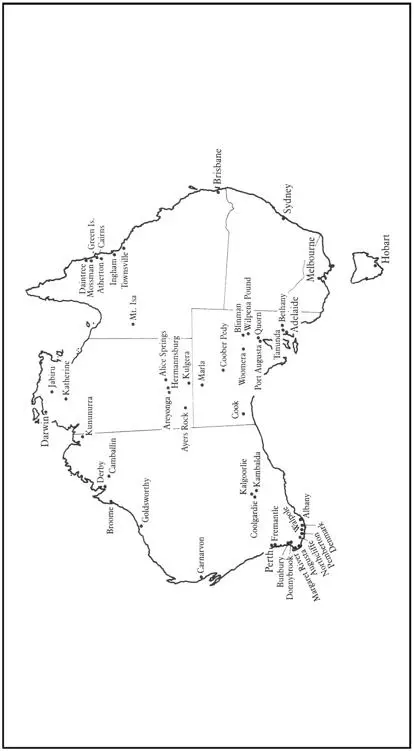
Map
1 On Wings of Poesy
2 Shiklone Troicee and After
3 Bungle Bungle
4 Arse-End Charlie
5 Umpie Bong
6 Neither an Ong nor a Mo
7 Et in Arcadia Nos
8 Lost Orisons
9 Granny Apples
10 The Town with a  of Gold
11 A Roomette with a View
12 Ich Hatt’ Einst Ein Schön’ Vaterland
13 Wher. Edna. Laide. Me
14 ‘An Interesting Place With Lots of Sandhills’
15 Mintja
16 Ghostbusting
17 The Townsville Hoist
18 Gone Troppo
19 The Expulsion From Paradise
20 Found! – The Spangled Drongo
About the Author
By the Same Author
Map
1 On Wings of Poesy
One
On Wings of Poesy
We knew where we were going. We knew how and even when we were going. The only thing we weren’t entirely sure about was why we were going.
We were loaded down with resolution; what we lacked was a reason. A publisher’s advance could not be called a reason. It was not elemental enough. And as for this being a double anniversary – twenty-one years exactly since I’d first gone to Australia, twelve years exactly since my wife had first left it; a total of thirty-three years almost all of them misspent – well, that was elemental to excess.
A course between expedience and sentiment somehow eluded us.
Then we had a stroke of luck. A couple of days before we were due to leave we ran into the Australian poetess Orianna Ooi (I have of course slightly changed her name) on the Strand. We weren’t close acquaintances, having only ever met two or three times before, on each occasion, as chance would have it, somewhere between Australia House and the Savoy; and we knew little about her except that she spent the afternoons of her exile under the chandeliers in the reading room of the Australian High Commission, combing the literary pages of the Australian newspapers for any mention of her verse. This was the only way, at so great a distance from home, that she could keep abreast with the progress of her reputation. Today, wrapped up extravagantly against the cold – every day had been the coldest day in living memory that winter – she was flushed with excitement: the Adelaide Advertiser had just alluded to her dense conceptual invention.
We congratulated her. ‘The Adelaide Advertiser,’ I remarked, ‘is not renowned for choosing its words lightly.’
She glowed at us. There might have been snow on the ground, but inside her heart it was suddenly summer. We all three paused to wave to an Australian short-story writer on his way to check what his home newspapers had to say about him.
‘He hates it over here,’ Orianna confided. ‘No one recognizes him. He hasn’t signed a single autograph. He has to read about himself in the Sydney Morning Herald to remember who he is.’
I must have given some involuntary sigh of sympathy, thinking that very soon now I would be suffering the indignity of anonymity myself, out there in the unheeding heat and dust, because out of the blue Orianna recalled what we’d told her the last time we’d collided on the Strand. ‘Aren’t you two off any time now?’
‘Day after tomorrow.’
‘And you’re going all the way round?’
I didn’t like the double emphasis. I thought I could hear a request for an exorbitant favour coming; something that would entail our having to look up every Ooi in Australia, or worse, having to search every local outback newspaper for veiled references to this Ooi’s effusions. But Rosalin has a less suspicious nature. ‘Yes, all the way round. Darwin, the Kimberleys, Perth, Kalgoorlie, Alice Springs, the Great Barrier Reef – you name it.’
‘Lucky you,’ Orianna said, allowing herself just one quick wintry shiver before she added, ‘Look, do you think you could do me a favour?’
I turned away. I became suddenly engrossed in architectural niceties I’d never before paid adequate attention to on the Strand; such as the deeply recessed clerestory fenestration of the building housing the New South Wales Government, and the ornamentation around the guttering of the Savoy. From the corner of one eye I could see my poor wife delivering herself of the usual courtesies – ‘Certainly . . . Only too delighted . . . If there’s any way we possibly can . . .’ – and Orianna rooting around in her handbag. Probably because they are never certain what errand they are on, whether they are meant to be ladies or bushwhackers, Australian women carry grotesque handbags. Orianna’s was a sort of sack made from emu feathers and the skin of fruit bat. But it was what was in it that frightened me. I looked just long enough to see her produce it – Jocasta’s Jest: Poems of The Domestic Life – and to hear her say, ‘What I was wondering was whether, while you’re on your travels, you could, you know, pop into every bookshop you see and check whether they’ve got stocks of this.’ Then I went back to staring at the Savoy.
When I felt that it was absolutely safe to let my attention return I discovered that Orianna had gone but that Jocasta’s Jest was still with us, in Ros’s hand.
‘She gave you a copy, then,’ I noticed.
There was a degree of hesitation. ‘Not exactly.’
‘How do you mean, not exactly?’
‘She didn’t exactly give it.’
‘You’re not telling me you nicked it? You didn’t mug her for it, did you?’
I could see that Ros was still thinking over what had occurred. There seemed to be some uncertainty as to just who had mugged whom. ‘No,’ she said at last, ‘I appear to have bought it.’
I let it go at that. Since I’d deliberately absented myself I couldn’t really complain about what had happened while I’d been away. And I’d long ago learnt that there was nothing to gain from being the sort of husband who took attitudes to his wife’s purchases. It was only later, when I caught Ros finding space for the poems in her corner of the suitcase, that I raised a query. ‘You aren’t really, are you?’
‘I’m not really what?’
It was too absurd to put into words. I gave one of those backward nods of the head that are meant to suggest previous events in other places – in this case yesterday’s encounter on the Strand. ‘You know,’ I said, adding a forward nod to suggest the next four months and bookshops all over Australia.
Her reply was more prompt than I thought it ought to have been. ‘I certainly am,’ she said. ‘Why shouldn’t I? Everybody needs a little project. You’ve got yours. This is mine.’
‘I would have thought we had better things to do out there,’ I said.
‘Such as?’
She knew she had me there. She knew I’d never been any good when it came to dealing with the big questions. Besides, there was a subtext to this. I’d squandered some of the best years of my life in Sydney and Melbourne in the sixties and early seventies. I’d been back on ghost-laying expeditions several times since, eating too much, drinking too much, fighting with my old friends, and coming home again bemused and disappointed. I was in no position, Ros’s question implied, to be talking of ‘better things’.
There was another unspoken issue in the room alongside our half-packed cases. Pineapples. I might have adopted Australia but Rosalin had been born there. The last time we’d been back nosing around the ruined sites of our several histories Ros had gone down with a mystery illness which was diagnosed finally as an allergy to her own country. ‘It’s common,’ the doctor told her. ‘Many people react badly to where they come from once they’ve been away. You’ll feel better when you leave again.’ In the meantime the only comfort available to her in her misery was that afforded by the sight and smell of pineapples. She lay delirious for three weeks in a hotel bed in Manly with a pineapple hanging from each bed post. I sat up through the nights listening to the sharks nibbling at the jetties and waiting for Ros to stir. ‘Pineapples,’ I had to whisper the moment she opened a bloodshot eye – ‘Pineapples, my dear.’
Australia, in other words – even leaving aside what lay curled and ticking in the undergrowth – was a dangerous place for us. Australia contained the past and the past holds more terrors than any jungle. We had to tread carefully. Self-discovery was out. The last thing we wanted to come upon at the end of some five hundred miles of dirt track was ourselves. Any of that and there was a good chance we’d both end up on our backs sniffing pineapples.
Keeping away from our old haunts – the merest whisk around the Eastern cities – would be one way of staying safe. And some simple, selfless project – some course of altruism or utility – would be another.
That’s how we came to be flying out of London on the coldest day in recorded history (this detail is important because it explains what we were wearing when we arrived in Darwin on its hottest) with the express purpose of scouring Australia – the Northern Territory, the Western Seaboard, the Goldfields, the Wineries, the Outback, the Rainforests, the Red Centre, the Reef and the ineffable Bush – for copies of Orianna Ooi’s latest volume of densely conceptual verse.
From a practical no less than from a poetical point of view, the common or garden flight from London to Sydney or Melbourne via Singapore suffers from the amount of time you are actually in or over Australia before you finally land. You are already sick of the country before you set foot on it. Come in the top way, via Darwin, however, and you arrive as fresh as a daisy and convinced, as you strictly speaking ought to be, that you are still in Asia.
‘You sweet?’ our steward asked us as we were barely out of Malaysian air-space.
‘You sweet?’ is Australian stewardese for, ‘Is everything absolutely to your requirements, sir?’
We were, I thought, sweetish. ‘Perhaps another bottle of Montrose Chardonnay, Mudgee, 1984?’ I wondered.
All Australian wines are overeager, impatient to escape the confines of the bottle; but this particular Chardonnay would not sit calmly even in the glass. It sprang to your lips if you so much as nodded to your neighbour. And Trevor was pretty much the same.
He’d been very good with me, spotting me at once as the sort of passenger who appreciated being served in bulk. But he did think it was worth mentioning this time that we would be in Darwin in twenty minutes.
‘Twenty minutes?’ I couldn’t believe it. ‘It feels as if we’ve just left Singapore,’ I said.
He shrugged his big broad high effeminate Australian shoulders inside his orange blazer. ‘There you are,’ he said. He seemed to be letting us in on some well-kept secret as to the real whereabouts of the Top End of Australia.
And there indeed, at a few minutes to four in the morning and with the Chardonnay still fizzing in the bottle, we were. Darwin International Airport. A single shed, as far as we could make out in the dark, constructed of aluminium and corrugated tin. There were no other planes on the runway – assuming this to be a runway that we were on – and the few ground staff we could see stood about rubbing their eyes, as if they wanted us to understand that they’d been dragged out of bed especially for us. Even in the air-conditioned cabin of the jumbo you could smell the damp warm lethargy of the tropics.
‘Look,’ Ros said, pointing to the open-mouthed passenger exit being driven slowly in our direction across the steaming tarmac, ‘it’s coming at us like a wet kiss.’
We experienced the faintest of tremors as the kiss rose and planted itself on the curved body of our craft, then we sat back and waited to be sprayed.
The quarantine officers came aboard yawning. For all the spruceness of their nautical rig – long white socks, navy shorts, short-sleeved white shirts with epaulettes, and deep-sea divers’ watches – I wouldn’t have wanted to be within a hundred miles of land on any vessel steered by them. And they were bad-tempered as well as half-asleep. They meant to give a hard time of it to a certain Mr Ramsden who was required to proceed to the front of the plane ‘with his possessions’.
From the time they took with him I could only suppose he was carrying about his person at least one example of every item you were not allowed to bring into Australia: a snakeskin belt from Venezuela, a woven bamboo basket from Borneo, a rhino horn from Tanzania, the larva of the Abyssinian fruit moth, and signed copies of Last Exit to Brooklyn and Das Kapital.
Mr Ramsden wasn’t our only delay. The quarantine officers refused to walk the length of our plane and back with their cans of deodorizer and disinfectant held aloft until every passenger was in his seat. They drummed on the luggage lockers with their uncontaminated fingers, in order that we should see it was our own time we were wasting, not theirs. They were in no hurry themselves. They’d been tipped out of their warm beds at 3.30 in the morning in order to sanitize us and make us fit for entry and they had nothing else to do now – since planes were few and far between in Darwin – with the entirety of their day. They could wait.
I later learnt that there might have been an element of politics in this show of petulance. Japanese visitors to Australia had been reacting badly to the ritual spraying of their persons, since in their country such an indignity was only ever visited on those whose appearance palpably merited it. Meticulous about their private hygiene they took it ill that they should be presumed to be carrying bugs and bacilli capable of wiping out the entire animal and human population of Australia. An exemption from this hysterical precaution had been requested and, since the first aim of all photogenic countries is to be visited by as many Japanese as possible, the request seemed likely to be granted. Good for the Japanese, good for tourism, but not so good for the self-esteem and future prospects of quarantine officers. It’s my belief that they saw the writing on the wall. Soon anyone would be able to breeze into Australia exuding germs and breathing viruses at will. It was unmistakable from the disdain with which they wielded their aerosols at last that they were making us pay for those virulent millions who would one day elude the spray.
Myself, I have to say I think the Japanese response is unimaginative. I love being sprayed. It is a perfect way to begin a journey or a holiday or a new life. It is a physical performance of an emotional requirement – the equivalent of a Turkish bath or a Finnish flagellation, but without the fuss or the pain. A purification. A little symbolical murder of the prior self.
Inside the tin shed that was the terminal they were more concerned with the extermination of the imported fruit fly than the prior self. As we queued to have our passports scrutinized we stood alongside a capacious green bin, gaily decorated with paintings of innocent-seeming apples and oranges and bananas. The bin represented one’s last, one’s absolutely final, opportunity to get rid of all the apples and oranges and bananas secreted about one’s person before they were spotted sticking out of one’s pockets by vigilant quarantine and customs men. ‘Why risk a fine of $50,000?’ the bin asked.
I don’t know why I decided to take such an interest in this receptacle. It might have been that the idea of a last-chance fruit depository appealed to something in my theology; or it might just have been inconsequentiality caused by jet-lag or the Montrose Chardonnay. Whatever the reason, I was no sooner through immigration than I wanted to be back out again, where the bin was. I wanted to be sure that I’d got the colour and dimensions right, and that the fine for smuggling in a cherry was indeed $50,000. I knew, of course, that I couldn’t really treat immigration as if it were a revolving door; but I didn’t think there would be any harm in my standing on tiptoe behind a passport officer’s back and jotting down some details in my notebook. It never crossed my mind that such action might look for all the world like espionage – pretty inept and footling espionage (what did they think I was after: the names and birthdays of the passengers I’d flown in with?) but espionage all the same. So I wasn’t prepared for the heavy hand that took me suddenly by the shoulder, or the rough inhospitable manner in which I was dispossessed of my notes.
I live in dread of having something taken from me. I am certain that I will fail of the indignation of outraged ownership. I am unable to imagine myself ever calling, ‘Stop, thief!’ But I did manage, on this occasion, to say, ‘Hey, that’s my notebook.’
My assailant flicked through it. I think the number of empty pages disconcerted him. That and the total illegibility of the pages that were full. My writing is so bad that it is often taken as shorthand or code.
The Story Continues on BooksBarbecue!
Enjoyed this preview? ❤️ Do not stop here!
Read the complete book free online → 🔗
Continue reading now on BooksBarbecue and discover every page!
Love reading? Bookmark BooksBarbecue.com for more amazing books!
Happy Reading!