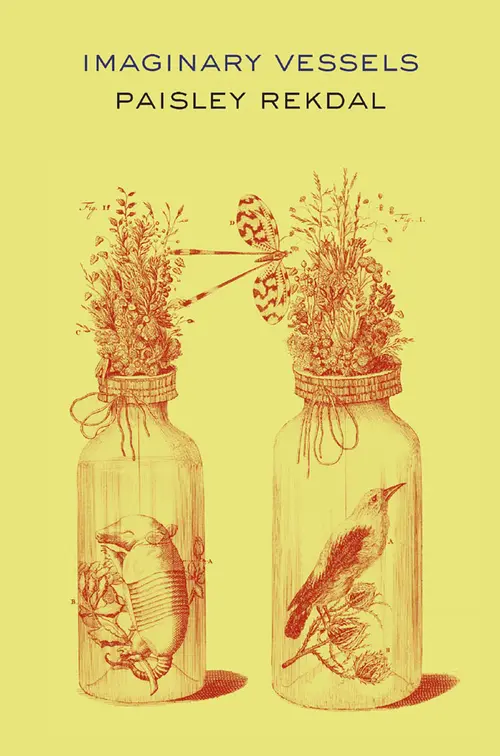
Imaginary Vessels
Cover
Note to Reader
Note to the Reader
Copper Canyon Press encourages you to calibrate your settings by using the line of characters below, which optimizes the line length and character size:
Lorem ipsum dolor sit amet, consectetur adipiscing elit. Pellentesque eui
Please take the time to adjust the size of the text on your viewer so that the line of characters above appears on one line, if possible.
When this text appears on one line on your device, the resulting settings will most accurately reproduce the layout of the text on the page and the line length intended by the author. Viewing the title at a higher than optimal text size or on a device too small to accommodate the lines in the text will cause the reading experience to be altered considerably; single lines of some poems will be displayed as multiple lines of text. If this occurs, the turn of the line will be marked with a shallow indent.
Thank you. We hope you enjoy these poems.
This e-book edition was created through a special grant provided by the Paul G. Allen Family Foundation. Copper Canyon Press would like to thank Constellation Digital Services for their partnership in making this e-book possible.
Dedication
FOR MY FRIENDS
You think you do well to hide the little things in the big ones—but what if you were to hide the world in the world?
Chuang Tzu
We are truly ourselves only when we coincide with nothing, not even ourselves.
E.M. Cioran
I
I
Murano
MURANO
It is not miraculous. Only a handful of silica, fire,
and then the blower twirls another knob of gold
on his metal pontil, dipping the tip into a pot
inlaid with spikes to make the burning globe
twist in upon itself as the man breathes out
and a thin neck bulges, wreathes into a spiral
like a unicorn horn; but we’re bored, he’s
bored, blowing and blowing the same shape over.
It takes no effort. He stares off through one
of the factory windows as he does it, beneath a sign,
No Flash, a red line drawn through a cartoon camera
to indicate the work is private, dangerous.
The man’s tongs pinch out a chest, a neck, the crowd
applauding each development though it has seen
the same thing around the corner.
We know what will come next. The man
reaches into the bright elastic to yank
a fat neck forward, to pinch out hair, a shovel-
shaped face; to pull out one thin, bent leg
and then another, the glass itself now tinged with ash
as the fire runs out of it, dimming to topaz,
caramel. He splashes water on the irons
to make them smoke. It must be dangerous, this
material, or why else would we watch?
The blower has a bald patch, earrings, scars.
He dips his tongs once more into the figure
and out come back legs, a tail. The neck twists
and now the little face has a mouth that’s open,
screaming. Transparent hooves tear into the air.
The tail’s curled filament starts to thread
as the pontil pulls away. You want to say
“like taffy,” but don’t. It is not sweet.
Only a spark of heat and then the inevitable
descending numbness. Someone laughs.
Someone takes a photo. For a moment, the room
fills with light behind which we hear
the scissor’s dulling snap.
Our senses return stretched thinner, fine.
We can almost feel the shattering of the glass.
Bubbles
BUBBLES
The child purses his lips around a hole. Blows
and out the radiant world swells forth.
The park swings bend. His mother’s face shrinks
to the size of a bubble. I sit across from them,
on my separate bench, bobbing past in its reflection.
It’s my gift, this vial of soap.
I bow my dark head low as my friend’s son
pats my cheeks in thanks, obediently
sucks in another breath
and blows.

“Any fool can make soap;
it takes a clever man to sell it.”
So Thomas Barratt, 1880, said, and pursued Millais
to paint Pears’ advertising: an English painter
for an English soap. “Of two countries
with an equal weight of population,” he wrote,
“the most highly civilized will consume
the greatest weight of soap.” A quote
from my scholar friend in her book
on bubbles that she’s given me: my gift
of this toy a nod to her descriptions
of palm oils rendered in chains
of vats, thickened with the meat
of African coconuts.
Through a stream of bubbles,
I watch her wipe her son’s streaked face, recall
my washing machine at home which has a setting
labeled Baby Clothes. The store model
wore a pink-and-blue sign reading,
Don’t You Want One? I think
of the painting on her book’s cover, Newton’s
Discovery of the Refraction of Light: a thin-faced scientist slumped
in dark, while his nephew, by a bank of windows,
blows bubbles. On Newton’s side of the canvas:
a dusty globe, a world of shadows
that dissolves beside the child
in play, revealing how the sun refracts the panes
the maid will have to scrub. In the image,
she turns her head away, the sun
begun to bore into her eyes. And here’s a bore of sun
illuminating the bubble’s flaw that stuns the child
now blowing in the park, learning the tensile skins
can’t withstand the pressure
of a touch. “They don’t last!” he shrieks
as his mother hugs him, a squalling
aggregate of cells neither of us can hush. Of cells,
I also thought an aggravate. “Make this the sweetest
picture postcard yet,” Barratt begged Millais. And so
the painter drew a Pre-Raphaelite child at play
blinking at the globe he’s made, a lens of clean in which
the thin white etch of him sails past
in dark, the milk-white cheek, the booted
foot: the boy’s blue eyes turned in rapture to what
a parent’s invention makes. A Child’s World,
Millais titled it, but Barratt
stuck a bar of Pears in it and turned
the painting into posters, puzzles, postcards
shipped along with images of English flags
and Maori girls, kaleidoscopic
slow flash photos of bursting
bullets, their shock waves caught and used to improve
British rifle manufacturing.
“We have a perfect right
to take toys and make them into philosophy,”
my friend’s book quotes. “Inasmuch as we have turned
philosophy into toys.”
Look: a bubble of black
wobbles and bursts: explodes the world
to a slick of oil.
The clouds pull back. The boy, damp faced from his fit,
now sleeps. Sunlight holds, refracts him in his nap
as something in my friend’s face
cracks. It wildly opens.
Don’t you want one? something whispers. Don’t you, really?
Last night’s thinnest edge
of dream still wavers, the one where the doctor tells me
I am carrying, but will not tell me what
or when. Black hope rises,
bursts inside me. “It’s an aggravate of sells,” he says—
The world grows thin. My friend packs up the toys and kit,
tapping at her soapy vial.
She shakes up the foam and sticks in the pipe.
A world blows up.
The mother and child float by in it.
Vessels
VESSELS
Shouldn’t it ache, this slit
into the sweet
and salt mix of waters
composing the mussel,
its labial meats
winged open: yellow-
fleshed, black and gray
around the tough
adductor? It hurts
to imagine it, regardless
of the harvester’s
denials, swiveling
his knife to make
the incision: one
dull cyst nicked
from the oyster’s
mantle—its thread of red
gland no bigger
than a seed
of trout roe—pressed
inside this mussel’s
tendered flesh.
Both hosts eased
open with a knife
(as if anything
could be said to be eased
with a knife):
so that one pearl
after another can be
harvested, polished,
added to others
until a single rope is strung
on silk. Linked
by what you think
is pain. Nothing
could be so roughly
handled and yet feel
so little, your pity
turned into part of this
production: you
with your small,
four-chambered heart,
shyness, hungers, envy: what
in you could be so precious
you would cleave
another to keep it
close? Imagine
the weeks it takes to wind
nacre over the red
seed placed at another
heart’s mantle. The mussel
become what no one
wants to:
vessel, caisson, wounded
into making us
the thing we want
to call beautiful.
A Peacock in a Cage
A PEACOCK IN A CAGE
shaking out its corona of tail feathers is like light
glowing in a bulb, a man
dancing inside an elevator: the space
too small to quite contain him, yet
contain him it does; the way a cloud
keeps some portion of the sea inside it or a box
encloses air, encloses also
the philosophical cat both dead and alive
inside it. The way a car inhales the gas
containing bones of dissolved dinosaurs
and the cheese breeds mold to heal the cut that holds
the hurt cradled inside the body, the blood
thick with the trace of all things
we might yet express or become, such as
the mathlete or music lover, who holds first
one note and then the next inside her ear.
We try to pin the mind’s attention to the task at hand
though the mind can sometimes falter, the way
a tongue sometimes cannot rein in the word
whose meaning may escape it, may be captured
so perfectly within its syllables for once
the desire/the surprise/the distaste churn
palpably when uttered; just as the parent’s past churns
inside the child’s future or the identity of the stranger
hides inside the mundane title with which
we greet him. There are lies we clasp to ourselves
upon waking, truths with which we worry
ourselves to sleep, dreams memory struggles
to capture in the retelling: only the ends remain
in which the building crumbles back to dust
or the mother steps, naked, out of her unzipped skirt:
an image that bears the seed of future therapy.
One book contains at least a dozen others, the scarlet
bitterness of its pith conceals the sweetness
of the mangosteen and, when saddest, we suspect everyone
embraces someone else, though many don’t.
We think a woman shelters a house, husband and a child
inside her, that a man might accommodate
no one else. The party can hold its liquor
only so long, as we can maintain faith that requires us
to keep two contradictions alive at once, like day
and night tucked into the same sunset or the sudden
hatreds ignited by love: the patience
with which we hold still for the camera, believing
it will shore up time, and knowing it won’t.
At the Fishhouses
AT THE FISHHOUSES
And the black water under the boats with their pools
of bilge rainbowed out like rinds
of steak fat, the salt thick
in my nostrils, but pleasant, too: details
I still keep from Bishop’s poem, everything
else about it lost. At the docks,
I watched my friend slip
in her rubber boots; the wide, wet planks
glossy with mosses. You must walk
duck-footed to get to the boats, the black-and-orange
fishing barrels, the air with its tang
of rust and blood. There are always hooks
and anchors to be found here, nets and scrapings
of wood planed by chisel, the way
my great-grandmother was said
to have worked, employed as a shipwright
on the city’s waterways in the ’30s, according
to the newspaper clipping my grandmother
photocopied for me each Christmas.
The description of her gunmetal hair
and slim torso clad in overalls, the hands
she held out for the Times reporter
(“Callused,” he noted, “strong
as a man’s”), does not recall the woman
I remember for her farm in Bothell
before it became a Seattle suburb, helping me gather
raspberries from the long canes
she planted by her porch. We spent an afternoon
together sweating in the matching
long-sleeved checkered shirts she’d made us,
according to the photo
I no longer have, and cannot remember
whether is the source or confirmation
of this memory. Only the papery, gray-green
streaks of road dust on the canes, a bowl
of chipped porcelain inside of which
were raspberries. Very red, very sweet, furred
like my friend’s upper lip I remember
between my teeth as we stood
on the docks. The smell
of iron and winter mist, her mouth
like nothing I have tasted since.
When It Is Over, It Will Be Over
WHEN IT IS OVER, IT WILL BE OVER
pen and ink reproduction by Troy Passey of a line by
Edna St. Vincent Millay
Hurricane of what must be
only feeling, the painting’s
sentence circling to black
on blank, ever-
tightening spiral
of words collapsing
to their true gesture: meaning
what we read
when not reading,
as the canvas buckles
in the damp: freckled
like the someone
I once left sleeping
in a hotel room to swim
the coast’s cold shoals, fine veils
of sand kicked up by waves where
I found myself enclosed
in light: sudden: bright
tunnel of minnows
like scatterings of
diamond, seed pearl whorled
in the same
thoughtless thought
around me: one column of scale
turning at a moment’s decision,
a gesture I
was inside or out
of, not touching but
moving in
accord with them: they
would not wait for me, thickening
then breaking apart as I slid
inside, reading me
for threat or flight by the lift
of my arm, as all
they needed to know
of me was in the movement:
as all this sentence
breaks down to O’s and I’s,
the remnants of someone’s
desires or mine so that
no matter whether I return
to that cold coast, they will
never be there: the minnows
in their bright spiraling
first through sight, then
through memory,
the barest
shudderings of sense:
O and I
parting the mouth with a cry
that contains—
but doesn’t need—
any meaning.
Letter from the Pribilofs
LETTER FROM THE PRIBILOFS
Elizabeth Beaman to her sister,
Pribilof Islands, July 13, 1880
Blunt, bullying, this season’s bachelors climb
the rocks near Nah Speel, sleek backs blackening
the waters inside their seacatchy. The old
bulls line up in rows as at a burlesque
house, while their matkas roll in surf, thrash
upon the parade ground’s volcanic sands
turned glassy from the constant passing of seals.
One by one the bulls slip the line to claim
their females, each dragging his choice to a private
catch, as the bull gathers what he can,
the matka cuffed and bitten on the throat
if she struggles, the bull shaking her, banging
her down upon the rock until she rolls
her belly up, blank eyes wet in supplication.
This is how I imagine it. The event being
“no sight a lady should witness,” the Senior
Agent forbids me from the rookeries; John,
my husband now these thirteen months,
must privately describe it. Libby, he tells me,
you should see how soulful they are, it is
amazing to watch them weep. He takes joy
in their human qualities, recalls tales
of selkies who turned to seal-like girls
in surf, braiding their hair in seaweed plaits
to chain an errant sailor’s legs. And yet,
in seasons such as this he goes out with company
men to kill the mating seals in their rookeries,
drive them to ground with wooden clubs.
I’ve heard the sounds and smelled grease fires
smoking after skins are flensed, seen John
creep back from work, clothes spattered with blood.
How many months to be endured! And all before winter
comes, its long months unpunctuated by sun—
And yet I can’t complain, having begged John
to take me, a lone white woman at these edges
of the Pribilofs. Reluctant first, he is, I think,
now proud of me. Without a maid, John is the one
to tighten my stays, fetch me
paper, drawing pencils, tea. When he’s gone
I walk as far as the officers will let me,
to sketch a little of the matkas and their young.
Yesterday, a shape disturbed me
at the game: some wraith shadowing
Nah Speel’s rocks I noticed late, absorbed
by the sight of two bulls hissing and spitting
at each other, while a third made off
with the spoil they longed for: the matka
flattened on the glassy ground. Interesting,
isn’t it, Elizabeth? the wraith addressed me.
I looked. It was the Senior Agent—
He is, as I wrote before, the dark one
who follows me on my rounds, complaining
of my presence here. He charts my walks
around the island; once, in the mess hall
pinched my arm in passing, hissing, Selfish
to remain—
At home I raged at John,
who shook his head, but will say nothing.
How can it be selfish to claim my rights
beside the one I love? A loud groan, the sea’s
kaboom, and one of the bulls, his shoulder
pierced deeply, struggled off.
I watched his slow creep back into the sea,
his shape dissolving inside a curl of blood.
When I looked up, the Senior Agent was gone.
Tonight, I send along a sketch I’ve done
of a bull with his sleek matka, half-drawn,
only the heads and eyes completely finished, that
peculiar quality to their gaze I struggle
to capture: that clear, yet fathomless unblinking
from which occasionally come—to John’s
continued astonishment—real tears.
II. Go West
II
GO WEST
Diamond Lil is all mine. I’m she. She’s I. Like Hamlet, but funnier.
Mae West
[Her language] isn’t clever dirt, and it isn’t really at all shocking—but it’s the kind women want, apparently. Women are simple souls.
Jim Timony, Mae West’s
manager
You’re
YOU’RE
Your hands your lips your hair your magnificent effervescence—
Vague as fog and turnip-hipped, a creel of eels
that slithers in stains. Dirty slate, you’re
Diamond Lil. She’s you, you say. You’re her. She’s I. O
Mae, fifth grade, we dressed in feathers and our mothers’ slit
pink slips, dipped into your schema and your accent,
aspiring (like you) to be able to order coffee and have it
sound like filth. And yet aspired to whom? Amazing
all these films and each cow-eyed character the same:
Catherine the Great, Margie LeMont, Peaches O’Day. I
grant, I never saw a single goddess go but you
rewrote her into you. Each maid a moon
orbiting your Mae. And she the same star always winking,
flaring out rotational names: Cave Girl, Sis, Tira, Fifi—
What’re you doin’ honey, makin’ love or takin’ inventory?
Mae West: Advice
MAE WEST: ADVICE
Ban tobacco: do bacon abed,
be delectable, collectible, a decent debacle.
Décolleté don’t conceal; acne, do. Be bold
and be toned, an octane-blond coed.
Be colonel not cadet, concede nada to doc;
date a cad and canoodle, be éclat on a cot.
Don’t lean on a deacon, be a dolt, a clone:
don’t bet on an Eden, don’t loot, don’t loan—
Be belle and ball, too, a deb Coco-labeled;
be ocelot, be lancet, be candle and cabled.
Canceled? Debated? Booed at to boot?
Elect to be tall. Don’t tan. Eat local.
Be oded, caboodled, be beacon and lect.
Don’t be a noodle: be cool and collect.
Marriage
MARRIAGE
Any dame that knows the ropes won’t get tied up.
Mae knows wit’s a waste on those who think
a woman is a sink of mind. Smart dames
edit out the spouse: rather get sent to Sing Sing
than tied in knots. A dame should take her own name.
She did. Tho ain’t that name turned into sign, her shape a stage
that’s trope? Rigid iteration, she smirked the same
at eighty as nineteen: a drawling monster roped
to her own shade. She’s a playwright. She’s a genre. “A woman
among men,” is what Mae said. “I’m new.” Then wrote
The Drag. Mae, did you get our unsure titters at the end?
Did you get you turned to gag? Prostitution’s
a more honest gig, you wrote, of marriage and the page.
And now your theaters stand dark. You got it right, it seems.
Hamunaptra, Dirt-Lip, Wag: everyone hates an institution.
Censored
CENSORED
I always believed in censorship: I made a fortune out of it.
Dalí nails Miss Bawdy: cave of lip-shaped couch and starry
eyes, a room dilated to empty: velvet space
in which a lotta hussy nothin’ floats, so writes
Variety of vaudeville’s paints that obsidian a face
moon-pale, shuttered to history—
Mae sends her maid Bea west
to Harlem where she cannot travel
to procure her tunes (Piano man croons: “He may be your man
but he comes up to see me sometimes”; “That’ll do,” Bea says) while
on the boards Mae nips out bits
of bio (spouse and birthday both), turns her script to cryptic
lace as police haul her off
for indecency. (“My play?” she purrs. “Let’s call it
‘Coitus,’ shall we?”)
In the courts and on the boards, Mae sways
and shimmies. Bea, from her place
behind curtains, applauds
as Mae’s mouth spits out bursts
of Bessie Smith, Lady Day, Ma Rainey.
Mae loves Bea so much she writes her
into play (Diamond to Maid: “Lissen, shadow,
whad’re you doin’ here?”), laughs at the thought
only one letter between them separates.
Dalí’s canvas is a frame
within a frame, portrait of a face for which
the outline is enough. She’s a sofa now. An oriflamme. Her eye
discourses. Hey, what’s that dark that breaks
through yonder window?
Court: So did you ever see her navel?
Witness: No, but I did see somethin’ in her
middle travel east to west.
Freedom
FREEDOM
He’s the kind of man a woman would have to marry to get rid of.
Mae: once, a man wrestled me to ground, wrangled my hands in his
and, when I tried to knee him in the groin (missed),
yanked my legs from under so I wouldn’t run. He laughed
as I saw stars. I get it: freedom (for a woman) has
a tag on it: ya gotta have more strength at hand, ya gotta have
no fear of fists. Give a man a free hand, he’ll run it all over you.
Gag whose strut of which I’m envious; of you, who thrived
on hungers without risk. Should I praise or blame these plays
no girl’s reality might imitate? Not even yours, feinting
off a drunken Fields, Yale men aswarm upon your stage—
To slide on your armor means to fake
away what hurts. The one who, instead of kiss, would shove.
The one who, gently, strangled. Mae, we weren’t swift
enough to rid ourselves of them. We were never swift enough.
Go West
GO WEST
“Mae West”: British slang in WWII for inflatable life jackets
The Story Continues on BooksBarbecue!
Enjoyed this preview? ❤️ Do not stop here!
Read the complete book free online → 🔗
Continue reading now on BooksBarbecue and discover every page!
Love reading? Bookmark BooksBarbecue.com for more amazing books!
Happy Reading!