If You Want to Make God Laugh
Cover
ALSO BY BIANCA MARAIS
Hum If You Don’t Know the Words
Dedication
For Poodle
(Please forgive me for what I did to Sodom and Gomorrah. You can’t win ’em all but at least you got “orc” and “Faloolah.”)
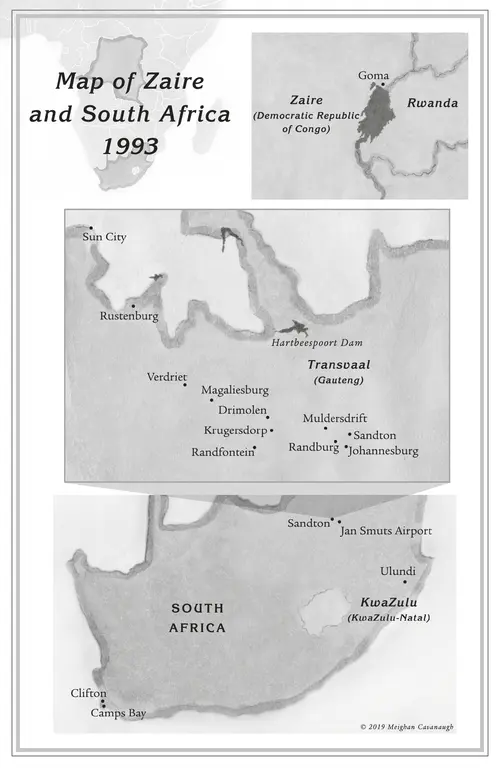
Map
CHAPTER ONE
Zodwa

21 November 1993
Sterkfontein, Transvaal, South Africa
A thread of smoke snakes up into the cloudless sky and serves as Zodwa’s compass needle. She trails it until the sandy path dips suddenly, revealing a squat hut nestled in the grassland below. A woman sits waiting at the threshold. She’s hunched over like a question mark, her headdress of white beads partially obscuring her face. A leopard skin is draped over her shoulders and the sight of it reassures Zodwa; the gold-and-black-spotted pelt ibhayi signifies the nyanga is a healer of great power.
The woman chews tobacco, which she spits out when Zodwa reaches her. “What took you so long?” she gripes, rising up on arthritic knees.
“How did you know I was coming?” Zodwa herself hadn’t known she’d be making the journey until the early hours of that morning.
“The ancestors told me.” The nyanga holds out her palm.
Zodwa reaches into her bra and withdraws a few crumpled notes. They are everything she has. “How much will it be?”
The nyanga’s knobbly hand shoots out and snatches it all away before Zodwa can protest. She disappears into the gloom and beckons for Zodwa to follow. Inside, it looks like a regular hut with its circular walls, thatch roof, and dung floor, but Zodwa knows it’s imbued with the spirits of the clan members who have gone before; the ndumba is a sacred place.
The healer motions for Zodwa to sit on the floor. “How many years do you have, child?”
“I’m seventeen,” Zodwa replies. “Almost eighteen.” She knows she looks younger and blames it on her rounded cheekbones, which lend her face a childish quality.
The healer’s eyes inspect Zodwa from head to toe and Zodwa flushes, knowing that the old woman disapproves. Her pleated black skirt is hemmed to just below her knees, but still it’s too short for traditional wear. The white blouse is a fraction too tight, but this is because Zodwa has outgrown it, not out of choice.
The nyanga holds up a gourd. “Undlela zimhlophe,” she explains before swallowing its contents. She limps to her mat and kneels down.
It’s past midday and the powerful root has to be consumed on an empty stomach so that it can induce the lucid and prophetic dreams that will help her hear the ancestors’ voices. The old woman must be hungry. Zodwa’s hungry too, though not because she’s been fasting. Her hunger isn’t the temporary kind that will soon be satiated; it’s the gnawing kind that takes up residence in a stomach that has been empty for too long. It’s a hunger born of poverty.
The nyanga begins groaning while rocking back and forth. The smell of impepho burning saturates the air, and the sage fills Zodwa’s lungs with every breath she takes, dulling her senses with its hypnotic scent. The hut, darkened and warm, reminds her of home. At least, the home she’d lived in with her grandmother in KwaZulu before she joined her mother in the sqatter camp earlier in the year.
Her grandmother had been reluctant, at first, to relinquish Zodwa to Leleti and considering everything that had happened, Zodwa couldn’t blame her. Her gogo had lost her only son, Zodwa’s father, to a mining accident in the City of Gold, and then Zodwa’s eighteen-year-old brother, Dumisa, disappeared less than a year after leaving for Johannesburg when Zodwa was seven.
“Be very careful, my child,” Zodwa’s gogo had cautioned her before she left the village for the township. “Bad things happen in the city. Its gods are very hungry and must be appeased. Don’t become one of the sacrifices made to it.
“You must study hard, mzukulu wami,” her grandmother had continued. “You must be brave but do not try to be as brave as your brother was. If your light shines too bright, someone will always seek to extinguish it. And do not give in to temptations. The city makes girls forget their virtue and modesty. It makes them behave in wanton ways. Remember, my child, that a good bride price comes from respect.”
Zodwa had tried to follow her gogo’s advice, she really had, but the township had awakened something in her. It was as if the city’s electricity had jump-started her body, and no matter how much she tried to keep her thoughts pure, they simply wouldn’t cooperate.
There will be no good lobolo now. There will be no bride price at all since no offer of marriage has come.
Zodwa’s thoughts are interrupted by the nyanga rising from her place on the floor. The old woman winces as she stands up on stiff knees and shuffles over to where Zodwa sits.
Her voice is hoarse. “The amadlozi are angry with you.”
It is what Zodwa most feared hearing. No one wants to incite the wrath of the ancestors. “Because of the baby?”
The old woman shoots Zodwa a shrewd look. “It is not the baby the ancestors speak of.”
Zodwa hangs her head, the familiar shame slithering its way up her spine.
“What did you dream the last time you slept?” the healer asks.
It isn’t difficult to answer, as the nightmare has stayed with Zodwa all day. “I dreamt I was being chased.”
“By what?”
Zodwa shivers inwardly. “Two white owls. Their wingspan stretched across the sky, blocking out the sun.”
The healer’s frown deepens. “And then what happened?”
“I thought they were going to kill me, but it wasn’t me they wanted.”
“What then?”
“The baby. They snatched it from me and flew away.”
The nyanga nods and sighs. “It is as the ancestors have said. You wage a war with yourself by following the wrong path. You have only yourself to blame that you are now expecting this child who will bring you even greater misery.”
“What can I do?”
“About the baby . . . only you can decide.” The nyanga shrugs. “I can give you herbs to try to take care of it. About the other matter . . . the ancestors say that you must walk the path that is intended for you. Only then will you find peace.”
Zodwa can’t think of that now. Any peace she could wish for in that regard would only follow a termination of her pregnancy, which is the more urgent of her problems. “I will take the herbs.”
“It may already be too late.” The nyanga’s face is inscrutable as she turns and hobbles to the table laid out with dozens of pots and baskets.
She moves assuredly between them, picking sprigs from some and roots from others, as she sets about making her infusion, adding water to a three-legged cast-iron pot and emptying the ingredients into it, before setting it over the coals in the middle of the room. Stirring it occasionally, she brings the mixture to a boil and then removes it, straining the liquid through a cloth.
“Drink,” she says, handing Zodwa a gourd filled with an acrid-smelling brew.
Everything makes Zodwa nauseous these days but the concoction is especially vile. She struggles to drink it, gagging a few times and almost bringing it up.
When she’s swallowed the last drop and wiped her mouth, the nyanga takes the gourd back. “Now we wait.”
CHAPTER TWO
Delilah
22 April 1994
Goma, Zaire
The letter that changed everything arrived as Xavier and I were coaxing the generator back to life after the power had gone out again. Considering that the orphanage housed more than two hundred children, the lack of electricity for lighting and heating was bad enough, but not being able to pump water out of the borehole was a potential crisis.
Everyone’s nerves were already on edge after the plane carrying the Rwandan and Burundian presidents was shot down two weeks before. Thousands of Rwandans were fleeing for their lives, the Tutsis streaming across the border into Zaire. We were all on full alert and had to be ready to make a run for it if the Rwandan military sent incursions across the border. It seemed more and more likely that it would.
As it was, the generator was useless without fuel, every last drop of which had been poured into the Land Rovers’ tanks in case we needed to evacuate. I’d had to siphon off some of it for the machine but the cantankerous beast was still refusing to accept the offering and start.
I looked to the horizon at the sun that would soon be setting. Xavier couldn’t work in the dark, so there wasn’t much time left. I was about to start sieving leftover sunflower oil through a sock, to serve as lubricant in case Xavier needed it, when I heard my name being called.
I turned to see Doctor grinning wildly and running at me while waving something in his hand. Everyone stepped back as he made his way through the playground. He was like Moses parting the Red Sea. “Granny! Granny!” he shouted.
That’s how all the children naturally addressed anyone over forty and, being closer to sixty, I more than qualified. When I was much younger and starting out as an aid worker across the border, I’d been called “Mother.” It had felt like a slap in the face to be named that, as if they were mocking me for my childless state, which of course they weren’t. All those countries and missions later, after all the thousands of children I’d tended, I’d finally grown used to it.
As Doctor ran at me, I should have chided him for his recklessness around the machinery but I didn’t. His joy at being alive was so pure that I found myself favoring him, even granting him amnesty from the rules all the others were expected to live by. My partiality for the boy wasn’t solely based on his positive outlook on life; I’d delivered him five years before.
Despite having had no child-birthing training, I’d stepped in when all the other midwives had refused to help his HIV-positive mother, back when HIV was so rare that it was considered more black magic than a disease. His mother had gone into labor a few weeks premature after almost being stoned to death as she was chased from her village. I’d refused to allow her to go through another ordeal alone.
Coached over satellite telephone by a Doctors Without Borders obstetrician, I’d kitted up in a makeshift kind of hazmat suit before helping bring Doctor into the world. We were lucky. Despite his mother’s health issues, it had been a textbook birth.
She’d cradled him to her chest for an hour afterward, too weak to sit up but too fierce to allow me to take him from her. She held him while I held her, my gloved hand over her bare one, which was resting on his scrawny buttocks.
“He will be a great man, this one,” she said, smiling weakly. “I name him Doctor.” It was the highest honor she could think to bestow on him. It depressed me, given that the medical profession had been able to do nothing for her.
I’d often wondered since then if a child could be inoculated in the womb against the horror of the world through the power of its mother’s love; if that love could infuse joy into a child even when her presence couldn’t. God knows, if ever there was a woman who wanted to live to raise her child, who’d fought like a hellion just so that he could be born, it was she. She told me it was because he was the only thing in her life that was truly hers.
“I have a letter for you, Granny,” Doctor now said, smiling proudly as he handed the envelope across.
He was painfully thin and out of breath from the short sprint. Breathing should never sound that way. As though lungs are blades and air is something solid to be chopped up. Still, Doctor had lived three years longer than any of us had expected and he accepted his condition stoically.
“Thank you, Doctor. You’ve done a good job getting it to me,” I said solemnly as I reached out and squeezed his shoulder. He beamed at the contact. “Could you put it in my pocket?” I asked, indicating my dirty hands and turning so he could tuck the envelope into the back of my trousers.
• • •
It was after midnight when Xavier and I finally parted ways, exhausted yet triumphant. The generator was running again. Disaster had been staved off for another day. Seeking refuge in my room, I made my way to the narrow bed and lifted the mosquito net to sit on the cotton sheet I’d paid such an exorbitant price for.
The view from there was of my makeshift wardrobe, which consisted of a pole balanced between two columns of raised cinder blocks. The few items of clothing I owned were hung up while my empty rucksack sat propped in a corner of the room. Amelia, the UN aid coordinator, would’ve had a fit if she’d seen it, since we’d been given strict instructions to be ready to evacuate at a moment’s notice.
Where did you flee to, though, when you were already in purgatory and surrounded by hell on all sides? And how was running an option when it would mean saving yourself while abandoning hundreds of defenseless children?
I lit the candle on my bedside table, pushing away thoughts of the threat across the border just as the light pushed away the darkness, and bent down to undo the laces of my boots. We usually wore flip-flops because of the heat, but they’d been banned that week because it was impossible to run in them. Boots made your feet sweat, but they wouldn’t trip you up or twist your ankle if you needed to sprint to safety.
Once I’d kicked off my shoes, I pulled the wrinkled envelope from my pocket. I held a candle up to the postmark, careful not to let the flame lick at the paper. The letter had originated in Johannesburg, though the date was too smudged to read. There was no return address, but I suddenly recognized the handwriting even though I hadn’t seen it in many years.
My pulse quickened as I set the candle holder down and slipped my finger under the envelope’s flap. I wriggled it until the seal tore and found a single sheet of onionskin paper inside. When I unfolded it, a Polaroid fluttered to the floor. I bent to pick it up and when I flipped it over, the face I beheld made my heart stutter. Setting the photo aside, I held the page to the light.
Dearest Delilah,
I pray that this letter finds its way safely into your hands. Please forgive me for being both the bearer of bad news, and for having to convey it in this impersonal manner.
The page trembled in my grasp as impossible words marched across its landscape: Father Daniel . . . rectory . . . robbery . . . Joburg General Hospital . . . coma . . . fighting for his life . . . I had to read it three times before I understood its full import. The past was beckoning and I had no choice but to answer its siren call.
I would leave as soon as possible.
CHAPTER THREE
Ruth
22 April 1994
Clifton, Cape Town, South Africa
I have to use my forearm to clear the mist from the bathroom mirror because my hands are both full: one holds a wineglass and the other, a razor. I’ve already swallowed the tablets, so at least I don’t have to clutch the pill bottle as well. Thank God for small mercies.
“So much for traveling light when you die.” Muttering around the cigarette propped between my lips, I giggle when I catch sight of my blurry reflection. The smoke’s tip end is in my mouth while the lit filter smolders comically. Once my gaze lifts from my mouth, I stop laughing. My mascara’s badly smudged and has bled into the cracks around my eyes. I look like a raccoon in drag.
I sigh, setting the glass and razor down. Aging is a bitch. Looking in the mirror and seeing a melting gargoyle face that absolutely isn’t yours is a bitch too. In fact, life in general is a bitch.
Plucking the useless smoke from my mouth, I spit out flakes of tobacco. Once I’ve set it the right way around, I close the bath taps and then head back to the kitchen to get my lighter and top up my glass. It’s on the marble counter next to two mostly empty wine bottles and the phone, which I’ve left off the hook. I’m reminded to check the clock to see how much time has passed since I made the call. There are probably about fifteen minutes left, but the pills are making me foggy, so I can’t be sure.
I light the smoke and inhale deeply. My eyes are drawn to the enlarged and framed magazine cover of myself from thirty years ago that hangs prominently in the lounge. It should console me that I once looked like that naked, beautiful girl staring defiantly back at me—a python draped around her neck, covering her breasts—but it doesn’t. She doesn’t feel like a part of me at all, just someone younger and wilder that I used to know.
Tearing my gaze away from her, I distract myself with the view. It’s spectacular. The wraparound glass doors perfectly frame the twinkling lights of Camps Bay to the east, while the infinity pool just in front of the patio creates the illusion that you could swim right out of our home into the ocean.
Well, I say “our home” but really, it’s Vince’s. I should never have signed that damn prenup. Hell, I was the one who suggested it in the first place. Stupid love makes you do stupid things. In my defense, I didn’t need his money when we got married. That’s not what we were about. But I’ve made a few bad decisions since then and I’m not quite as independent as I once was. To be perfectly blunt, this is the worst possible time to lose everything.
Stubbing the cigarette out, I press play on the CD I’d cued up earlier, and then drain what’s left of the Kanonkop Pinotage into my glass. I prop the note to Vince against the empty bottle where he can’t miss it, and head back to the bathroom with a candelabra. Once the candles are lit (musk-scented to add to the drama), there isn’t much left to do except fix myself up as best I can.
I remove the dark smudges and reapply my mascara and signature red Dior lipstick. My final decision is whether I should be naked in the tub or not. Naked would create more of an impact but the old body isn’t what it used to be. I want to remind Vince what he’ll be losing, not send him running for the hills.
Deciding that killer cleavage is a girl’s best friend, I keep my La Perla lace bra and panties on, reclaim my wineglass and the razor, and then step into the bath. Setting everything down on the side of the tub, I sink into the water. Air Supply is crooning “Without You” loudly from the hidden speakers. It’s the song I want playing when Vince finds me. I’ve set it to automatically replay, as I can’t be sure exactly what time he’ll arrive.
Things are getting woozy and I blink a few times to see better. The bath needs some blood for effect, but I really don’t want to have to cut myself too badly or bleed out too much, so I’ll only do that at the last minute. Even the sight of my own period used to make me queasy, before the onset of menopause.
I sink lower into the water just to ease the strain on my back and take a sip of wine, careful not to let the bathwater flood over the rim and into the glass. Diluting award-winning wine would be sacrilege. Sweat runs down my forehead and pools into my eyes. Still no sign of Vince, but he’ll come. Of course he’ll come.
What if he doesn’t come?
I bat away the thought and close my eyes for a second. The water rises up to just below my nose. It’s a pleasant sensation that tickles.
CHAPTER FOUR
Zodwa
21 November 1993
Sterkfontein, Transvaal, South Africa
An hour after Zodwa drinks the infusion, the cramps begin. They start like ripples on a pond. Soon they expand into swells that rock her from side to side. When the pain peaks, it spills over into whitecaps, frothing until Zodwa kneels on the dung floor clutching at her belly.
No. No. No.
Her bowels loosen and Zodwa groans as she grabs at the bucket the nyanga left next to her. The scent of sage is no longer comforting. It has become the smell of suffering and it offends Zodwa even more than the stench of her own waste.
Perhaps this is her punishment for trying to bend the Lord’s will to her own. She knows her mother would strongly disapprove of her being here trying to play God. When the cramps finally subside, Zodwa’s groans give way to whimpers. She lies curled up, shivering and spent, and watches as the nyanga rises from her place at the fire and limps over to her. She roughly spreads Zodwa’s thighs and then reaches down between them. Her fingers come away clean.
“No blood. The baby will not leave. It has fought this battle and won. May you be stronger to win the other struggle. Now leave, child. You have made this old woman tired.”
The Story Continues on BooksBarbecue!
Enjoyed this preview? ❤️ Do not stop here!
Read the complete book free online → 🔗
Continue reading now on BooksBarbecue and discover every page!
Love reading? Bookmark BooksBarbecue.com for more amazing books!
Happy Reading!