I Rise
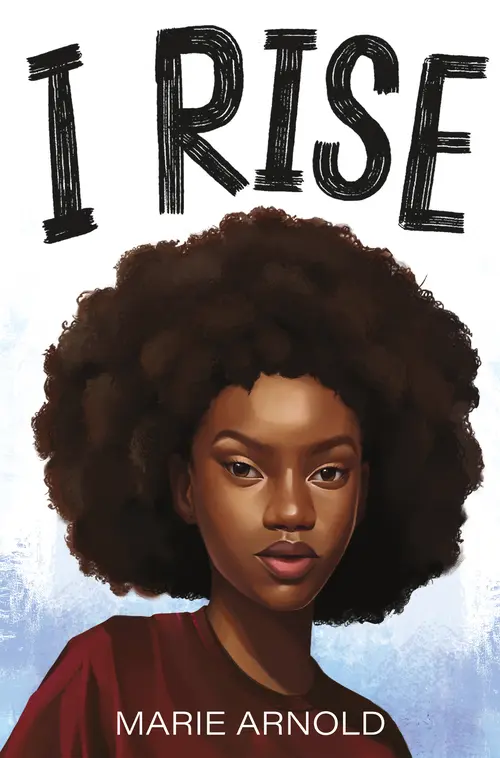
Cover
Title Page
Dedication
Dedicated to the Black boys and girls who didn’t have a camera to document their trauma and whose stories we may never know.
I would also like to dedicate this book to my family and especially to my sister, Cindy, because she’s the strongest, most courageous woman I know. But she hates sappy stuff like that, so . . .
I dedicate this book to my sister, Cindy, because it’s hard for her, knowing that our mom loves me more.
PS. “I’m so happy.” *Joey Tribbiani voice*
Epigraph
Love does not begin and end
the way we seem to think it does.
Love is a battle, love is a war;
love is a growing up.
—James Baldwin
Chapter One
Afro Rules
I drained all the color out of Harlem. I made the wind so angry it’s pounding on the window like po-po at the front door. I even made the tree branches mad—so mad, they bend away from me. Everyone who looks out the window thinks it’s just a cold, gray day in September, but I know the truth: Harlem is giving me the side-eye.
But despite my neighborhood’s tantrum, I will follow through with my plans. I can’t keep putting it off. I had all summer to break the news to my mother and I didn’t. I stayed silent. Well, no more.
Do you hear me, Harlem? You can howl and roar all you want; today is the day I claim my freedom.
I nod pointedly at the window and turn my attention back to homeroom. We’re only a week into the new school year and most of the students have already broken up into groups.
There’s a bunch of guys in the back of the room gathered in a circle. They bounce in rhythm to the music coming from their mini speaker. I call them the Knights, short for “Knights of the Hip-Hop Round Table.” They love hip-hop and live to argue about every aspect of it. Their discussions are generally peaceful—except for the time they were arguing about who the greatest rapper was and someone said “Drake.”
Drake?
Seriously?
Sitting across from the Knights are a group of girls with long nails and even longer weaves. They’re perfectly put together, from their sculpted eyebrows to their designer boots. For them, mirrors are a religion and Rihanna is their high priestess. I call them the Narcs after Narcissus, the hunter in Greek mythology who was so vain, he fell in love with his own reflection.
But don’t get it twisted—vain doesn’t always mean stupid. Last year they held a workshop during lunch called Lace Front for Beginners. They charged twenty bucks a head and cleaned up. And now they have their own YouTube channel, with over three hundred thousand followers.
A few feet away from the Narcs is a small tribe of kids with their heads buried in their textbooks. In addition to their love of all things academic, they have an affinity for old-school stuff—like Richard Pryor T-shirts and Nintendo games. I don’t know why, but something about the past seems to make them really happy. So, I call them Vintage.
Standing in the opposite corner are the basketball players and cheerleaders. They don’t get a nickname. God already gave them enough.
I look up at the clock on the wall; class will start soon. I go to unzip my backpack, but I feel a sharp pain just below my shoulder.
“Ow!” I shout as I turn to the desk behind me.
“Hello? I asked you a question,” my best friend, Naija, says. “What are you doing later?”
“Looking for new friends, ones who don’t resort to violence to get my attention,” I grumble as I try to inspect the mark she left on me.
“Girl, I called your name three hundred times. And as usual, you were dumbing out.” I’m sure she only called my name once or twice; Naija’s being extra. It’s her way.
I turn toward her and playfully announce, “Queen Naija, oh great one, I’m sorry I wasn’t listening. Please honor me with your sacred thoughts.”
She rolls her eyes. “Do you wanna come to my house later?”
“I can’t. I’m having dinner with my mom. Tonight’s the night.”
Her eyes nearly pop out of her head. “You’re gonna tell your mom today? For real this time?”
“Yeah. I have a plan. I’ll tell you about it later.”
“Well, knowing your mama, it better be good,” she warns me.
One of the girls from Narc—Joy Mitchell—looks up from her pink compact and calls out to me, “Ayo, I saw the words ‘How Much?’ spray-painted on the back wall of the precinct on One Thirty-Fifth and at the nail shop by my house.”
One of the Knights shouts, “My girl Toni said she saw it on a sticker in front of the post office and the supermarket. And yesterday, I saw it on a banner outside the laundromat.”
“I’ve seen it all over the place too. Girl, your mom knows how to get people’s attention,” Naija adds.
She’s right. My mom knows how to get noticed. She’s responsible for all the spray-painted signs, stickers, and banners throughout Harlem. They all ask the same thing: “How Much?”
When I walk by anything that’s been spray-painted with that question, a pool of ice forms in the pit of my stomach. It’s a reminder of what I have to do later today, and it makes me queasy. Thankfully, I don’t have to think about it too much, because our new history teacher enters. He’s the only teacher we haven’t met yet; he was sick and missed the first few days of school. All the kids scramble to their seats.
He’s a pale, lanky, middle-aged guy with a receding hairline. He wears dark-rimmed glasses and, for some strange reason, has on red cowboy boots. He tells us his name is Mr. Gunderson and heads over to his desk. Then he makes an announcement and I roll my eyes so hard that I nearly injure myself.
“Instead of you students telling me your names, I’d like to read them off my list. I’m what they call a visual learner,” he says in a squeaky voice.
Naija looks over at me. She knows I dread roll call because teachers always mess up my name.
“He might get it right,” she whispers.
I shrug. “Yeah, maybe . . .”
But when he stumbles on Naija’s name, I know it’s a lost cause. He’s going to remix my name. But not the kind of dope underground remix that makes you dance harder than the original. Nah, this is the kind of remix that makes you wonder why the person didn’t just leave the original alone.
“First name starts with the letter A, followed by Y . . .” he says with uncertainty.
Please, God, let this white man pronounce my name right so no one laughs at me. Or at least get it close enough that I don’t have to spend the rest of class under my desk.
I try to help him out. “Mr. Gunderson, you don’t have to—”
“No, I can do this.”
He can’t.
Naija says, “Why don’t you just let her tell you?”
He replies, “I got it.”
He doesn’t.
By now the class is snickering and staring at me. Finally I shout, “Ayomide! My name is Ayomide.”
“One more time,” he says.
The entire class loudly breaks down my name in unison: “Ay-o-mide.”
“Got it.”
He doesn’t . . .
“Everyone just calls me Ayo: the letter I and the letter O together. Ayo.”
“Yeah, okay. I was close,” he says.
I roll my eyes and silently curse my mother for not naming me Lisa. What’s wrong with Lisa? It’s short. It’s uncomplicated. And it fits nicely on a mug.
I’m grateful when he starts to move on to the next name. I can feel the stress slipping from my body. But then . . .
“Your last name is Bosia?” he asks.
I nod slightly as dread seeps back into my body.
“Any relation to Rosalie Bosia? The founder of See Us?”
“Yeah, she’s my mom,” I mutter.
The thing about being Rosalie’s daughter is that people either love or hate her, and they all want me to know about it. I guess that’s what happens when your mom is the founder of the biggest civil rights movement to hit Harlem in decades. See Us is similar to Black Lives Matter. It takes aim at police brutality, racial profiling, and an unjust prison system. But See Us specifically targets communities in Harlem.
My mom started it the year I was born, before the Black Lives Matter movement. The movement took off faster than anyone expected. And before she knew it, her five-person operation became a citywide movement with thousands of members. They organize marches, boycotts, and basically an all-points assault on the establishment.
“I saw her on Good Morning America a few weeks ago. I love her! She’s so well spoken. She’s grown into quite a divisive figure, and to that I say, ‘Right on!’ We need more sassy women like her.”
Mr. Gunderson thinks he just gave my mom a compliment. But I’m pretty sure she wouldn’t take it that way. I can practically hear her now: “Does my skin color lead you to believe I would be anything other than well spoken? And did you just call me sassy?”
Just before he moves on to the next name, he mumbles to himself, “Rosalie Bosia’s daughter . . . Gosh, what must that be like?”
What’s it like?
Well . . . while other kids made houses with Popsicle sticks, I made posters to free unjustly convicted prisoners. When other kids were playing video games, I was studying Black history with flash cards. And when my classmates were going to their first school dance, I was going door to door with my mom to get people to register to vote.
And yes, many people in Harlem know me, but don’t get it twisted; that doesn’t mean I have a lot of friends. It’s hard to make friends when you invite them over but then your mom won’t let them eat until they tell her who was the first Black woman to refuse to sit in the back of the bus. And God help you if you said “Rosa Parks,” because that is most definitely not the right answer.
I envied the kids whose parents let them get away with knowing only the basics of Black history: Who is Madam C. J. Walker and what is Juneteenth? My mother was not having it. By the time I was ten, I knew more about Black history than most of my teachers.
That’s what it means to be Rosalie’s child. And now, I want out.
I’m not crazy. I know I can’t opt out of her being my mom. But I want out of See Us and out of the activist life. I’ve done more than my part. Now, I just want to be normal. My reading list may be advanced, but my social life is so far behind that I’m not sure I even qualify as a teenager anymore.
Most the girls I know are dating, and some are already having sex. Don’t get me wrong, I’m not really trying to get down like that, but damn, I’m almost fifteen. I should have been kissed already, right?
Okay, to be fair, I did get kissed one time, but it didn’t count because it was really fast and the guy did it on a dare. His name was Keith Hightower. Keith was hesitant because, like many guys in our school, he’s kind of afraid of me. Why? One word:
Afro.
My Afro makes guys think I’m a badass. Like I’m the younger version of Angela Davis and I don’t take no mess. But really, I’m not a badass. I’m more of a “measured” ass. And even though I’d like to say I don’t take no mess, the truth is, I take it.
When I go into the CVS Pharmacy on my block, the manager Donna tries to put her hand in my hair. I have to find a way to dodge her probing fingers. Someone should have told me that putting my hair in an Afro would repel guys while attracting curious white women with no boundaries.
According to the unwritten rules of wearing an Afro, I have to put Donna in her place. And also, according to the rules of being Rosalie’s daughter, I have to let Donna know why her actions are offensive. But I’m opposed to confrontation. That’s why I go to a different CVS, five blocks out of my way, to avoid Donna and her looming fingers of curiosity.
Yeah, I know. I’m a disappointment to badasses everywhere.
When class is over, I tell Naija to hurry so we can go before Mr. Gunderson asks me anything else about my mom. We almost make it.
“Ayo, can I see you for a moment?” he asks. Naija gives me a sympathetic shrug and says she’ll wait for me outside. I sigh and put on my best bargain-basement smile as I approach my mom’s fanboy.
“Yes, Mr. Gunderson?” I reply as everyone else leaves the room.
“My wife and I have a small gathering—it’s nothing fancy. We meet here in Harlem once a month at the café inside Whole Foods on One Twenty-Fifth and Lenox. Your mom wrote a powerful piece for the New Yorker about the struggle to combat gentrification in Harlem. It had such an impact on my friends and me. Do you think she’d be open to speaking to our group?”
So far, I know two things about Mr. Gunderson: one, he sucks with names. And two, he’s not great with irony. If my mom’s article on gentrification had really been a success, there probably wouldn’t be a Whole Foods on 125th Street.
“That sounds nice, but . . . she’s really busy,” I inform him.
“Oh, yes, I understand.” He nods.
“Can I go now, Mr. Gunderson?”
“Yes . . . Wait! Is there a way you can get me her autograph? I’m a bit of a collector. I have a church program signed by all of Dr. King’s children! I’d love to add your mom’s signature to my collection. Is that possible?”
Is this guy joking? Sometimes I have to call my mom’s office and make an appointment to get a hug. It’s bad enough that I have to share her with all of Harlem; now I’m supposed to share her with my teacher? If I were a badass, I’d say, “Boy, bye.”
But I’m not. So instead, I smile politely and mumble something about getting back to him. If I keep going like this, my Afro will rebel against me and turn itself into a perm.
Tragic.
Normally the school day takes forever to end. But now that I have something to do after school, something I’m dreading, the day is flying by. And before I know it, it’s already lunchtime. On my way to the cafeteria, I spot How Much? stickers on students’ notebooks and backpacks.
My mom has outdone herself.
I buy my lunch and head toward Naija, seated at the table near the entrance. We’re still waiting for the last two of our crew to show up.
“Ayo, I know you have a lot on your mind, so I forgive you,” Naija says.
“Forgive me for what?”
“For failing to recognize my hair and how I’m killing it right now,” Naija says proudly. She’s not lying; her hair is beautiful. It’s freshly styled in Havana crochet braids with pale strands of purple, pink, and gray. It flows down to her waist and frames her round face perfectly.
Naija is beautiful. Her russet-colored eyes are big and sparkle with flecks of gold when the sun hits them. She has full lips that kids used to make fun of but now try to replicate. I don’t think Naija’s mother actually gave birth to her. I suspect she was created by midnight itself and left on her mother’s doorstep.
Her skin color is the reason we met. We were in first grade and a boy was teasing her about her being dark-skinned. I walked up to the kid and dumped my tray of food on him. Everyone laughed at him. I think that was my first and last act of badassness.
After that day, we became best friends. My mom would tell her about different parts of the world where her dark skin tone was worshipped and adored. That helped her self-esteem—maybe too much.
“Hello? Is my hair everything or what?” she asks.
“I love it!”
“Thank you. Now, what’s your plan to talk to your mom?”
Before I can reply, the guys make their way toward us. The short kid with deep-set eyes is Dell Rogers. He always wears long, dark jackets and shades. He plays the saxophone and lives for three things: food, girls, and Miles Davis.
The guy walking next to him is Shawn Anderson. He’s a tall, muscular basketball player, and all the girls want him. The thing is that he’s not into girls. Last year, we were all at my house, playing video games and stuffing our faces, and out of nowhere, Shawn blurted out, “I’m gay.”
The words sucked all the air out of the room. The first person to recover was Dell. “You gay? For real?” he asked.
Shawn looked over at his best friend and nodded. “Yeah, I am. I knew for a while, but I didn’t want to say anything.” He shrugged.
Dell nodded. “I get it, yo. You didn’t want to say anything, but now you have to ’cause . . . you have feelings for me.”
“Feelings? For you? Nah,” Shawn replied.
“Well, damn, you ain’t had to say it like that,” Dell replied, clearly offended.
Shawn said, “I just meant that—”
“No, I know what you meant. And I’ma tell you something—I’m a catch. You hear me?” Dell informed us.
Shawn walked over to his friend. “So you don’t care that I’m gay. You only care that I’m not feel’n you like that?”
“I’m say’n, look at me. I’m fire, baby!” Dell said as he checked himself out in the mirror across the room.
Shawn laughed and then looked over at the rest of us to gauge where we were with his announcement. “What y’all think?” he asked nervously.
“So the thing about gay people having fashion sense, that’s all a lie?” Naija teased.
Shawn threw the nearest pillow at her head. I went over and hugged him. The last thing I remember about that night was us gossiping about which guy would be a good match for Shawn, while Dell stood in the background making kissing faces at himself in the mirror.
Shawn hasn’t told his dad that he’s gay yet. But I don’t think his dad will cast him off when he tells him. I mean, it will be hard at first, for his dad to let it all sink in, but in the end, I’m sure things will work out. I’m sure of this because Shawn and Dell have the best dads.
When I was a kid, I remember growing curious about mine. I had a million questions. They bubbled up in my head for a while before I had the courage to ask my mom about him. I remember that day vividly. We had come from Dell’s birthday party—one that his dad had arranged for him. I watched the two of them interact, and it made me wonder about my dad.
When I got home later, my mom was in the kitchen, finishing up the dishes. She dried the last one and placed it on the shelf. I entered the kitchen slowly, heart pounding and pulse racing. I had no idea how my mom would react. She never said we couldn’t discuss my dad, but she never brought up the subject either.
“Mom, can I ask you something?” I said, voice cracking with uncertainty. “Who’s my dad? Is he even alive? Is he somewhere with another family?”
My mom was thrown. I guessed she wasn’t expecting us to have this conversation, at least not on that day, or maybe ever. She started to get fidgety, and there was something in her eyes I had never seen before—panic. She walked over to the sink and started to rewash the very dishes she had just washed. It’s like she needed something to do with her hands. I followed her to the sink.
She looked out the window, but in her mind’s eye, she was far away from here. I could almost hear her heart beat. Her chest moved up and down quickly and her whole body stiffened. I had never seen my mom so rattled before.
“Did I say something wrong?” I asked.
And then something happened that I didn’t think was possible: my mom was crying. I had made my mom cry! The uneasiness that filled me would last for days. And even now when I think back to that moment, a chill runs down my body. I never ever wanted to hurt my mom or drive her to the point of tears. I didn’t even know that could be done. So I told her I wasn’t ready to meet him and I never brought it up again.
Dell pleading brings me out of my thoughts and back to the table. “C’mon, y’all. I need ten bucks to get lunch. Who got me?” Dell asks, dragging me back to the present.
“Nobody but Jesus. So go ask him for money,” Naija replies as the guys join our table.
The Story Continues on BooksBarbecue!
Enjoyed this preview? ❤️ Do not stop here!
Read the complete book free online → 🔗
Continue reading now on BooksBarbecue and discover every page!
Love reading? Bookmark BooksBarbecue.com for more amazing books!
Happy Reading!