I Look Divine
Cover
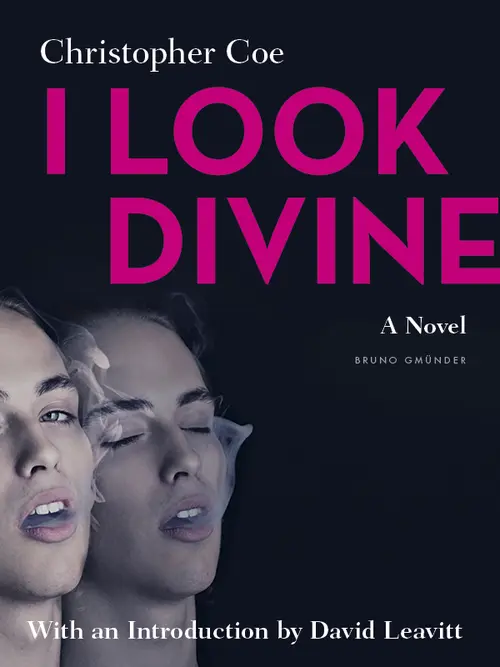
Titel
Introduction
Introduction
Christopher Coe, whose death from AIDS in 1994 robbed us of a visionary American writer, published only two novels. The second of these, Such Times, is a lyrical dirge, a paean to life written in the valley of the shadow of death. Its predecessor, I Look Divine, is funnier, leaner, more nimble, if no less dark and majestic. At its center stands Nicholas, the narrator’s younger brother, a man “with an instinct for placing himself in a frame.” Nicholas’s narcissism is, to borrow a term from Henry James, the donnée of I Look Divine, the spark by which its wit and its tenderness are ignited. Impossibly wealthy, impossibly smart, and possessed of the finest cheekbones in Christendom, Nicholas parades through the novel throwing off insouciant remarks and admiring himself in mirrors. (“You are the smartest little boy in the world, and you also look like this,” he tells one of these.) Yet he is also committing a suicide as “long and lovely” as any since Oscar Wilde coined the phrase. It is the course of these parallel trajectories—and their eventual confluence—that the novel charts.
The plot of I Look Divine, to the extent that it has one, is modest. Nicholas has died, and his brother has come to New York to survey his effects. Among these is a photograph of Nicholas in a black Japanese robe, standing against “a wall of skull-like faces carved in stone. His pose includes a cigarette, white filtered, and a hollow-stemmed champagne glass that he is holding to his neck, just below the jawline.” Not surprisingly, the photograph has a mirrored frame—and indeed, one might say that I Look Divine is the mirrored frame within which Coe positions Nicholas. Where the narrator—and the reader—catch glimpses of themselves is in the reflective edging.
A genius of self-regard with a penchant for self-destruction, Nicholas commands his brother’s awe and his ire, his passion and his compassion. Though his preferred milieu is the hotel bar—in Madrid, in Rome, at various Mexican resorts—it is when he stumbles into environments where he finds himself at a disadvantage that he comes most gloriously into his own. Indeed, Nicholas’s strategies for making himself feel at home (which entail making others feel uneasy) provide Coe with some of his best opportunities for comedy, in particular when he is sending up, through the effete Nicholas, the hypermasculine posturing that was such a feature of gay life in New York in the nineteen-seventies. Hence we get this hilarious description of a Roman gay disco:
The one wall not covered by mirrors was covered instead by a mural of opulently muscled, overgendered men, half or more undressed. The illustrator must have tried to capture how men might look if they could issue directly from each other in a womanless world, and in the mural the lewdly virile specimens, cartoon ideals, regarded each other with untender admiration.
Or this passage, as notable for its elisions as its skewering of a particularly humorless kind of gay vanity:
Nicholas had taken me to a place where men did not wear ties. Ties were not allowed. Sweaters were not allowed. The sign at the door listed what was not allowed. Cologne was not allowed. Certain kinds of shirts were not allowed. Shirts could be checked at the door. Anything could be checked at the door. Some men checked everything but their shoes.
The pool table was not used for pool.
The passage exemplifies Coe’s style in I Look Divine: a sequence of short sentences, repetitions, lists will suddenly open out into broad humor or rhapsodic song.
“Maybe you can tell me,” Nicholas said, “why everybody wears these trousers, with the labels in the back that tell the waist size. Why do all of you want to go around telling the world your waist size? I mean, disclosing it. And maybe you can tell me why it is always, always thirty.”
The heartbreak here—as in so much of the novel—is that Nicholas doesn’t fit in to the bar. The men ignore him—and for Nicholas, to be ignored is far worse than to be ridiculed. For despite his self-proclaimed splendor, Nicholas does not belong to the age in which he lives. Rather he is a throwback to the teens and twenties, to the heyday of Ronald Firbank, who was famous for eating a meal consisting of champagne and a single pea on a porcelain plate (and whose novels, not incidentally, this one recalls). Even Nicholas’s vanity is dated, as the narrator observes in the Rome nightclub where “the most beautiful men” dance with themselves in front of mirrors. “It was not only true that they were not looking at each other,” Coe writes; “it was also the truth that, when they danced by themselves in mirrors the most beautiful men in Rome were not looking at Nicholas…He was sitting between two older, good-enough-looking men at a front table, in several hundred dollars’ worth of clothes, and the most beautiful men in Rome were not looking at his drop-dead bone structure, and it was not going over.”
I only met Christopher Coe a few times, toward the end of his life. He was very sick by then, yet in his face you could still discern the vestiges of an abruptly cancelled youth. From what I gathered, he had been rich but had lost all his money, first through profligacy then through lack of medical insurance. Now he lived in poverty, in an apartment on Christopher Street the shabbiness of which was in its way seigneurial. Home health aides had stolen his last Baccarat tumblers, a detail that might have come out of I Look Divine. For there was no question that Christopher was an aristocrat—which did not stop him from displaying extraordinary modesty, in particular when it came to his own literary talents. I doubt he realized how much he had already achieved by the time he died, how close he had already come to mastery.
Though AIDS is never mentioned in I Look Divine, its specter haunts the novel. Contagion is always a step away here—in a justly famous scene, Nicholas, on a whim, dives into the contaminated waters of the Tiber—just as the body, rather than a site of pleasure, is a site of vulnerability. Near the end of the novel, the narrator recalls traveling in Mexico with his brother and seeing “a horse or a cow that has been hit, burning.”
One sees the animal in flames. On many roads in Mexico, when a horse or a cow is hit, the natives ignite it with gasoline. Sometimes the animal is alive when it is ignited, and one can see, from one’s car, or on foot if one is walking, the animal dying of the impact while it is dying also of the fire. One sees the animal convulse. The smell of the fire and the flesh is also a taste. It gets into the throat, the carcass taste, with the smell of smoke and the taste of blood in the swallow of each breath.
For all its charm, and elegance, I Look Divine has “the carcass taste.” Early in the novel, the narrator describes an antique lacquer table that he has found in his brother’s apartment, made according to an “old Japanese process that, over time, makes the black base show through in random patches under the red layers laid over it.” Lacquer, he goes on to explain, “comes from toxic sap…When raw, if touched, the sap will burn through skin.” Though certain monks discovered a means by which the exposure of the black base could be hastened, Nicholas’s table, his brother is sure, “is the real item, lacquer aged the valued way, before the monks learned to coax the base, by artifice, to come up through the many sheer layers of red.” The same might be said of I Look Divine, a novel of self-evident authenticity, through the radiant surface of which a dark core of suffering burns.
—David Leavitt
Dedication
For Hans Guggenheimer
For Majorie Edwards Brush
Epigraph
“And he carried to the wars with him a gilded scutcheon, whereon he had no cognisance, nor ordinary device of the Athenians, but only had the image of Cupid on it, holding lightning in his hand.”
plutarch, Lives
I Look Divine
My brother would not smile for a photograph. He smiled now and then in life, he was even known to laugh, but never for a camera. Even when we were growing up, when he was a little boy, Nicholas knew how he wanted to be seen.
He knew how he was willing to be remembered. Any camera would alert my brother’s instinct for posterity.
In the years that we had grandmothers, one of them was the kind who liked to compose grandsons within a frame in front of a Christmas tree. She liked to pose the smaller boy in front of the bigger boy, the bigger boy holding the smaller one, me holding Nicholas, my arms around him, enfolding him from behind.
The idea, I think, was that this embrace would make us look like brothers.
Ours was a weak resemblance.
Nicholas would look at himself in the red glass ornaments hooked to the boughs, the ones that were silver inside when they shattered. He could see himself in them and in the presents wrapped in shining paper at our feet. He could find his face in the heaps of packages, of which more than half, every year, were invariably for him. He would be himself up to a point, as much as Nicholas ever was himself, until our grandmother would say, “Say cheese.”
We could not, even in those years, either of us, believe that we had that kind of grandmother.
Nicholas said that she came from a bad family.
He did not say this in those years; he said it later, in the years when he was fond of calling things de trop.
One year—almost thirty years ago—while we were waiting for the cheese, Nicholas stood on my shoes and reached behind us both. He put his hands in my back pockets and squeezed handfuls of me, the biggest handfuls he could get, clutching through the cloth. He held on to me, his feet planted on mine, and he tipped his weight forward, leaning with it, not to make us fall, but as though he wanted to take flight without leaving me behind.
I pulled him to me and smelled soap on his skin, starch in his white shirt, and the wool smell of his short gray trousers. I smelled tonic in his hair, and Listerine, and under them, I was sure, I smelled our mother’s perfume. It may have only been the scent that her kisses left behind, but with his weight on me I imagined Nicholas looking at himself in our mother’s mirror, splashing her Arpège into his hand, then lavishing it behind his ears, as she did. I could picture my brother stroking perfume on the pulse of his neck, with the thrill that is the point of the forbidden.
I imagined what must have been his rapture.
I squeezed him tighter, and while our grandmother squinted, trying to attach the flash, Nicholas took one hand from inside my pocket and forced it in between us.
He whispered, “Goose you!”
I felt his laughter in my feet. I felt it rise, I felt his laughter in his ribs, where I was holding him. My brother’s laughter made me laugh. I felt it in his body, then in mine.
I thought our grandmother should have captured that. I thought that would have been a picture worth taking, worth having.
It would be worth having now.
Now it would be proof.
Nicholas and I were still laughing when she told us she was ready.
She called us boys.
She said cheese.
“Cheese, boys,” our grandmother said.
That was all it took to stop my brother’s laughter. Nicholas stepped down from my shoes. He folded his hands in front of his body and made them mimic a boyish repose. I watched his face change in the ornaments.
He changed it to a face that he had taught himself. It was a face that a little boy will learn to make after hearing too often that he is a beautiful little boy, in the same way that children who have been told that they are smart are apt to teach themselves to act it.
It was a face that said, “This is how I look.”
Our grandmother said that she was waiting for Nicholas to smile.
I kicked his foot and told him to do it. I told him that the smile would only be for her, that no one else would see it. I told him that it would not end up on the cover of Photoplay or anywhere else that would embarrass him.
I told him that a smile was nothing.
Nicholas stepped forward, a step away from me. Then he turned his face all the way around and gave me a look of everlasting patience that did not want to last.
“You are so oblibious,” he said. “How do I know who she’s going to show it to?”
He kept looking at me, kept giving me the look, and there was nothing else to see. There was nothing else in his face that I could make out under the look, and it occurred to me then, posing with my brother thirty years ago, that standing in front of me was a seven-year-old boy who had already vowed to show the world only the face that he wanted it to see and had done so at a time while he was still negotiating speech.
He stepped back, finally, into my embrace, turned to the camera and offered the unsmiling face, until our grandmother gave in and took the picture of Nicholas posing in the way he was willing to be seen.
There is no photograph of my brother standing on my feet. There is no photograph of my brother laughing. In the photographs from those years, in every one of them, I am the brother in the back, the one who always looks like any boy who ever smiled for a grandmother.
Nicholas is the one who always looks like Nicholas.

This is the room I thought that I would start in, and for the past several hours I have stayed in it, sitting on my brother’s unmade bed, without starting.
I could start anywhere. Any room would do.
I could empty ashtrays, open windows, take down pictures, put books in boxes, check the kitchen for spoiled food. I could throw out old onions.
I could flip through the mail that has kept coming and pitch the junk.
I could pick my brother’s clothes up from the floor and try them on for fit, then go through drawers and feel under folded clothes, under lining paper, for things he might have hid there.
Music could help me start, then help me hurry. I could hum “Moon River.”
That would be a record Nicholas would have. In another room, records fill a wall of shelves that do not stop until the ceiling. Everything that I could ever want to play or sing along to is here for me to play. I could pick out Broadway scores and belt out the big numbers over the stars who belt them on the records.
Or, as I used to see my brother do when he was a little boy, I could lip-synch in the mirror. I could close my eyes the way I used to watch him do, making them look closed but, I was always sure, keeping a space to look through, his eyelash space, so that he could see what he looked like with his eyes closed.
Nicholas used to do that.
I do not know for a fact that he stopped doing it.
He used to pretend that pencils were long cigarette holders and would glide around rooms flicking ashes into flowerpots, saying things like, “Daddy, don’t be droll.”
That is something else my brother used to do.
I cannot say that I am sure he ever stopped doing it.
I cannot say for certain that he did not know he was being watched.
I cannot even say that my brother did not know I was the one who was watching.
There might be another way. Maybe I could pay to get this done, pay someone to pack up and empty this place out. There must be companies you can call, the way you do when you move, companies that come with cartons, with padded wrap, and do it for you.
There must be a way to get it done, without doing it yourself.
There must be a way to get it all behind you.
If not, someone has not been smart, someone has not been on the ball. Someone has overlooked a need, missed a calling, lost a chance, because doing this could be an industry.
Doing this could be a life.
But I do nothing that a company would do. I stay here, sitting on the cashmere blanket with the cigarette burn in it, looking at objects around the room, my little brother’s things as he left them.
Of course, I have looked a bit in other rooms, but I have chosen this room—if chosen it is what I’ve done—because this is the room with the best objects.
I do not mean “best” in the sense of necessarily to my taste, though I am thinking that I may take the lacquer table by the bed.
I can see myself in it.
Nicholas once told me the name for this kind of antique lacquer, for the old Japanese process that, over time, makes the black base show through in random patches under the red layers laid over it. The red is actually an orange-red, what is sometimes called Chinese red, but the name that Nicholas told me sounded Italian, not Japanese, not even Oriental, and it may have been that Nicholas did not know the real name.
Nicholas may have called it a name that the men who made it never called it.
I am wondering if Nicholas knew the name that the lacquer is called among the artisans. I am wondering if he ever got around to learning Japanese, as he used to threaten that he would one day, because he expected it would be fun to flirt with what he called little Japanese houseboys, what he called little Japanese comestibles.
Nicholas called most men little.
It was nothing against the Japanese.
Nicholas liked beautiful things. But he did not keep
them beautiful. The lacquer is water-ringed from drinks he drank in bed.
I mean “best” in another sense.
I mean “best” in the sense that objects, particulars, things like cigarette burns in cashmere blankets and water rings on antique lacquer, can be said to cast a verdict on a life.
I am not saying they do.
I am saying they can be said to.
I myself would be inclined to say they do.
Nicholas knew a few things about lacquer. Years ago, he told me what he knew.
Lacquer comes from toxic sap. The sap comes from a tree that is called by different names around the world. Actually, there are different species of the tree. In Japan, for example, there is the Rhus verniciflua; in Thailand, in Burma, there is the Melanorrhoea laccifera. The trees are somewhat different, but their sap, I understand, is more or less the same. When raw, if touched, the sap will burn through skin. The sap must take in oxygen to lose the poison and is slow to do so at high altitudes, though lacquer trees will grow high up. Lacquer trees will grow on mountains.
Sometimes the sap is mixed with ash, a vehicle for air. You will not often find lacquer that is pure.
The process that can force the black base through was invented by monks, by accident. It made their temple rich, their discovery of how to simulate the aging. They learned how to hasten nature and make layers wear away as though time had done it.
They learned to make it happen on command.
I expect, though, that my brother’s table is the real item, lacquer aged the valued way, before the monks learned to coax the base, by artifice, to come up through the many sheer layers of red.
This lacquer table was a present from a man. For a number of years in his life, Nicholas attracted many presents.
I must make a note to have it appraised.
I must make a note to inquire what can be done about the water rings.
There must be a gentle technique.
I will make my notes in a minute.
There are objects on the lacquer and also objects in it. On it are two glasses, a half-empty bottle of tequila, and a glass ashtray filled up to the top with cigarettes smoked down to the filters—different filters, one kind cork, one kind white—and many snapped nitrites mixed in among them.
The yellow box with the warning on it remains here by the bed.
I have not seen this kind, the old, snapping kind, for years. One sees the liquid now, in vials, if one sees anything. These are the kind that one can hardly buy now, hard to get, and there are more of them in this ashtray than I remember coming to a box.
I wonder—did Nicholas go through them, as it were, in one sitting, or did they, as things will, if allowed, accumulate?
I wonder if on nights he was alone, my brother looked at them, to remember nights that he had not been.
The Story Continues on BooksBarbecue!
Enjoyed this preview? ❤️ Do not stop here!
Read the complete book free online → 🔗
Continue reading now on BooksBarbecue and discover every page!
Love reading? Bookmark BooksBarbecue.com for more amazing books!
Happy Reading!