Hurry on Down
Chapters (14)
Introduction by Nick Bentley
INTRODUCTION
John Wain was a novelist, poet, essayist, literary critic, journalist, radio producer, dramatist, cultural commentator and biographer.1 A man of letters then, but one that was part of a new intellectual group that emerged in a Britain that was still recovering from the effects of the Second World War. He started out as an academic, working as a lecturer in English at the University of Reading, before making the decision to leave academia to pursue a full-time writing career. This career was forged from relatively obscure beginnings, but Wain is in many ways representative of the shifts in the British class structure that were taking place in the 1950s and 1960s.
He was born in 1925 and brought up in Stoke-on-Trent, an industrial city in the north-Midlands of England famed for its production of pottery ware. His parents had a working-class background, although his father had become a dentist and as Wain puts it, ‘starting from the lumpenproletariat had somersaulted straight into the two-thousand-pound-a-year bracket’; resulting in the fact that his son could not make ‘the fashionable claim’ to come from a working-class family. Growing up in the 1930s in Stoke-on-Trent, Wain saw the day-to-day effects of the economic depression of that decade, but his broadly middle-class background made him markedly different from the majority of working-class kids in the area. In his autobiography, Sprightly Running, written in the early 1960s, he talks about his childhood in Stoke and living in fear of being beaten up by the boys who lived on the local housing estate during the ‘dangerous dash home’ from the High School he attended. His childhood experiences contributed to his desire to leave Stoke as a young man and he seems to have flourished when he went to Oxford University in 1942 to study English; he graduated with a first in 1946, and stayed on to complete an MA.
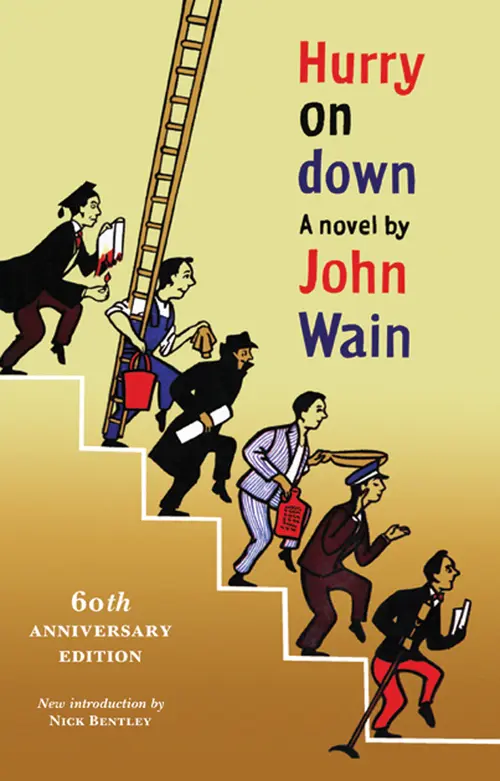
It was at Oxford that he met and became friends with Philip Larkin and Kingsley Amis, who together with a number of other contemporary writers would later constitute the loose grouping called the Movement. Although predominantly concerned with poetry, the Movement linked Wain with a group of writers who were keen to reject the modernist experimentation of the 1920s and 1930s and return to what they saw as the long line of realism in the English literary tradition. Wain would later write ‘the experimental novel died with Joyce’. This return to realism has perhaps been overplayed in literary accounts of the period; nevertheless the emphasis on provincial life recorded in a conversational prose style, with storylines that dealt with everyday situations and characters was taken up by Wain in Hurry on Down, his first novel, published in 1953. Many critics and cultural commentators emphasized the link between this group of emergent writers and the social revolution that was felt to be taking place in 1950s Britain. John Holloway, for example, writing in 1956 explained: