Chapters (12)
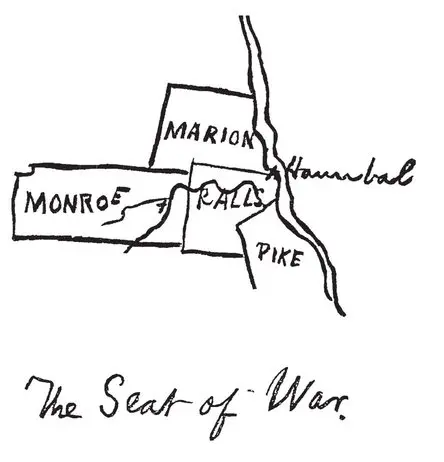
I was visiting in the small town where my boyhood had been spent—Hannibal, Marion County. Several of us got together in a secret place by night and formed ourselves into a military company. One Tom Lyman, a young fellow of a good deal of spirit but of no military experience, was made captain; I was made second lieutenant. We had no first lieutenant; I do not know why; it was long ago. There were fifteen of us. By the advice of an innocent connected with the organization, we called ourselves the Marion Rangers. I do not remember that any one found fault with the name. I did not; I thought it sounded quite well. The young fellow who proposed this title was perhaps a fair sample of the kind of stuff we were made of. He was young, ignorant, good-natured, well-meaning, trivial, full of romance, and given to reading chivalric novels and singing forlorn love-ditties. He had some pathetic little nickel-plated aristocratic instincts, and detested his name, which was Dunlap; detested it, partly because it was nearly as common in that region as Smith, but mainly because it had a plebeian sound to his ear. So he tried to ennoble it by writing it in this way: d’ Unlap. That contented his eye, but left his ear unsatisfied, for people gave the new name the same old pronunciation—emphasis on the front end of it. He then did the bravest thing that can be imagined,—a thing to make one shiver when one remembers how the world is given to resenting shams and affectations; he began to write his name so: d’ Un Lap. And he waited patiently through the long storm of mud that was flung at this work of art, and he had his reward at last; for he lived to see that name accepted, and the emphasis put where he wanted it, by people who had known him all his life, and to whom the tribe of Dunlaps had been as familiar as the rain and the sunshine for forty years. So sure of victory at last is the courage that can wait. He said he had found, by consulting some ancient French chronicles, that the name was rightly and originally written d‘Un Lap; and said that if it were translated into English it would mean Peterson: Lap, Latin or Greek, he said, for stone or rock, same as the French pierre, that is to say, Peter; d’, of or from; un, a or one; hence, d’Un Lap, of or from a stone or a Peter; that is to say, one who is the son of a stone, the son of a Peter—Peterson. Our militia company were not learned, and the explanation confused them; so they called him Peterson Dunlap. He proved useful to us in his way; he named our camps for us, and he generally struck a name that was “no slouch,” as the boys said.