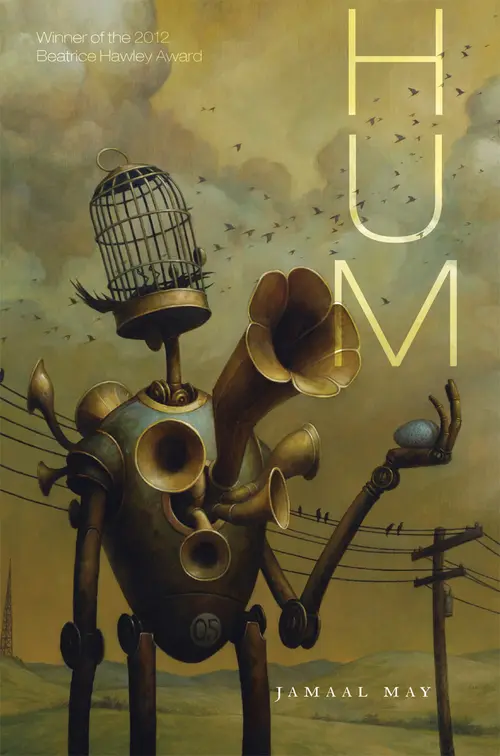
Hum
Cover

Note to the Reader
NOTE TO THE READER
Alice James Books encourages you to calibrate your e-reader device settings using the line of characters below as a guide, which optimizes the line length and character size:
clean off, brought icicles down. The boy listened for the sea.
Please take the time to adjust the size of the text on your viewer so the line of characters above appears on one line, if possible. Doing this will most accurately reproduce the layout of the text intended by the author. Viewing the title at a higher than optimal text size or on a device too small to accomodate the lines in the text will cause the reading experience to be altered considerably; single lines of some poems may be displayed as multiple lines of text. If this occurs, the line break will be marked with a shallow indent.
Acknowledgments
Acknowledgments
The author gratefully acknowledges and thanks the following publications in which poems previously appeared:
Another and Another: An Anthology from The Grind Daily Writing
Series: “If They Hand Your Remains to Your Sister in a Chinese Takeout Box”
Atlanta Review: “Triage”
Blackbird: “Man Matching Description” and “Ask What I’ve Been”
Callaloo: “Pomegranate Means Grenade”
The Collagist: “If They Hand Your Remains to Your Sister in a Chinese Takeout Box,” “Macrophobia: Fear of Waiting,” and “Thinking Like a Split Melon”
The Cortland Review: “Mechanophobia: Fear of Machines”
The Drunken Boat: “The God Engine”
Foreign Policy in Focus: “Pomegranate Means Grenade”
The God Engine (Pudding House Press Chapbook Series, 2009): “Chionophobia: Fear of Snow,” “Coming Back for You,” “The Boy Who Bathes the Dead,” and “Paper Crane on Letting Go”
Gulf Coast: “On Metal” and “Thalassophobia: Fear of the Sea”
The Hairpin: “Hum for the Bolt”
Indiana Review: “Athazagoraphobia: Fear of Being Ignored”
The Kenyon Review: “The Sky, Now Black with Birds” and “The Hum of Zug Island”
The MacGuffin: “The Girl Who Builds Rockets from Bricks”
Mead: The Magazine of Literature and Libations: “Aichmophobia: Fear of Needles”
Michigan Quarterly Review: “A Detroit Hum Ending with Bones” and “Hum of the Machinist’s Lover”
Minnesota Review: “The Man Who Paints Mountains and Helicopters”
Muzzle Magazine: “I Do Have a Seam” and “Neat”
New England Review: “And Even the Living Are Lost” and “Hum for the Hammer”
The Normal School: “Hum for the Stone”
The Paris-American: “On Gentleness” and “Hum of the Machine God”
The Pedestal Magazine: “Paper Frog on Spring”
Ploughshares: “Masticated Light”
Poetry: “Hum for the Bolt”
Sixers Review: “How to Get Your Gun Safely Out of Your Mouth” and “How to Disappear Completely”
Southern Indiana Review: “Looks Like a Boy” and “Paper Tiger to Wind”
Spoon River Poetry Review: “Still Life”
Many thanks to the many friends and colleagues who made this collection possible through creative, logistical, and emotional support including Reginald Dwayne Betts, Tommye Blount, Veronica Castrillon, Nandi Comer, Kahn Davison, francine j. harris, Khalid El-Hakim, Quincee Herbert, Melissa Roberts, Anna Saini, Erin Shaughnessy, Laura Swearingen-Steadwell, Scheherazade Washington, Jasmin White, and Team Turgid: Roger Bonair-Agard, J.W. Basilo, Tom Budday, and Karrie Waarala.
Thank you to the organizations that fed me in multiple ways: The Stadler Center for Poetry, Shara McCallum, Andrew Ciotola, and G.C. Waldrep; Terry Blackhawk and the Inside Out Literary Arts Project; the entire Cave Canem family, Alison Meyers, Toi Derricotte, and Cornelius Eady; Ross White and the Daily Grind Writing Series; Callaloo Writers Workshop, Dr. Charles Henry Rowell and Gregory Pardlo; Poetry Slam Incorporated and the poetry slam community; Lynn Procope and the NYC LouderArts Project; Team Fucking Nuance; Michael Collier and the Bread Loaf Writers Conference; the MFA Program for Writers at Warren Wilson College, Ellen Bryant Voigt, Debra Allbery, and Amy Grimm; Alice James Books, Meg Willing, Carey Salerno, and the cooperative board for believing in this collection and showing that belief at every turn.
Thank you to Vievee Francis and Matthew Olzmann, the two hardest working and most generous poets I know. They may have done more for my writing life than even I have.
Special thanks to the careful eyes that gave these poems no quarter: Alan Shapiro who guided me in laying the foundation that became Hum, Gabrielle Calvocoressi for challenging me on form and endings, C. Dale Young for the revision philosophy and thoughts on organic ordering, Rick Barot for the title and his macro to micro insights, Catherine Barnett for her fresh perspective and finishing touches, Carl Phillips for his guidance and big picture advice, and Tarfia Faizullah, the first, last, and closest reader of every kobita.
And thanks especially to the May family for making me the rare poet whose craft is respected and encouraged by all of his kin: my father Claude, mother Sytoria, brothers Jabari and Jared, and my twin sister Danielle, who believed in my poetry before I even began writing it.
Dedication
Dedicated to the interior lives of Detroiters and the memory of David Blair

Still Life
Still Life
Boy with roof shingles
duct taped to shins and forearms
threading barbed wire through pant loops.
Boy with a safety pin-clasped
bath towel of a cape
tucking exacto knife into sock.
Boy with rocks. Boy
with a metal grate for a shield.
Boy with a guardian
daemon and flawless skin.
Boy in the shuttered district,
a factory of shattered vials,
green and brown glass.
Boy with a tiny voice
and crooked cursive handwriting,
with bent nails in a pouch,
metal flashing scavenged in bits,
with half a neck tie
tied around the brow
pushing a fire door wide.
Boy with a boy living
in his head kept quiet
by humming a lullaby
of static and burble.
The boy in the boy’s head
watches sparse traffic
from a warehouse window
and takes notes on where
overpass paint hides rust,
where the cyan bubbles up
into a patchwork of pock
and crumbling disease,
a thief in the bridge’s body
he doesn’t see, but knows
is coming tomorrow
to swallow his song.
Hum of the Machine God
Hum of the Machine God
There isn’t much to discuss with the Machine
God, though its voice is hard to ignore;
it speaks in planks of wood shaped for the sea,
sputters smoke, eats grass. It speaks in snow
spit into piles, commands the motion of a needle
through a hem. It hums. It waits.
Once, in a parking lot, it spoke to the boy waiting
for an exchange between a sewing machine
and his mother to come to a close. Mother’s needle-
skilled fingers had already learned to ignore
pain, but the boy’s hands were supple. The snow
under Father’s idling car became a sea,
running into drains towards another sea
the boy hoped and hopes is out there waiting.
Almost heard it one morning, shoveling snow
as a neighbor’s open garage rattled with machinery,
boatbuilding tools, a thrum he knew to ignore.
Father said, Might as well build that boat with needles,
but the spell held the boy. To watch the needling
of a board through a notch was to see a wooden sea-
dragon and dream of riding it away. Boy, don’t ignore
me. A lip split open. Shovel. Father hated waiting
and had even less patience for the broken machine
coughing exhaust in the yard, clutching a snow-
colored stone in its throat. Yes, he prayed the snow-
blower would take Father’s hand. Yes, the needle
of Father’s scream, as a thumb was machined
clean off, brought icicles down. The boy listened for the sea.
Gripped his shovel. Gripped his oar. Now, in a waiting
room, he bows to the florescent hum and begs. Ignore
my prayer, goes his stupid little prayer, please ignore
my voice. The thumb in a jar packed with snow,
will take a miracle for doctors to reattach. Waiting,
as if to plead, Let me try my hand, give me the needle,
Mother taps a knitting needle against the sea-
foam-colored formica, rapid as a machine,
but the Machine God, still busy with the lights, ignores
the needle’s morse code prayer while the boy waits
for snowmelt in his mouth to taste of oak and sea.
Athazagoraphobia: Fear of Being Ignored
Athazagoraphobia
Fear of Being Ignored
I used to bury plum pits between houses. Buried
bits of wire there too. Used to bury matches
but nothing ever burned and nothing ever thrived
so I set fire to a mattress, disassembled a stereo,
attacked flies with a water pistol, and drowned ants
in perfume. I pierced my eyebrow, inserted
a stainless steel bar, traded that for a scar in a melee, pressed
tongue to nipple in a well-lit parking lot, swerved
into traffic while unbuttoning my shirt—
There is a woman
waiting for me to marry her or forget her name
forever — whichever loosens the ribbons from her hair.
I fill the bathtub for an enemy, lick the earlobe
of my nemesis. I try to dance like firelight
without setting anyone ablaze. I am leaning over
the railing of a bridge, seeing my face shimmer
on the river below — it’s everywhere now —
Look for me
in scattered windshield beneath an overpass,
on the sculpture of a man with metal skin grafts,
in patterns on mud-draggled wood, feathers
circling leaves in rainwater — look. Even the blade
of a knife holds my quickly fading likeness
while I run out of ways to say I am here.
How to Disappear Completely
How to Disappear Completely
You are quarter ghost on your mother’s side.
Your heart is a flayed peach in a bone box.
Your hair comes away in clumps like cheap fabric wet.
A reflecting pool gathers around your altar
of plywood subflooring and split wooden slats.
You are rag doll prone, contort,
angle and arc. Rot. Here you are
a greening abdomen, slipping skin,
flesh fly, carrion beetles. Here
where bullets found shelter,
where scythes found their function, breath lost
its place on the page, where the page was torn
out of every book before chapter’s close.
This is slippage, this is a shroud of neglect
pulled over the body, this
is your chance to escape.
Little wraith,
bend light around your skin until it colors you clear,
disappear like silica in a kiln, become
glass and glass beads, become
the staggered whir of an exhaust fan,
a presence only noticed
when gone. Become origami.
Fold yourself smaller
than ever before. Become less. More
in some ways but less
in the way a famine is less.
We will forgive you for not being
satisfied with fitting in our hands.
We will forgive you for dying to be
a bird diminutive enough
to fit in a mouth without being crushed.
Man Matching Description
Man Matching Description
Because the silk scarf could have cradled
a neck as delicate as that of a cygnet
but was instead used in last night’s strangling,
it is possible to marvel at the finish on handcuffs,
because I can marvel at handcuffs
pummeled by stones until shimmering,
the flashlight that sears my eyes
is too perfect to look away, because
a flashlight has more power on a southern roadside
than my name and blood combined
and there is no power in the very human
frequency range of my voice and my name is dead
in my mouth and my name is in a clear font on a license
I can’t reach for before being drawn down on,
because the baton is long against my window,
the gun somehow longer against my cheek,
the vehicle cold against my abdomen
as my shirt rises twisted in fingers
and my name is asked again—I want to
screech out, Swan! I am only a swan.
The Sky, Now Black with Birds
The Sky, Now Black with Birds
If I say riot helmets outnumbered the protesters
who, after Troy Davis was executed, stuck around
to throw useless punches into the courthouse grass
while a woman near the forest of batons
lay sprawled facedown in the lawn gripping a Bible,
a green sea beginning to memorize
the shape of her grief—If I say Death,
cure death, and had such power over the scythe,
how many cranes would it take to lift her
out of this drowning?
If I tell you
Lawrence Brewer was executed
five hours earlier for the murder of James Byrd—
if I ask you to look for birds foraging
between Brewer’s intricate tattoos,
I don’t mean to distract you from the cross
that still burned on his arm that day.
I don’t expect you to stare into a graffiti
of iron crosses and spider webs scrawled
across flesh and find a thrush vibrating with birdsong,
but I want you to know why I listen for more
than the cawing of crows:
I wanted Brewer dead.
So dead, my tongue swelled fat with hexes, so fat
I wonder how forgive could ever fit inside my mouth.
Somehow it’s always there, fluttering in the larynx
of Ross Byrd—the man whose father was dragged,
urine soaked, by Brewer behind a truck.
Watch him say it.
Forgive.
I swear,
the word has feathers. I want
to learn to get its wings between my teeth
before more retribution
blots out the sky.
When I tell you
glare flickered off a cop’s visor
and startled a single crow away
from the murder that flapped the sky into inky pieces,
I want you to watch close enough
to notice the feathers aren’t black at all.
Like bruises and ink, they are
only this full-bodied purple—purple so rich
your eyes will still swear it’s black the next time
you see it spread out across sky. Watch it
spread like the flush of pancuronium bromide
into diaphragm, watch close enough to pinpoint
when the muscles lock.
If it is said the injection
is humane, we mean to say this
is humanity: no crack of rope, jerk
of limb, no bloated face, clenched jaw, or reek
rising twisted in smoke from a cooked torso—
we mean to say there is nothing to disturb
the nest between our ribs, there is nothing
to make a heartbeat rumble
like a murder of so many wings.
Looks Like a Boy
Looks Like a Boy
A Detroit Hum Ending with Bones
A Detroit Hum Ending with Bones
Glass above my bed trembles
at the touch of bass pouring thunder-thick
out of twelve-inch speakers and I almost don’t mind
being jolted awake because I know this song.
It’s not a favorite song, but I know it. Sometimes
just knowing a pattern is plenty. Sometimes
I need more rattle from the cabinet, more
whir from the fan spinning in the laptop
warming my twin sister’s lap—
and when that’s not enough,
I might take off my shirt and press
my shoulders against a refrigerator—
one of those beige monsters
from the 80s you can really feel
working for its hum.
A humming bird draws
nectar in my thoughts, wings beating
80-something times per second
but there aren’t many flowers here; it’s been many
summers since I stopped even listening for bees.
I know my cell phone near a hive
can confuse insect signals,
a natural technology too outmoded
for a message vibrating in my pocket to not
make a drone go haywire
and spiral into the grass.
Is that enough?
Then what about your Chrysler that idles
so hard the tickle scurries from thigh
to earlobe? There’s always a hymn
waiting for ears. A Tibetan singing bowl
looking for an audience. A vibraphone
begs to collide over and over
with the yarn-tipped mallets you hold.
And even when you were young and smirking
and the clerk was definitely afraid of you,
the tremble of his hand made your change clink
out the notes of a small tune
made of fear, just for you.
Do you remember the key
of the plastic kazoos in choir?
Do you remember elementary science?
We were taught to read an entire sentence
before trying to fill its blanks
and began to say umm
as a placeholder for answers, as in:
“Hearing, the only sense that is completely mechanical,
occurs when sound travels the umm , vibrates
your eardrum, and is amplified by the umm ,
which is a group of tiny bones.”
On Metal
On Metal
Hmmmmm, drags at the back of a throat
and becomes mmmhmm, when three men huddle
around a car, admitting some smaller defeat,
while not quite admitting the emergence of digital
parts means this won’t be solved by ratchet alone.
No one is happy to learn what an afternoon of chafed
knuckles, metal on skin, no longer solves. What can’t
be pulled from the steel tangle under a hood.
It’s as though they found the wrench that could set
free a bike from its training wheels only to discover
their daughter has had a driver’s license for years.
I clap the man at the center of this trio on his shoulder,
not quite hard enough to shake loose a cigarette
dangling almost acrobatically from his lips and say,
I’ll just take it to a dealership and be done. I say it as if this
is not a huddle—like I’m not a team manager plucking
the ball from my pitcher’s glove early in a game
that falls near the wane of an otherwise solid career.
Detroit’s building’em like robots now, he concedes, slams
the hood and rattles the chassis. He’s probably right,
considering the clank of metal closing on metal,
but I still can’t help thinking of how much the frame
is like my frame. The mystery of my Chrysler’s right side
not responding—silent speaker, head lamp dead, window
sealed shut, frozen power door lock—is no more
mystifying than my left ear’s limited frequency range
or the left eye I’m now told is blind by a doctor
who huddles over me to assess some unknown damage.
Damage that is ongoing. A diminishment I’ll live with.
I don’t get cars, but I get this: how difficult it is to get
a wreck off cinder blocks and why my dad once fiddled
daily with a dead Camaro, refusing to believe its silence.
Masticated Light
Masticated Light
In a waiting room at the Kresge Eye Center
my fingers trace the outline of folded money
and I know the two hundred fifty dollars there
is made up of two hundred forty-five I can’t afford to spend
but will spend on a calm voice that can explain
how I can be repaired. Instead, the words legally blind
and nothing can be done mean I’ll spend
the rest of the week closing an eye to the world,
watching how easily this becomes that.
The lampposts lining the walk home
are the thinnest spears I’ve ever seen, a row of trash cans
becomes discarded war drums, and teeth
in the mouth of an oncoming truck
want to tear through me. Some of me
always wants to be swallowed.

The last thing my doctor said before I lost
my insurance was to see a vision specialist
about the way light struggles and bends
through my deformed cornea.
Before the exam I never closed my right eye
and watched the world become a melting watercolor
with the left. Before a doctor shot light
into the twitching thing, before I realized
how little light I could handle, I never
thought much of the boy who clawed up at me
from beneath my punches, how a fingernail scraped
the eye, or how it closed shut
like a door to a room I could never leave.
I could see the reflective mesh of his shoes,
the liquor bottle tossed in an arc
even before it shattered at my feet, and I am embarrassed
at how sharp my eyes were, how deft my body,
my limbs closing the distance—how easily
I owned his face, its fear and fought back tears—
all of it mine. I don’t want to remember the eyes
that glanced over shoulder just before
I dragged him like a gazelle into the grass
that was a stretch of gravel and glass
outside a liquor store. How easily this becomes that.
On a suspension bridge I close my bad eye
and it’s like aiming through a gunsight;
even the good eye is only as good as whatever glass
an optometrist can shape. I watch sundown
become a mouth. Broad and black-throated,
it devours the skyline and every reflection.
Horns sprout from the head of my silhouette
rippling dark, dark, dark against the haze of water
and I try to squint that monster
into the shape of a man.
On Gentleness
On Gentleness
Tell me I once came close. That your body wasn’t
an obelisk and mine, so much wire wound
around wire. I will always wonder
if I can take you, know you will always be stronger,
and marvel at how you appear even larger
than before with my niece cupped
in your tattooed arms. I know something simple
provokes you to call: a comic book
we’ve both read, a good time
to visit, but my thumb hovers over decline
and I hold my breath before I press
against the waiting answer.
Before I left for Florida—a week after I tore
the collar of my shirt twisting out
of your grip, a week after
I disappeared with our shared car, the Venture
minivan we nicknamed Vendetta,
and brought it back to you
empty and smashed—you stopped to tell me
never come back. You meant it. I said
I wouldn’t. I meant flinching
is something I’d only do in oncoming light, never
in the overcoat of a shadow; being the size of
a threat did strange things to my tongue.
Tell me about the night I hurled a phone receiver
at your head and the orb of blood on your lip
seemed like it’d never fall, how you
bound me by a wrist, bruised my ribs against the floor,
and never threw a single punch. Wasn’t that
a kind of gentleness, Jabari?
Chionophobia: Fear of Snow
Chionophobia
Fear of Snow
Fluttering ash dissolves on your brother’s tongue.
He thinks of you building a fort from snow
before you knew what forts were
and he could stand in your footprints
without touching the sides.
Can two snowflakes be the same
on a ghost-white street where enough gather
to construct faceless snowmen? In this desert,
sand blinds the way snow did back home.
Your brother patches holes
in men with names he can’t or won’t learn,
and wonders if, somehow, you are still here,
using an earthmover to pour sand
into foxholes. Do you still hear soldiers claw
at the shifting weight of their fresh graves,
or are there only silent arms and legs
in your dreams, bent like strange flowers?
Is the sun a flash grenade? This heat
is so heavy the fruit stands buckle and ripple
like mirages, but your brother shivers
remembering your mother’s shiver,
the way she sank to the ground, heavy
with news, and your body comes home again.
Your bone-colored casket repeats
its descent, sinks under the flag, and a thud
resounds. Fades. He still hears it.
The rub of your snow pants, the fallout
of snowball fights, every ice-ball slapping
garage, snowflakes dragged in circles
The Story Continues on BooksBarbecue!
Enjoyed this preview? ❤️ Do not stop here!
Read the complete book free online → 🔗
Continue reading now on BooksBarbecue and discover every page!
Love reading? Bookmark BooksBarbecue.com for more amazing books!
Happy Reading!