Chapters (46)
- Cover
- Praise
- Dedication
- Chapter 1
- Chapter 2
- Chapter 3
- Chapter 4
- Chapter 5
- Chapter 6
- Chapter 7
- Chapter 8
- Chapter 9
- Chapter 10
- Chapter 11
- Chapter 12
- Chapter 13
- Chapter 14
- Chapter 15
- Chapter 16
- Chapter 17
- Chapter 18
- Chapter 19
- Chapter 20
- Chapter 21
- Chapter 22
- Chapter 23
- Chapter 24
- Chapter 25
- Chapter 26
- Chapter 27
- Chapter 28
- Chapter 29
- Chapter 30
- Chapter 31
- Chapter 32
- Chapter 33
- Chapter 34
- Chapter 35
- Chapter 36
- Chapter 37
- Chapter 38
- Chapter 39
- Chapter 40
- Acknowledgements
- About the Author
- Letter from the author
At Oranienburg, I took a small detour to visit the Sachsenhausen concentration camp, one of the first to be established (in fact it was under construction at the same time as Germany was hosting the 1936 Berlin Olympics). Experiments were carried out there to determine the most efficient ways of murdering people, including gas. Over one hundred thousand died within its grey stone walls.
Fittingly, perhaps, it was damp and overcast when I visited. At the gate was the grimly ironic sign beloved of the criminals who designed these hideous camps: Arbeit macht frei – work sets you free.
Nowadays, Sachsenhausen is a memorial and a museum. Most of the buildings have been torn down. The stench of decay, disease, burning bodies and raw sewage is long gone. And yet the malevolence of the place is still there, hanging like a pall, seeping into your soul.
As I drove on through northern Germany, I found myself imagining life under the Nazis wherever I went.
At the entrance to each village I saw in my head a sign saying, ‘Jews not welcome’.
At each town hall and important building, I had a vision of the fluttering pennants in red and white with a black hooked cross at the centre.
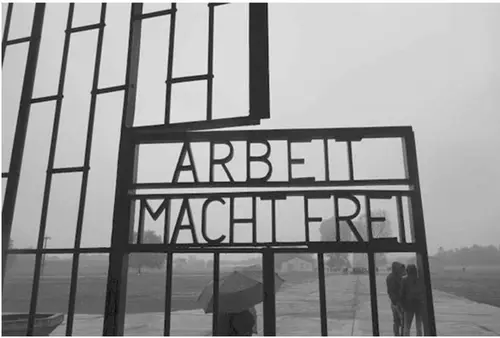
Sachsenhausen Gate
In every park I seemed to see massive anti-aircraft guns poking their noses into the sky.
At every factory gate and in every field I visualised streams of slave workers being marched in and out.
At every corner, I saw Gestapo men watching me intently. And in the baleful buildings behind them, there were surely dungeons where torture was all in a day’s work.
At every bridge I half-expected to be stopped by a military checkpoint with machine-gun trained on the car.
And behind walls and high fences I saw barracks full of black-clad young men with death’s head insignia, in training for the onslaught in the east.
This was the world of late 1941, as I imagined it. This was the deadly world into which I placed my protagonist, the Cambridge history professor Tom Wilde, an avowed enemy of the Nazis and all they stood for.
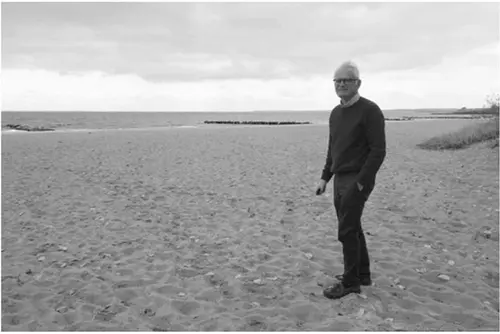
On the Baltic shore in northern Germany
The very thought of it makes me shudder. Just to live under such a regime is ghastly enough; to be a hunted foreigner in the middle of a war, unarmed and with no prospect of any help from outside is simply terrifying.
I hope that I have properly depicted the truth of that dreadful time in Hitler’s Secret. I hope, too, that I have got somewhere close to portraying the true characters of Martin Bormann, the Görings, Adolf Hitler, Geli Raubal and her mother. Historical fiction – like history itself – is always a matter of deep research, weighing up the evidence and doing one’s best to interpret it for a modern audience.