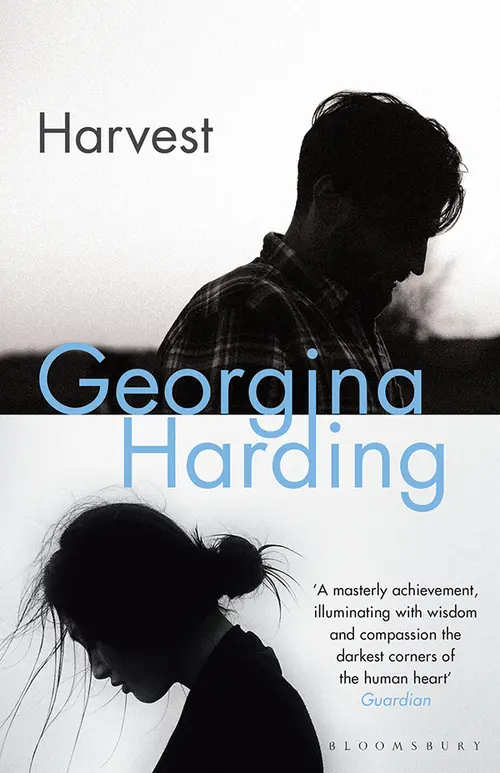
Harvest
Cover
Land of the Living
‘A masterly novel of grief and conflict … Audacious and moving… What it means to be civilised and behave with decency are questions raised throughout this fine novel’ Sunday Times
‘Land of the Living is a poised and carefully crafted novel of powerful, submerged emotions, taking an under-explored aspect of Britain’s war and ending in it something graceful and strange, mythic as well’ Allan Massie, Herald
‘Revelatory in many ways, shining a light on the darker aspects of war’ Nilanjana Roy, Financial Times
‘A landscape of arresting beauty and extreme violence …Vivid, illuminating and unbearably tense, this is a masterly meditation on trauma, on beauty, on the idea of home and on the limits of love’ Guardian
‘The quiet power of Georgina Harding’s novel lies in how she conveys with such bruising lyricism the way language fails…. Land of the Living is a moving testament to the battle that starts once the fighting has stopped’ The Times
‘Her Land of the Living is as wise and haunting as its predecessors’ Lucy Hughes Hallett, New Statesman Books of the Year
The Gun Room
‘Georgina Harding’s novel is the finely tuned work of a writer exceptionally at ease with her craft and a testament to the power and poetry of clean and disciplined prose… The Gun Room focuses minutely on one man and in doing so it tells a deep history of the many men who, having seen war, struggle to be anything but soldiers’ Sadie Jones, Guardian
‘The narrative flits between past and present in an impressionistic manner; facts and character emerge slowly. The dreamlike quality is heightened by Harding’s sharply observed prose, conjuring up with great intensity the claggy English fields, Vietnam’s pockmarked delta and Tokyo’s ordered suburbs’ Sunday Telegraph
‘A captivating, superbly written novel about the impossibility of escaping from the past’ Mail on Sunday
‘A powerful novel about war and its aftermath in memory … The narrative attends to its people with delicacy and detail. Stubborn and painful memories are evoked in a nuanced understatement, and the frequent inarticulacy of the characters only intensifies the power of the prose. The writing is allusive without ever losing lucidity, and the whole is beautifully orchestrated. It is an excellent novel’ Abdulrazak Gurnah, Financial Times Summer Reading
GEORGINA HARDING is the author of five previous novels: The Solitude of Thomas Cave, The Spy Game, a BBC Book at Bedtime and shortlisted for an Encore Award, Painter of Silence, shortlisted for the Orange Prize for Fiction 2012; and, most recently, The Gun Room and Land of the Living. Together, The Gun Room, Land of the Living and Harvest make up the critically acclaimed Harvest Cycle. In 2021, her short story ‘Night Train’ was shortlisted for the BBC National Short Story Award. Georgina lives most of the time on a farm in the Stour Valley, Essex.
By the Same Author
BY THE SAME AUTHOR
FICTION
The Solitude of Thomas Cave
The Spy Game
Painter of Silence
The Gun Room
Land of the Living
NON-FICTION
In Another Europe: A Journey to Romania Tranquebar: A Season in South India
Dedication Page
Two definitions:
Mau Mau: possibly from Kikuyu; name for militant nationalist movement against British rule in Kenya. For the British of the 1950s, a word associated with terror and atrocity.
Mā mā: Japanese; an everyday word meaning so-so, OK, comme ci comme ça.
He sent her a photo in the spring, of daffodils and trees without leaves, and the house behind the trees. She couldn’t see much of the house in the photo, only a stretch of brick wall and a tiled roof, and two lines of windows reflecting sunshine. The point of the picture was the brilliant yellow of the daffodils in the foreground that was meant to tell her that, whatever England was, it was not always grey.
He was standing in the midst of the daffodils. Grinning and holding out his arms.
Come and see me, he wrote. Just that, in soft pencil, on the back of the photograph.
Already she had imagined the place he came from, from things that he had said before. When she got the photo she imagined it differently. When she finally went there it would be different again. Nothing, when you saw it, was quite as you imagined.
And people, she would think, wasn’t it like that with people? That they were not as you imagined, or even as you remembered them? Or so it seemed to her, after that summer. That people weren’t as you thought they were – or even, you weren’t quite who you thought you were yourself.
Once she was there of course she knew how it was, so she forgot, or almost forgot, all she had thought it would be before she came, from whatever he had said and whatever she had made out from the photo. Jonathan’s house was big, and old, and many people had lived in it. She was aware of that as she had never been aware of it anywhere else. She had a sense there of others in the past who had lived in those rooms, other women before her opening the doors, touching their fingers before hers to the rail of the stairs. Almost all of the people that she had known until that time lived in quite modern houses – except for her grandparents, and their house dated only from around the end of the Meiji era, so although it looked old it could be no more than eighty or ninety years, and her grandfather had been born there, so she thought that it was never lived in by any other family. Her grandparents’ house was nothing like so old as Jonathan’s. This house was hundreds of years old. It was bigger than any house that she had known, with passages and cupboards and an attic that nobody entered, spaces in it that were never touched, not like a Japanese house where you could reach to every corner. And they wore their shoes indoors. That was only a little thing, but it was the sort of thing that it took time for a Japanese to get used to. There was old dark furniture, a smell peculiar to the place that was both dust and polish, a still dry smell of indoors that told you how the people who lived in the house spent most of their days out of doors, out of the house in the clear air outside, and there were worn rugs here and there on worn wooden floors, glowing Persian reds and blues, and in the bedroom where she slept, a thin faded one that slipped beneath the feet. The floorboards had big cracks between them. When she took off an earring and dropped it, sitting on the antique stool before the table with the mirror, she was afraid for a moment that it had fallen through one of the cracks. Beside the lion’s paw that was the foot of the stool. She wondered if there were more earrings down there in the dust, earrings and hairpins and coins, wedding rings even, that had slipped down and been lost beneath the boards maybe for one hundred or two hundred years. Or longer.
It was only a little pearl stud, one of a pair that was the first present Jonathan gave her. She thought them a bit of a cliché and not really her style, but he had been sweet and shy with her then. She wouldn’t have liked to lose it.
She had asked him to tell her about his home, many times. She wanted to know so that she could know him better, so that she had some world to fit him into, that he came from, so that he had some dimension deeper than being just an Englishman who had come to Japan, who turned up one day at the language school where she worked, and got a job teaching English because he was English and someone else had left, and that was all the qualification or identity that was needed in Tokyo in the 1970s, Englishness. She did not yet understand what a freedom it was to him to be just that, an Englishman who had come to Japan and had no need of other identity. Sometimes a language teacher, sometimes a photographer, whoever he felt like being, with his leather jacket and his hair (that had been cut too short when he first arrived) left to grow a little long, quietly outside of it all. She would come to think that it was that quality that made him a good photographer; what seemed like the freedom in him, that he could be one person or another, the way that he could hold back but at the same time seem to empathise, both close and distant at once, as if he could look from outside and yet reveal things about a person as if he had seen inside them.
She didn’t even know about the photography, to start with. Not until he had been coming and going for some weeks. She had been aware of him only in the background, a slim dark-haired Englishman who appeared as the replacement for a blonde Canadian girl, and who was nice enough, and attractive in a subtle way, and seemed to do everything OK, and came and went at the right times. They did not get talking until there was a problem with a student, a grown man who just disappeared, and she saw how he was concerned about this man. Sometimes it was like that, attraction, as if a person opens a door, and suddenly you look in and they’re interesting to you. The two of them stayed late in the office trying to contact this man and then when they left they went to a nearby tempura restaurant to eat, because it was late and they were hungry. They never did know what happened to the man – maybe something bad but maybe nothing bad at all, maybe he had just moved on without telling the school or paying his bill – but because of him they ate tempura and Jonathan got talking, telling her about his travels. Doors opened onto doors. She thought that he had spoken a lot about himself, and then they said goodbye and she got on the subway train alone, sitting there in the carriage with the evening still alive in her head, as the train ran and stopped and the passengers came in and went out at the stations, and she realised that he had talked almost all about other people’s lives and places, not his own.
What is it that’s so important for you to know? he would say. You know me, all that matters of me. But she wanted to know more. How had he come to be in Japan? Where had he come from? Why? She thought, that’s how it is when you fall in love with someone. Not only the first day, but always. You want to know what it is that makes you love them; if it is only the surface, the dark lashes about his grey eyes, his smile with that reserve in it, that becomes so warm in those moments when the reserve goes, or the feel of his skin, tanned from hot days they spent that summer at the beach in Izu, his body taut as he stretched back on the sand; or if it is more – and she told herself it must be more, mustn’t it, if she and he were anything or to amount to anything – that it must be who he is inside, where he comes from, his story. (Or maybe it wasn’t. Maybe there was no more than the moment. Or an accumulation of moments that she or the two of them had strung together, one way or another. The tempura restaurant, Izu, a garden they went to see, the mountains in autumn, so many everyday moments in the city that were different because Jonathan was there and he made her see them differently. Maybe that was what Jonathan, the story of knowing him, taught her. Maybe a man, whoever it is that you love, is no more than what he appears to you to be at some particular moment against some particular surroundings. How he then moves, in those surroundings, at your word or your touch. How he makes you see them, and yourself. Maybe he can be no more to you than that, and your love has no existence in any time but the present. Maybe love is only a passing thing. Unless you choose to make it otherwise. Unless you work on it in the memory, calling it back, making – fixing – the story. Maybe that was why Jonathan took photos, fixing all those moments to carry forward into the future.)
She said to him once, Tell me about your family.
She had known him only a short time but already he had met some of her family, her mother’s parents, in the old house in Kamakura. They had been to Kamakura sightseeing, walking round temples in the rain.
He had a mother and a brother, he said. His father died in a shooting accident when he was seven. (Not the truth, then. Only something close to the truth. He would not tell her the truth until much later, when he was about to go home to England.) They had a farm. His mother had kept the farm for them – at least, for his brother who wanted to farm, if not for him.
Oh, she said. She did not quite know what to say. She just had an ordinary Tokyo life. Nothing bad had ever happened to her and she had never even been on a farm. Didn’t your mother marry again?
I guess she didn’t meet anyone, he said. There weren’t so many men for her to meet, out there in the countryside.
So she asked him to tell her about the farm. The house where he grew up.
He said the house was a big, rambling old farmhouse. His voice was slow, a little distant, though he lay close beside her. It was the first time they had spent a night together. They had come back from Kamakura and gone to his apartment, in a tatami room bare of things and with the windows open to what seemed like those days’ unending rain, and made love there. They had the conversation the next morning when they woke. Or maybe pieces of it came at other times. At least, this was how she would remember it. Talking while their bodies were soft with the sex and the rain, as if they might melt, one into the other.
What’s ‘rambling’? she said. It was a difficult word for a Japanese to pronounce.
‘Rambling’ meant that the house had no plan, and rooms ran into rooms as it had been extended, piece by piece, over centuries, as the owners had bigger families or made money and wanted to be stylish. There was a symmetrical brick front, added in the eighteenth century, but a muddle of earlier rooms behind. And there were two staircases, one main one and an old steep back staircase for servants.
You have servants? she said. It was a puzzle to her, the England where he lived.
Oh no. Only the house had servants once.
It sounds grand.
Not so grand. All sorts of houses had servants in those days. A cook, or a maid to sweep and clean, make the fires, I suppose, carry water in jugs up those stairs, do whatever it was maids did.
She could not picture it. Do you have any photos to show me?
No.
If you’re a photographer then you should have photos to show.
Not from home. I left home to take pictures of other places. I didn’t bring pictures with me.
Oh.
He had brought only the camera. His eyes. As if that was all he wanted to be when he travelled away from home, eyes. (He used his eyes and his lens. On her. On Tokyo. On all the places where he went. Before he came to Tokyo he had used them in a war. And he had run away from the war to come to Tokyo. He did not tell her that in the tempura restaurant. She had to know him a long time before she learnt about Vietnam, so well hidden he kept what he had seen. Even when she knew that he had been there, it was some time more before she saw the pictures he had taken. Jonathan was trying to live only some moments and not others, the present moments and not the past ones. It made him complex, much more complex than he had seemed at the start, her Englishman. Elusive. Maybe that was a part of why she was in love with him. But also it kept her at a distance.)
You have all those other photos. Don’t you have any of your family? Your mother?
Why should I bring photos? I know who they are. I know what my home looks like. I don’t need photos to remember them by.
You might have brought them for me.
Why, he said, and rolled over towards her. Their faces close, eye to eye. Breath to breath. All they could see was each other. They could hear rain soft outside, the occasional movement of wind chimes. Why should I bring somewhere else with me? Isn’t here enough?
There can be one moment in the year, Claire said, turning back to the girl even as she led her out into the garden. One moment, she said, looking back, speaking clearly as one speaks to a foreigner, one moment when everything falls just right, the irises still in bloom, the roses just coming out. Some week at the start of June, so long as the weather is kind.
The girl said, Then I am lucky to come here just now.
Yes, it’s perfect now. Last year we had a wet start to June and it was all ruined by the rain. These old roses can’t bear too much rain, the wet gets in and the petals spoil and begin to rot even in the bud.
The daffodils were long gone. There were roses instead. When Kumiko stood where he had stood to take the photo, she could scarcely see the house for leaves.
The Story Continues on BooksBarbecue!
Enjoyed this preview? ❤️ Do not stop here!
Read the complete book free online → 🔗
Continue reading now on BooksBarbecue and discover every page!
Love reading? Bookmark BooksBarbecue.com for more amazing books!
Happy Reading!