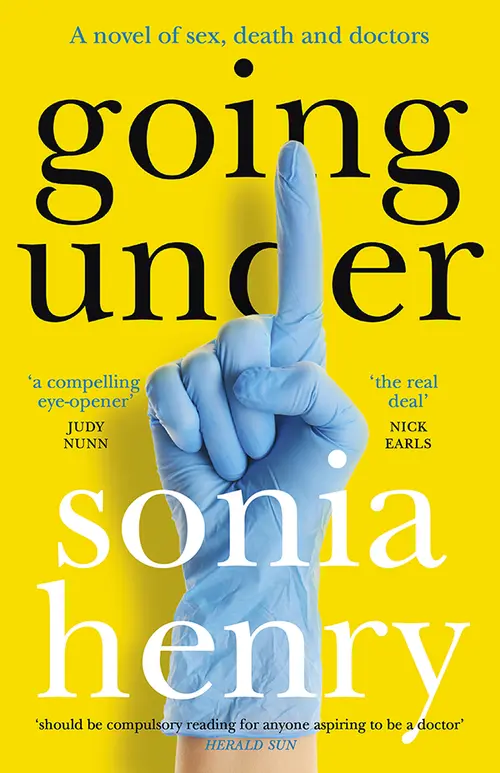
Going Under
COVER PAGE
Praise for Going Under
‘A light book with heavy themes … the issues tackled in this novel are important and urgent.’
Books + Publishing
‘An alarming—albeit funny—glimpse into life beyond those white coats … a light, pacy read.’
Who Magazine
‘Anyone with first-hand knowledge of [Henry’s] subject will find this story true to life … There’s plenty to shock, but also black humour, camaraderie, sex, drugs and moments of poignancy wrested from a dehumanising culture.’
Sydney Morning Herald/The Age
‘When focused on hospital life, Henry’s experience and expertise shine through, illuminating the difficulties her characters—and her real-life colleagues—face.’
West Australian
‘A really good read … Steps are being taken to remedy the culture in teaching hospitals but, judging from this story, there is still a long way to go.’
Blue Wolf Reviews
A book that has a vital role to play, Going Under is a conversation starter, an astute and penetrating tale that strikes at the very heart of our country’s health care system.’
Mrs B’s Book Reviews
‘An important, timely book. The story gets smarter and darker as it moves on, but that only adds to the enjoyment. Here is someone who gets it [being a junior doctor], and has written about the experience clearly.’
Sam Still Reading
ABOUT THE AUTHOR
Sonia Henry is a doctor and a writer. Prior to her career in medicine she qualified and worked as a physiotherapist. She has been published on a variety of platforms, including the physician blog KevinMD, the Sydney Morning Herald, the Australian Medical Students Association magazine, and the ANZ Journal of Surgery. She enjoys wine, skiing, her friends and black humour (not necessarily in that order). She lives in Sydney. This is Sonia’s first novel.
DEDICATION
This book is for all the doctors who have ever felt lost or alone inside a system that should care for you better
Footfalls echo in the memory
Down the passage which we did not take
Towards the door we never opened
Into the rose-garden. My words echo
Thus, in your mind.
T.S. ELIOT, ‘FOUR QUARTETS’
PROLOGUE
prologue
Thirty-three years ago, Toby Henderson was working in the emergency department of a hospital on the outskirts of the city. With a grand total of thirteen months’ experience, he was the most senior doctor on the floor.
When the patient came through the doors, he didn’t look that sick. He was holding his left arm above his head and it was wrapped in a towel, but he was walking and talking, which is always a reassuring sign. But as he came closer, Toby noticed that his skin had the pale, sweaty sheen of someone about to collapse.
He did collapse, and let go of the towel. Toby struggled to repress the urge to vomit as he saw half a stump where the patient’s hand should have been, the rest of the fingers dangling by a few bits of muscle and skin, and blood spurting out from what Toby dimly knew to be one of the main arteries supplying the bottom half of the man’s limb. Or former limb.
‘I wanted to kill myself,’ the man gasped, ‘so I tried to chop off my hand. But then I realised that I’d made a huge mistake.’
That was a bit of an understatement, Toby thought as he grabbed the towel and rewrapped it around the stump, trying desperately to reposition the remaining piece of hand to stem the flow of blood.
‘What are you going to do, Doctor?’ a nurse whispered as together they heaved the man off the floor and towards one of the resuscitation trollies.
Toby had the unusual sensation of being inside a large fishtank. Everything was happening so slowly, as if they were moving through water. He watched as the man’s face went from pale white to ivory to grey. Tombstone grey, Toby thought. Death grey.
‘Doctor!’ The nurse was yelling now, startling Toby from his dreamlike state, plunging him back into an awareness of his own helplessness.
‘Get me an anatomy textbook!’ he shouted, grabbing a needle to start an IV line before the peripheral circulation disappeared.
He stared at the gaping hole between the man’s hand and his wrist. ‘Saline—more saline!’ he instructed.
Someone thrust a book into his hand and he peered at the page, trying to identify what was being revealed by the saline wash. The ulnar artery. No, the radial artery. No …
This is easy, he chided himself. You topped anatomy at uni. You know which artery runs down which side of the hand. This is first-year medical student stuff.
For some reason, his brain was scrambled. It was the blood; it was confusing him, making him disorientated. Was the man’s thumb missing? His ring finger?
‘You’ve got the book the wrong way around!’
By this time, the patient had lost consciousness. Toby felt a small sense of relief.
The nurse flipped the book the other way.
‘Radial,’ he muttered.
He swallowed. He knew that before he woke the plastic surgeon on call he’d have to know exactly which vessels had been severed, otherwise the surgeon would start yelling at him or, worse, refuse to come to his assistance.
‘I reckon it’s the ulnar,’ the nurse said unhelpfully, looking first at the book then at the bleeding half-hand, half-stump that lay between them.
‘Get plastics on the phone,’ Toby said, ‘and get a cross match now. He needs blood.’
‘You ring the surgeon,’ the nurse snapped. ‘I’ll get the blood.’
Toby called the plastic surgeon.
‘Are you sure he’s severed his radial artery?’ The surgeon sounded irritated at being woken up and also doubtful. ‘What can you see?’
‘His thumb is hacked off,’ Toby said, ‘so it must be his radial.’ The nurses had taken over now. Hanging blood, applying pressure, preparing the defibrillator paddles.
‘We’ll handle this!’ a nurse bellowed at Toby as he ended the call. ‘There’s a guy who’s arresting in cubicle four. You need to get over there—now!’

‘Was he dying too?’ asked one of the two medical students listening to the story with wide eyes.
Thirty-three years later, Dr Toby Henderson leaned back in his chair in the emergency department where he was now regaling the doctors of the future with his cautionary tales. ‘Of course,’ he replied. ‘Everyone dies at two am when you’re the most senior doctor on. It’s Murphy’s law.’
‘What happened afterwards?’
Toby smiled. ‘The head of medical administration hauled me into her office and tore me to shreds for failing to respond quickly enough.’ He frowned at the memory. ‘God, she was a bitch,’ he added.
Kitty Holliday, a final-year medical student soon to be known as Dr Katarina Holliday, shuddered. ‘I don’t know how I would have coped with that,’ she said honestly.
She expected him to reassure her; he’d coped, after all.
‘Well, you just don’t,’ Toby said. He glanced at his watch, signalling the end of his shift and the conversation.
‘Excuse me?’ said Estelle, Kitty’s fellow medical student and friend. Surely he’d meant to say, ‘Well, you just do.’ Doctors always did seem to cope.
As Toby stood to leave he looked each girl in the eye and repeated: ‘You just don’t.’
‘What a load of crap,’ Estelle said some hours later. They were having their standard end-of-day debrief at the pub down the road from the hospital.
‘I know,’ Kitty agreed. ‘I mean, of course he coped. He’s still working in emergency, isn’t he?’
The conversation gradually meandered towards other topics. Exams, men, what they’d do when they finally finished university and had some money. The thirty-three-year-old story of the near-severed hand and the idea that doctors might not cope was quickly forgotten.
PART I BIRTH
PART I
birth
‘But I don’t want to go among mad people,’ Alice remarked.
‘Oh, you can’t help that,’ said the Cat: ‘we’re all mad here. I’m mad. You’re mad.’
‘How do you know I’m mad?’ said Alice.
‘You must be,’ said the Cat, ‘or you wouldn’t have come here.’
Lewis Carroll, Alice’s Adventures in Wonderland
ONE
one
‘You’ve done this before, haven’t you? Like, I’m not your first?’
There’s a moment in which I consider being completely honest with the agitated half-naked man lying on the bed in front of me.
Yes, darling, I will say. You’re my first.
‘You’re going to put that into me? But it’s huge!’ His eyes dart across to the long metal device I’m holding, then he winces involuntarily and shifts away from where I’m perched on the edge of his bed. I see a white flash of his exposed buttocks. They look even more frightened than he does. Or I am.
We both glance down at the 18-gauge cannula gripped in my sweaty right hand. My mental picture of a virgin high-class escort and her nervous virgin client dissolves into reality. For a moment, I almost wish I was an escort. Better that than, on my first day as a doctor, inserting an enormous metal needle into a patient’s skinny-looking vein—a feat I’ve never yet managed to accomplish, though as a medical student I had plenty of opportunity to master it. ‘We’ll learn on the actual job,’ Estelle and I used to tell each other with the confidence of people who could put off any unpleasant tasks into a distant future. Well, this is the job, and that distant future is suddenly the present.
‘Yes, I’ve done this before,’ I lie, trying to smile but knowing it’s coming out more like a demented grimace. If I told him the truth we’d probably both pass out with fear, further delaying the inevitable.
He doesn’t respond, but he grants me implied consent by extending his arm in front of me. I have a mental image of Jesus on the cross, arms outstretched, the stigmata of crucifixion mirroring the icon on the wall above the bed. I’m meant to be his angel saving him from his fate, but instead all that happens is I stare at his juicy, bulging vein, slightly purple underneath the translucent skin, and swallow.
Lord, grant me the serenity to accept the things I cannot change …
I pull the tourniquet on his upper arm tight. I see him tense slightly, but to his credit my virgin cannula client says nothing. He surrenders to his unexpected angel, and waits.
Courage to change the things I can …
I unsheath the cannula, stare at the end of the sharp needle, and take a breath. With my free hand, I tap along the vein, hoping desperately it will get bigger and more obvious. Tap tap tap. Tap tap tap tap tap. I’m merely delaying the inevitable, though. At some point I will have to attempt to pierce his skin and insert the needle.
‘Just do it, please,’ he says through gritted teeth.
I stare at the vein, now so enlarged by the tourniquet I feel certain I won’t miss. Just push it through the skin, I tell myself. One quick movement.
‘Sharp scratch!’ I bellow enthusiastically and, trying not to think too much, I plunge the needle directly into the vein (I hope).
And wisdom to know the difference …
‘ARGHHHHHH!’ screams the patient, jerking his elbow and knocking my now-shaking hand. The cannula pierces the vein all right, but thanks to the unexpected movement it travels straight through it—coming very close to his brachial artery, I realise in horror.
I try to unclip the tourniquet but by now the patient is completely hysterical. I must have nicked his artery because there’s blood squirting from his arm in a pulsating red stream.
At this point I am definitely a better potential escort than angel, I realise mournfully. Or doctor.
‘Is everything okay in here?’ Lawrence, the medical student assigned to me, appears out of nowhere. ‘Did you get the cannula in?’
I refrain from pointing out the obvious, letting the blood-soaked patient, sheet and doctor speak for themselves.
‘You have to keep your arm still,’ I scold the patient. ‘Otherwise this happens.’
‘You didn’t say anything about that!’ he snaps back at me. He looks past me to Lawrence. ‘Is he the doctor? Why isn’t a doctor doing it?’
‘She is the doctor,’ Lawrence says at the same time as I say, ‘I am the doctor.’
The patient, clearly not convinced that someone of my gender is capable of earning a medical degree, pleads with Lawrence—the final-year medical student doing his surgical term under my supervision—to put the cannula in.
Lawrence, being one of those medical students who stays back after hours and stalks the ward on weekends to learn handy skills like cannulation, agrees.
The patient, calmed by the fact that a tall strapping man is taking the reins, relaxes.
‘It’ll be a great learning opportunity for you, Lawrence,’ I say supportively, backing away from the bed. ‘Let me know if there are, ah, any problems. I’ll just be sorting out some … other jobs.’
I leave the ward as quickly as possible and text Estelle, who texts back to say that she is in the hospital cafeteria with my housemate Max. Like me, they are interns—though I prefer the term ‘junior doctor’, which at least confers some sense of what the job actually entails—struggling through their first day on the wards at a major teaching hospital in Sydney.
I arrive to find them slumped over a table at the back of the cafeteria.
‘I fucking hate this,’ Estelle says as I join them. ‘I want to go home.’ She runs a hand through her long blonde hair and sighs. I watch in awe, amazed that someone can be so beautiful even when wearing an expression of extreme disgruntlement.
Two nurses walk past and give us a glance that hovers between disgust and pity. ‘The baby interns,’ I hear one say to the other, not bothering to lower her voice. ‘That time of year when the hospital death statistics, like, triple.’
I can’t help but feel their lack of confidence is justified. My first night shift is approaching and it fills me with fear. The public hospital where I work—a big old rabbit warren with kilometres of corridors and staircases—is huge. And on night shift those hundreds of patients, along with a skeleton staff, will all be under my inexperienced care.
The hospital is called Holy Innocents Hospital, which is as macabre as it sounds. Despite the fact it’s almost directly on the ocean (these religious institutions always did know how to buy up good real estate), the glorious view of the waves crashing from the windows of the surgical ward is rather mitigated by the icons that loom down on us as we walk through the corridors. My favourite is an enormous painting which depicts the Massacre of the Innocents, which the hospital is named after. I said a better name would have been St Trinian’s (a bit of a personal joke that I had to explain to Max). Nothing inspires a sense of confidence in your medical team more than gigantic paintings of young children being massacred on the order of King Herod.
It’s like another planet compared with the scenes outside. Holy Innocents Hospital is in a relaxed beachside suburb in northern Sydney, and most patients who attend the place are either wealthy retirees or surf bums. It makes a good mix. One day you’ll see a stoner surfie, the next a retired barrister. It’s also not that far from the city so you also get a good mix of general bad behaviour, like people with weird things inserted in their rectums.
There is an affiliated private hospital, but that’s a good ten-minute walk up the road. The consultants like that because it means they can keep to themselves in the glorious land of private practice and stay in their ivory towers while their juniors sweat it out in the trenches. I can’t complain too much. Being so close to the water means that, hypothetically, after work I can rip off my doctor’s badge and clothes and, in a small section of the beach not seen by the general public, swim in my undies. Even on day one of doctoring the idea of that kind of freedom is truly fantastic.
‘You’ve got blood on your shirt, mate,’ Max says, removing me from my fantasy of the ocean by slurping on his milkshake. ‘Good first day then?’
‘I tried to put in a cannula,’ I admit. ‘It was a bloodbath. I left my medical student to sort it out.’
‘Yeah, that happened to me too,’ Estelle says gloomily, staring into her coffee. ‘In emergency I think I’ll have to put in heaps of cannulas. It’s awful.’
Max is shaking his head. ‘I’m so glad I haven’t started on a surgical or emergency term like you guys. Respiratory is so great.’
Max has had the incredibly good fortune of being rotated to a respiratory term in summer. Pneumonia being traditionally a winter illness, he only has two or three patients to look after. Sadly, neurosurgical patients don’t seem to have a climatic preference.
Interns operate on a system of terms. You have some choice in this, but there are standard experiences every junior doctor needs to have under their belt before the medical board deems us fit to progress. At a bare minimum, you need to do a surgical term, a medical term and an emergency term. I’ve requested nearly all surgical terms. It’s inevitable, really, that I will be a surgeon. My fate was sealed years ago in a delivery suite at the Royal Hospital for Women, with an innocuous comment by an unsuspecting midwife. I was nine minutes old.
‘Look how long her fingers are,’ the nurse said to my mother, touching my hands as she cradled me. ‘Maybe she’ll be a concert pianist …’
Mum, despite having just gone through labour, snapped to attention. ‘Maybe she’ll be a surgeon,’ she said firmly, examining my hands.
Thanks, Mum—no pressure or anything. I’m certainly doing my best to live up to my mother’s expectations. My first term is neurosurgery, before we’re shipped off to the middle of nowhere in the great Aussie outback for our rural medical secondment. Then, aside from a single mandatory term in the emergency department, I’ll spend the rest of the year inside the operating theatre. Or attempting to get in there, at least, as a lot of the time surgical interns are stuck trying to manage the catastrophes sitting on the surgical ward.
‘Why are you so keen to be a surgeon, Kitty?’ Estelle asks me now, as if reading my thoughts. ‘I hate the operating theatre.’
I consider this. Even as a student the surgical terms were always my favourite. The whole romance of the operating theatre appeals to me. It’s the closest you can get to treading the precarious line between controlled life and equally uncontrolled deterioration and death. And it isn’t called a theatre for no reason. It’s a stage of sorts. The surgeons are movie stars with egos to match. The patients play their role to perfection, being helpless and unconscious. Bodies are cut open, lives are saved and lost—and everyone acts as if it is just another day, which for them it is, I suppose. I’ve heard other doctors say they enjoy surgery because it’s straightforward; they can just ‘go and get things done’. It’s a world away from the complexities of human interactions with difficult patients on that other planet—the ward. But that’s not at all how I see surgery. I like the grace and precision it requires, while all the time being aware that at any moment things can go wrong, that the careful choreography of the theatre can descend into chaos. The fact that so often it doesn’t is, for me, miraculous. The operating theatre is a place where magic happens.
Estelle is staring at me. ‘Earth to Kitty …’
I snap myself back to the present. ‘You know,’ I say, in answer to her question, ‘blood and knives and power and pain and mercy and magic. It’s all in there.’
Estelle smiles. ‘There’s the Kitty Holliday I know and love: half surgeon, half writer.’
‘How’s the book going, mate?’ Max asks, upending his milkshake to drain the dregs.
I sigh. Despite the subliminal pressure to become a doctor—a surgeon, no less—I also grew up in a house full of literature with an English teacher for a mother. She instilled in me a love for language; words are my oldest and greatest friends. Mum’s texts asking if I was studying for my medical exams were always peppered with quotes from obscure poets. No wonder I have an identity crisis. It’s because I’m on the Pisces–Aries cusp, I reckon. The creative dreamer is always doing battle with the pragmatic, determined future surgeon. I write to escape, and for the last few years—ever since I started medical school—I’ve been working on a novel. But progress has been slow; there was always another anatomy lecture to attend, or exam to study for. And now that I’m finally a real doctor, my dreams of a literary life seem further away than ever.
‘Badly,’ I admit. ‘But as my mum always says: novelists starve, doctors don’t.’
The Story Continues on BooksBarbecue!
Enjoyed this preview? ❤️ Do not stop here!
Read the complete book free online → 🔗
Continue reading now on BooksBarbecue and discover every page!
Love reading? Bookmark BooksBarbecue.com for more amazing books!
Happy Reading!