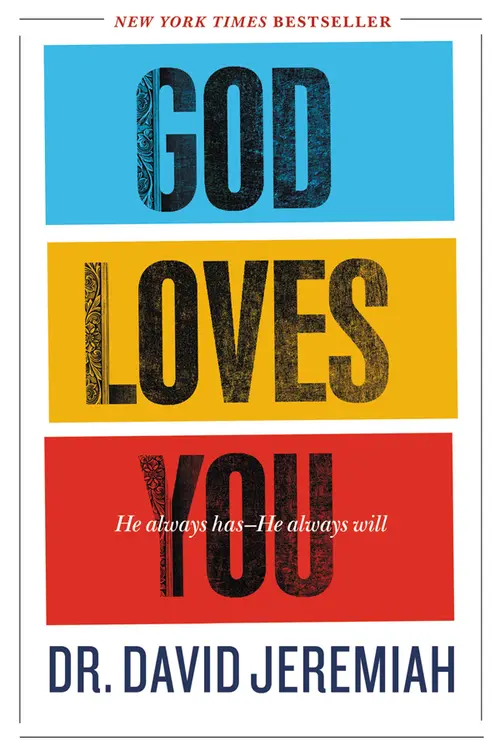
God Loves You
Cover
Welcome

Begin Reading
Table of Contents
Newsletters
Copyright Page
In accordance with the U.S. Copyright Act of 1976, the scanning, uploading, and electronic sharing of any part of this book without the permission of the publisher constitute unlawful piracy and theft of the author’s intellectual property. If you would like to use material from the book (other than for review purposes), prior written permission must be obtained by contacting the publisher at [email protected]. Thank you for your support of the author’s rights.
Dedication
For as long as I can remember Dr. Billy Graham has been telling people that God loves them. He has preached the Gospel in almost every country in the world and to more people in live audiences than anyone else in history. By conservative estimates he has proclaimed the good news of God’s love to nearly 215 million people. And he has been doing this from before he was ordained in 1939—that’s almost three-quarters of a century. Thank you, Dr. Graham, for your faithful life of ministry—and for always keeping the main thing, the main thing.
ACKNOWLEDGMENTS
On more than one occasion I have been asked about the process of writing a book. As I was writing God Loves You, I discovered a phrase that is a pretty accurate description of the process: “relentless incrementalism”—taking each phase of the process seriously and pouring oneself into it. At each stage there is nothing more important than continuing to learn and move forward—whether the day’s writing yields two pages or just two words.
I have found that the writing of a book can be divided into six steps: inspiration, incubation, investigation, creation, publication, and circulation. And at each intersection of the journey, there are people who help—each in their own and unique ways.
There is no greater source of inspiration than the Word of God and prayer. I am also inspired daily by the people I meet and the books I read. As a pastor, I write first of all to minister the Word of God to the people God has entrusted to me, the people at Shadow Mountain Community Church. But no one person inspires me more than my wife. Thank you, Donna, for the hours you have spent encouraging, listening, and sharpening my vision for this project. And thank you for loving me with the love of our great God.
Next comes a period of incubation. Once I have settled on a topic, I have found it necessary to take time to reflect on the message of the book and to truly understand the issues. This is a time of excitement, angst, and solitude. Thank you, Diane Sutherland and Barbara Boucher, for guarding my schedule and freeing me to pursue the things God has called me to do.
As ideas and thoughts begin to grow, the hard work of investigation is now in full bloom. During this time, articles flow in and books are piled high, as I try to read everything I can get my hands on. My friends Luke Thompson and Dr. Chuck Emert provided many articles, books, illustrations, and ideas during the writing of this book.
Next comes the creation of the manuscript. Here, there is much editorial work to be done. I would like to thank Tom Williams and Beau Sager for their attention to detail. And it has also been a pleasure to work with Rob Suggs and William Kruidenier one more time. Thank you for adjusting your schedules so that you could add your creative touch to this project.
As the book enters the publication stage, my literary agent Sealy Yates gets involved, coordinating the finished project with the publishing firm. This is the third book I have written for FaithWords, and I have enjoyed working once again with my editor Joey Paul.
The circulation of the book has become a very high priority for us at Turning Point. As a ministry, we believe it is our responsibility not only to produce the book but to promote it and see that it gets before as many readers as possible. My son David Michael oversees this process. Paul Joiner produces the incredible creativity that drives the process and Kevin Small is the genius behind the plan.
To all of you who have been a part of this “relentless incrementalism,” and, most important, to the God who loves us relentlessly, thank you.
Dr. David Jeremiah
San Diego, California
June 1, 2012
INTRODUCTION
What the World Needs Now

These last few years have been some of the most remarkable in my lifetime. I would guess the same has been true for you.
In 2008, I felt compelled to write a book about world events and what the Bible had to say about them. As I was completing that book, a worldwide economic crisis suddenly arrived. I knew the timing was providential.
Over the ensuing months, as current events continued to take new twists, I felt the need to respond with works that offered guidance through the most confusing, perplexing events of our generation. This meant writing about the world and the shape it was in, so I wrote about distressing events in government, distressing events in our culture, and distressing events on the world stage. I felt humbled that God would use me during such times as I worked hard to obey Paul’s admonition to “preach the word! Be ready in season and out of season. Convince, rebuke, exhort, with all longsuffering and teaching” (2 Timothy 4:2).
As I finished those projects and stepped back from the chaos, I was reminded of a truth that seemed to have been marginalized during the confusing days I have just described: God is love. I stopped and thanked God that, with everything we were living through and all the cautions and admonitions I was responsible to deliver, we still served such a wonderful, loving God; that no matter how much despair burdens humanity, our God still loves us and counts us as His precious children—and nothing can change that.
And I thought, Does everyone realize this? That God is still love? Has anyone told them lately?
I did some checking on what kinds of books were being published, particularly books about God. And I was surprised that the simple message of God’s love was being largely ignored. I knew what God wanted me to do. He wanted me to tell people, in the midst of such dark times, that God loves them; that He always has loved them; and that He always will love them. The title came together in my mind—something that doesn’t always happen up front in the writing process: God Loves You: He Always Has—He Always Will.
I knew those were the right words. People needed fresh assurance of those truths. So I went to the Word of God one more time on this topic, looking at the love story that flows through the thousands of years of history that make up our Bible. I studied the love that God has for His children, following the rich pageant of His pursuit from Old to New Testaments, and time after time I was moved to tears by the majesty, the grace, the staggering insistence of His abiding affection for every citizen on Planet Earth.
Not only did all people in general need this message; I needed it.
As I studied to produce these chapters, I was reminded of what I’ve always known, but needed to be reminded of again: love isn’t simply a Christian message—it’s the Christian message. The Gospel—the “good news”—is that regardless of our human failings, God loves us.
There are plenty of details to teach about and preach about and write about and talk about, and each is important in its own way. But this is our headline news. This is what the world desperately needs to know, and we are responsible to tell them.
However, I also need to point out that, even if this is the greatest and most exciting news about God—it’s not the only news about God. In this book, I’ve kept to the subject of God’s love because there’s plenty to say about the topic. But I want to be certain no one draws the conclusion that since God is love, this somehow rules out His other attributes, attributes that all orthodox Christians have recognized from the beginning. God’s love cannot be allowed to obscure His holiness and His justice.
A popular song from several decades ago declared, “What the World Needs Now Is Love.” And I have to agree—as long as the love the world is given is the true love of God. I don’t know of anything the world needs now, or at any other time, more than the love of God. Only the love of God can remove the barrier of sin that separates mankind from God—“For God so loved the world that He gave His only begotten Son” (John 3:16). And only the love of God gives us hope in the face of disappointment and despair—“[Nothing] shall be able to separate us from the love of God” (Romans 8:39).
God desires to give you the gift of His love. But a gift must be received. If someone gives you a Christmas gift, and you leave it under the tree and never unwrap it, you haven’t really received it.
My point is that the giving of a gift is one half of a transaction. The transaction doesn’t become real and doesn’t take effect until that gift is accepted, opened, identified, and appreciated. In the same way, it’s not enough that God simply offers His love. He expects us to receive it.
This has been one of the more personally rewarding projects I’ve worked on, and I’ve worked on a few. As I delivered each of these messages to the church I pastor, Shadow Mountain Community Church in El Cajon, California, I was aware of the power of this topic as people interacted with the teaching. It has absolutely nothing to do with my preaching abilities, and everything to do with the eagerness of the Holy Spirit to comfort, encourage, and revitalize the human spirit with the message of God’s eternal love.
As I retold the story of the prodigal son, I felt that our people were experiencing God’s love in fresh and soul-freeing ways. Most of them had heard it as many times as I’d spoken it, yet that story never loses its power; it never fails to pull us in so that we become the characters and play out our own issues.
As I preached John 3:16, the thesis statement of the Gospel message, I could feel our people glorying in each word of the verse, each phrase, each implication. Again, I can’t imagine there were too many people in that room who weren’t familiar with “For God so loved the world…” And yet, there is special power in that simple, elegant, ageless sentence.
It’s the same as singing “Amazing Grace” or hearing the “Hallelujah Chorus.” There’s no statute of limitations to prevent the hair from rising on the backs of our necks. We know we’re on holy ground with certain verses (though all are inspired), certain pieces of music (though many are wonderful)—and certain messages.
The love of God is one of those messages. It’s a basket of fishes and loaves that keeps replenishing itself. It’s a feast for the heart, mind, and soul. My prayer is that these chapters minister to you in the reading, in the same way that they have ministered to me in the preaching and the writing.
In praise of our God—
who loves you,
who always has,
who always will,
Dr. David Jeremiah
ONE
God Is Love
Because Your lovingkindness is better than life, My lips shall praise You.
—PSALM 63:3
In the days when the great evangelist Dwight L. Moody was preaching in Chicago, a poor drunkard stumbled up the steps to the front door of Moody’s church. The man pushed the door open, scanned the room, and saw no one inside. His eyes, however, were drawn to a large sign hanging above the pulpit that read “God Is Love.” It struck him—with anger. He slammed the door, and staggered down the steps, muttering, “God is not love. If God was love He would love me, and He doesn’t love a miserable man like me. It isn’t true.”
He went on his way, but those words were burning inside him, God is love. God is love. God is love… He couldn’t resist, Was it true… is it possible? After a while he turned around, retraced his steps, and entered the church again—confused and desperate. By now the people had gathered, and as Moody began to preach the man slipped into a seat in the back corner. He wept during the entire sermon as anger and confusion began to give way to joy and hope.
Afterward, Moody made his way to the door to shake hands with the people as they left. But the man didn’t leave. He remained in his seat, weeping. Moody came over, sat down beside him, and asked, “What are you crying about, my friend? What was it in the sermon that touched your heart?”
“Oh, Mr. Moody, I didn’t hear a word that you spoke tonight,” the man responded. “It’s those words up there over your pulpit, ‘God Is Love,’ that broke my heart.” Moody sat down and explained to him the depths of God’s love. The man listened and gave his heart to God, understanding for the first time that God really did love him.1
In her autobiography, Over Mountain or Plain or Sea, Trula Cronk, who served as a missionary in India for twenty-four years, tells of a little girl who visited her house one evening and stayed just a little longer than she intended. Darkness fell, and she was afraid to walk home. Trula explained that she should not be afraid, saying, “Dolan, God loves you and He will take care of you as you walk to your house.” The little girl replied very solemnly, “No, memsahib, God does not love little girls.”2
Trula Cronk was never able to forget that misguided statement, and it made her want to tell all little girls everywhere that God is love, and He does indeed love them.
There are many souls in this world who, like that little Indian girl and the drunken man in Moody’s hall, believe for one reason or another that God does not love them. Maybe they have suffered misfortunes that convinced them that God does not care. Or maybe they believe they have committed sins that caused God to turn His back on them. Or maybe they believe that God simply favors certain classes or races or genders and does not love the others.
Like Trula Cronk, I have a burden to dispel this grievous misunderstanding. I have a burden to tell you that God is love, and that He deeply, stubbornly, and eternally insists on loving every individual on the face of the planet. It doesn’t matter who you are or what you have done. As speaker and author Max Lucado has said, “You can’t fall beyond His love.”3 God’s love includes even people you may have trouble loving: That person who cut you off in traffic—God loves him. That woman who was rude at the grocery store—God loves her, too. That entire nation of people across the ocean that you deeply mistrust—God loves its every citizen. As a matter of fact, God loves you.
This is the most important fact in your life. God loves you. The eternal, self-existent Being who created and sustains everything that exists dearly loves you. The profound thought of God’s love should begin and end your every day. It should define your every goal, your every action.
And He doesn’t merely like you when you do well; He is personally and passionately committed to your good, even when you fail. God loves you. What would happen if that three-word sentence became the theme of your life—if you let it change everything about you and your world?
Let’s see if we can find out.
The Declaration of God’s Love
The Bible tells us that God is love. The apostle John writes, “He who does not love does not know God, for God is love” (1 John 4:8). He reiterates this truth a few sentences later: “God is love, and he who abides in love abides in God, and God in him” (v. 16).
It is important that we avoid two common mistakes when considering the statement “God is love.” The first is to invert the equation and insist that “love is God.” This is a serious error because there are many false loves that bear little or no resemblance to the perfect love of God. A man may “love” his mistress, but this is not God’s love. These false loves must never be equated with His love.
Secondly, we cannot make the mistake of subordinating all of God’s attributes to His love. There is more to God than love. For example, He is all-knowing, He is everywhere present, He is infinite, He is eternal, and He is just. And John can even write “God is light” (1 John 1:5). Any time we discuss His love, we must remember that God “may display one attribute or another at a given time, [but] no quality is independent of or preeminent over any of the others. Whenever God displays His wrath, He is still love. When He shows His love, He does not abandon His holiness.”4
However, we must recognize the force of the apostle’s declaration that God is love. In fact John Stott has called it “the most comprehensive and sublime of all biblical affirmations about God’s being.”5 So what does the apostle mean when he says that God “is” love? He is telling us something about the nature and essence of God. It’s not merely that God loves, it’s that God is love. Everything He does is rooted in and motivated by love. He made the world because He is love. He formed human beings because He is love. And He rules the universe in love. In other words, John is reminding us that when we think of God and the world He created, we should never forget about His love.
Before we can go much further in this discussion, we need to do some additional disentangling. Just as people tend to be confused about who God is, they’re also confused about what love is.
Bartlett’s Familiar Quotations lists approximately thirteen hundred different definitions, reflections, and opinions on the subject of love, from the sappy to the abstract to the perverse.6 Everyone talks about love, everyone experiences some form of it, and everyone is driven by the need to give and receive it. But false ideas of love are tearing the world apart—homes, hearts, even nations. Why does this happen? Christian philosopher Peter Kreeft points out that “the more important a thing is, the more counterfeits there are. There are no counterfeit paper clips, but plenty of counterfeit religions.”7
Counterfeit ideas of love are all around us. Kindness is often a counterfeit for love. Discipline causes pain, which seems unkind, so parents withhold it in the name of love. But authentic love will administer discipline to achieve a long-term good for the child. Sex is often misused as a counterfeit of love, causing unmarried couples to be led down the dead-end path of temporary pleasures instead of the harder but more rewarding path of a long-term marriage commitment.
Those who have suffered from common abuses of love are often skeptical of love from any source, including God. If your heart is broken romantically, you face the danger of concluding that all love, including God’s, is just as unstable. If you have a troubled relationship with your human father, you might conclude that your heavenly Father is just as unreliable. These mistaken ideas about God can be devastating, but they are not uncommon.
We cannot afford to make broad judgments about love or God from our limited personal experiences. Nor can we look to pop culture as any kind of authority—songs or sitcoms or soaps or cinema. We might as well get our idea of the beach from a child’s sandbox. Better to go to the ultimate authority on both God and love. The Bible must be our guide.
In the Bible the love of God is like a multifaceted diamond: Each glistening facet reveals some blindingly beautiful truth about God. For this is where the quest for love leads—to an encounter with God Himself. To begin to understand love, we must begin to understand God. And to begin to understand God, we must begin in no other place than the revelation of His love in the Bible.
The Momentous Task of Describing God’s Love
I am going to do my very best to describe God’s love. But I must warn you, when I have said everything I can possibly say about the love of God, I will barely have touched it. In many respects I share the feeling of Frederick M. Lehman, who wrote these words to the well-known gospel song “The Love of God”:
The love of God is greater far
than tongue or pen can ever tell;
It goes beyond the highest star
and reaches to the lowest hell.
Could we with ink the ocean fill,
and were the skies of parchment made,
The Story Continues on BooksBarbecue!
Enjoyed this preview? ❤️ Do not stop here!
Read the complete book free online → 🔗
Continue reading now on BooksBarbecue and discover every page!
Love reading? Bookmark BooksBarbecue.com for more amazing books!
Happy Reading!