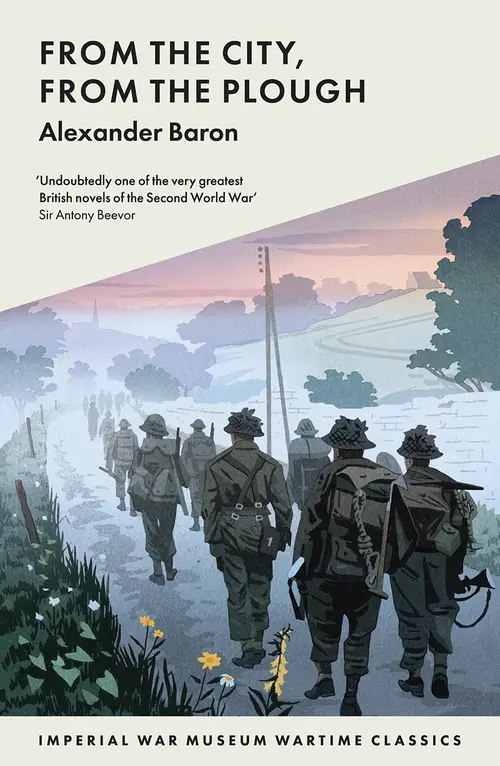
From the City, From the Plough
Cover
PRAISE FOR IMPERIAL WAR MUSEUM WARTIME CLASSICS
‘If poetry was the supreme literary form of the First World War then, as if in riposte, in the Second World War, the English novel came of age. This wonderful series is an exemplary reminder of that fact. Great novels were written about the Second World War and we should not forget them.’
WILLIAM BOYD
‘It’s wonderful to see these four books given a new lease of life because all of them are classic novels from the Second World War written by those who were there, experienced the fear, anguish, pain and excitement first-hand and whose writings really do shine an incredibly vivid light onto what it was like to live and fight through that terrible conflict.’
JAMES HOLLAND, Historian, author and TV presenter
‘The Imperial War Museum has performed a valuable public service by reissuing these four absolutely superb novels covering four very different aspects of the Second World War. I defy you to choose which is best: I keep changing my mind!’
ANDREW ROBERTS, author of Churchill: Walking with Destiny
‘The Imperial War Museum has performed a valuable public service by reissuing these four absolutely superb novels covering four very different aspects of the Second World War. I defy you to choose which is best: I keep changing my mind!’
‘Alexander Baron’s From the City, From the Plough is undoubtedly one of the very greatest British novels of the Second World War and provides the most honest and authentic account of front line life for an infantryman in North West Europe.’
ANTONY BEEVOR
‘A wonderful novel: vivid, rich, profoundly moving and beautifully written by an author who was actually there, it is a novel that takes the reader into the heart of the Normandy campaign. Quite simply, it’s one of the finest novels to have been written about the soldier’s experience of the Second World War.’
JAMES HOLLAND, Historian, author and TV presenter
FROM THE CITY, FROM THE PLOUGH
Alexander Baron

About the Author
Alexander Baron (1917–1999)
ALEXANDER BARON was born on 4 December 1917. He grew up in Hackney, East London, and became active in the 1930s in left-wing politics and the anti-fascist movement. During the Second World War he served with the Pioneer Corps in Sicily, Italy and northern France, basing his first novel, From the City, From the Plough on his experiences of the D-Day landings and the allied advance into Normandy. The novel was both a critical and popular success, establishing Baron’s reputation as a skilled, powerful and authentic writer. It was praised by V.S. Pritchett as ‘the only war book that has conveyed any sense of reality to me’. Other reviewers wrote: ‘every reader who fought in Europe will acclaim this story as the real thing’ and ‘we have waited a long time for this war’s All Quiet on the Western Front. Here it is’.
Baron went on to publish fifteen novels in all, including two more based on his wartime experiences: There’s No Home (1950), set during the Italian campaign, and The Human Kind (1953, later filmed by Carl Foreman as The Victors, 1963). Eight of Baron’s novels, including the ‘War Trilogy’, are currently in print. He also wrote numerous film and television screenplays. He died in 1999.
Introduction
War literature is often associated with the First World War, with an explosion of the genre in the late 1920s. Erich Maria Remarque’s All Quiet on the Western Front was a bestseller and later made into a Hollywood film, while generations of schoolchildren have grown up on a diet of the poetry of Wilfred Owen and the words of Siegfried Sassoon.
Yet the novels of the Second World War – or certainly those written by individuals who had first-hand experience of that war – are often forgotten. Alexander Baron’s From the City, From the Plough is one of the most impressive from both conflicts and is written from the perspective of the ordinary soldier, rather than the largely officer-penned novels of the earlier war. The book proved popular on publication and has remained admired by commentators and historians ever since. From the City, From the Plough depicts a fictional infantry battalion training in England, before going on to fight in the D-Day landings and the ensuing Normandy campaign. The novel’s great strength is its unflinching realism; coupled with Baron’s skilful economy of language and the unsentimental way such devastating events are portrayed. This lends the work a huge emotional power – less is certainly more in this case.
Alexander Baron joined the Pioneer Corps in 1940, which, according to his unpublished memoir Chapters of Accidents was ‘because I wore glasses’. To him, this was a disappointment – ‘I wanted to be an infantryman’ (his first impulse at the start of the war had in fact been to enlist in the RAF, as he had a passion for flying, but he was sent away immediately for the same reason). Baron eventually transferred to the infantry in late 1944, having served in Italy and France. It is this infantry experience on which the novel is based. ‘Throughout the book, as the story of the battalion develops, I have tried to keep in the reader’s mind the background – the lovely summer of 1944, which made the period of training and waiting seem in some ways so unreal and which in Normandy provided such a contrast to the actual fighting’. The novel’s opening chapters focus on this training of an infantry battalion, based on Baron’s own experience. The author himself was acutely aware of the importance of this time, writing in his memoir, ‘the entire British Army was transforming itself […] leaders were trained in realistic war conditions […] By the time we went into training, it seemed as if every division and area Command had its school for the new tough methods’. Such training was vital – training teaches soldiers, in this case citizen soldiers, to kill against the norms of society, and how to react appropriately on the battlefield.
The first half of From the City, From the Plough, as the battalion awaits the order to move, beautifully evokes the long periods of boredom inherent in both training and soldiering itself. Baron writes, ‘the soldier lives a drama: he never has the time to perceive it. His life, even in battle, is a succession of chores’. He demonstrates the humour and pathos of the soldier, as well as the hierarchy and structure of the battalion – and just how important this is. Baron himself held the non-commissioned officer (NCO) rank of corporal, and in his memoir he comments how ‘in a good unit the NCO ought to be able to convince most of his men that they will be safer and more effective if they become a good team’. As well as these official hierarchies, the novel also shows the unofficial hierarchies amongst the men. Very early on, the reader learns that ‘Charlie Venable [is] the man who matter[s] in this hut’; while the ‘Doggy Boys’ of Chapter Six ‘lacked nothing. In winter, when the rest of the men had four blankets each, every Doggy Boy had six. While the rest of the battalion supped on bread and cheese and cocoa in a cold, gloomy dining hall, the Doggy Boys resorted every night to the officers’ mess kitchen, where they sat at their ease with only a thin partition between them and the colonel and dined, course by course, with the unsuspecting officers’.
Baron’s writing lays bare the realities of this group of men, living in such close quarters. Jokes and banter abound – sometimes using language which may not sit entirely comfortably with the modern reader, but which nonetheless gives a veracity to the text. The writing is unflinching in its descriptions of these men – the good and the bad – and they are by no means shown as angels. Yet perhaps even more important, and touching, are the quiet scenes of almost tenderness which the reader is party to – notable is Charlie Venable’s treatment of the young Alfie Bradley, overheard by Lance-Corporal Feather: ‘Been awake all the time, Charlie. Charlie, you know what you are? You’re a gentleman.’ ‘Dear, oh dear,’ sighed Charlie, ‘I do get called some names. Good night, Corp.’
***
The D-Day landings of 6 June 1944 play a huge role in the national memory of Britain, Canada and the United States. This was the largest amphibious assault to date, indeed a cross-channel landing was envisaged as early as April 1942, but, due to the complex nature of such operations, the long planning and training was essential. There were five main amphibious landings spanning a distance of almost 55 miles. To the west of Bayeaux were the three beaches of Gold, Juno and Sword where the British and Canadians landed, with the Americans to the east landing at Omaha and Utah. Allied casualties for the D-Day landings were c. 10,000, with 4,500 Allied soldiers confirmed dead. Despite such devastating losses, the landings were successful, and 156,000 allied troops were ashore by the end of the day. Alexander Baron was one of these men. His Pioneer company landed in one of the earliest waves, immediately after the first assault, and Baron witnessed (though didn’t participate in) the fiercest fighting first-hand. Later, he wrote, ‘in two of my novels there are accounts of the landing in Normandy on D-Day, June 6, 1944. These are based on my memories but I read them today as if they were somebody else’s story’.
Contrary to what one might expect, From the City, From the Plough depicts the soldiers as surprisingly keen for the action to start. Some are motivated by boredom, while others have more personal reasons. Charlie Venable, having seen the bombing of London and what it has put his beloved mother through, exclaims ‘Wouldn’a missed this for a million quid’. After such a long period of training and waiting, the scene just before the men land is short (perhaps surprisingly so) and poignant; ‘some of the men were talking, some smoking, some vomiting quietly into brown bags of greaseproof paper’. Then the talking stops as they enter the shallower water, before ‘wading with weapons held above their heads towards the wet sand ahead’.
Feature films of D-Day such as The Longest Day (1962) and Saving Private Ryan (1998) remain popular. Baron himself was critical of war films as he thought they lacked realism. What this novel brings, that perhaps films cannot quite capture, is this realism of the war experience. After all, Baron was there.
A dirty tape wriggled across the beach and the riflemen came stumbling along it, shedding water from their sodden trousers. Mister Paterson flopped beneath a wrecked landing craft that lay broadside on and waited for his platoon to come up. One by one they dropped to the sand behind him. There were German shells falling a little inland, where the first assault troops had already passed, and somewhere among the yellowed, battered houses scattered along the waterfront and the smashed rubble of wrecked pillboxes a machine gun was rapping remotely.
‘All right, my lads,’ said Paterson breathlessly. He ducked under the bows of the beached craft and ran heavily along the tape. There was a tangle of wire ahead, with German mine warnings poking up everywhere and a few British dead lying with their faces in the sand. They followed the tape along a path torn through the wire and came on to a narrow track running laterally. In front of them now were gentle, dreary dunes rising from pools and runnels of water, with grass growing scantily on their upper flanks. On each side of them sappers were rooting up mines as hastily as potatoes, and a little away to the right a beach dressing station had just been established, with a row of loaded stretchers waiting on one side and a row of corpses laid out on the other, each a still mound under a grey blanket, with big boots protruding at the end. Some pioneers were trying to dig in along the far side of the road, in the wet sand.
***
The author’s memoir tells us just how much of From the City, From the Plough is taken from Baron’s direct experience. Of the men of his own unit, he says ‘each was bound in a web of friendships which he did not want to betray […] Besides, training had conditioned them to war as a natural activity and imbued them with the idea that they knew how to get through it’. Nowhere is this clearer than in in some of the final, deeply moving scenes of the novel, in which Colonel Pothecary leads his men to capture an enemy held bridge:
The colonel strode calmly along the road as if he were walking on to a parade ground, looking back sometimes to call encouragement to his men, ignoring the bullets that squealed about him and kicked up little devils of earth at his feet.
He was crossing the bridge now, with men streaming after him. It was as if he had, by his own physical strength, lifted the battalion up out of the ground and borne them with him.
Baron’s portrayal of battle is particularly visceral and realistic. Again and again, the importance of comradeship shines through:
Battle has its own strange chemistry. The courage and endurance of a group of men is greater than the sum total of the courage and endurance of the individuals in the group; for when most of the group have reached the limits of human endeavour, there is always one among them who can surpass those limits of human endeavour, who will hold the others together and drive them on. It is not the romantic picture of war; but is the truth of war.
***
The final, attritional scenes of From the City, From the Plough are based on the attack on Mont Pincon by the 5th Battalion, Wiltshire Regiment, who were almost wiped out in the action. Baron had heard about the battle and after the war, he wrote:
It was the climax I needed for my novel. The 5th Wilts became the 5th Wessex. The story leading up to this climax would be a mosaic of my own experiences. Evidently these were typical, for a number of readers who had served with the 5th Wilts wrote to me recalling the events in the novel as real, and characters whom they claimed to recognise. So did many others who had served in other battalions.
From the City, From the Plough was originally called The Fifth Battalion after the fictional 5th Battalion, the Wessex Regiment, then The Englishmen, followed by A Summer’s Harvest. The final title was suggested by the publisher Jonathan Cape’s wife and evokes the men’s origins with their urban and rural backgrounds. Baron started writing the book during the second half of 1946 and finished it the following year. He had a job with a theatre company and therefore worked on the novel every night for three hours after midnight. He put the manuscript away in a drawer, until his friends persuaded him to send it to a publisher. The first print run of 3,000 copies sold out before publication, with From the City, From the Plough achieving both popular success and critical acclaim. Over its lifetime, the book sold in excess of one million copies. With this new edition of such an authentic and moving novel, we can only hope to reach a readership of many, many more.
Alan Jeffreys
2019
PROLOGUE
AT THE END of the first week of August 1944, the Allied armies in Normandy were at last on the move after two months of bloody fighting.
On the right the American armour had broken through and was rumbling southwards across the base of the Breton peninsula towards the Loire. In the centre British troops, massed secretly and striking suddenly, were battering down from Caumont into the switchback of the Bocage, the thickly-wooded hill country. Towards the left of the line, the British divisions which had been fighting for weeks over the same strip of ground, from Tilly down to the Odon, and from the Odon down to the Orne, pushed forward at last, an army of tired, muddy, battle-drunk men leaving behind them Hottot and Hill 112 and a score of other shell-pitted hills and smashed villages. Every night as these men moved forward there was yet another hill or yet another village to take, yet another stream to cross under fire; every night they summoned fresh reserves of strength and will from their exhausted bodies and went forward against the mortars and the Spandaus and the eighty-eights. This time nothing was going to stop them.
Then they came to the last obstacle between their tanks and the flat lands of the French interior, the gateway to the Big Push, the last and highest ridge that forms the southern border of Normandy. For months they had pointed to this ridge on their maps, talked about it, read with foreboding the Intelligence reports of the fortifications that the enemy had installed here. Now it lay before them, twelve hundred feet above sea level; and the battalions of British infantry moved forward once more to the attack.
The Fifth Battalion of the Wessex Regiment had been ordered to deploy along its start line before daylight. Throughout the night the files of riflemen, plodding up and down hill along the narrow, tall-hedged lanes, had looked over their shoulders at the barrage flaring on the horizon, fretting the edges of the night with fire, and had felt its thudding rumble against their eardrums.
Now, towards dawn, the barrage was slackening. The men moved over the last hilltop that faced their objective and walked quietly downhill, their rifles at the trail or slung, hidden from view by the milky, white mist that clung to the hillsides.
Their start line lay along the valley between the two hills, and as they filed down to it, the mist that shrouded their objective began to slowly recede, heaving and billowing, like a glacier in a dream. As the mist crept down towards the valley it revealed the meadows and woods that clothed the hillside, still sombre in the dawn.
The infantrymen filed silently into their positions along the valley, sinking down out of sight against the banks of sunken lanes. The icy dew soaked through their trousers; the chill of the dawn lay like cold steel against their cheeks.
The first light stealing over the ridge, touched the black fringe of treetops up on the hillside, and a multitude of birds awoke to shrill song.
There was no other sound in the morning.
CHAPTER ONE
Reinforcements
THE RAILWAY CARRIAGE was full of men and smoke and the smell of wet uniforms drying. Above each row of seats the space between luggage-rack and ceiling was jammed with packs and equipment. There were more packs piled in the corridor outside, and men squatting on them all along the corridor.
There was the noise of the train and of many men talking and laughing; and in the carriage the noise, wavering and mournful, of a mouthorgan.
‘Put that bloody thing away,’ said the sergeant who was sitting pressed tight against the window by the crush of bodies. He was watching the rain stream down the windowpane and he did not turn his head as he spoke.
There was a growl of assent from some of the other men, and the private who was playing tapped his mouthorgan on his knee and dropped it in his pocket.
‘What’s up, Sergeant?’ he asked. ‘You look pigsick.’
The sergeant turned from the window. ‘I’m pigsick all right,’ he said bitterly. ‘Six years in a regiment, you go abroad with it, you fight with it, you bury your mates, you get stripes in it, you play football for it, you win a bloody boxing championship for it, and what then? One fine morning you wake up, and you find a detail on the board…’ he fumbled in his pocket, pulled out a sheet of paper and, unfolding it, began to read: ‘“Movement order: at oh-eight-thirty hours January fifteenth, nineteen-forty-four, the undermentioned officers and other ranks will parade in Field Service Marching Order, with fifty rounds of ammunition each and the unexpired portion of the day’s rations, for transfer to the Fifth Battalion, Wessex Regiment”.’
He crumpled the paper and smeared it against the windowpane; he swore, repeating one word furiously, again and again.
The men sat jammed shoulder to shoulder, with their hands between their knees, and watched him, silently. They were all cast in the same mould; all hard, all brown-skinned, all grave and composed of countenance, all with desert ribbons on the left breasts of their tunics.
One of the privates, swaying with the motion of the train, steadied himself for a moment to light a cigarette. He spat out a mouthful of smoke. ‘Well, Ah don’t mind tellin’ yer, Sarge,’ he said, ‘’tharrah don’t give a boogger what battalion Ah’m in. Ah never asked ter coom in t’ first place. If Ah were a Regular it might be different, but Ah’m not, and Green ’Owards don’t mean no more t’me than any other regiment.’
‘Not even when you’ve come all the way across the desert with them?’ the sergeant asked him. ‘And through Sicily?’
‘Lewk, Sarge,’ answered the private. ‘Ah’ve got one ambition – ter see our lass an’ the kid again after t’war, an’ what ’appens ter me between now an’ then don’t mean a thing.’
The Story Continues on BooksBarbecue!
Enjoyed this preview? ❤️ Do not stop here!
Read the complete book free online → 🔗
Continue reading now on BooksBarbecue and discover every page!
Love reading? Bookmark BooksBarbecue.com for more amazing books!
Happy Reading!