Frances Johnson
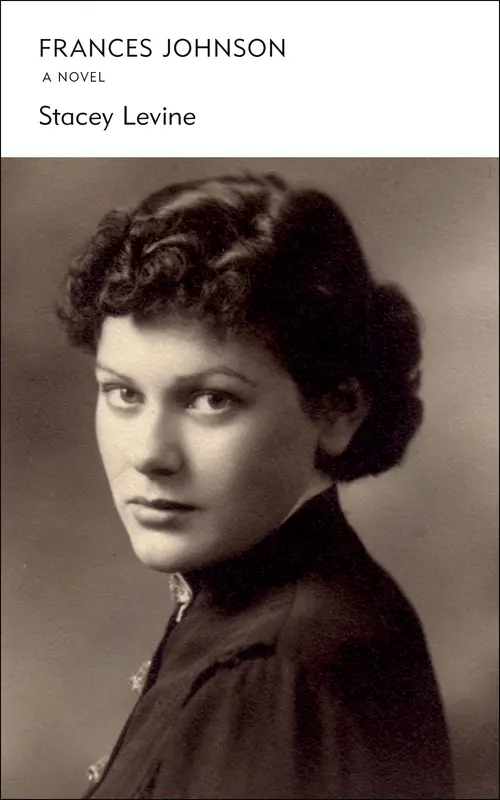
Frances Johnson
Stacey Levine
© 2005, 2010 Stacey Levine
All rights reserved. No part of this book may be reproduced, stored in or introduced into a retrieval system, or transmitted in any form or by any means (digital, electronic, mechanical, photocopying, recording, or otherwise), without the prior written permission of the publisher, except by a reviewer, who may quote brief passages in a review.
First published in 2005 by Clear Cut Press.
The author would especially like to thank Corrina Wycoff, Glenn MacGilvra, Matthew Stadler, Emily White, Rich Jensen, Deborah Woodard, Paul Constant, the Levines, and Steve Connell at Verse Chorus Press.
Copyedited by Allison Dubinsky
Cover image enhancement by Scott Nasburg
A portion of this book appeared in the Santa Monica Review.
This book was written with assistance from the 4Culture Commission of King County, Washington.
ISBN 978-1-891241-80-2
Library of Congress Control Number: 2010925517
for CEMW
Frances Johnson sat on her front porch, listening to the radio in the dark. She wore a blue dress.
Frances Johnson sat on her front porch, listening to the radio in the dark. She wore a blue dress.
Beyond the wooden porch, night was thick. Frances stood, walking into the living-room, listening. A train lumbered across a nearby trestle, halting as it reached the center of the weak bridge. Below the trestle was a curving road, leading in one direction toward the town, and in the opposite direction toward the sea.
The train hissed. It would follow a tricky, meandering route that would probably lead to another state.
Frances was an expressive woman in many ways.
There were so many people and things to think about, such huge compendiums of circumstances.
Sometimes Frances was afraid for no real reason, it seemed. Oftentimes, waking in the middle of the night, she was uncertain who she was. Frances did not like that. Stumbling to the bathroom, she feared that who or whatever she was would be inappropriate or cause a calamity of some kind—and that was the most frightening thing of all. Standing on a little foot-rug, she would calm herself by rubbing her limbs briskly, hoping the heat would fill out her body and make it more dimensional.
“We can’t know the future,” she said dully to someone on the telephone, then hung up the heavy receiver.
Outside, the porch swing creaked.
“I will not attend the dance,” she spoke aloud to herself.
Frances had a suitor, Ray Garn. Ray was fine, though sometimes his enthusiasms were hard to understand. The two had been together for quite some time, making vague, halfhearted plans for the future.
Ray was mild-tempered, and things generally went well. Once, though, they traveled a few miles south to search for the sea—just that once—and Ray hid behind a wall for hours, causing Frances to feel a kind of fury.
It was a long, tall wall that rose up to hide the ocean shore from the road. Ray squatted next to it, smoking, smiling, and looking up at Frances when she found him, as if it were all a game, as if he had made her worry on purpose by hiding. She got so angry that she smacked him, hard, on the jaw.
He laughed. “Frances, it was just a joke! You know—hide-and-seek? Well, now you can hide, if you like.”
Frances did not want to. She preferred to go into the cabin and play a quiet game by herself with a bowl of salty water, a religious-type game in which she imagined punishing and bathing herself and others. Sitting alone, in any case, brought such relief that Frances locked Ray out for most of the trip, feeling deliciously private while he stood by the sea with its freezing waves.
After some time, she saw through the cabin window that Ray had resorted to taking a walk. The wall along the beach prevented him from looking at the sea—assuming he liked the sea—and clamorous, gusty winds ripped at his sleeves and hair.
Frances left the cabin to join him at the far end of the wall. They said nothing at first, but soon were sharing some hard crackers and butter, sitting in the wild grass near the fence, chatting amicably and joking, shouting into the wind.
That evening she allowed Ray into the cabin bedroom, which smelled cheerlessly of mothballs and skin. He lay next to her on the bed for a while, then, levering upon bent arms, rolled atop her. She heard a tiny click: Ray’s eyes shifting. After moments, he rolled away.
“It doesn’t make sense to me,” she exhaled toward the window, which framed a dark, gelatinous sky. “Two adults, in the middle of the night . . . one lying on top of the other . . . ?” Frances felt out of sorts.
“Yes, it’s awfully strange,” Ray agreed.
They fell asleep.
After the vacation, the pair got along fine. There was no reason to argue, they said, and each day vanished quickly, as if eager to flee the world. While not exactly gloomy, Frances regarded Ray with some sense of puzzlement.
Frances could not perceive Ray easily. She noticed, when physically close to him, that his head loomed so near and large she lost the sense of what he really looked like or who he was altogether; she would wonder why she was positioned next to him at all. She did not always enjoy their time together. But Frances stuck with Ray, on some days forgetting about him entirely. Her parents did not care for him, which was disappointing, but on the other hand, he was dependable, and good at bicycle tire repair.
It seemed she loved Ray.
Whom did Frances Johnson love?
Tonight, she looked at the door.
Ray was there. He looked down over his broad, tanned face.
“If things keep going the way they are, well, I think someday soon there might be a revolt!”
He was referring to their town, Munson. Years before, it had been called Hutchinson-Munson, after the pair of entrepreneur brothers-in-law who had founded the city upon a dream of a prosperous smelter. That business failed for countless reasons, the unpredictable Florida weather being only one of these. Still, the brothers-in-law strove to become famous, because they feared sudden death and the nothingness that might come after. So they became joint mayor of the town, writing a pamphlet about the local volcano and its stolid beauty before fleeing the region. Now, the town was simply known as Munson.
Munson was isolated, though at its border stood a sister town, Little-Munson, which was poor and weak. The people there always seemed to struggle for the simplest things.
Ray often expressed irritation with Munson, because, as he put it, the town preferred to forget—perhaps hide from—the outer world. Others, including Frances, were inclined to feel the same. Certainly there were worse places to live, towns that lacked even a council. But Munson had a strange air; besides, it had too many rules.
“Oh, Ray, who’s going to revolt? There’s no one to revolt,” she said tiredly, glancing at his dark sweater-vest. Frances did not care about Ray’s childhood or his life before they were together. She did not bother to inquire about his former girlfriends, though sometimes she saw Ray gazing at a wallet photograph of a girl sitting on the lap of a tough-looking older man: the girl’s father, who had been prominent in a long-ago war. The girl was Fluff Davis, with whom Ray had spent a year or so. He doted on the old picture, even kissed it once, Frances observed, perhaps in admiration for the soldier father.
He opened the door. “Hmm,” Ray began. “There’ve been plenty of revolts through history—peasants revolted during the reformation in Germany. Ha! They thought Martin Luther was on their side.”
“Please, can’t you take that discussion to your friends or brother?” Frances grew tired of Ray’s overly detailed references to battle. “Give me some advice. I need something for this problem of mine.” She shut her eyes and lay back on the beige sofa.
“What is it, Frances?” He sat nearby.
“Oh, the not-sleeping, I guess.”
“Yes. It’s awful for you! What can we do?”
“All those pots and pots of coffee to wake me up! I feel sick, thinking of it. And the sleeping pills to get me down at night—I don’t necessarily like taking them, you know.”
“I know. Well, can’t we—”
“My heart could even burst! Could it?”
“Oh, no, Frances, no—that doesn’t happen.”
“Look at my eyes—these eyes are tired. I can barely get up in the morning.”
“Frances, let Palmer help. I’ll call him and make an appointment for you.”
Frances scowled. She said, “Can’t you just stay here, Ray? Let me lie in bed, with you on one side, and the telephone on the other, just for the night! Please.”
Ray laughed. “Ho, I suppose that might be all right.”
“Thanks! And Ray, don’t talk about Napoleon, all right?”
“All right.” Ray undressed. He was plump, and that pleased Frances. She looked away, thinking of other things: the insomnia, the strange non sequiturs she overheard neighbors speaking through the phone lines, and her dog. Immediately, she fell into a hapless, jagged doze, only to wake moments later, frightened back from the horizon of unconsciousness, for she had seen a turtle there.
Munson was hard on folks, she guessed, tossing in the bed, punching back the stiff coverlet. There was a sense of shame and difficulty in the town, though it was hard to say why. It wasn’t easy to find another point of view, either, since Munson didn’t much care for newcomers, and they stayed away. Companies and industries—ones that made gadgets—rarely settled in Munson or the adjoining Little-Munson, though they headed in sure droves for other Florida towns.
Frances recalled passing along Munson’s main street that day and seeing the remains of a tattered, blowing poster on a pole asking as to the whereabouts of Josh White. He had been, she recalled, an argumentative boy of about thirteen. A year ago, Josh White had gone looking for his dog, who had run into Munson’s oil-black nighttime streets. It seemed that the dog was lost, but it had in fact been detained by one of the town’s sheriffs, and later the dog died, though no one could say why, only that there had been some type of a mix-up. Josh White got mad then. He fought loudly with his mother all that week in their cabin on the forest hill. The boy told his mother he would never forget the dog, though she pleaded with him to do so. But over the next month Josh White grew worse, not better, walking alone through the town late at night, hurling dirt chunks at Hodgkins’ Movie House and other local businesses. Finally, his state of mind seemed to turn entirely: when spoken to, the boy would only open a wet, rosy mouth to scream, so in a short while, his mother took him to Ohio. After weeks the boy returned, again milling around town resentfully, and shortly after that, no one ever saw Josh White again. Secretly, Frances was a bit envious of the teenager, if only because she wanted to leave Munson, too.
Lately, Frances had been thinking of various plans to leave, but they seemed to her shaky, laughable plans.
Ray pulled back the bedclothes, and Frances’ nose whistled with air. The atmosphere in the bedroom was one of contained quiet, as if the little room itself were keenly balanced on a pole. And at the other end of the pole, creating the balance—what was that? Maybe all the pills and pots of coffee, Frances considered wryly, turning over, eyes open.
She looked up. Everything seemed all right.
“Asleep?” Ray said.
She made no answer, and soon heard a muted clicking: the sound of Ray picking at his front tooth. She dozed.
In the late morning, Frances and Ray dressed together and unrolled their town paper. The sun was bright and high. Frances had awoken rather easily, with less exhaustion than usual, and in a burst of energy, she giggled at something Ray said.
Then, there came the sound of a blast. The house vibrated. Another booming noise seemed to burst hollowly into the first, causing both Frances and Ray to yell reflexively as the bedroom window shook. In the backyard, a small wooden fence toppled over.
She raised her eyes to the ceiling. Yes, it had happened again! A volcano was situated in the sea outside Munson, though Frances so often forgot. Sometimes it rumbled like this. The vibration manipulated the ground such that it trembled; this was at times followed by fierce winds, fires, an d even steam puffs dotting the sky. Townsfolk occasionally referred to the volcano as “Sharla,” but just as often, they didn’t think about it at all.
The house rattled with a moaning wind, and, in spite of herself, Frances was frightened, her heart beating hard enough that she felt her pulse in her eyes. She looked around the room: but where to go? “This is awful!” she cried, diving onto the bed next to Ray.
“It’ll probably be fine!” he shouted reassuringly.
They lay still. The sounds of rushing wind and debris continued; briefly, the sky dimmed. A few fist-sized chunks of rough rock tumbled across the roof onto Frances’ lawn. It’s as if another world has come crashing into this one, she thought.
Ray clutched a tissue. “That damned volcano!”
“Let’s just wait,” she said.
They did.
Soon, light eased into the room again. The pair relaxed, then fell asleep; after waking, Frances felt better for the extra rest.
“Ray,” she muttered dreamily then, looking to his glossy eyes. “I don’t think I’ve ever asked you directly. How old are you?”
“Thirty-six. And you?”
“Thirty-eight. We’re the same age, really.”
They smiled together.
When Ray stood, he remarked, “Why, you look as helpless as a little girl, all wrapped in that blanket!” Then he moved to the bathroom.
Frances reached for the whisk broom and dustpan in her bedside table and began to sweep, eyeing the black telephone, a hot, serpentine anger climbing at the back of her throat because of Ray’s remark. At times he was maddeningly superior, she felt, in a way that made her want to shout.
She looked through the living-room window, facing the yellowish light, glimpsing outside the refuse blown by the eruption and what appeared to be a large dog lying in the street. She turned away, shivering. All the nice things about life, she mused, are they nice because we compare them to all the ugly, awful things, like threatening winds, crashing stones, and the sun—the sun? And fury, she finished to herself. She spoke aloud, “Is fury such a terrible thing?”
“What, Frances?” Ray answered, sitting, jiggling his sock right-side out.
She leaned at the window. The anger had abated, and Frances looked toward town, past quiet Ann Street with its homes blanched in stillness. Without thinking, she turned to the bed and kissed Ray’s cheek, then kissed it again and again, an activity that made so little sense to her that she could not stop, for each kiss was both the beginning of a chance to understand the thing and a way to avoid it.
Ray waited, looking at his shoes. “What will you do today?” she asked finally.
“Don’t know, Frances. Maybe I’ll call Kenny. I’ll work. I think I’ll take a little walk! And I’ll make an appointment with Palmer, too—for myself. I think, Frances, that you might do the same.”
Frances scowled.
Ray left.
She reached for the telephone, not sure whom to call.
She began dialing her mother’s number, and heard a mechanical screeching in the phone, then the sound of folks laughing. Frances sighed and hung up. The phones often malfunctioned in Munson. Lifting, then dropping her arms with sudden fatigue, she recalled, as if from long ago, the deep pleasure of sleep.
As Ray had suggested, Munson was often frustrating. Yet the world beyond it, and beyond Little-Munson, was too complicated to imagine. Considering this idea as a schoolgirl, Frances often had stared at classroom maps.
Her vivacious teacher, Mrs. Cover, had frequently whirled past the students’ desks, laughing, hips swinging, dress swishing and suspended from the tension of its crooked seams. Once, reaching out to adjust Frances’ undershirt, the teacher chimed gently, “The earth spins round and round, making us nearly sick! The earth knows how to trick us, too, so watch out.” Most townsfolk felt similarly, Frances realized, and turned away from the larger goings-on of the world. It—the world—was not for her, nor for anyone in Munson, Frances knew; yet at once, the outer world seemed glamorous and delicious, at least in magazines.
Now Frances sat on a straight chair. In a matter of hours it would be dark, and she expected company for supper. In her cool, half-lit living-room, she waited, ruminating.
When Frances was born, she had had a disorder. Her face had hung strangely, and still did slightly to this day. She had a low eye. Her mouth sagged to one side. The disorder was named after a Belgian doctor, and with it came problems. But fortunately, when Frances was nineteen years old, a young man named Martin French appeared. Martin was a stranger to the town, and so everyone avoided him suspiciously, though he had such a light, smooth air that folks soon forgot themselves and wound up flocking to Martin French after all. As a professional businessman, he inspired respect throughout town, finally; and the newcomer’s eyes squinted in such a way when he smiled that he created a sensation—especially with Frances’ mother, who told him about electrolysis for the first time in his life.
Martin and Frances met outside the post-office toilet, and there discovered a shy sense of camaraderie. They saw a potential together, and began to keep company. But Frances worried how Martin perceived her. Finally, during a dinner date at the Cove restaurant, she asked, “Martin, what about my face?”
“That’s how you are. It doesn’t affect me,” Martin said, chewing his dinner. Frances smiled to herself, sensing the remark was portentous. Something would come of her friendship with Martin French, she was sure.
When they were married it seemed almost a lark, or, for Frances, a chance to see if everything wouldn’t turn out right in life after all. And for a month or two, things were effortless, indeed—just like Martin’s smile—requiring so little effort that, in fact, life became featureless to the point that now the period was rather unrememberable. Yet it was not hard to recall the awful thing that happened. In their small apartment at the edge of the beach wall, Frances began to notice that Martin ate large numbers of figs, then later grew gruff and explosive; this became a pattern. And the heart-lifting feeling—the feeling of being saved, which Frances experienced a few months before —disappeared; instead, she sensed a sleek escarpment right next to her. One night, Martin asked her to play a distasteful game, and she refused. On yet another night, he lay pillows on the floor for her to walk upon, as a signal that she should only know softness in life. Frances wondered about the marriage. Sometimes when Martin toweled off near the bathtub, knees bent, arms stretching downward, he seemed feminine, with his diminutive hands and feet. Yet he was unreachably manly as well, protected by the tough barriers of his skin and nose.
Frances had begun to discover the quiet adventure in knowing another human being, and with this came the desire to flee.
Try as she might, she could not know what the marriage meant. She decided to ask her mother about it over a game of cards.
But the mother dragged out the discussion for hours with strange circumlocutions about birds interspersed with sighs of unhappiness: she was not attentive to Frances’ concerns. That night, Martin told Frances that he would rather have a heart attack than live with her. She responded, “Could that be because of my face? Or yours?” For it seemed that Martin’s face had changed too, and was now beginning to hang lower, like Frances’, if only slightly.
“It is not because of anyone’s damned face,” he yelled.
“I don’t know what’s happening,” she said, and then Martin French tied his robe and left the apartment, never coming back, though at times he called from phone booths.
During this period, Frances sat on the sofa of her old apartment with the westward-facing picture window that took the full brunt of the sun each day and cried to herself. She tried to write down her feelings with a pen, but the pen wobbled too much.
Her mother urged Frances to apply for a job at a small local laboratory to take her mind off the situation. They stood on Frances’ porch one night. “Your life is strange,” the mother said with distaste, leaning against a beam, cuddling her desiccated fur stole, not minding the heat. “I wonder if you’ll always be alone now?”
Frances did not know. In the meantime, keeping busy was a good idea. There were so few jobs in Munson that Frances took the laboratory position, performing the dissection of frozen caterpillars and slicing their tissue with a hand-cranked, circular steel blade.
It was then that her face slowly changed. As she worked long hours in the school lab, the face’s sagginess actually began to lift. At moments, she even looked lovely, as an orderly once remarked in the empty cafeteria. At first, the face-shift was imperceptible, though undeniable, and then it became an outstanding fact, though no one mentioned it to Frances once the change was complete.
She considered that the happy, inverted sensation she felt upon first meeting Martin French might merely have been a counterweight to her fear of dying. The ongoing, sickish feelings caused by their onetime alliance compelled her, and she loathed letting this go.
“Why analyze it, Frances?” her sister, Valencia, had said one night, leaning over a steel bowl filled with skinned pears. “Freeze that bastard out of your life, then go down to Ming’s for a drink.”
Ming was the local tavern proprietor who lived alone at the far edge of Little-Munson, where he tended a family of doves.
“I can’t exactly forget Martin. I wonder about him,” Frances said.
The Story Continues on BooksBarbecue!
Enjoyed this preview? ❤️ Do not stop here!
Read the complete book free online → 🔗
Continue reading now on BooksBarbecue and discover every page!
Love reading? Bookmark BooksBarbecue.com for more amazing books!
Happy Reading!