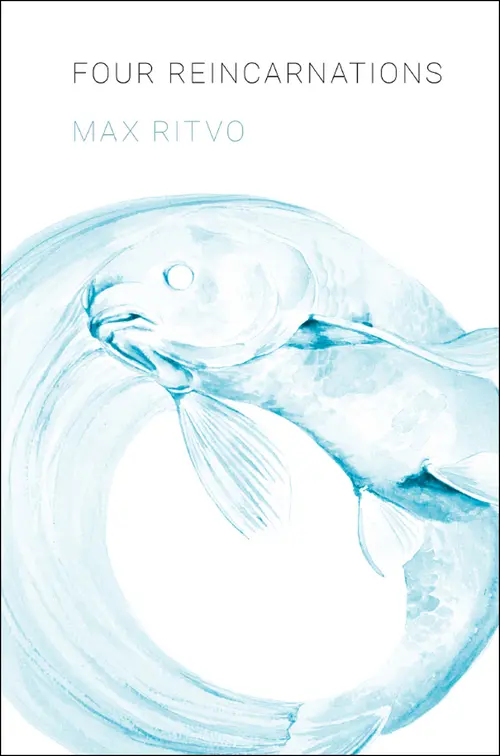
Four Reincarnations
Cover
PRAISE FOR MAX RITVO’S FOUR REINCARNATIONS
“In Four Reincarnations, Max Ritvo brings us along where poetry needs to go; away from the small confessional and into a big world of death, love, and metaphysics. While allowing for the possibility of a confessional mode in the details, Ritvo’s poems take stock of the nineteenth-century sublime, adding the contemporary death of God, and going forward with bravery, irony, and the most compassionate sense of humor. The relationship he hews between language and the body is both original and hard won. His lyric complicity is between self, dedicatee, reader, and world. Ritvo’s ear for language is beautiful, as is his spirit. His poems defy solipsism and enter a cosmology of unconditional love. How lucky I am that I found Max Ritvo and his poetry; he makes me love poetry again.”
—SARAH RUHL
“This is poetry written in the dark light of dying young. You feel the truth of this poetry too deeply to want to talk about it in your own words. You want to give it to other people still back here in health, to say to them, ‘Here: the earthly gift of this poet of genius, Max Ritvo.’ To Ritvo himself, we might say what he says to his wife in one of these poems: ‘Thou art me before I am myself.’ In the sense not of death, but of most ardent life.”
—JEAN VALENTINE
“If you could confect a numinous cauldron and stir into it the lumens of Christopher Smart’s Spiritual Musick, the spirit-hounds of Hopkins’s ‘terrible crystals,’ the hysteria of Monty Python’s antics, the grace and depth of Keats’s early wisdoms, you would render incarnate the first and final book of Max Ritvo’s, Four Reincarnations. The poems flicker like fireflies let loose from their captivity in a mason jar, fulgurating like Nobodaddy’s business. Somehow, somewhere, Ritvo must have begun as an infant scholar, a prodigy, a young man of the rarest and most prescient gifts. This is a dazzling collection, rife with life, and with death, impending. This book, then, will be the afterlife. Ritvo’s work is extracelestial, riddled with brilliance and with ecstasies. We are lucky to have this luminous collection in our world. It will go on. And then on.”
—LUCIE BROCK-BROIDO
“Armed with intelligence, valor, audacity, and grace, Max Ritvo’s imagination pushes back against one grim reality after another in its insistence on celebrating being embodied in the first place. No poet I can think of undertakes the transmutation of suffering into art with anything resembling Ritvo’s wild theatricality, inclusiveness, and tonal range. Dizzying, out of proportion, poundingly felt, fantastical, fanatical, urgently constructed, confessional, gaudy, absurd, mystic, harrowing—the fact that Ritvo’s work can be described in so many ways is testament to its complexity. The fact that we can never quite describe it in full is evidence of its irreplaceability. The fact that it haunts so many of its readers is proof that it has already become a necessary and sustaining part of us—some measure of our acquired wisdom, some portion of our vision of what it means to be alive.”
—TIMOTHY DONNELLY
Dedication
to my master, to my wife, to my mother,
to my fathers, to my sisters, to my nephew,
to my teachers, to my friends, to my exes,
to my shrinks, and to my doctors
Part 1
1
Living It Up
LIVING IT UP
The bed is on fire, and are you laughing?
You leave the bed
and leave me without thought.
The springs want to embrace each other
but they’re afraid if they break
their spiral, they will never
be able to hold anyone.
I wish you would let me know
how difficult it is to love me.
Then I would know you love me
beneath all that difficulty.
You are tending not only to me, you tell me,
but to your other child—the air,
and air puts his feet in my slippers,
and air scrubs his teeth on my brush,
and we must learn to share a bed,
we must learn to share a body.
The money is running out.
We will have to split one needle
this winter—one end for me,
one end for air.
The Curve
THE CURVE
Something, call it X, wanted a body
so it made our bodies.
But our bodies weren’t right for it—
gum around the bones,
a rash of gold or black,
eyes like blisters
leaking fondness.
*
X realized all animal bodies were like this, so it made language.
*
Language forced X into the body
like carbonation into a soda.
When I hear the word rock,
a translucent lump
shimmers in front of the world.
To its right, a piece of glass cuts a clear finger,
and to its left, there pulses a rocky, low, cold crust.
*
Though the images
vary exhaustingly and troublingly,
I always remember
the spoke of earth
cutting into the ocean
we saw from above, on a bicycle ride,
the sheen of the bicycles
spreading over the earth,
distinct from the ocean’s sheen.
The sheens alarmingly similar to one another
to be so close together—like two bodies making love.
*
We imagine a vertical meadow
complicated into our world needlessly
but complication is all X ever wanted for us.
We misunderstand purity. This is purity.
*
I am your lover and X’s.
I am too good a lover
to ever be bored:
Skinny, hairy-chested,
made of pellets of rice,
cheeping in a way that’s
endearing and inappropriate,
confused, surprised at the confusion,
surprised at the surprise,
and so on, very tiringly, so on.
The Senses
THE SENSES
Everything feels so good to me:
my wool hat,
the cocoon of dryness in my throat.
The sound of burning vegetables
is like a quiet, clean man folding sheets.
But I keep having thoughts—
this thought always holding at bay the next thought
until it sours into yet
another picture of dissatisfaction
that loves to be thought,
another pear, ugly
as the head
of a man who is thinking.
I thought my next thought would be a vision of my suffering;
I thought I would understand the yellow lightning in a painted storm—
the crucial way it disappears
when I imagine myself flung
headlong into the painting.
Instead I have this picture of dissatisfaction,
the thought not rising, but splitting in half
on the unanswered question of lightning,
my mind
like a black glove
you mistake for a man
in the middle of a blizzard.
Holding a Freshwater Fish in a Pail above the Sea
HOLDING A FRESHWATER FISH IN A PAIL ABOVE THE SEA
He strips health out
of the water,
reminding me
of my mother.
I walk in sea
and hold my sweet
fish above me,
no small feat
given the rice-
hard salt scraping
my eyeballs twice
each blink of lid.
I put the pail
in the ocean
and then unveil
the decorous
frail, white-eyed koi.
But the salt, I
think, will destroy
his rocking breath.
Where he wants space
he will get salt.
Where key traces
of the silence
should hang inside
his cathedral
of musical
blood—
Instead, delicious
crystal drills
will crack it all
open; the church,
its ebbs and flows.
I scoop the fish
up by its nose,
a forked affair.
I show you him.
Looks fine to me
you say (Ha!), dim
and lovely you.
This happens more
times, stopping and
starting, me showing
you my full hand,
my fish. Where have
you gone? I was
hoping to wake
from this dream
with you drawing
the curtains, a gold
glow on the sheet
wrapping me up.
You aren’t here
but I’m aware
that somewhere
you have moved.
The Watercolor Eulogy
THE WATERCOLOR EULOGY
for Melissa Carroll
When you leave my mind,
the last piece of you to leave
is your hands.
When you go to the earth
the last part of you visible
above what is either sand or clay
isn’t a hand, but a glowing shroud.
The black goose
with your name in its throat
and my name in its stomach
will cough you up with her hoots:
part jelly, part watch,
part bone, part me,
part power.
There is a dead language buried in English.
There is a word no one remembers
for a temple
with a bowl of millet sealed
in each brick.
When you are buried, the word
will grow a ssa sound.
Its meaning will change
to specify you as the builder.
No one can speak the language you will rewrite.
I know this isn’t the heaven we wanted.
What ever is?
And soon I’ll join you
amid the terms
for tiny bottles of defunct potions
and no longer understood passions
and together we’ll bury
our own particular I love you.
I wouldn’t mind its being sealed off with us, in our brick of earth.
Hi, Melissa
HI, MELISSA
I have spoken to you of heaven—
I simply meant the eyes are suns that see.
Seeing is the faces’ nervous delicious Lord.
Listening to you makes me naked.
When I kiss your ankle I am silencing an oracle.
The oracle speaks from the hill of your ankle.
Poem to My Litter
POEM TO MY LITTER
My genes are in mice, and not in the banal way
that Man’s old genes are in the Beasts.
My doctors split my tumors up and scattered them
into the bones of twelve mice. We give
the mice poisons I might, in the future, want
for myself. We watch each mouse like a crystal ball.
I wish it was perfect, but sometimes the death we see
doesn’t happen when we try it again in my body.
My tumors are old, older than mice can be.
They first grew in my flank a decade ago.
Then they went to my lungs, and down my femurs,
and into the hives in my throat that hatch white cells.
The mice only have a tumor each, in the leg.
Their tumors have never grown up. Uprooted
and moved. Learned to sleep in any bed
the vast body turns down. Before the tumors can spread
they bust open the legs of the mice. Who bleed to death.
Next time the doctors plan to cut off the legs
in the nick of time so the tumors will spread.
But I still have both my legs. To complicate things further,
mouse bodies fight off my tumors. We have to give
the mice AIDS so they’ll harbor my genes peacefully.
I want my mice to be just like me. I don’t have any children.
I named them all Max. First they were Max 1, Max 2,
but now they’re all just Max. No playing favorites.
They don’t know they’re named, of course.
They’re like children you’ve traumatized
and tortured so they won’t let you visit.
I hope, Maxes, some good in you is of me.
Even my suffering is good, in part. Sure I swell
with rage, fear—the stuff that makes you see your tail
as a bar on the cage. But then the feelings pass.
And since I do absolutely nothing (my pride, like my fur,
all gone) nothing happens to me. And if a whole lot
of nothing happens to you, Maxes, that’s peace.
Which is what we want. Trust me.
Dawn of Man
DAWN OF MAN
After the cocoon I was in a human body
instead of a butterfly’s. All along my back
there was great pain—I groped to my feet
where I felt wings behind me, trying
to tilt me back. They succeeded in doing so
after a day of exertion. I called that time,
overwhelmed with the ghosts of my wings, sleep.
My thoughts remained those of a caterpillar—
I took pleasure in climbing trees. I snuck food
into all my pains. My mouth produced language
which I attempted to spin over myself
and rip through happier and healthier.
I’d do this every few minutes. I’d think to myself
What made me such a failure?
It’s all a little touchingly pathetic. To live like this,
a grown creature telling ghost stories,
staring at pictures, paralyzed for hours.
And even over dinner or in bed—
still hearing the stories, seeing the pictures—
an undertow sucking me back into myself.
I’m told to set myself goals. But my mind
doesn’t work that way. I, instead, have wishes
for myself. Wishes aren’t afraid
to take on their own color and life—
like a boy who takes a razor from a high cabinet,
puffs out his cheeks, and strips them bloody.
Black Bulls
BLACK BULLS
My mind is
three black bulls on
three hills of sand, far apart.
My loved ones
sleep in clay hollows.
If I turn from you, you will go back
to your clay hollow.
The aqueducts of the city of my language
clot with lather.
The world is bad
and I am bad.
Three black bulls on three hills
of sand are stretching apart
the sheet of my language, crawling with ants.
This is the basis
upon which we seek company:
I am bad,
the world is bad.
Three black bulls stomp the hills of sand
into blistered glass.
Their hooves swelter against these
wrong bells.
I am so sorry that you have come to this mind of mine.
Part 2
2
For Crow
FOR CROW
We tended to a crow,
and now it’s fine.
It shakes its head, and eats crickets,
forgetful bird
that you put in a pouch to make sleep.
They said his eyes were blue because he was young.
Black blurs the eyes of crows as they grow old—
all motion
disruption in a lake of light.
I am a crow, and
I think you are mostly a pattern of motion
and I am a leaf—and your hands fan under
and over me, and create a little space
in which the thing in my life that adds up
is my motion.
I think you can be traced
most easily by the echoes of your kinetics, my love.
Your lips, neck, arms,
these are not a harbor;
the you-around-you is the harbor.
In our bed, in the dark,
it is not sound, not outline,
but the motion of you
that brings to the surface of my body
all of the apparentness
of a settling glass of muddy water.
How I feel is then forgotten,
and instead I find myself
moving, joy, moving!
To Randal, Crow-Stealer, Lord of the Greenhouse
TO RANDAL, CROW-STEALER, LORD OF THE GREENHOUSE
I master the technology to make bricks.
I build altars clumped with fire.
I am not afraid to light
a flower and destroy her beauty;
the crispy flower has been taken to a godly feast.
Do you pity my imagination? It will kill you.
My mother will kill you.
She is my imagination.
I am a leather horse, and my mother is riding me.
You are a man: alert, passionate.
You sit in an almond of glossy hair.
You are capable of being persuaded by fine argument.
You even smile eagerly when convinced.
Remember what a great time we had in the first stanza?
And now this: me blubbering to mommy
over your brilliance.
Tell me what it’s like to be you. Well Max,
imagine if you stayed
by your bricks after your sacrifice
until your body warmed them.
It’s called being indoors, and it’s a good first step.
I’d die of thirst!
Imagine prying fingers through the bricks,
making tunnels your mind first saw as ghosts.
Imagine pressing your lips to the pipes
and sipping dew from the outside.
You are exquisitely sensitive.
I imagine defecating over your eyebrows: a unibrow.
And what about my godly flower? You still haven’t accounted for that!
I inhale the flower’s smoke, and it allows me to control every inch of
my body,
and a little man emerges: this is called being possessed.
I dance out here, trouserless on the salt flat, dazzled by hail,
because every gesture perfects my body
into the little man’s happy home.
You have no flowers in your indoor dark, fireless Randal!
Max, I have invented glass, through which the sun may light my flowers.
One of these days you’ll be stable enough to make a woman happy,
and that will go a long way.
*
The secret to making people happy, Randal,
I call at your departing, shiny suit,
is that I am the people!
Sky-Sex Dreams of Randal
SKY-SEX DREAMS OF RANDAL
I am raving at you
with extremely good eye contact.
I fancy, lovely, that there are many drains
to circle.
Look at me and bore me,
bore me good and flaccid.
That’s right, now I’m in a getup,
dressed like a palm-tree lady—hula skirt, the whole shebang.
I have reached the end of suffering
and sat on the dark porch:
On the white ledge, a spider throws up the fat
of a bee.
Three white wood chairs in the mud,
a glass-topped table sealed into
a knot of pampas grass.
The chairs watching shadows on the glass top
like white poodles, all named Handsome,
from different phases of your life,
watching television pictures of your sex dreams play out.
Sob, elf.
Yelp, gnome, of the end.
Stalking My Ex-Girlfriend in a Pasture
STALKING MY EX-GIRLFRIEND IN A PASTURE
In the beginning, the Worldly Winds
portioned us hides of equal thickness.
But then one day my ex’s glossy vagina spoke.
The breath came from inside—
a womb-rung bell of molten gold
unfed by the Winds:
You are a cart that I can teach to be two bicycles.
I wetted my hands in her
and her eyebrows and smile made a circuit in her face;
she described an orgasm
so imaginatively that I longed to become her.
She instructed me to unyoke the mind and body
so that the mind could speak
as the body came
but I split wrong. Only my mind split—
into an array of sirens with
show tunes played in between them.
Or maybe it was only my body
and that is why I am naked and bloody.
I want to dress to the nines—
to wear a navy tuxedo
with a white chrysanthemum in the lapel.
Then I can approach her,
submit her body to the operations
of the gods, expose her
bell to the Winds,
and take back the hide she took
to be the sheet
on my eternal sickbed.
*
I refuse the doctor’s fizzy tincture
because each bubble is me
until it pops on my tongue
and then it’s you.
Mommy Harangues Poor Randal
MOMMY HARANGUES POOR RANDAL
Money is self-comprehending,
take a hard look in the mirror,
your brow is brutal, your teeth are for meat,
your eyes are globes and hunched beneath them
is my ghost who blinks them shut, who pulls out
your tears, I’m finished. We’re finished.
Go outside and play, but if you come
knocking on my door when you’re done
don’t be surprised if I say Who’s there?
And if you keep pushing, and dare
name yourself, here’s a warning—
they call it a punch line because I punch you
in the fucking face if you step over the line.
Lyric Complicity for One
LYRIC COMPLICITY FOR ONE
I wanted to speak with a woman
so passionately and imaginatively that our personalities
would dissolve, we would begin to lie,
and a thing between us
much more beautiful than either of our voices
would begin to speak—a lyric complicity.
Instead, imagine a fisherman
rubbing hot water on his throat.
His mother once said
gargle hot water when your throat’s tight.
He can’t remember the word gargle in the memory,
only his mother fanning out her fingers as she said it,
small, precise, and a little wicked.
So now he gets it wrong, remembering the fingers, feeling forlorn.
Beneath him swim bluefin tuna at fifty miles an hour,
fast and invisible as the wicked fingers.
These sea-seams, these black-bodied cloaks of guts,
are just as dazed as the thoughts of the fisherman.
For every thought, a new fish soars
right under the anchored boat—
a lullaby to quiet another lullaby.
Part 3
3
Poem About My Wife Being Perfect and Me Being Afraid
POEM ABOUT MY WIFE BEING PERFECT AND ME BEING AFRAID
You chase my face with your face
by making my faces:
Your lips, right after mine, form a crescent
and wax and wane with all the moons
of my mouth.
You catch up and have my thoughts.
Your brain binds around mine, a gold gauze.
You have my thoughts faster than I can.
The mouth made from our lips
pours chilly water
out the pipe.
We go faster than I imagined
my mind built time or built itself.
I see behind the documents:
the gauze swelling with gold
blood into a halo.
Thou art me before I am myself.
When I Criticize You, I’m Just Trying to Criticize the Universe
WHEN I CRITICIZE YOU, I’M JUST TRYING TO CRITICIZE THE UNIVERSE
Why do you shit so much—is it cancer or anxiety?
I go to the bathroom to visit my ex-girlfriends.
They’re two lily pads, fire-white—one in the bath,
the other in the toilet—and they call me Kermit,
and beg Kermit to swim.
My body’s voices, normally so quarrelsome,
grow warm and weepy, and start
to sing together “Take Me to the Water.”
I thought I might sleep in the bathroom tonight.
Please don’t be mad, wife.
I’m not mad at you,
I’m mad at the universe unfolding in your body.
Can’t you think of me as a person?
Me seeing the universe in your body
is what makes you such a people person.
*
I went to the bathroom to sleep.
I dreamt two dreams—one inside the other—
The outer dream, a shell,
the deeper dream, a yolk.
In the yolk dream I was a horse—the dream broke,
I awoke, and I saw you driving the dream,
charioteer of my sleep.
Then the shell dream broke and I woke again,
my back stippled with tile, a scar of soap in my ear.
*
Beyond the door, in the realest bed,
I find you sleeping.
Your breast
is like the delicious voice
in the telephone.
Your bones when I bite too deep
are the phone’s wires,
full of voice, blue marrow.
Poem in Which My Shrink Is a Little Boy
POEM IN WHICH MY SHRINK IS A LITTLE BOY
Pick which is yours, I say.
Wordlessly, you take the legal pad, his old legal pad,
from a glass table between us.
My excitement mounting,
I plunk down a block
of toffee, a box of Tic Tacs,
and a husk of Listerine PocketPak Breath Strips.
You reach for the Breath Strips, his Breath Strips.
Welcome back, Doc! What a strapping young lad
The Story Continues on BooksBarbecue!
Enjoyed this preview? ❤️ Do not stop here!
Read the complete book free online → 🔗
Continue reading now on BooksBarbecue and discover every page!
Love reading? Bookmark BooksBarbecue.com for more amazing books!
Happy Reading!