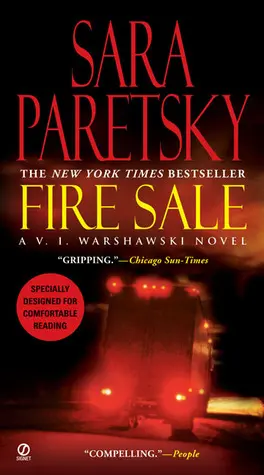
Fire Sale
Cover
Praise for the novels of Sara Paretsky
Fire Sale
“Another gripping chapter in the ongoing adventures of the Chicago private investigator…tightly written.”
—Chicago Sun-Times
“The great thing about Sara Paretsky’s novels is that they have meat on their bones, burrowing down to explore issues…without taking anything away from the thrills and suspense…a cleverly constructed novel that serves a dual purpose of providing first-class entertainment and at the same time reminding us just how brutal man’s inhumanity to man can be.”
—The Orlando Sentinel
“Warshawski is among the most intriguing of detective characters, and Paretsky among the smoothest of stylists.”
—Detroit Free Press
“Fast-paced…as entertaining as any entry in the series.”
—Library Journal
“An action-packed thriller.”
—The Wichita Eagle
“Packed with social themes and moral energy, held together by humor, compassion, and sheer feistiness, this novel shows why Paretsky and her heroine are such enduring figures in American detective fiction.”
—Publishers Weekly (starred review)
“Tense, sharp.”
—Kirkus Reviews
“The author’s strong cast of characters includes a nervy fundamentalist preacher, worried mothers, young star-crossed lovers, an angry former high school classmate, a Romeo with an insatiable appetite, a nervy journalist, impatient businessmen, and assorted thugs, schemers, and dreamers…a nifty, dark-edged, fast-paced urban thriller.”
—Lansing State Journal
“[Warshawski is] as savvy, sardonic, and saucy as ever.”
—The Providence Journal-Bulletin
“A summer sizzler…rich and complex.”
—The Associated Press
“An engaging read that gives social issues a human face.”
—Chicago Tribune
“Anyone who has drifted away from Paretsky’s V. I. Warshawski should promptly return to the fold. The thirteenth Warshawski novel is one of the best…. Paretsky has never been better than she is here at evoking a sense of place.”
—Booklist (starred review)
Blacklist
“A thoughtful, high-tension mystery.”
—The Washington Post Book World
“Sara Paretsky’s Chicago private eye, V. I. Warshawski, is one tough cookie…memorable.”
—The New York Times Book Review
“Thoroughly gripping.”
—The Seattle Times
“Because she is still among the very best drivers of narrative engines in the business, Paretsky also has produced a genuinely exciting and disturbing thriller, a raging vehicle that can carry a load of baggage from 1950s blacklisting to present-day terrorist hysteria without missing a beat.”
—Chicago Tribune
“A stellar entry in a celebrated series, which offers a provocative history lesson along with very contemporary commentary on loyalty and betrayal and how the past shapes the present…. A tightly woven and thoughtful thriller, this enticing mix of history and mystery showcases sharp, clever, vulnerable V. I. at her best.”
—Booklist (starred review)
“You are getting much more here than an ordinary detective novel.”
—The Buffalo News
Praise for Sara Paretsky
“Paretsky still writes with the kind of dazzling, diamond-hard clarity that can break your heart on every other page.”
—Chicago Tribune
“Paretsky is still the best…. She doesn’t pull punches.”
—The Washington Post Book World
“Paretsky’s books are beautifully paced and plotted, and the dialogue is fresh and smart…. V. I. Warshawski is the most engaging woman in detective fiction.”
—Newsweek
“No one, male or female, writes better P.I. books than Paretsky.”
—The Denver Post
“Articulate and independent…Warshawski never wears thin.”
—San Francisco Chronicle
“Not a lot of mystery writers are as pulse-pounding and as literary.”
—Detroit Free Press
“Paretsky’s V. I. is a rare literary entity, a woman quick to anger and action, yet sympathetic and credible.”
—Publishers Weekly
“A character much loved in the crime and suspense genre.”
—The Kansas City Star
“Paretsky’s novels not only entertain us, keeping us suspended with her twists and turns, but they also make us think.”
—South Florida Sun-Sentinel
“An old-school crime-writing pro.”
—The Boston Globe
ALSO BY SARA PARETSKY
Blacklist
Total Recall
Hard Time
Windy City Blues
Tunnel Vision
Guardian Angel
Burn Marks
Blood Shot
Bitter Medicine
Killing Orders
Deadlock
Indemnity Only
FIRE SALE
A V. I. WARSHAWSKI NOVEL
SARA PARETSKY

Copyright
SIGNET
Published by New American Library, a division of
Penguin Group (USA) Inc., 375 Hudson Street,
New York, New York 10014, USA
Penguin Group (Canada), 90 Eglinton Avenue East, Suite 700, Toronto,
Ontario M4P 2Y3, Canada (a division of Pearson Penguin Canada Inc.)
Penguin Books Ltd., 80 Strand, London WC2R 0RL, England
Penguin Ireland, 25 St. Stephen’s Green, Dublin 2,
Ireland (a division of Penguin Books Ltd.) Penguin Group (Australia), 250 Camberwell Road, Camberwell, Victoria 3124,
Australia (a division of Pearson Australia Group Pty. Ltd.)
Penguin Books India Pvt. Ltd., 11 Community Centre, Panchsheel Park, New Delhi-110 017, India
Penguin Group (NZ), cnr Airborne and Rosedale Roads, Albany, Auckland 1310, New Zealand (a division of Pearson New Zealand Ltd.)
Penguin Books (South Africa) (Pty.) Ltd., 24 Sturdee Avenue, Rosebank, Johannesburg 2196, South Africa
Penguin Books Ltd., Registered Offices:
80 Strand, London WC2R 0RL, England
Published by Signet, an imprint of New American Library, a division of Penguin Group (USA) Inc. Previously published in a G. P. Putnam’s Sons edition.
Signet International Edition, June 2006
ISBN: 1-4295-1994-0
 REGISTERED TRADEMARK—MARCA REGISTRADA
Without limiting the rights under copyright reserved above, no part of this publication may be reproduced, stored in or introduced into a retrieval system, or transmitted, in any form, or by any means (electronic, mechanical, photocopying, recording, or otherwise), without the prior written permission of both the copyright owner and the above publisher of this book.
PUBLISHER’S NOTE
This is a work of fiction. Names, characters, places, and incidents either are the product of the author’s imagination or are used fictitiously, and any resemblance to actual persons, living or dead, business establishments, events, or locales is entirely coincidental.
The publisher does not have any control over and does not assume any responsibility for author or third-party Web sites or their content.
The scanning, uploading, and distribution of this book via the Internet or via any other means without the permission of the publisher is illegal and punishable by law. Please purchase only authorized electronic editions, and do not participate in or encourage electronic piracy of copyrighted materials. Your support of the author’s rights is appreciated.
For Rachel, Phoebe, Eva, Samantha, and Maia—
my own hope for change in the world
THANKS
Helen Martin, M.D., was most helpful in coming up with Long QT Syndrome, the heart condition afflicting one of V. I.’s basketball team. I’m grateful for her advice on the condition, its symptoms, and how to treat it. Thanks to Dr. Susan Riter for introducing us.
Mr. Kurt Nebel, the district manager at the CID Recycling and Disposal Facility on 138th Street, was quite generous with his time and expertise in explaining how and where the City of Chicago disposes of its garbage. Dave Sullivan made that important introduction, and also helped me spend time in the churches of South Chicago; I am grateful for all my experiences in that beleaguered community.
The City of Chicago produces over ten thousand tons of garbage a day; keeping up with it is a daunting task. Although the city’s landfills have been topped off in the last year or two, and Chicago sends most residential garbage out of town, I have kept the landfill at 122nd Street active for the purposes of this book.
Thanks to Janice Christiansen, president of FlagSource, for letting me visit their factory, and thanks to Beth Parmley for her informed and lively tour. She also suggested the accident described in chapter 44, “The Recording Angel…or Devil?” Sandy Weiss, of Packer Engineering, made this connection for me, and provided invaluable technical advice, including photographs of the accident. Fly the Flag does not resemble FlagSource in any way, shape, or form.
Judi Phillips helped with the plant life in V. I.’s childhood garden. Kathy Lyndes gave generously of her time and experience in many ways, including the painstaking work of finishing the draft. Jolynn Parker and the Fact Factory were most helpful as well. Calliope kept me from withering away in front of the computer by stealing my shoes at appropriate moments. The Senior C-Dog did his usual kneecap-endangering job as first reader, copy editor, and creator of chapter titles.
I owe special thanks to Constantine Argyropoulos for the CDs he created of V. I.’s music, which include all the pieces she’s sung or heard over the years. Nick Rudall provided Coach McFarlane’s Latin.
This is a work of fiction. Nothing in it is intended to reflect the reality of modern American life. For NFL purists, I moved the 2004 Kansas City–New England game from November 22 to November 15. For readers who fear that V. I. does not sufficiently adulate multinational conglomerates, please remember that she is a fictional character, and her views are not necessarily those of the management.
CHAPTERS
Prologue
1. Remembrances of Things Past
2. Homie
3. Enter Romeo (Stage Left)
4. Mountains of Things
5. Imperial Relations
6. Girls Will Be Girls
7. Close Quarters
8. Plant Life
9. The Fog of…What?
10. Unions? Not a Prayer!
11. Home on the Range
12. Company Practice
13. Hired Gun
14. (Re) Tired Gun
15. Heart-stopper
16. Command Performance
17. A Frog in My Jeans
18. Visiting Hours
19. The Hospitable Mr. Contreras
20. Buffalo—and Gal—Won’t You Come Out Tonight?
21. Loose Buffalo in Church
22. Poverty’s Whirlpool
23. Star-crossed Lovers
24. Yet Another Missing Child
25. Bedtime Stories
26. Annie, Get Your Gun
27. Death in the Swamp
28. It’s a Bird, It’s a Plane, No, It’s…
29. On the DL—Once Again
30. Comrades in Arms
31. The Walking Wounded
32. Time to Nail the Pastor to the Cross
33. Happy Families Are All Alike, Unhappy Families…
34. And the Rich Ain’t Happy, Either
35. Why, Freddy, What a Surprise!
36. Shown the Door—Again
37. Where the Buffalo Roam
38. Primitive Art
39. Painful Extraction
40. An Acid Touch
41. Punk, Cornered Like a Rat
42. The Hiding Place
43. The Fugitives
44. The Recording Angel…or Devil?
45. Down in the Dumps
46. Behold: The Purloined Pen
47. Office Party
48. Dancing Rhino
About The Author
PROLOGUE
I was halfway down the embankment when I saw the red-orange flash. I dropped to the ground and covered my head with my arms. And felt a pain in my shoulder so intense I couldn’t even cry out.
Lying facedown in bracken and trash, I breathed in shallow panting breaths, a dog, eyes glazed, until the pain receded enough that I could move. I edged away from the flames on my hands and knees, then drew myself up on my knees and sat very still. I willed my breaths to come slow and deep, pushing the pain far enough away to manage it. Finally, I gingerly put a hand to my left shoulder. A stick. Metal or glass, some piece of the window that had shot out like an arrow from a crossbow. I tugged on the stick, but that sent such a river of agony flowing through me that I started to black out. I curled over, cradling my head on my knees.
When the wave subsided, I looked across at the factory. The back window that had blown apart was awash with fire, blue-red now, a mass so thick I couldn’t make out flames, just the blur of hot color. Bolts of fabric were stored there, fueling the blaze.
And Frank Zamar. I remembered him with a sudden appalled jolt. Where had he been when that fireball blew up? I pushed myself to my feet as best I could and stumbled forward.
Weeping with pain, I pulled out my picklocks and tried to scrabble my way into the lock. It wasn’t until my third futile attempt that I remembered my cell phone. I fumbled it out of my pocket and called 911.
While I waited on the fire trucks, I kept trying the lock. The stabbing in my left shoulder made it hard for me to maneuver the thin wards. I tried to brace them with my left hand, but my whole left side was shaking; I couldn’t hold the picklocks steady.
I hadn’t expected the fire—I hadn’t expected anything when I came here. It was only some pricking of unease—disease—that sent me back to Fly the Flag on my way home. I’d actually made the turn onto Route 41 when I decided to check on the factory. I’d made a U-turn onto Escanaba and zigzagged across the broken streets to South Chicago Avenue. It was six o’clock then, already dark, but I could see a handful of cars in Fly the Flag’s yard when I drove by. There weren’t any pedestrians out, not that there are ever many down here; only a few cars straggled past, beaters, people leaving the few standing factories to head for bars or even home.
I left my Mustang on one of the side streets, hoping it wouldn’t attract any roving punk’s attention. I tucked my cell phone and wallet into my coat pockets, took my picklocks from the glove compartment, and locked my bag in the trunk.
Under cover of the cold November night, I scrambled up the embankment behind the plant, the steep hill that lifts the toll road over the top of the old neighborhood. The roar of traffic on the Skyway above me blocked any sounds I made—including my own squawk when I caught my foot in a discarded tire and tumbled hard to the ground.
From my perch under the expressway I could see the back entrance and the side yard, but not the front of the plant. When the shift ended at seven, I could just make out the shapes of people plodding to the bus stop. A few cars bumped behind them down the potholed drive to the road.
Lights were still on at the north end of the plant. One of the basement windows facing me also showed a pale fluorescent glow. If Frank Zamar were still on the premises, he could be doing something—anything—from checking inventory to planting dead rats in the vents. I wondered if I could find a crate in the rubble that would get me high enough to see into the back. I was halfway down the hillside, searching through the debris, when the window went briefly dark, then burst into fiery life.
I was still struggling to undo the front lock when sirens keened up South Chicago Avenue. Two trucks, a command car, and a phalanx of blue-and-whites screamed into the yard.
Men in black slickers surrounded me. Easy there, miss, move away, we’ve got it covered, the ka-chung of axes breaking metal, my God—look at that thing in her shoulder, get her an ambulance, a giant gloved hand scooping me up as easily as if I were an infant, not a 140-pound detective, and then, as I sat sideways on the command car’s passenger seat, feet on the ground, panting again, a familiar voice:
“Ms. W., what in Jesus’ name are you doing here?”
I looked up, startled, and felt giddy with relief. “Conrad! Where’d you come from? How did you know I was here?”
“I didn’t, but I might have guessed if buildings were blowing up on my turf that you’d be close by. What happened?”
“I don’t know.” The current of pain was sweeping through me again, tugging me loose from my moorings. “Zamar. Where is he?”
“Who’s Zamar—your newest victim?”
“Plant owner, commander,” a man outside my narrow field of vision said. “Trapped in there.”
A walkie-talkie squawked, cell phones rang, men talked, engines clanged, soot-grimed faces carried a charred body. I shut my eyes and let the current pull me away.
I came to briefly when the ambulance arrived. I stumbled to the rear doors on my own, but the EMT crew had to lift me into the back. When they had me strapped in, awkwardly, on my side, the jolting of the ambulance drew me down to a tiny point of pain. If I shut my eyes I felt sick to my stomach, but the light stabbed through me when I opened them.
As we swooped in through the ambulance entrance, I vaguely noticed the hospital’s name, but it was all I could do to mutter answers to the questions the triage nurse was asking. I somehow got my insurance card out of my wallet, signed forms, put down Lotty Herschel as my doctor, told them to notify Mr. Contreras if anything happened to me. I tried to call Morrell, but they wouldn’t let me use my cell phone, and, anyway, they had me on a gurney. Someone stuck a needle into the back of my hand, other someones stood over me saying they’d have to cut away my clothes.
I tried to protest: I was wearing a good suit under my navy peacoat, but by then the drug was taking hold and my words came out in a senseless gabble. I was never completely anesthetized, but they must have given me an amnesia drug: I couldn’t remember them cutting off my clothes or taking out the piece of window frame from my back.
I was conscious by the time I was wheeled to a bed. The drugs and a throb in my shoulder both kept jerking me awake whenever I dozed off. When the resident came in at six, I was awake in that dull, grinding way that comes from a sleepless night and puts a layer of gauze between you and the world.
She’d been up all night herself, handling surgical emergencies like mine; even though her eyes were puffy from lack of sleep, she was young enough to perch on the chair by my bed and talk in a bright, almost perky voice.
“When the window blew apart, a fragment of the frame shot into your shoulder. You were lucky it was cold last night—your coat stopped the bolt from going deep enough to do real damage.” She held out an eight-inch piece of twisted metal—mine to keep, if I wanted it.
“We’re going to send you home now,” she added, after checking my heart and head and the reflexes in my left hand. “It’s the new medicine, you know. Out of the operating room, into a cab. Your wound is going to heal nicely. Just don’t let the dressing get wet for a week, so no showers. Come back next Friday to the outpatient clinic; we’ll change the dressing and see how you’re doing. What kind of work do you do?”
“I’m an investigator. Detective.”
“So can you stop investigating for a day or two, Detective? Get some rest, let the anesthesia work itself out of your system and you’ll be fine. Is there anyone you can call to drive you home, or should we get you into a cab?”
“I asked them to call a friend last night,” I said. “I don’t know if they did.” I also didn’t know if Morrell could manage the trip down here. He was recovering from bullet wounds that almost killed him in Afghanistan this past summer; I wasn’t sure he had the stamina to drive forty miles.
“I’ll take her.” Conrad Rawlings had materialized in the doorway.
I was too sluggish to feel surprised or pleased or even flustered at seeing him. “Sergeant—or, no, you’ve been promoted, haven’t you? Is it lieutenant now? You out checking on all the victims of last night’s accident?”
“Just the ones who raise a red flag when they’re within fifty miles of the crime scene.” I couldn’t see much emotion in his square copper face—not the concern of an old lover, not even the anger of an old lover who’d been angry when he left me. “And, yeah, I’ve been promoted: watch commander now down at 103rd and Oglesby. I’ll be outside the lobby when the doc here pronounces you fit to tear up the South Side again.”
The resident signed my discharge papers, wrote me prescriptions for Vicodin and Cipro, and turned me over to the nursing staff. A nurse’s aide handed me the remnants of my clothes. I could wear the trousers, although they smelled sooty and had bits of the hillside embedded in them, but my coat, jacket, and rose silk blouse had all been slit across the shoulders. Even my bra strap had been cut. It was the silk shirt that made me start to cry, that and the jacket. They were part of a cherished outfit; I’d worn them in the morning—yesterday morning—to make a presentation to a downtown client before heading to the South Side.
The nurse’s aide didn’t care about my grief one way or another, but she did agree I couldn’t go out in public without any clothes. She went to the charge nurse, who scrounged an old sweatshirt for me from someplace. By the time we’d done all that, and found an orderly to wheel me to the lobby, it was almost nine.
Conrad had used police privilege to park right in front of the entrance. He was asleep when the orderly wheeled me out, but he came to when I opened the passenger door.
“Woof. Long night, Ms. W., long night.” He knuckled sleep from his eyes and put the car into gear. “You still in the old crib up by Wrigley? I heard you mention a boyfriend to the doc.”
“Yes.” To my annoyance, my mouth was dry and the word came out as a squawk.
“Not that Ryerson guy, I trust.”
“Not the Ryerson guy. Morrell. A writer. He got shot to pieces last summer covering the Afghanistan war.”
Conrad grunted in a way that managed to heap contempt on mere writers who get shot to pieces: he himself had been hit by machine-gun fire in Vietnam.
“Anyway, your sister tells me you haven’t taken monastic vows, either.” Conrad’s sister Camilla sits on the board of the same women’s shelter I do.
“You always did have a way with a phrase, Ms. W. Monastic vows. Nope, none of them.”
Neither of us spoke again. Conrad turned his police-issue Buick into Jackson Park. We joined a heavy stream of cars, the tag end of the morning rush, filing through the Jackson Park construction zone onto Lake Shore Drive. A feeble autumn sun was trying to break through the cloud cover, and the air had a sickly light that hurt my eyes.
“You called it a crime scene,” I finally said, just to break the silence. “Was it arson? Was that Frank Zamar the firemen carried out?”
The Story Continues on BooksBarbecue!
Enjoyed this preview? ❤️ Do not stop here!
Read the complete book free online → 🔗
Continue reading now on BooksBarbecue and discover every page!
Love reading? Bookmark BooksBarbecue.com for more amazing books!
Happy Reading!