Fall of Light
Cover
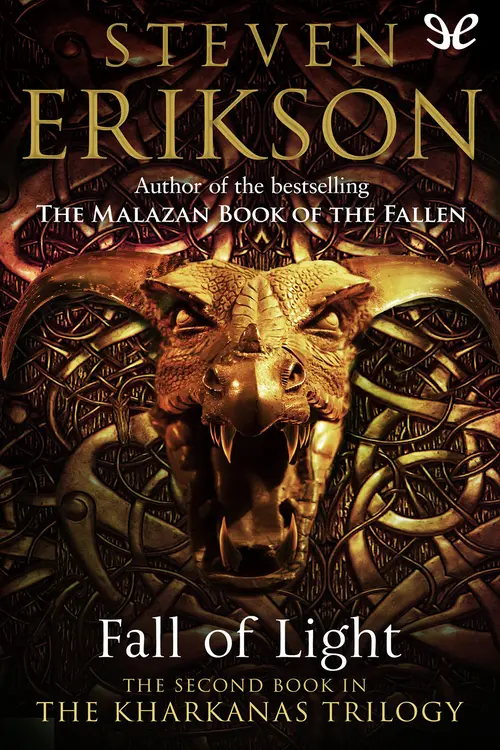
It is a bitter winter and civil war now ravages Kurald Galain, as Urusander’s Legion prepares to march upon the city of Kharkanas. The rebels’ only opposition lies scattered, bereft of a leader since Anomander’s departure in search of his estranged brother, Andarist. The last brother remaining, Silchas Ruin, rules in Anomander’s stead. He seeks to gather the Houseblades of the Highborn Noble families and resurrect the Hust Legion in the southlands, but is fast running out of time.
The officers and leaders of Urusander’s Legion, led by Hunn Raal, want the Consort, Draconus, cast aside and Vatha Urusander wedded to Mother Dark, taking his place on a throne at the side of the Living Goddess. But this union will be far more than political, as a sorcerous power has claimed those opposing Mother Dark - given form by the exiled High Priestess Syntara, the Cult of Light rises in answer to Mother Dark and her Children.
Far to the west, an unlikely army has gathered, seeking an enemy without form, in a place none can find, and commanded by a Jaghut driven mad with grief. Hood’s call has been heard, and the long-abandoned city of Omtose Phellack is now home to a rabble of new arrivals. From the south have come Dog-Runners and Jheck warriors. From the Western Sea strange ships have grounded upon the harsh shore, with blue-skinned strangers arriving to offer Hood their swords. And from the North, down from mountain fastnesses and isolated valleys, Toblakai arrive, day and night, to pledge themselves to Hood’s impossible war. Soon, all will set forth - or not at all - under the banners of the living. Soon, weapons will be drawn, with Death itself the enemy.
Beneath the chaos of such events, and spanning the realm and those countless other realms hidden behind its veil, magic now bleeds into the world. Unconstrained, mysterious and savage, the power that is the lifeblood of the Azathanai, K’rul, runs loose and wild. Following its scent, seeking the places of wounding where the sorcery rushes forth, entities both new and ancient are gathering. And they are eager to feed.
Comprehending the terrible risk of his gift of blood, a weakened, dying K’rul sets out, in the company of a lone guardian, to bring order to this newborn sorcery - alas, his choice of potential allies is suspect. In the name of order, K’rul seeks its greatest avowed enemy.

Steven Erikson
Fall of Light
Kharkanas Trilogy - 02
ePub r1.3
Watcher 21-12-2020
Original title: Fall of Light
Steven Erikson, 2016
Maps: Neil Gower
Cover art: Steve Stone
Digital editor: Watcher
ePub base r2.1


Maps
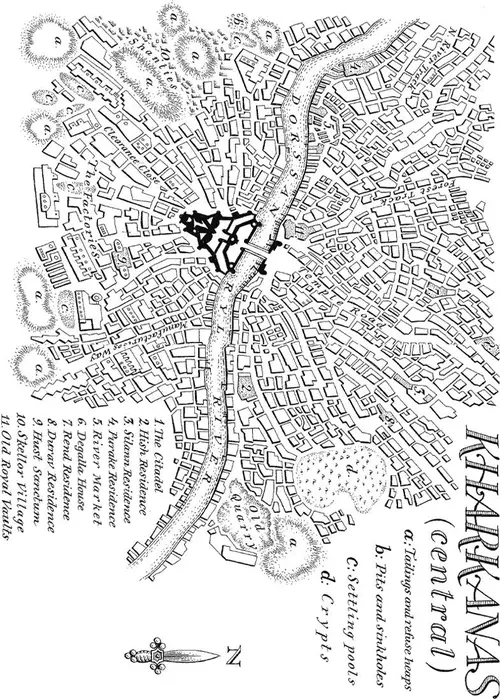
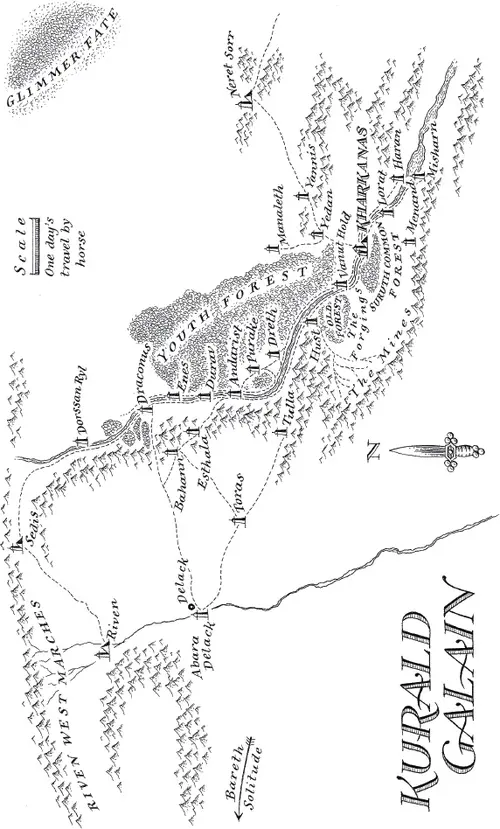
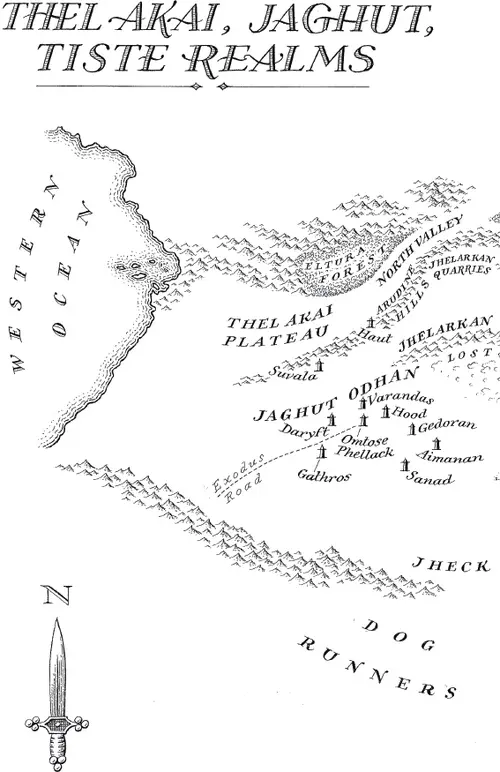
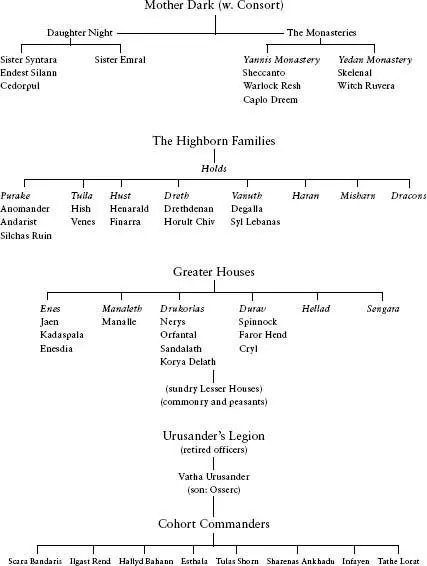
DRAMATIS PERSONAE
PURAKE HOLD
Anomander
Andarist
Silchas Ruin
Kellaras
Prazek
Dathenar
TULLA HOLD
Hish Tulla
Venes Turayd
Rancept
Sukul Ankhadu (hostage)
Gripp Galas
DRETH HOLD
Drethdenan
Horult Chiv
Sekarrow
DRACONS HOLD
Draconus
Spite
Envy
Ivis
Yalad
Sandalath Drukorlat (hostage)
HOUSE DURAV
Spinnock Durav
Faror Hend
VANUT HOLD
Lady Degalla
Jureg Thaw
Lord Vanut Degalla
Syl Lebanas
THE CITADEL AND PRIESTHOOD
Mother Dark
Emral Lanear
Endest Silann
Cedorpul Ahras
Rise Herat
Orfantal
Ribs
HUST
The Forge Works
Hust Henarald
The Hust Legion
Toras Redone
Galar Baras
Seltin Ryggandas
THE SHAKE
The Yannis Monastery
Sheccanto Derran
Warlock Resh
Caplo Dreem
The Yedan Monastery
Higher Grace Skelenal
Witch Ruvera
URUSANDER’S LEGION
Scara Bandaris
Ilgast Rend
Esthala
Kagamandra Tulas (Shorn)
Tathe Lorat
Sheltatha Lore
Infayen Menand
Sharenas Ankhadu
Hallyd Bahann
Sagander
THE BORDERSWORDS
Lahanis
THE DENIERS
Wreneck
Narad
Glyph
THE PRISONERS
Wareth
Listar
Rebble
Rance
THE WARDENS
Calat Hustain
Faror Hend
Spinnock Durav
Bursa
Finarra Stone
NERET SORR (TOWN OF)
Vatha Urusander
Hunn Raal
Serap
Sevegg
Renarr
Syntara
The Tiste: Holds, Greater and Lesser Houses, Priesthood and Court
BOOK ONE
The Seduction of Tragedy
So THEY LUST FOR BLOOD. POETS KNOW ITS TASTE, BUT SOME KNOW IT better than others. A few are known to choke on it. Stand at a distance, then, and make violence into a dance. Glory in its sounds, in the mayhem and those stern expressions that seem better suited to an unpleasant task completed with reluctant forbearance. There is for the audience that glee of admiration in the well-swung sword, the perfect thrust, the cold, professional face with the flat eyes. Revel, then, in the strut, and see something enticing in the grim camaraderie of failed men and women—
Failed? You say many do not see that? Oh dear.
Shall I then offer up the reek of shit and piss? The cries for loved ones far away? The hopeless longing for a mother’s embrace to ease the pain and the terror, to bless the gentle slowing of the hammering heart? Shall I describe the true faces of violence? The twist of fear, the heaviness of dread, the panic that rushes in a surge of blood, a surge that drains the visage and bulges the eyes? But what value any of this, when to feel is to acknowledge the frailty of one’s own soul, and such frailty must ever be denied in the public swagger that so many find essential, lest they lose grip.
Indeed, I would think armour itself whispers of weakness. Tug free the helm’s strap, let your scalp prickle in the cool air. Strip down until you stand naked, and let’s see again that swagger.
There are poets who glory in their recounts of battle, of all those struggles so deftly ritualized. And they tend lovingly their garden of words, heaping high the harvest of glory, duty, courage and honour. But each of those luscious, stirring words is plucked from the same vine, and alas, it is a poisonous one. Name it necessity, and look well upon its spun strands, its fibrous belligerence.
Necessity. The soldiers attack, but they attack in order to defend. Those they face stand firm, and they stand firm to defend as well. The foes are waging war in self-defence. Consider this, I beg you. Consider this well and consider this long. Choose a cool dusk, with the air motionless, with dampness upon the ground. Draw away from all company and stand alone, watching the dying sun, watching the night sky awaken above you, and give your thoughts to necessity.
The hunter knows it. The prey knows it. But on a field of battle, when every life totters in the balance, where childhoods, begun long ago, and youthful days suddenly past, have all, impossibly, insanely, led to this day. This fight. This wretched span of killing and dying. Was this the cause your father and mother dreamed of, for you? Was this the reason for raising you, protecting you, feeding you, loving you?
What, in the name of all the gods above and below, are you doing here?
Necessity, when spoken of in the forum of human endeavour, is more often a lie than not. Those who have laid claim to your life will use it often, and yet hold you at a distance, refusing you that time of contemplation, or, indeed, recognition. If you come to see the falseness of their claim, all is lost. Necessity: the lie hiding behind the true virtues of courage and honour – they make you drunk on those words, and would keep you that way, until comes the time for you to bleed for them.
The poet who glories in war is a spinner of lies. The poet who delights in visceral detail, for the sole purpose of feeding that lust for blood, has all the depth of a puddle of piss on the ground.
Oh, have done with it, then.
CHAPTER ONE
STEPPING OUT FROM THE TENT, RENARR FACED THE BRIGHT morning light, and did not blink. Behind her, on the other side of the canvas wall, the men and women were rising from their furs, voicing bitter complaints at the damp chill, snapping at the children to hurry with the hot, spiced wine. Within the tent, the air had been thick with the fug of lovemaking, the rank sweat of the soldiers now gone, the metallic bite of the oils with which the soldiers honed weapons and worked to keep leather supple, the breaths of drunkards and the faint undercurrent of vomit. But out here those smells were quickly swept away, clearing her head as she watched the camp stir awake.
She took coin no different from the other whores, although she did not need it. She made her false moans and moved beneath a man like a woman both eager and hungry, and when they shuddered, emptying their hoards into her and becoming weak and childlike, she held them as would a mother. In every way, then, she was the same as the others. Yet they kept her apart, forever pushed away from their close company. She was the adopted daughter of Lord Urusander, after all, Legion Commander and reluctant holder of the title of Father Light, and this was a privilege worthy of dreams, and if flower petals were scattered in her wake, they were the colour of blood. She had no friends. She had no followers. The company she kept had all the warmth of a murder of crows.
There was frost silvering the tufts of grass between the tents and the ground was frozen hard underfoot. The smoke rising from the cookfires did not rise far, drifting like confusion about the heads of the soldiers as they readied their gear.
She could see, in their agitated gestures, in the nerves betrayed by fumbling at buckles and the like, and could hear, in the surly tones of their conversations, that many now believed that this would be the day. A battle was coming, marking the beginning of the civil war. If she turned to her left, and could make her vision cut through the hillside to the northeast, through the unlit tumble of stone and earth and root and then out again into the morning light, she would see the camp of the Wardens, a camp little different from this one, barring these snow-burnished skins and hair now the hue of spun gold. And in that other camp’s centre, on a standard rising from the command tent, she would make out the heraldry of Lord Ilgast Rend.
The day felt reluctant, but in an ironic way, like a woman feigning resistance on her first night, with rough hands pushing her thighs apart, the air then filling with its share of harsh breaths, ecstatic moans and clumsy grunts. And when it was all done with, amidst deep pools of satisfied heat, there would be blood on the grass.
Just so. And as Hunn Raal would say, had he the wits, justice is a sharp-edged thing and today it will be unsheathed, and wielded with a firm hand. The reluctance is an illusion, and as only Osserc knows, my resistance was indeed feigned, the day Urusander’s son took me to rough bed. We are awash in lies.
Of course, it was equally likely that Lord Urusander would defy this seemingly inevitable destiny. Bind the woman’s legs together, securing a chastity belt with thorns on both sides, to refuse satisfaction from either direction. He might well ruin things for everyone.
So, in its more prosaic details – the frost, the faint but icy wind, the plumes of breath and smoke, the distant neighing of horses and the occasional bray of a pack-mule; all the sounds of a day’s dawning in the company of men, women, children and beasts – she could, if unmindful, believe the stream of life to be unbroken, with all its promise arrayed before it, bright as the morning sun.
She drew her cloak about her rounded shoulders, and set out through the camp. She passed between tent rows, stepping carefully to avoid the ropes and stakes, taking caution on the furrows that cut diagonally across her path, and the stubble left behind by the harvesting only a week past. She skirted the trenches carved deep into the soil where wastes floated on the sluggish surface of murky water, along with the bloated carcasses of rats. By mid-afternoon, when the sun warmed the air enough, mosquitoes would arrive in thick, spinning clouds, thirsty for blood. If soldiers stood arrayed in ranks, facing the enemy, there would be little comfort preceding the clash of weapons.
Though her mother had been a captain in the Legion, Renarr had little sense of the makings and leavings of war. For her, it was a force that had, until now, been locked in her past: a realm of sudden absences, hollow with losses and ill luck, where even sorrow felt cool to the touch. It was a place somewhere else, and to give it any thought was to feel as if she was stealing a stranger’s memories. The veterans she took to her furs had known that realm, and each night, as the prospect of battle drew closer, she sensed in them a vague weariness, a kind of fatalism, dulling their eyes and stealing away what few words they were inclined to utter. And when they made love, it seemed an act of shame.
My mother died on a field of battle. She woke to a morning like this one, settling bleak eyes upon what the day would bring. Did she taste her death on the air? Did she see a vision of her rotting corpse, there in her own shadow? And would she have known, by sight, the weapon that would cut her down – a blinding flash drawing closer through the press? Did she look into the glaring eyes of her slayer, and see in them her death writ plain?
Or was she no different, on that morning, from every other fool in her company?
The questions seemed banal, like things covered in dust, the dust shaken free, blown into the air by a heavy but meaningless sigh. Renarr was not born to take sword in hand. The knife in its thin leather sheath at her hip was modest in its pragmatic necessity. She was not yet ready to imagine drawing it. As she walked, unburnished, her skin as yet unblessed by whiteness, soldiers surrounded her, and in the bright light, which rose like another world, a world unlike the night before, she was deftly ignored, seen but not seen, and the sight of her, if it yielded anything at all, raised surely little more than a pang of regret – the soft feel of her flesh, the weight she carried that surprised every man she straddled in the dark. None of these things were relevant now.
But there was power to be found nonetheless: the cheap woman as harbinger of regret, making faces turn away, making strong men bend to some task, frowns cascading on their bared brows. The pleasures of flesh made but a sharp fold in the sensations of life, and upon its opposite side that flesh knew pain and terrible damage. In a careless moment, one could mistake the stains of one for the other.
She was the reminder they did not want, not here and not now, and so she walked unaccosted, too solid to be a ghost, but shunned all the same. Of course, this could perhaps be said of all ghosts – the living ones at least – and if so, then the world was full of them, solid but not quite solid enough, and each day they wandered unseen, dreaming of a future moment, imagining their one perfect gesture that would yield in everyone the delicious shock of recognition.
The banner of the command tent, the golden sun in its blue field, was directly ahead now, and as she drew nearer she noted the gap surrounding that tent, as if some invisible barrier occupied the space. No soldiers edged closer and those that she could see, there on the periphery, were all turned away. Moments later, she could make out shouting from within, the harsh bark of anger, bridling: the voice of Vatha Urusander, commander of the Legion and her adoptive father.
Those who might have replied to Urusander spoke in low tones, with murmurs that failed in passing through canvas walls, and so it seemed as if their lord was arguing with himself, like a madman at war with the voices in his head. For a brief instant, Renarr imagined him alone in the command tent. And in she would stride, to witness his decrepit ignominy. She saw herself observing, strangely unaffected, as he swung to her a confused, baffled face. Then the moment passed and she approached the entrance, where the stained flap hung down like a beggar’s blanket.
She was still a half-dozen strides from the tent when she saw that flap stir and then buckle to one side. Captain Hunn Raal emerged, drawing on his leather gauntlets as he straightened. His face was red beneath the bleached mask of his miraculous transformation, but then, it was always red. Pausing, he glanced around, gaze momentarily fixing on Renarr, who had slowed her steps. One of his cousins appeared behind him, Sevegg, and upon her round, chalky face there was a subtle flash of expression, which might have been pleasure, that then curled into a sneer when she saw Renarr.
Nudging her cousin, Sevegg stepped to one side and sketched a mocking bow. ‘If you ache on this chill morning, dear girl,’ she said, ‘winter is not to blame.’
‘I am well beyond aching,’ Renarr replied, moving past.
But Hunn Raal reached out and touched her shoulder.
She halted, faced him.
‘I think he would not delight in seeing you, Renarr,’ the captain said, studying her with his bloodshot eyes. ‘How many cloaks of defeat can one man wear?’
‘You smell of wine,’ Renarr replied.
She drew aside the flap and strode into the tent.
Their lord was not alone. Looking tired, Lieutenant Serap – two years older than her sister, Sevegg, and a stone heavier – sat to the man’s left, in a battered camp-chair little different from the one bearing Urusander’s weight. The map table was set up in the centre of the chamber, but it stood askew, as if it had been shoved or kicked. On its battered surface, the vellum map denoting the immediate area had pulled loose from its anchor stones on one end and the corners had curled up and around, as if eager to hide what it revealed.
With skin so white as to be almost glowing, Renarr’s adoptive father was staring at the muddy canvas floor beyond his equally muddy boots. There was gold in his long hair now, streaking the silver. Virtually all among the Legion were now white-skinned.
Serap, her expression grave, cleared her throat and said, ‘Good morning, Renarr.’
As soon as she began speaking, Urusander stood, grunting under his breath. ‘Too many aches,’ he muttered. ‘Memories awaken in the bones first, and send pain to every muscle, and all this serves to remind a man of the years behind him.’ Ignoring his adopted daughter, the lord faced Serap and seemed to study her quizzically for a moment. ‘You’ve not seen my portrait yet, have you?’
Renarr saw the lieutenant blink, as if in surprise. ‘No, milord, although I am told Kadaspala’s talent was—’
‘His talent?’ Urusander bared his teeth in a humourless smile. ‘Oh indeed, let us speak of his talent, shall we? Eye wedded to hand. Deft strokes of genius. And in this, my likeness is well captured in thinnest paint. You can look upon my face, on that canvas, Serap, and tell yourself how perfectly it renders depth, as if I stood in a world you could step into. And yet draw close, if you dare, and you’ll find my face is naught but paint, thin as skin, with nothing behind it.’ His smile was strained now. ‘Nothing at all.’
‘Milord, no painting can do other than that.’
‘No. In any case, the portrait awaits a washing of white now, yes? Perhaps a sculpture, then? Some Azathanai artisan with the usual immeasurable talent. Dust on his hands and a chisel that shouts. But then, whenever has pure marble revealed the truth beneath the surface? The aches, the strains, the twinges springing from nowhere, as if every thread of nerve within has forgotten its own health.’ Sighing, he faced the entrance. ‘Even marble pits with time. Lieutenant, I am done with Hunn Raal on this day, and all matters of campaign. Do not seek me out and send no messenger in search – I am going for a walk.’
‘Very well, milord.’
He strode from the tent.
Renarr walked over to the chair Urusander had vacated and settled in it. The heat of him remained on the leather saddle.
‘He’ll not acknowledge you in this state,’ Serap said. ‘You have fallen far and fast, Renarr.’
‘I am a ghost.’
‘The ghost of regret for Lord Urusander. You appear as the underside of your mother, like a turned stone, and where all we saw of her was in sunlight, you are nothing but darkness.’
Renarr held out her right arm and studied the not quite pearlescent skin. ‘Stained marble, not yet gnawed by age. Naked, you are like snow. But I am not.’
‘It comes to you,’ Serap said. ‘But slowly, to mark the reluctance of your faith.’
‘Is that it? I but wear my hesitation?’
‘At least our enemies wear their blight for all to see.’
Renarr dropped her arm. ‘Take him to your furs,’ she said. ‘His aches, his twinges – drive away his thoughts of mortality.’
Serap made a disgusted sound, and then asked, ‘Is that what you glimpse each night, Renarr? In that uncaring face hovering above your own? Some faint flush of immortality, like a rose in a desert?’
Renarr shrugged. ‘He’s made his flesh a sack of faults. Untie the knot, lieutenant.’
‘For the good of the Legion?’
‘If your conscience needs a salve.’
‘Conscience. That’s a word I’d not thought to hear from you.’ Serap waved a hand in dismissal. ‘Today, it will be Hunn Raal leading the Legion. Out to parley with Lord Ilgast Rend. This madness needs to end.’
The Story Continues on BooksBarbecue!
Enjoyed this preview? ❤️ Do not stop here!
Read the complete book free online → 🔗
Continue reading now on BooksBarbecue and discover every page!
Love reading? Bookmark BooksBarbecue.com for more amazing books!
Happy Reading!