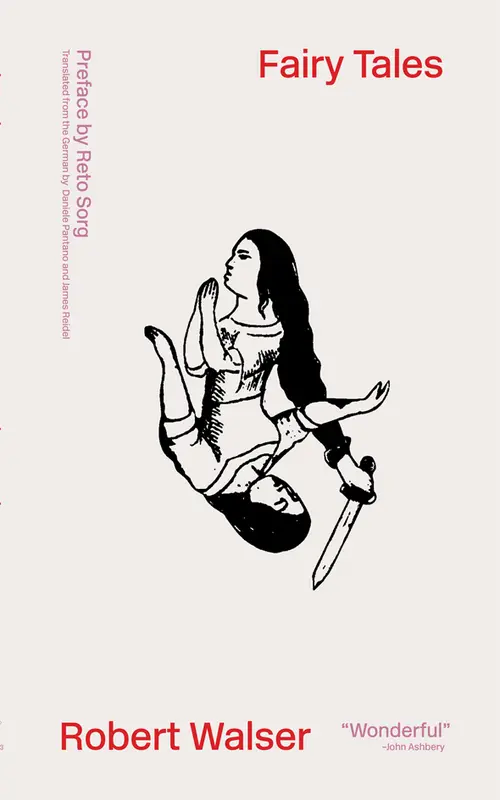
Fairy Tales
Cover
ALSO BY ROBERT WALSER
FROM NEW DIRECTIONS
The Assistant
A Little Ramble
Looking at Pictures
Microscripts
The Tanners
Thirty Poems
The Walk
Foreword
FOREWORD
“Cinderella, she seems so easy.”
Bob Dylan, “Desolation Row”
In his hometown of Biel, where he was born in 1878 and which he left in 1895, Robert Walser discovered his passion for the theater. Inspired by Friedrich Schiller, he dreamed of becoming an actor and playwright. As a writer, Walser retained and masterfully cultivated this histrionic passion for the spoken word. He expressed, imitated, and perfectly adapted the immediate presence of speech into writing, which also complemented his arsenal for irony.
Walser is not an author who strives in the free and open. “We are so glad in dark, meditative holes,” he wrote in 1907 in his essay “The Theater, a Dream.” He loved the delimited and well-defined space. Restriction allowed him to compress and unfold his imaginarium. Since his youth, Walser knew that the magical effect of literature finds its most wonderful expression in the theater. “Are the fictions not dreams, and isn’t the open stage nothing other than its wide-open mouth talking in its sleep?”
Although Walser admired the theater, he never wrote directly for the stage. Instead, he imparted a theatrical Grundgestus in his prose (Brecht’s word meaning fundamental gesture, attitude, posture), which the fairy-tale dramolettes—translated here by Daniele Pantano and James Reidel—also demonstrate. They are short, closet plays that do not retell the familiar fairy tale but rather recall their symbols and tropes. “Whether they could ever be put on with, for instance, music is totally questionable and seems for the present utterly beside the point. They are tempered for speech and language, to a beat and a rhythmic enjoyment,” Walser wrote to a publisher in 1912.
As it turned out, Walser’s fairy-tale dramolettes found their way to the stage during the 1970s, when young troupes and little theaters discovered them. Representing a milestone in the history of their reception is Heinz Holliger’s opera Snow White (Schneewittchen), which is based on Walser’s text and premiered at the Zurich Opera House in 1998 with great success. Originally, in 1901, Cinderella (Aschenbrödel) and Snow White were published in the journal Die Insel. In 1919, Walser gathered them with other dramolettes for the volume Comedies. Around the same time he likely wrote Thorn Rose (Dornröschen), or Sleeping Beauty, which appeared a year later in the journal Pro Helvetia. The Christ Child (Das Christkind), also dates from that time and was published in Die Neue Rundschau in 1920. It can be read too as a fairy tale or, more properly, a verse morality.
During Walser’s lifetime these publications received very little real public reaction. An exception is Walter Benjamin who, in his 1929 essay on Walser, called Snow White “one of the most profound creations of recent literature and one that is sufficient on its own to show why the most playful of all writers was a favorite of the merciless Franz Kafka.” Benjamin continues, “Walser starts where the fairy tales stop. ‘And if they are not dead, they live now.’ Walser shows how they live.”
Looking at literary history, Walser’s fairy-tale dramolettes are not unique. They belong to adaptations, re-creations, collections, and studies in the field of folk and literary fairy tales that have been treated by different minds such as Carlo Collodi, Oscar Wilde, L. Frank Baum, Engelbert Humperdinck, Johann Strauss, Selma Lagerlöf, Blaise Cendrars, Carl Einstein, Franz Kafka, Hugo von Hofmannsthal, and Carl Jung.
The fairy-tale dramolettes are magical literary theater—“entirely poetry” in Walser’s words. The characters, while still fairy-tale beings, exemplify the modern individual who exists to understand the possible terms of his or her fate. For the characters, the fairy tale is the world and language out of which they are made, their nature. Walser depicts self-knowledge as an existential state of poetic exaggeration. When the characters speak of their existence, they stand as if beside themselves. Everything has already happened; time has stopped; life becomes reflectively stretched apart. It is transformed into this dream reality, which is fantastic, disillusioning, demonic, enchanting, enlightening, and uplifting. In addition to the subject matter and the metatheatrical dimension is Walser’s inimitable language that gives the dramolettes their special charm. For all its simplicity and elegance, his language is dazzling and full of surprising, ironic twists:
The language must be a weasel
falling headlong when it wishes
that it didn’t lack words for her,
but it can see her poverty.
These days we have learned to deal with the ambivalence of the tableau. Together with innovation, making the unreal means a threatening alienation as well. Walser, however, belongs to a generation that welcomes illusion. Fiction appears as a romantic power that allows one to transform a mundane reality:
Isn’t reality a dream too?
Aren’t we all, even when awake,
going about a bit like dreamers,
sleepwalkers in the light of day,
who play around with caprices
and act as if awake?
While they are jubilantly playful, the fairy-tale dramolettes are little teaching plays too. The characters behave as if in a poetic purgatory, twisting and turning until they confess, which in the end is precisely their purpose. They are messengers of a poetic existence who bear witness to the human longing for being without boundaries while rooted in a center. As an enlightened poet, Walser knew where the power of poetry exists. This is revealed by the Fairy Tale, as a character herself:
The people don’t believe in me,
but so what when just my nearness
makes them think a little again.
RETO SORG
ROBERT WALSER-ZENTRUM, BERN
Translators’ note
TRANSLATORS’ NOTE
The source text for these translations is Robert Walser, Komödie: Märchenspiele und szenische Dichtungen (1986). Occasional notes are provided to enhance reading and understanding. The order of the first three plays is not chronological, but rather that of a dramatic or cinematic trilogy-triptych, one that allows the reader to challenge, in a small, Walserian way, the culturally hegemonic Disney cartoon adaptations of the past midcentury (and reinforced once more with the 2014 film Maleficent).
As to the titles, Snow White is a virtual cognate of the German title. Cinderella, however, is from the familiar French version of the tale by Charles Perrault — Cendrillon — which means the same as the German word Aschenbrödel, a scullion maid. (The second part of the word/name is from the verb brodeln, or prudeln, literally to seethe, boil, sputter, and figuratively to talk too much, which Walser exploits here.) Thorn Rose — which alludes to the heroine’s “thorny” quality — would be lost in the title that has supplanted it over time. Thus, “Sleeping Beauty” appears in the translation’s subtitle.
The inclusion here of The Christ Child is our inescapable assertion that Walser intended it as a fairy tale, too, given all the devotion to the original text as the other three.
J.R. & D.P.
Snow White
SNOW WHITE
A garden. To the right the palace entrance. In the background rolling mountains. The Queen, Snow White, the foreign Prince, the Hunter.
Queen:
Say, are you sick?
Snow White:
You would ask since you wanted death
on the one who ever stung you
in the eyes as too beautiful.
How you look at me so composed.
This kindness, showing in your eyes,
so full of love, is just made up,
the serene tone just counterfeit.
Hate really does dwell in your heart.
You dispatched the Hunter to me
and told him to draw his dagger,
to point it at this despised face.
You ask me whether I’m sick now?
Such sport sounds bad from a soft voice.
Indeed, softness becomes sly sport
when it is so fearlessly cruel.
I’m not sick; I’m very much dead.
The poison apple was painful,
O, O so painful, and Mother, you,
you’re the one who brought it to me.
So why joke about my being sick?
Queen:
Fair child, you are wrong. You are sick,
no, gravely, very gravely ill.
There’s no doubt this fresh garden air
will do you good. I beg of you,
just don’t let your weak little head
give in to the idea. Be still.
Don’t mull things over and over.
Get some exercise, skip and run.
Shout racing for a butterfly.
Scold the air for not making it
warm enough yet. Become a child.
Soon you’ll leave this color behind,
which is like a pale winding sheet
draped over your pink complexion.
Think not of sin. The sin should be
forgotten. Perhaps I did sin
against you many long years ago.
Who could remember such a thing?
Unpleasant things are easily
forgotten if you consider
who’s near and dear. Are you crying?
Snow White:
Yes, I must when I realize
how quick you are to wring the past
by the neck the way you wanted
mine wrung. Crying, of course, over
the sinful absent mind that wants
to sweet-talk me. O how you give
this sin such wings, and yet it flies
terribly with this new pair
that do not fit. It lies so close
to me and you, this thing you want
bantered away with a sweet word,
so close, I’d say, close to the touch,
such that I can never forget it,
nor you who committed it.
Hunter, speak, you did swear my death?
Hunter:
Of course, princess, a grisly death,
just not performed as loud and clear
as the fairy tale made public.
The humble way you begged touched me,
your face, lying there sweet as snow
beneath the kiss of the sunlight.
I sheathed that which I intended
for your murder, stabbing the deer
that leapt across our path. I sucked
the blood out of him greedily.
Yours, however, I left untouched.
So don’t say I swore you should die.
I took pity and broke my oath
before I did you any harm.
Queen:
So what are you crying about?
He drew his dagger as a joke.
He’d have to stab what’s soft in him
before he could ever stab you.
But he didn’t. The soft in him
is alive like the morning sun.
Come give me a kiss and forget.
Look up with joy and show some sense.
Snow White:
How can I kiss the lips of one
who pushed this Hunter off, kissed him
into doing the bloody deed.
I’ll never kiss you. With kisses
you fired the Hunter to murder
and my death was seconds away,
because he was your sweet lover.
Queen:
What did you say?
Hunter:
Me with kisses?
Prince:
I really believe it’s all true.
That man in the green jacket has
far less respect than befits him
in the presence of this great Queen.
Snow White, O how evilly have
you been played by such ruthless hate.
It’s a wonder that you’re alive.
You survived poison and a knife.
From what stuff are you made,
for you’re dead and yet so lovely
alive, indeed, so little dead
that life must be in love with you?
Tell me, did this Hunter stab you?
Snow White:
No, no, there beats in this fellow
a good heart filled with compassion.
If the Queen had this heart, she would
be a better mother to me.
Queen:
I mean to be much better with you
than your keen suspicion suggests.
I did not send the Hunter off
after you with kisses. Blind fear
has made you too apprehensive.
In fact, I have always loved you
as my sweet, innocent child.
Why would I have any reason,
cause, or right to hate one as dear
to me as a child of my own breast!
O do not believe that coy voice
that whispers of sin, which it’s not.
Believe your right, not your left ear,
I mean that false one telling you
that I am this evil mother
green-eyed at beauty. Don’t be fooled
by such an absurd fairy tale
stuffing the world’s greedy ears full
of these newsy bits that I am
mad with jealousy, by nature
evil. It is just idle talk.
I love you. To admit this has
never been said more sincerely.
That you’re so lovely gives me joy.
Beauty in one’s own child is balm
for a mother’s love gone weary,
not the goad to some heinous deed,
like the fairy tale has laid out
for this story line here, this play.
Don’t turn away. Be a dear child.
Trust a parent’s word as your own.
Snow White:
O I believed you with pleasure,
for believing is quiet bliss.
But how much faith is going to make
me believe when no faith exists,
where a roguish malice lurks, where
injustice sits with a proud neck?
You speak as kindly as you can,
and yet you still cannot act kind.
Those eyes, flashing so scornfully,
wince at me so threatening, so
unmotherly, laugh with menace
at the affection on your tongue,
with derision. They speak the truth,
and they alone, those proud eyes, I
believe, not the backstabber’s tongue.
Prince:
I believe you see right, my child.
Queen:
Must you keep helping, little prince,*
feeding more flames to the fire, where
a flood of healing is needed?
A stranger clad in motley clothes
should not step too close to a queen.
Prince:
Why not dare to rise against you,
you fiend, for the princess’s sake?
Queen:
What?
Prince:
Yes, and while I look small and weak,
I’ll echo this a thousand times,
ten—a hundred thousand times for you:
a dreadful crime’s taken place here,
and one that points to you, the Queen.
Poison was strewn for this sweet child,
set out as though she were a dog.
Why not admit your wickedness,
your good conscience! You, fair child,
let’s go up for a little while
and contemplate this grievous thing.
If you’re too weak, just lay your head
upon my faithful shoulder here,
which would cherish such a burden.
From you, Queen, we shall take our leave
for now of a short span of time.
Then we’ll continue our talk.
(To Snow White) Come,
permit me this sweet liberty.
He leads her inside the palace.
Queen:
Just go, broken mast and rigging.
Go newlyweds, married to death.
Go misery, lead weakness away,
and be very dear arm in arm.
Come, fair Hunter, let’s have a talk.
Change of scene. A room inside the palace. The Prince
and Snow White.
Prince:
I would talk away the whole day
with you and do so arm in arm.
How strange this language is to me
that comes from that sweet mouth of yours.
Your mere word, how alive it is.
My ear hangs rapt on its richness
in a hammock of harkening,
while dreaming of a violin strain,
a lisp, a fair nightingale’s song,
of love’s twittering. In and out
the dreaming goes like ocean waves
washing onto our garden shore.
O speak, and I’m ever asleep,
a prisoner of love this way,
in chains, yet infinitely rich,
free as no free man ever was.
Snow White:
You speak such noble princely speech.
Prince:
No, let me listen instead,
so that the love I swore below
in the garden, in that playpen,
never blows away in vain words.
I only want to listen and respond
to your love that sounds in my head.
Speak, that I am ever silent
and true to you. Unfaithfulness
comes quick with words. It speaks rashly,
a fountain in the wind, being whipped,
to froth over into babble.
No, let me be silent, true to you.
In this sense I shall love you more
than with love. Then wholeheartedness
knows itself no more. It showers
me in wetness the same as you.
Love is wet the way the night is,
such that dry dust never clouds it.
So speak, such that when you speak
it falls like dew upon our love.
You’re quiet. What do you see there?
Snow White:
You do talk like a waterfall
of silence, yet you’re not silent.
Prince:
What’s wrong, speak! You look so somber,
so plaintive right down to your toes,
as if you were searching for words
that whisper love. Do not sulk there.
Speak up when something troubles you.
Unroll it just like a carpet
on which we will merrily play.
To dally in heartache does one good.
Snow White:
You talk forever and promise
silence though. What are you saying,
talking headlong on and on?
Confidence is not so quick-tongued.
Love fancies it soft and serene.
O if you’re not devoted
to my bliss in every sense,
then say so. Say it, for you say
unfaithfulness would talk away
eagerly, talkative, so fast.
Prince:
Let us drop that.
Snow White:
Yes, let’s make small talk, be merry.
Let us banish from love’s kingdom
melancholy and dolefulness.
Let’s jest and dance and cheer aloud.
Why worry of the pain of now,
which commands us to be silent!
Well, what see you in the garden?
Prince (looking out the window):
Alas, what I see is fair and sweet
to the naked eye that but sees.
To feeling, which takes in this scene
with its fine net, it is sacred.
To intellect, which knows the past,
it’s disgusting, a dirty flood
of muddy water. Oh, it takes
a twofold view, sweet and terrible,
thoughtful and beautiful. Look there,
with your own eyes, see for yourself.
Snow White:
No, say, what’s going on? Just tell me.
From your lips then I could gather
such a picture’s subtle detail.
If you paint it, surely you will
cleverly, prudently temper
the view’s poignancy. Now, what goes?
Rather than look, I’d rather hear.
Prince:
It is the most lovely passion
that ever inflamed two lovers.
The Queen kisses the Hunter’s lips,
and he gives kiss after kiss back.
They sit beneath the willow tree,
whose long branches flutter downward
on both their heads. The grass kisses
the tangle of interlocked feet.
The wood bench sighs under the press
of their bodies making one body
in the rapture of their embrace.
O, so a tiger pair would mate
in the jungle, far from the real world.
The sweet bliss makes them one, tears them
apart just to bring them closer
all over again. I’m speechless,
imageless at such an image.
Will you see it and be speechless?
Snow White:
No, such a thing would disgust me.
Come away from that filthy scene.
Prince:
The colors barely release me
from its spell. It is a painting,
and sweet love is its painter.
O, how she lies down there, this Queen,
being crushed inside his strong arms.
How she cries from passion and how
her beau smothers her with kisses,
like one smothering a bowl of food,
no, a sky, this mouth opening
on heavenly passion itself.
That rogue is utterly shameless.
He thinks his green hunting jacket
protects him from barbs. Here’s a barb,
what seems to bewitch me up here.
O, I’m furious. It’s this woman!
Not this wretch. O, just that woman!
Something does wrong to that crude wretch.
Alas, this sweet, this sweet woman.—
If I could only lose the sense
of what I saw. Now I’m lost.
A storm rages above it all,
what is called love, wishes being called,
but no longer. Go, everything.
Snow White:
Woe unto me that I must hear.
Prince:
Woe unto us that I must see.
Snow White:
O, how I long for nothing more
than to be smiling and dead, dead.
This I am too and always was.—
I’ve never felt life’s seething storm.
I feel as still as this soft snow
that lies for a ray of sunlight
that accepts it. I’m snow this way—
and melt away with a warm breeze
meant not for me but for the spring.
Sweet is this seeping down. Dear earth,
receive me unto your dwelling!
The sun is too painful for me.
Prince:
Do I give you this terrible pain?
Snow White:
O no, not you. You could never!
Prince:
How lovely you are, how you laugh
for me, come smiling! Don’t love me.
I simply disturb your repose.
O, to have left your coffin alone!
How beautiful you lay therein,
snow in a silent winter world.
Snow White:
Snow, always snow?
Prince:
Forgive me, you dear winter scene,
you likeness of serene white calm.
If I upset you, it happened
only for love. Now this love turns
away from you again weeping,
toward the Queen. Please forgive this love
for lifting you from that coffin,
the glass one, wherein you lay
with rosy cheeks, an open mouth,
and this breath just like one alive,
this picture to die for most sweet.
I should have left it just like that,
with love kneeling before you then.
Snow White:
Look, look! Now that I am alive
you dump me like a dead body!
How very strange you men all are.
Prince:
Rightly scold me. You’re being tender.
Hate me and I’ll kneel before you.
If you called me a rotten knave
it would fit well. But let me now
find that lovely Queen, for I wish
to free her from a love unworthy.
I beg of you, be very cross
with me, indeed, be very mad.
Snow White:
Why then? Give me a reason why?
Prince:
Well, because I’m such a villain
to run from you to another,
she who excites his mind more now.
Snow White:
You are not a villain! Well, well—
that mind, that mind of yours is more
excited? What’s on your mind is so
mindless. What a pack of dogs must
excite your mind such that you flee
like a terrified deer, the foe
pursuing you. Well, so be it.
So fly from me then to this stream
with the better water to lap.
I’ll remain, smiling, teasing you
with my pale white hand outstretched,
follow your flight with a gay voice
that calls: Snow White shall wait for you.
Come, knock on this familiar door
and laugh aloud. And then you turn
your dear, faithful head to me
begging me to just be quiet,
for shouting serves no purpose.—Go!
O go then, for I release you.
And do commend me to my Queen.
Prince:
Commend you to the Queen? What for?
Am I dreaming?
Snow White:
Well, am I not allowed to send
my regards to Mommy with you,
who’s down there in that shady park
occupied with her needlework?
She sews a token of her love—
what do I care. I owe her love,
and love sends its regards with you.
Say, I forgive her. No, not that.
Anyway, it doesn’t show well
for a child to be on her knees
and begging for me to forgive.
You’ll be half love’s own already
on your knees. Then say it like so,
in passing, like sugared pastry,
and pay heed when she nods so fair,
when she’s choking with emotion
and gives her hand for your hot kiss,
which sends, you being so chivalrous,
my forgiveness for this mistake.
How impatient I am for word
The Story Continues on BooksBarbecue!
Enjoyed this preview? ❤️ Do not stop here!
Read the complete book free online → 🔗
Continue reading now on BooksBarbecue and discover every page!
Love reading? Bookmark BooksBarbecue.com for more amazing books!
Happy Reading!