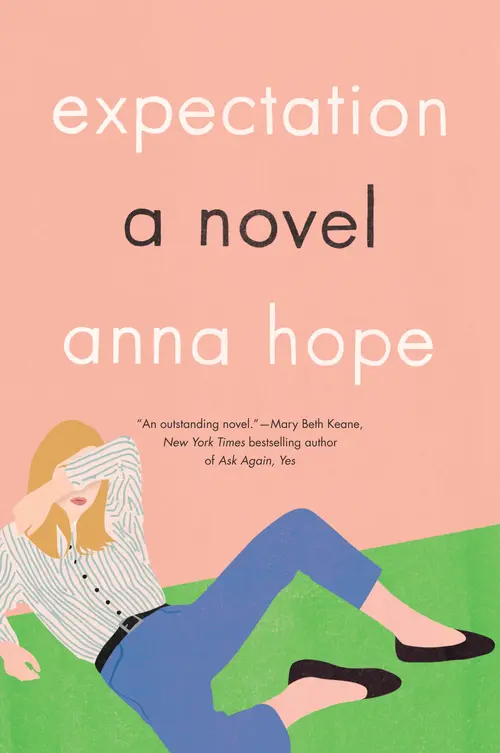
Expectation: a Novel
Cover
Dedication
For Bridie, when she’s older,
and for Nimmi, who wove me back into the tale.
Epigraph
You do not solve the problem or question of motherhood. You enter, at whatever risk, into its space.
JACQUELINE ROSE,
MOTHERS: AN ESSAY ON LOVE AND CRUELTY
London Fields
2004
IT IS SATURDAY, WHICH IS MARKET DAY. IT IS LATE SPRING, OR early summer. It is mid-May, and the dog roses are in bloom in the tangled garden at the front of the house. It is still early, or early for the weekend—not yet nine o’clock, but Hannah and Cate are up already. They do not speak much to each other as they take turns making toast and tea. The sun slants into the room, lighting the shelves with the haphazard pans, the recipe books, the badly painted walls. When they moved in here two years ago, they vowed to repaint the dreadful salmon color of the kitchen, but they never got around to it. Now they like it. Like everything in this shabby, friendly house, it feels warm.
Upstairs, Lissa sleeps. She rarely gets up before noon on the weekends. She has a job in a local pub and often goes out after work—a party at a flat in Dalston, one of the dives off Kingsland Road, or further afield, in the artists’ studios of Hackney Wick.
They finish their toast and leave Lissa to sleep in, taking their faded canvas shopping bags from the hook on the back of the door and going out into the bright morning. They turn left and then right into Broadway Market, where the stalls are just getting set up. This is their favorite time—before the crowds arrive. They buy almond croissants from the baker at the top of the road. They buy strong cheddar and a goat cheese covered with ash. They buy good tomatoes and bread. They buy a newspaper from the huge pile outside the Turkish store. They buy two bottles of wine for later. (Rioja. Always Rioja. They know nothing about wine, but they know they like Rioja.) They amble further down the road to the other stalls, looking at knickknacks and secondhand clothes. Outside the pubs there are people, in the manner of London markets, already clutching pints at nine o’clock.
Back in the house they lay out the food on the table in the kitchen, make a strong pot of coffee, put on some music, and open the window out onto the park, where the grass is filling with small clusters of people. Every so often one of those people will look up towards the house. They know what the person is thinking—how do you get to live in a house like that? How do you get to live in a three-story Victorian townhouse on the edge of the best park in London? Luck is how. A friend of a friend of Lissa’s offered her a room, and then, during the same year, two more rooms came up, and now they live in it together—the three of them. In all but the deed, the house is theirs. There is an agent somewhere in the far reaches of Stamford Hill, but they have a strong suspicion he does not know what is happening to the area, as their rent has remained stable for the last two years. They have a pact not to ask for anything, not to complain about the peeling linoleum or the stained carpets. These things do not matter, not when a house is so loved.
Sometime around eleven Lissa wakes and wanders downstairs. She drinks a pint of water and holds her head, and then drinks some coffee and eats some of a croissant. She takes her coffee to the steps outside and rolls a cigarette and enjoys the morning sun, which is just starting to warm the lowest of the stone steps.
When coffee has been drunk and cigarettes smoked and morning has become afternoon, they take plates and food and blankets out into the park, where they lie in the dappled shade of their favorite tree. They eat their picnic slowly. Hannah and Cate take turns reading the paper. Lissa shades her eyes with the arts pages and groans. A little later on they open the wine and drink it, and it is easy to drink. The afternoon deepens. The light grows viscous. The chatter in the park increases.
This is their life in 2004, in London Fields. They work hard. They go to the theater. They go to galleries. They go to the gigs of friends’ bands. They eat Vietnamese food in the restaurants on Mare Street and on Kingsland Road. They go to openings on Vyner Street on Thursdays, and they visit all the galleries and they drink the free beer and wine. They remember not to use plastic bags when they go to the corner shop, although sometimes they forget. They bike everywhere, everywhere, all the time. They rarely wear helmets. They watch films at the Rio in Dalston, and then go to Turkish restaurants and eat pide and drink Turkish beer and eat those pickles that make your saliva flow. They go to Columbia Road flower market and buy flowers in the very early morning on Sundays. (Sometimes, if Lissa is coming home early from a party, she buys cheap flowers for the whole house—armfuls of gladioli and irises. Sometimes, because she is beautiful, she is given them for free.)
They go to the city farm on Hackney Road with hangovers, and they eat fried breakfasts among the families and the screaming children, and they swear never to go there again on a Sunday morning until they have children of their own.
They worry. They worry about climate change—about the rate of the melt of the permafrost in Siberia. They worry about the kids who live in the high-rises, right behind the deli where they buy their coffee and their tabbouleh. They worry about the life chances of these kids. They worry about their own relative privilege. They worry about knife crime and gun crime, then they read pieces that suggest the violence is only ever gang-on-gang, and they feel relieved, then they feel guilty that they feel relieved. They worry about the guy who sits begging outside the liquor store, who only ever asks for twenty pence. They worry about the tide of gentrification that is creeping up from the City of London and lapping at the edges of their park. Sometimes they feel they should worry even more about these things, but at this moment in their lives they are happy, and so they do not.
They do not worry about nuclear war, or interest rates, or their fertility, or the welfare state, or aging parents, or student debt.
They are twenty-nine years old. None of them have children. In any other generation in the history of humankind this fact would be remarkable. It is hardly remarked upon at all.
They are aware that this park—London Fields—this grass on which they lie, has always been common land, a place for people to pasture their cows and sheep. This fact pleases them; they believe it goes some way to explaining the pull of this small patchy patch of green they like to feel they own. They feel like they own it because they do; it belongs to everyone.
They would like to pause time—just here, just now, in this park, this gorgeous afternoon light. They would like the house prices to remain affordable. They would like to smoke cigarettes and drink wine as though they are still young and they don’t make any difference. They would like to burrow down, here, in the beauty of this warm May afternoon. They live in the best house on the best park in the best part of the best city on the planet. Much of their lives is still before them. They have made mistakes, but they are not fatal. They are no longer young, but they do not feel old. They still have time, time to look backwards and look forwards. Life is still malleable and full of potential. The openings to the roads not taken have not yet sealed up.
They still have time to become who they are going to be.
2010
Hannah
HANNAH SITS ON THE EDGE OF THE BED, HOLDING THE VIALS IN their plastic case. She runs her thumbnail along the thin wrapper and brings out one of the tubes. It weighs almost nothing. A quick fit of the needle, one flick of her fingertip to release the bubbles—she knows what she’s doing, she has done this before. Still. Perhaps she should mark the moment somehow.
The first time, two years ago, Nathan bent over her with the needle, kissing her belly each day as the injections went in.
He kissed her differently this morning.
Promise me, Hannah, after this, no more.
And she promised, because she knew after this there wouldn’t need to be more.
She lifts her shirt and pinches her skin. A brief scratch and it is over. When she has finished she stands, straightens her clothes, and heads out into the morning to work.
LISSA IS NOT there when she arrives at the Rio, so Hannah gets a tea from the little bar and moves outside. It is September but still warm, and the small square beside the cinema is busy with people. Hannah spots Lissa’s tall frame threading its way up the street from the station and lifts her hand to wave. Lissa is wearing a coat Hannah has not seen before; narrow at the shoulders, fuller below the waist. Her hair, as ever, is long and loose.
“I love this,” Hannah murmurs, as Lissa leans in to kiss her hello, catching the rough linen lapel between her finger and thumb.
“This?” Lissa looks down as though surprised to discover she’s wearing it. “I got it years ago. That charity shop on Mare Street. Remember?”
Never anywhere you might be able to go and get one for yourself, always a charity shop, or that little stall in the market, you know, the man in Portobello?
“Wine?” says Lissa.
Hannah wrinkles her nose. “Can’t.”
Lissa touches her arm. “You’ve started again then?”
“This morning.”
“How are you feeling?”
“Fine. I’m feeling fine.”
Lissa takes her hand and squeezes it lightly. “Won’t be a sec.”
Hannah watches her friend weave over to the bar, watches the young man serving light up at her attention. A bright, shared laugh and Lissa is back outside, her red wine in a plastic cup. “All right if I have a quick cig?”
Hannah holds the wine while Lissa rolls. “When are you going to give that up?”
“Soon.” Lissa lights up and blows smoke over her shoulder.
“You’ve been saying that for fifteen years.”
“Have I? Oh well.” Lissa’s bangles clink as she reaches back to take her wine. “I had the callback,” she says.
“Oh?” It’s terrible, but Hannah never remembers. There have been so many auditions. So many parts almost had.
“A fringe thing—but a good thing. A good director. The Polish woman.”
“Ah.” She remembers now. “Chekhov?”
“Yeah. Vanya. Yelena.”
“So how did it go?”
Lissa shrugs. “Good. In parts.” She takes a sip of wine. “Who knows? She worked with me quite a bit on the speech.” And then she launches into an impression of the Polish director, replete with accents and mannerisms.
“Here, do it again. Make it real. None of this—how do you say it? Microwave emotion—put it on high. Two minutes. Ping! Tastes like shit.”
“Jesus,” says Hannah, laughing. It always astonishes her, the crap Lissa puts up with. “Well, if you don’t get the part, you could always do a one-woman show, Directors I Have Known and Been Rejected By.”
“Yeah well, that’d be funny if it weren’t true. No. It is funny. Just . . .” Lissa frowns and throws her cigarette into the gutter. “Don’t say it again.”
“Not bad,” says Lissa, as they emerge from the cinema into the darkness of the street outside. “Bit Chekhovy actually.” She threads her arm through Hannah’s. “Not much happens forever and then the big emotional punch. The Polish director would probably have loved it. Long though,” she continues, as they head down towards the market, “and no decent parts for women.”
“No?” It hadn’t occurred to Hannah, but now that she thinks of it, it’s true.
“Wouldn’t pass the Bechdel test.”
“The Bechdel test?”
“Jesus, Han, call yourself a feminist.” Lissa steers her towards the crossing. “You know—does a film have two women in it? Do they both have names? Do they have a conversation about something other than a man? This American writer came up with it. Loads of them fail it. Most of them.”
Hannah thinks. “They did have that conversation,” she says. “In the middle of the film. About the fish.”
They both snort with laughter as they cross the street arm in arm.
“Speaking of fish,” says Lissa, “you want to eat something? We could head down and get some noodles.”
Hannah pulls out her phone. “I should get back. I’ve got a report due tomorrow.”
“Through the market then?”
“Sure.” This is their preferred route home. They weave their way past the shuttered-up fronts of the African hairdressers, past sliding piles of cardboard boxes, crates of too-ripe mangoes buzzing with flies. The blood-metal stink of the butchers’ shops.
Halfway down the street a bar is open and a bunch of young people stand outside, drinking colorful cocktails with retro umbrellas. There is a rackety, demob air to the throng; some of them still wearing sunglasses in the dusky light. At the sight of them Lissa hangs back, tugging on Hannah’s arm. “Come on—we could just have a little drink?”
But Hannah is suddenly tired—irritated by these young people laughing into the weekday night, by Lissa’s spaciousness. What does she have to get up for in the morning? By her constant capacity for forgetting that lately Hannah does not drink.
“You go. I’ve got to be in early. I’ve got a report due. I think I’ll get the bus.”
“Oh, OK.” Lissa turns back. “I guess I’ll walk. It’s such a lovely evening. Hey”—she brings her hands to Hannah’s face—“good luck.”
Cate
SOMEONE IS CALLING HER. SHE FOLLOWS THE VOICE BUT IT twists and echoes and will not be caught. She struggles upwards, breaks the surface, understands—it is her son crying, lying beside her in the bed. She brings him to her breast and gropes for her phone. The screen reads 3:13—less than an hour since his last waking.
She had been dreaming again: the nightmare; broken streets, rubble, and her with Tom in her arms, wandering, searching the burned-out carcasses of buildings for something, for someone—but she did not recognize the streets, or the city, did not know where she was, and everything was over, everything destroyed.
Tom feeds, his grip slowly slackening, and she listens for the change in his breathing that signals the beginning of sleep. Then, with the barest of movements, she slides her nipple from his mouth, her arm from above him, turns onto her side and pulls the covers up over her ear. And she is falling, falling down into the pit of sleep and the sleep is water—but he is crying again, escalating now, announcing his distress, his indignation that she should fall like this away from him, and she hauls herself back awake.
Her tiny son is writhing beneath her in the gritty light. She lifts him and rubs his back. He gives a small belch and she puts him back on the breast, closing her eyes as he suckles and then bites. She cries out in pain and rolls away.
“What? What is it?” She pushes her fists into her eyes as Tom wails, hands and legs flailing, fists closing on nothing. “Stop it, Tom. Please, please.”
On the other side of the thin wall there are low voices, the creak of a bed. She needs to pee. She moves her crying son into the middle of the bed and goes out towards the landing, where she hovers. To her right is the other bedroom, where Sam sleeps. Nothing wakes him. Downstairs is the narrow hallway, filled with piles of boxes, the lumped, heaped things she has not attended to since the move.
She could leave, leave this house, pull on her jeans and boots and walk away from here, away from this wailing creature that she cannot satisfy, from this husband wrapped in the interstellar blankness of his sleep. From herself. She would not be the first woman to do so. In the bedroom her son’s cries grow louder—a small animal, afraid.
She hurries to the bathroom and pees quickly, then stumbles back to the bedroom where Tom is howling. She lies beside him, pulls him back onto her breast. Of course she will not leave—it is the last, the very last thing she would do—but her heart is beating strangely and her breath is ragged and perhaps she will have no choice, perhaps she will die—die like her mother before her, and leave her son to be brought up by his father and his family in this sterile house in the far reaches of Kent.
Tom flutters finally on her breast, slackens, and sleeps. But she is wide awake now. She sits up in bed and pulls back the curtains. Through the window she can see the parking lot, where the cars sit in their neat, obedient rows, then the dark shape of the river, and beyond that the orange lights from the loop road, where the traffic is already building, trucks moving out to the coast, or returning from the Channel ports, cars on their way to London, the great greased machine of it lumbering towards the light. She feels her heart, the adrenaline swill of her blood. The moon comes out from behind clouds, illuminating the room, the messed up bed, her tiny son beside her, abandoned now to sleep, his arms flung wide. She wants to protect him. How can she protect him from all the things that might fall upon his unguarded head? She reaches out and touches his hair, and as she does so sees the picture tattooed on her wrist, silver in the moonlight. She brings back her hand, traces the image slowly with her opposite fingertip—a filigree spider, a filigree web—a relic, now, from a different life.
She wants to see someone. To speak to someone. Someone from another lifetime. Someone who made her feel safe.
SHE IS SITTING on her bench, facing the river, where a low mist is rising from the water and a tangle of nettles clogs the bank. There is movement on the towpath now, a thin stream of humanity: joggers, early-morning workers, heads down, heading towards town. Tom is calm at least, a warm weight on her chest, face framed by a little bear hat. He woke again at five or so this morning and would not be placated, so they came out here. Her phone tells her it is almost seven o’clock, which means the supermarket will be open soon, which means there is somewhere dry to go at least, and so she stands and follows the banks of the little tributary, over the humped bridge, under the underpass and out by the parking lot. By the time she joins the small crowd outside the supermarket doors, it has begun to drizzle.
Tom whimpers in the sling and Cate shushes him as a uniformed woman comes out and casts a look to the sky, then goes back inside, and the doors slide open. The people stir themselves and follow, funneled through the bakery aisle where the heated air circulates the smell of sugar and yeast and dough. She makes for the baby section, filling her basket with several little foil packets. She bought these packets in ones or twos at first—always sure the next meal would be the one she prepared properly—now she buys them in bulk. Diapers too; at first she was sure she would use cloth, but after the trauma of the birth, she started using disposable ones and then came the move, and now here she is lifting huge packages of diapers into her basket, the sort guaranteed to take half a millennium to decompose.
It is a two-minute walk back home, past the trees encased in concrete and wire cages, the garbage can area with its padlocks, the parking lot with its barriers, the signs alerting you to the burglar paint on the walls. She reaches her front door and lets herself into the narrow kitchen. She puts down the bag, lifts Tom from the sling, and puts him into his high chair. She selects one of the little foil packages—banana and blueberry—and Tom holds out his hands for it as she untwists the seal and holds the plastic teat to his lips. He sucks away happily, like a little astronaut with space food.
“Morning.” Sam wanders in, hair mussed from sleep. He looks as though he slept in the clothes he wore last night—a faded band T-shirt and boxers. Straight to the teakettle he goes, without looking up; hand out to test the temperature, switch flicked, used grounds dumped into the sink, the French press barely rinsed before the fresh grounds are shaken in. The swaddled luxury of the morning trance—no point in speaking till the caffeine has entered the blood.
“Morning,” she says.
The Story Continues on BooksBarbecue!
Enjoyed this preview? ❤️ Do not stop here!
Read the complete book free online → 🔗
Continue reading now on BooksBarbecue and discover every page!
Love reading? Bookmark BooksBarbecue.com for more amazing books!
Happy Reading!