Excalibur
Cover

BERNARD CORNWELL
Excalibur
The Warlord Chronicles: III
A NOVEL OF ARTHUR

PENGUIN BOOKS
PENGUIN BOOKS
EXCALIBUR
Before becoming a full-time writer Bernard Cornwell worked as a television producer in London and Belfast. He now lives in Massachusetts with his American wife. He is the author of the hugely successful Sharpe series of historical novels.
Penguin publish his bestselling contemporary thrillers Sea Lord, Wildtrack, Crackdown, StormChild and Scoundrel, and the historical novel Redcoat. Penguin also publish his myth-imbued Arthurian romance, The Warlord Chronicles, which consists of The Winter King, Enemy of God and Excalibur.
Dedication
Excalibur is for John and Sharon Martin
Characters
| AELLE | A Saxon King |
| AGRICOLA | Warlord of Gwent |
| AMHAR | Bastard son of Arthur, twin to Loholt |
| ARGANTE | Princess of Demetia, daughter of Oengus mac Airem |
| ARTHUR | Bastard son of Uther, warlord of Dumnonia, later Governor of Siluria |
| ARTHUR-BACH | Arthur’s grandchild, son of Gwydre and Morwenna |
| BALIG | Boatman, brother-in-law to Derfel |
| BALIN | One of Arthur’s warriors |
| BALISE | Once a Druid of Dumnonia |
| BORS | Lancelot’s champion and cousin |
| BROCHVAEL | King of Powys after Arthur’s time |
| BUDIC | King of Broceliande, married to Arthur’s sister Anna |
| BYRTHIG | King of Gwynedd |
| CADDWG | Boatman and sometime servant of Merlin |
| CEINWYN | Sister of Cuneglas, Derfel’s partner |
| CERDIC | A Saxon King |
| CILDYDD | Magistrate of Aquae Sulis |
| CLOVIS | King of the Franks |
| CULHWCH | Arthur’s cousin, a warrior |
| CUNEGLAS | King of Powys |
| CYWWYLLOG | One-time lover of Mordred, servant to Merlin |
| DAFYDD DERFEL | The clerk who translates Derfel’s story (pronounced Dervel) The narrator, one of Arthur’s warriors, later a monk |
| DIWRNACH | King of Lleyn |
| EACHERN | One of Derfel’s spearmen |
| EINION | Son of Culhwch |
| EMRYS | Bishop of Durnovaria, later Bishop of Silurian Isca |
| ERCE | A Saxon, Derfel’s mother |
| FERGAL | Argante’s Druid |
| GALAHAD | Half-brother to Lancelot, one of Arthur’s warriors |
| GAWAIN | Prince of Broceliande, son of King Budic |
| GUINEVERE | Arthur’s wife |
| GWYDRE | Arthur and Guinevere’s son |
| HYGWYDD | Arthur’s servant |
| IGRAINE | Queen of Powys after Arthur’s time. Married to Brochvael |
| ISSA | Derfel’s second-in-command |
| LANCELOT | Exiled King of Benoic, now allied to Cerdic |
| LANVAL | One of Arthur’s warriors |
| LIOFA | Cerdic’s champion |
| LLADARN | Bishop in Gwent |
| LOHOLT | Bastard son of Arthur, twin to Amhar |
| MARDOC | Son of Mordred and Cywyllog |
| MERLIN | Druid of Dumnonia |
| MEURIG | King of Gwent, son of Tewdric |
| MORDRED | King of Dumnonia |
| MORFANS | ‘The Ugly’, one of Arthur’s warriors |
| MORGAN | Arthur’s sister, married to Sansum |
| MORWENNA | Derfel and Ceinwyn’s daughter, married to Gwydre |
| NIALL | Commander of Argante’s Blackshield guard |
| NIMUE | Merlin’s priestess |
| OENGUS MAC AIREM | King of Demetia, leader of the Blackshields |
| OLWEN THE SILVER | Follower of Merlin and Nimue |
| PERDDEL | Cuneglas’s son, later King of Powys |
| PEREDUR | Lancelot’s son |
| PYRLIG | Derfel’s bard |
| SAGRAMOR | Commander of one of Arthur’s warbands |
| SANSUM | Bishop of Durnovaria, later Bishop at Dinnewrac monastery |
| SCARACH | Issa’s wife |
| SEREN (1) | Derfel and Ceinwyn’s daughter |
| SEREN (2) | Daughter of Gwydre and Morwenna, Arthur’s granddaughter |
| TALIESIN | ‘Shining Brow’, a famous bard |
| TEWDRIC | Once King of Gwent, now a Christian hermit |
| TUDWAL | Monk at Dinnewrac monastery |
| UTHER | Once King of Dumnonia, Mordred’s grandfather, Arthur’s father |
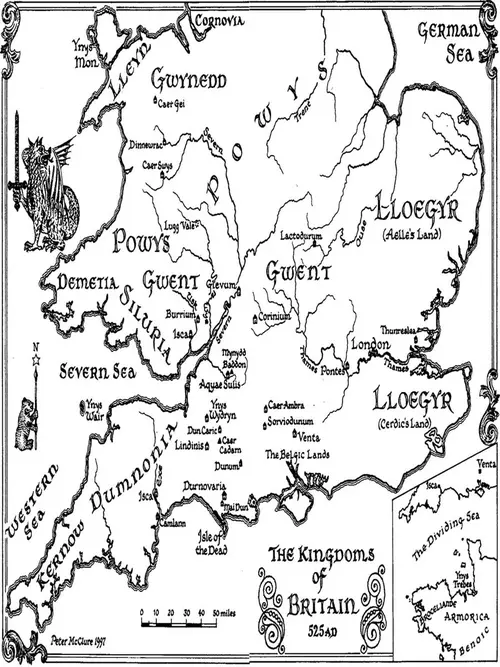
Places
Names marked* are fictional
| AQUAE SULIS | Bath, Avon |
| BEADEWAN | Baddow, Essex |
| BURRIUM | Usk, Gwent |
| CAER AMBRA * | Amesbury, Wiltshire |
| CAER CADARN * | South Cadbury, Somerset |
| CAMLANN | Real location not known; Dawlish Warren, Devon, suggested |
| CELMERESFORT | Chelmsford, Essex |
| CICUCIUM | Roman fort near Sennybridge, Powys |
| CORINIUM | Cirencester, Gloucestershire |
| DUN CARIC * | Castle Cary, Somerset |
| DUNUM | Hod Hill, Dorset |
| DURNOVARIA | Dorchester, Dorset |
| GLEVUM | Gloucester |
| GOBANNIUM | Abergavenny, Monmouthshire |
| ISCA (DUMNONIA) | Exeter, Devon |
| ISCA (SILURIA) | Caerleon, Gwent |
| LACTODURUM | Towcester, Northamptonshire |
| LEODASHAM | Leaden Roding, Essex |
| LINDINIS | Ilchester, Somerset |
| LYCCEWORD | Letchworth, Hertfordshire |
| MAI DUN | Maiden Castle, Dorset |
| MORIDUNUM | Carmarthen |
| MYNYDD BADDON | Real location not known; Little Solsbury Hill, near Bath, suggested |
| SORVIODUNUM | Old Sarum, Wiltshire |
| STEORTFORD | Bishop’s Stortford, Hertfordshire |
| THUNRESLEA | Thundersley, Essex |
| VENTA | Winchester, Hampshire |
| WICFORD | Wickford, Essex |
| YNYS WAIR | Lundy Island, Bristol Channel |
| YNYS WYDRYN | Glastonbury, Somerset |
Map
PART ONE
The Fires of Mai Dun

WOMEN, HOW THEY do haunt this tale. When I began writing Arthur’s story I thought it would be a tale of men; a chronicle of swords and spears, of battles won and frontiers made, of ruined treaties and broken kings, for is that not how history itself is told? When we recite the genealogy of our kings we do not name their mothers and grandmothers, but say Mordred ap Mordred ap Uther ap Kustennin ap Kynnar and so on all the way back to the great Beli Mawr who is the father of us all. History is a story told by men and of men’s making, but in this tale of Arthur, like the glimmer of salmon in peat-dark water, the women do shine.
Men do make history, and I cannot deny that it was men who brought Britain low. There were hundreds of us, and all of us were armed in leather and iron, and hung with shield and sword and spear, and we thought Britain lay at our command for we were warriors, but it took both a man and a woman to bring Britain low, and of the two it was the woman who did the greater damage. She made one curse and an army died, and this is her tale now for she was Arthur’s enemy.
‘Who?’ Igraine will demand when she reads this.
Igraine is my Queen. She is pregnant, a thing that gives us all great joy. Her husband is King Brochvael of Powys, and I now live under his protection in the small monastery of Dinnewrac where I write Arthur’s story. I write at the command of Queen Igraine, who is too young to have known the Emperor. That is what we called Arthur, the Emperor, Amherawdr in the British tongue, though Arthur himself rarely used the title. I write in the Saxon tongue, for I am a Saxon, and because Bishop Sansum, the saint who rules our small community at Dinnewrac, would never allow me to write Arthur’s tale. Sansum hates Arthur, reviles his memory and calls him traitor, and so Igraine and I have told the saint that I am writing a gospel of our Lord Jesus Christ in the Saxon tongue and, because Sansum neither speaks Saxon nor can read any language, the deception has seen the tale safe this far.
The tale grows darker now and harder to tell. Sometimes, when I think of my beloved Arthur, I see his noontime as a sun-bright day, yet how quickly the clouds came! Later, as we shall see, the clouds parted and the sun mellowed his landscape once more, but then came the night and we have not seen the sun since.
It was Guinevere who darkened the noonday sun. It happened during the rebellion when Lancelot, whom Arthur had thought a friend, tried to usurp the throne of Dumnonia. He was helped in this by the Christians who had been deceived by their leaders, Bishop Sansum among them, into believing that it was their holy duty to scour the country of pagans and so prepare the island of Britain for the second coming of the Lord Jesus Christ in the year 500. Lancelot was also helped by the Saxon King Cerdic who launched a terrifying attack along the valley of the Thames in an attempt to divide Britain. If the Saxons had reached the Severn Sea then the British kingdoms of the north would have been cut off from those of the south, yet, by the grace of the Gods, we defeated not only Lancelot and his Christian rabble, but Cerdic also. But in the defeat Arthur discovered Guinevere’s treachery. He found her naked in another man’s arms, and it was as though the sun had vanished from his sky.
‘I don’t really understand,’ Igraine said to me one day in late summer.
‘What, dear Lady, do you not understand?’ I asked.
‘Arthur loved Guinevere, yes?’
‘He did.’
‘So why could he not forgive her? I forgave Brochvael over Nwylle.’ Nwylle had been Brochvael’s lover, but she had contracted a disease of the skin which had disfigured her beauty. I suspect, but have never asked, that Igraine used a charm to bring the disease to her rival. My Queen might call herself a Christian, but Christianity is not a religion that offers the solace of revenge to its adherents. For that you must go to the old women who know which herbs to pluck and what charms to say under a waning moon.
‘You forgave Brochvael,’ I agreed, ‘but would Brochvael have forgiven you?’
She shuddered. ‘Of course not! He’d have burned me alive, but that’s the law.’
‘Arthur could have burned Guinevere,’ I said, ‘and there were plenty of men who advised him to do just that, but he did love her, he loved her passionately, and that was why he could neither kill her nor forgive her. Not at first, anyway.’
‘Then he was a fool!’ Igraine said. She is very young and has the glorious certainty of the young.
‘He was very proud,’ I said, and maybe that did make Arthur a fool, but so it did the rest of us. I paused, thinking. ‘He wanted many things,’ I went on, ‘he wanted a free Britain and the Saxons defeated, but in his soul he wanted Guinevere’s constant reassurance that he was a good man. And when she slept with Lancelot it proved to Arthur that he was the lesser man. It wasn’t true, of course, but it hurt him. How it hurt. I have never seen a man so hurt. She tore his heart.’
‘So he imprisoned her?’ Igraine asked me.
‘He imprisoned her,’ I said, and remembered how I had been forced to take Guinevere to the shrine of the Holy Thorn at Ynys Wydryn where Arthur’s sister, Morgan, became her jailer. There was never any affection between Guinevere and Morgan. One was a pagan, the other a Christian, and the day I locked Guinevere into the shrine’s compound was one of the few times I ever saw her weep. ‘She will stay there,’ Arthur told me, ‘till the day she dies.’
‘Men are fools,’ Igraine declared, then gave me a sidelong glance. ‘Were you ever unfaithful to Ceinwyn?’
‘No,’ I answered truthfully.
‘Did you ever want to be?’
‘Oh, yes. Lust does not vanish with happiness, Lady. Besides, what merit is there in fidelity if it is never tested?’
‘You think there is merit in fidelity?’ she asked, and I wondered which young, handsome warrior in her husband’s caer had taken her eye. Her pregnancy would prevent any nonsense for the moment, but I feared what might happen after. Maybe nothing.
I smiled. ‘We want fidelity in our lovers, Lady, so is it not obvious that they want it in us? Fidelity is a gift we offer to those we love. Arthur gave it to Guinevere, but she could not return it. She wanted something different.’
‘Which was?’
‘Glory, and he was ever averse to glory. He achieved it, but he would not revel in it. She wanted an escort of a thousand horsemen, bright banners to fly above her and the whole island of Britain prostrate beneath her. And all he ever wanted was justice and good harvests.’
‘And a free Britain and the Saxons defeated,’ Igraine reminded me drily.
‘Those too,’ I acknowledged, ‘and he wanted one other thing. He wanted that thing more than all the others.’ I smiled, remembering, and then thought that perhaps of all Arthur’s ambitions, this last was the one he found most difficult to achieve and the one that the few of us who were his friends never truly believed he wanted.
‘Go on,’ Igraine said, suspecting that I was falling into a doze.
‘He just wanted a piece of land,’ I said, ‘a hall, some cattle, a smithy of his own. He wanted to be ordinary. He wanted other men to look after Britain while he sought happiness.’
‘And he never found it?’ Igraine asked.
‘He found it,’ I assured her, but not in that summer after Lancelot’s rebellion. It was a summer of blood, a season of retribution, a time when Arthur hammered Dumnonia into a surly submission.
Lancelot had fled southwards to his land of the Belgae. Arthur would dearly have loved to pursue him, but Cerdic’s Saxon invaders were now the greater danger. They had advanced as far as Corinium by the rebellion’s end, and might even have captured that city had the Gods not sent a plague to ravage their army. Men’s bowels voided unstoppably, they vomited blood, they were weakened until they could not stand, and it was when the plague was at its worst that Arthur’s forces struck them. Cerdic tried to rally his men, but the Saxons believed their Gods had deserted them and so they fled. ‘But they’ll be back,’ Arthur told me when we stood among the bloody remnants of Cerdic’s defeated rearguard. ‘Next spring,’ he said, ‘they will be back.’ He cleaned Excalibur’s blade on his blood-stained cloak and slid her into the scabbard. He had grown a beard and it was grey. It made him look older, much older, while the pain of Guinevere’s betrayal had made his long face gaunt, so that men who had never met Arthur until that summer found his appearance fearsome and he did nothing to soften that impression. He had ever been a patient man, but now his anger lay very close to the skin and it could erupt at the smallest provocation.
It was a summer of blood, a season of retribution, and Guinevere’s fate was to be locked away in Morgan’s shrine. Arthur had condemned his wife to a living grave and his guards were ordered to keep her there for ever. Guinevere, a Princess of the Henis-Wyren, was gone from the world.
‘Don’t be absurd, Derfel,’ Merlin snapped at me a week later, ‘she’ll be out of there in two years! One, probably. If Arthur wanted her gone from his life he’d have put her to the flames, which is what he should have done. There’s nothing like a good burning for improving a woman’s behaviour, but it’s no use telling Arthur that. The halfwit’s in love with her! And he is a halfwit. Think about it! Lancelot alive, Mordred alive, Cerdic alive and Guinevere alive! If a soul wants to live for ever in this world it seems like a very good idea to become an enemy of Arthur. I am as well as can be expected, thank you for asking.’
‘I did ask you earlier,’ I said patiently, ‘and you ignored me.’
‘It’s my hearing, Derfel. Quite gone.’ He banged an ear. ‘Deaf as a bucket. It’s age, Derfel, sheer old age. I decay visibly.’
He did nothing of the sort. He looked better now than he had for a long time and his hearing, I am sure, was as acute as his sight – and that, despite his eighty or more years, was still as sharp as a hawk’s. Merlin did not decay but seemed to have a new energy, one brought to him by the Treasures of Britain. Those thirteen Treasures were old, old as Britain, and for centuries they had been lost, but Merlin had at last succeeded in finding them. The power of the Treasures was to summon the ancient Gods back to Britain, a power that had never been tested, but now, in the year of Dumnonia’s turmoil, Merlin would use them to work a great magic.
I had sought Merlin on the day I took Guinevere to Ynys Wydryn. It was a day of hard rain and I had climbed the Tor, half expecting to find Merlin on its summit, but discovered the hilltop empty and sad. Merlin had once possessed a great hall on the Tor with a dream tower attached to it, but the hall had been burned. I had stood amidst the Tor’s ruin and felt a great desolation. Arthur, my friend, was hurt. Ceinwyn, my woman, was far away in Powys. Morwenna and Seren my two daughters, were with Ceinwyn, while Dian, my youngest, was in the Otherworld, despatched there by one of Lancelot’s swords. My friends were dead, or else far away. The Saxons were making ready to fight us in the new year, my house was ashes and my life seemed bleak. Maybe it was Guinevere’s sadness that had infected me, but that morning, on Ynys Wydryn’s rain-washed hill, I felt more alone than I had ever felt in all my life and so I knelt in the hall’s muddy ashes and prayed to Bel. I begged the God to save us and, like a child, I begged Bel for a sign that the Gods did care about us.
That sign came a week later. Arthur had ridden eastwards to harry the Saxon frontier, but I had stayed at Caer Cadarn waiting for Ceinwyn and my daughters to come home. Some time in that week Merlin and his companion, Nimue, went to the great empty palace at nearby Lindinis. I had once lived there, guarding our King, Mordred, but when Mordred had come of age the palace had been given to Bishop Sansum as a monastery. Sansum’s monks had been evicted now, chased by vengeful spearmen from the great Roman halls so that the big palace stood empty.
It was the local people who told us that the Druid was in the palace. They told stories of apparitions, of wonderful signs and of Gods walking in the night, and so I rode down to the palace, but found no sign of Merlin there. Two or three hundred people were camped outside the palace gates and they excitedly repeated the tales of night-time visions and, hearing them, my heart sank. Dumnonia had just endured the frenzy of a Christian rebellion fuelled by just such crazed superstition, and now it seemed the pagans were about to match the Christian madness. I pushed open the palace gates, crossed the big courtyard and strode through Lindinis’s empty halls. I called Merlin’s name, but there was no answer. I found a warm hearth in one of the kitchens, and evidence of another room recently swept, but nothing lived there except rats and mice.
The Story Continues on BooksBarbecue!
Enjoyed this preview? ❤️ Do not stop here!
Read the complete book free online → 🔗
Continue reading now on BooksBarbecue and discover every page!
Love reading? Bookmark BooksBarbecue.com for more amazing books!
Happy Reading!